Account-Based Marketing Software Explained
Account-based marketing software can be an excellent complement to your overall system, but only if you have a strong foundation. Discover how to strike that balance.
Key Takeaways
Don't confuse software with strategy. Most platforms help you do things faster, but they don't help you decide if those actions are worth doing.
Data integration is only part of the problem. More data and better dashboards won’t help teams interpret buying signals correctly.
Engagement isn't intent. Dashboards show activity, but they often fail to tell you if an account is actually ready to buy.
Alignment is the real goal. Companies buy these tools to get sales and marketing on the same page, yet many still lack a documented value proposition to guide that effort.
If you're looking at account-based marketing (ABM) software, you've likely heard the big promises. It'll find your best prospects. It'll personalize your outreach at scale. It'll finally get your sales and marketing teams on the same page.
It's an easy story to buy, and why ABM software is now a multi-billion-dollar category. Most teams think that if they want to do "real" ABM, they need a "real" platform. Better tools lead to better results. That's the logic, anyway.
The problem is that most teams already have the tools, and they're still struggling. It's easier than ever to send an email or launch an ad. But it's still difficult to know what to send or when to send it.
Most software is excellent at pulling in data, showing which accounts are active and what they’re clicking on, but it won't tell you the "so what?"
It doesn't say if that activity signals real buying intent or if you're just witnessing a curious intern doing research. To win in this "answer economy," you need to stop thinking about one-off campaigns. It’s time to move past execution and start focusing on the decisions that actually move the needle.
What Is Account-Based Marketing Software?
ABM software helps B2B teams identify, target, and measure interactions with high-value accounts. There are subset vendors who do specific parts of these same functions in isolation, but broadly, they will all be designed for those 3 things. So instead of casting a wide net, you're using a spear. Most platforms group their features into four main buckets:
Account selection: You use firmographic data to build lists of accounts that actually fit your ideal customer profile.
Intent data: These tools surface signals showing which accounts are researching solutions like yours.
Orchestration: This is the "doing" part. It automates ads, targeted outreach in demand generation, and webinars.
Reporting: You get to see which stakeholders are interacting with your brand and how often. You can even use these insights to improve webinar marketing results by seeing who actually engaged.
On paper, it's everything you need. In practice, though, something's missing, and it’s not always obvious until several weeks or months down the line in your campaign. These features give you the capacity to act, but they don't give you the judgment to ensure the work is worth the effort.
Why Companies Invest in ABM Software
B2B marketers aren't buying software for fun, even if there is an unbelievable amount of Martech vendors out there currently. You're buying it because you're desperate for efficiency.
The expected wins are clear. You want sales and marketing to agree on which accounts to chase. You want to move past generic emails to outreach that actually means something to the buyer. Most of all, you want higher conversion rates by focusing on people who are actually likely to buy.
But more data has only created more noise. Marketers are swimming in data they can't use and chasing metrics that don't prove real impact. The software helps you run the race faster, but it doesn't always tell you if you're running in the right direction. If we compare that analogy to the vast increase in content created by AI that we deem to be “AI slop” versus the amount of content we like and enjoy, it doesn’t paint a favourable picture.
The ABM Software Landscape
The ABM software ecosystem's grown fast. It's full of specialized tools that promise to be the missing piece of your revenue puzzle. Most of these platforms generally fall into four distinct camps:
First, you have the all-in-one platforms like Demandbase and 6sense. These are the heavy hitters designed to be the central nervous system of your program. They combine targeting, orchestration, and reporting into one place.
Then, there are intent data providers like Bombora or ZoomInfo. They focus on uncovering buying signals, so you know who's researching solutions right now.
Next are engagement and orchestration tools like DemandScience or AdRoll ABM. These specialize in widening your reach through tactics like display ads and website personalization.
Finally, you have CRM-native extensions in platforms like HubSpot and Salesforce. They keep your account tracking centralized within the systems you already use every day.
How Today’s ABM Software Competes
Category | What It Optimizes | Where It Falls Short |
All-in-One Platforms | Campaign orchestration, multi-channel coordination | Improves execution but not decision quality |
Intent Data Providers | Visibility into account activity and buying signals | Signals lack context |
Engagement Tools | Ads, email sequencing, website personalization | Disconnected from real buying intent |
CRM-Native Extensions | Data centralization and account tracking | Doesn’t help prioritize efforts or compel teams to act |
These tools share the common goal of better execution. They make it faster to send ads and easier to build lists. But there's a catch. None of them explicitly helps your team decide what to do with all that information. They solve for the "how," but leave the "why" and "what next" to you.
So, unless you come up with those answers yourself, there’s no real pipeline impact for all your time, effort, and spend. Not a great place to be in.
Where ABM Software Falls Short
Executing campaigns has never been easier. Reaching your goals is another story. Most teams find the "doing" is easy, but "knowing what to do" is where things break down. Software fails to close that gap for three main reasons:
Campaign over-optimization: It's incredibly easy to launch multi-channel plays with a few clicks. But campaigns aren't buying decisions. Just because you've sent a series of touch points doesn't mean you've influenced a buyer's journey. As Peter Drucker said, “There's nothing as useless as doing efficiently what shouldn't be done at all.”
Engagement metrics can be misleading: ABM tools create a constant stream of clicks, impressions, and scores. These create the appearance of progress, but they're often mistaken for real intent. Without context, you might see a spike in activity and have sales reach out, only to find the prospect was just doing casual research.
Surface-level signals: A tool can show you an account visited your pricing page, but it won't tell you what that visit means. Is it a ready-to-buy prospect or a current customer checking renewal terms? Research from DreamData shows the average B2B journey has 76 touch points before a purchase. Expecting a tool to interpret that mess without a human framework is a losing game.
The Real Bottleneck: Decision Quality
ABM fails because teams make poor decisions about their accounts. CMOs told HubSpot they use only one-third of their tech stack's capabilities, proving that more features aren't the answer.
Think of it like a game of chess. Your ABM software shows you the entire board, every piece, and every action in real time. But knowing which move to make next still requires strategy. You need to know if an account is truly high-value or just a lead that fits a loose profile.
If you’re part of a lean marketing team, you can't afford to guess. You have to get the timing right and understand if a signal indicates real buying intent. These decisions determine whether your effort turns into a pipeline. Success is dependent upon how clearly your team can interpret signals and act with confidence.
The Shift From Campaigns to Signals
Historical ABM approaches tend to follow a linear sequence. You pick a list, blast some ads, and wait impatiently for a lead to pop out the other side. That almost sounded like a rushed lead generation campaign…
It's a "set it and forget it" mindset that doesn't work. Modern buying journeys are messy, fragmented, and non-linear. They happen in "dark social" or through conversations you'll never see.
The best teams are shifting from campaigns to signals. Instead of sticking to a pre-set schedule, they look for specific behaviors that show an account is under pressure to act. They treat the signal as raw input, not a command to start spamming.
You have to know the difference between noise and real intent, though. A casual blog read or a random white paper download is often just someone browsing. But a spike in pricing page visits or deep engagement with technical docs? That's a signal worth your time.
We're also seeing a massive shift in where these signals live. Traditional search traffic is down as buyers move to AI engines for their research. These AI-referral visitors arrive much further along in their journey and convert three times better than the average lead.
You can’t rely on software to give you the push to act on these insights. You need a human in the loop to make the final call. In this signal-driven model, the real value is judgment. You pause to ask who's engaging and if the activity actually points to a real buying need. This is exactly why OrbitalX built DemandWEBS™. We reframe ABM around signal-driven execution rather than campaign execution.
When you understand the "why" behind the data, you stop chasing random activity and start turning real intent into revenue.
A Simple Framework for Evaluating ABM Software
Most people buy ABM software based on a massive checklist of features. That's a mistake. Decisions drive your revenue, not fancy features. If a platform doesn't improve how your team decides what to do next, it's just another line item in a budget that's already under scrutiny.
When you're digging into the market, stop looking at the shiny dashboards. Instead, ask these three questions:
1. Does It Improve Signal Quality?
The last thing any marketing team needs is more data. We're already swimming in info we can't use. Your goal is to find better signals that correlate with your specific ICP.
For instance, say a company identifies 3,000 "ideal" accounts they want to chase. When they actually filter those signals against their strict ICP, they realize only half of them could actually buy their solution. If they hadn't checked the signal quality, every second sales conversation would've been a total waste of time. That's how you erode seller confidence.
2. Does It Improve Interpretation?
The necessary tools are there, but the execution is failing because marketers can't clearly figure out what the data means. Software can show you every move on the board, but it won't tell you which move will win the game. You need a tool that provides the context your team needs to understand the "so what?" behind the numbers.
3. Does It Improve Action?
Does the platform help you take the right action at the right time, or does it just make it easier to send more "Dear [First_Name]" emails that nobody wants to read? Marketers today are looking for a way to convert genuine intent into revenue rather than just launching another campaign.
If a platform doesn't improve how your team decides what to do next, it's not going to improve your outcomes. It's just another line item in a tech stack that's already under too much scrutiny. Focus on tools that help your team think better, not just work faster.
What Actually Matters More Than the Software
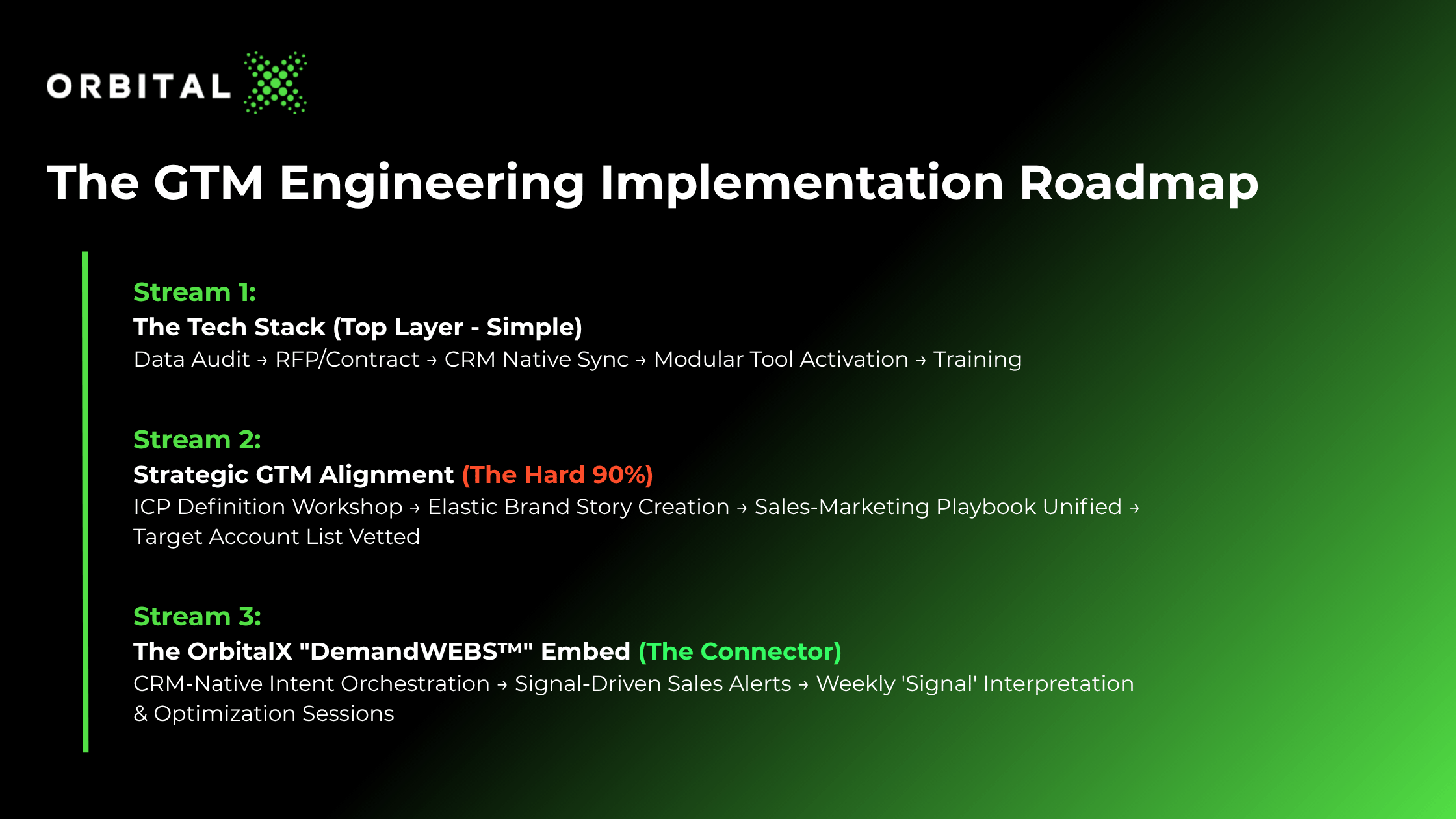
Tools amplify rather than create systems. If your foundation is shaky, the most expensive platform in the world will only help you fail faster at scale. Before you double down on your MarTech spend, you have to prioritize the elements software can't give you.
You need a crystal-clear ICP that isn't just a list of tech companies. It needs to provide a deep understanding of who actually sees wins with your product and why. If you haven't documented your brand's unique value proposition, you'll just create content that feels bland and boring.
You also need real sales and marketing alignment. Both teams have to agree on what a "good" signal looks like. When your data can't talk, your strategy walks. Recent research has found that 37% of marketers struggle to share and connect data across their teams, which is why most ABM programs stall out.
Lastly, you need a decision framework. This is your pre-set playbook for what happens when a specific signal is detected. Don't wait for the signal to hit to start wondering what to do. The advantage is in the way your team thinks and acts while using it.
 When ABM Software Makes Sense
ABM software is misunderstood. It's a powerful support system, but only when your foundation is solid. You can't afford to buy tools that just sit on the shelf.
Think about investing in a platform when:
Your manual strategy actually works. You've proven the process by hand, and you're ready to automate it.
You're scaling to hundreds of accounts. You can't spearfish at that volume without some technical help.
You have a large, global team. You need centralized visibility so everyone's looking at the same board.
In these cases, software can get you better efficiency and coordination. It amplifies rather than replaces your strategy. But remember, tools are like a megaphone. They'll make a great message louder, but they'll also make a confusing one deafening.
The New Growth Equation
For a decade, we've treated ABM like a plumbing problem that needed better pipes. We were told the answer was more data and more automation. The real hurdle is decision-making. The teams that win the next few years will be the ones who can interpret a signal, align their people, and move at the right moment. But execution was never the main issue. It was just the easiest thing for people to sell.
OrbitalX is built for this shift. With our DemandWEBS™ approach, we move past the campaign-heavy noise and transform fragmented data into high-quality action.
If you're looking at software, skip the feature list. Ask if your team's equipped to make better decisions with the data in front of them. Because in the modern market, the best judgment wins.
It's time to stop doing more and start doing what matters. If you want to see what a signal-driven strategy looks like in practice, book a call with us today.
FAQs About ABM Software
What is an ABM platform?
Think of an ABM platform as a tool that helps you trade a giant, leaky net for a sharp spear. It helps your team identify, target, and measure interactions with high-value accounts that actually fit your business. These platforms usually handle four big tasks: picking the right accounts, tracking intent signals, running campaigns, and reporting on who's showing up.
How much do ABM platforms cost?
The price of an ABM platform varies widely depending on what features it includes, the ABM agency, your account volume, and other factors. Some entry-level solutions can start as low as $12,000 a year or $2,500/month, while enterprise solutions require a custom quote but can reach over $300,000 per year.
What are the different types of ABM platform integrations?
Most platforms have a few standard integrations to keep your data from getting siloed:
CRM-Native Extensions: These live directly inside tools like HubSpot or Salesforce to keep your account tracking in one place.
API Integrations: These let your various tools talk to each other so data flows between your tech stack.
CDP and "CDP-Lite" Solutions: These provide a central hub for activating your data across different channels.
More Resources

Lead Generation for Technology Companies: How to Build a Pipeline System
Lead generation for technology companies breaks when volume is mistaken for pipeline. Here’s how to build demand that actually translates into revenue.

Forget 7 Touchpoints. B2B Buyers Now Take 80+ Interactions to Convert.
Most B2B marketers are still running their outbound math on an anecdote from a decade ago: seven touchpoints to convert a prospect into a meeting. It made for a tidy stat on a slide. It was never particularly true, and it's certainly not true now.

Lead Generation Software: Choose the Right Tools for Your Growth Strategy
Discover how to choose lead generation software that aligns with your strategy, supports your funnel, and helps build a scalable B2B pipeline.