Account-Based Marketing Services: Why B2B Teams Need a Signal-Based System
Some account-based marketing services try to sell a formula when what you really need is a system that adapts. Learn how to spot a valuable partner that’ll elevate your account wins.
Key Takeaways
Campaigns aren't your revenue driver. Timing is. Stop betting on a rigid calendar and start responding to real-time signals that show when a buyer is actually in-market.
Skip marketing projects with an expiration date. You need a continuous system that compounds over time and builds momentum while you sleep.
The teams that thrive use behavior signals to know when to jump on a lead, lean on AI to put simple tasks on autopilot, and create a feedback loop based on what works and what doesn’t to adapt and stay agile.
Your marketing marching orders are growing, yet your team is increasingly thinning. Your budget is so tight, you can practically feel it suffocating you. The pressure to prove your efforts actually drive genuine pipeline is hanging over your head like a guillotine. As you drown, account-based marketing (ABM) offers a life preserver, promising to keep your head above water.
On the surface, it looks like it's working. Campaigns launch on schedule. Dashboards flash with upward arrows. Engagement metrics climb each month. Life as a marketer is feeling good.
But even with all that movement, your pipeline isn’t consistent. Sales and marketing team leaders start to really feel their patience thinning. Sales teams are still skeptical about marketing reports. Deals don't accelerate regularly. High-value accounts don't convert when you expect them to.
And when revenue streams in, it's often unclear what actually drove it. Your team isn’t to blame here. It's because your ABM strategy is built on the wrong model. A rigid formula of strategy decks and pre-set email cadences won’t drive continuous account movement.
Some might say, 2012 ABM tactics.
The Flawed Service Model
Many ABM services treat their offerings like a factory assembly line: They target accounts and measure engagement, then give you quarterly lists and fixed messaging frameworks.
It’s like paying for a carpenter to craft a mahogany table … only to get an IKEA box on your doorstep a month later. Lazy ABM services shrink your strategy into a checklist of deliverables: You get a nice PDF of your ICP, but by the time you've finished reading it, your best buyers have already moved on.
Imagine spending $50,000 on a target account list in Q1. By Q2, half those companies have already gone into a hiring freeze or a merger. When you buy the wrong ABM service, success is measured in outputs like content and interactions. You get influenced pipeline and engagement scores that look great in a board meeting but don't close deals.
This leads to a flood of generic messages that buyers tune out. If your ABM is just "more campaigns," you're paying to be IKEA furniture. Today's buyers trust people, communities, and AI results more than ads.
 Why This Model Breaks
Buyers follow unique journeys to purchasing, so trying to force them onto a linear path will only end up with egg on your face as you explain the wasted money to your C-suite. When ABM is set up as a series of scheduled blasts, you’re just actively annoying the people you're trying to reach.
A campaign assumes you can predict the future. It operates as if buyers move in tidy stages from "aware" to "ready."
The reality? Buying groups now average 6 to 10 people, and cycles have stretched to roughly 9 to 11 months. On top of that, full deal closures require about 88 touch points.
That means if your campaign only runs for six weeks, you're missing 90% of the conversation. You end up offering a demo request when the target account is still trying to define the problem. Or, worse, you push awareness content when they're already shortlisting your competitors.
The Alignment Disconnect
Alignment usually looks like marketing and sales agreeing on a target list once a quarter and then not talking until the next one. That's not alignment. It's a truce. And execution is where the wheels usually come off.
The problem is that marketing operates on campaign calendars while sales operates in the now. That disconnect creates data siloes that sabotage momentum and eat up 20% to 30% of your ROI.
Sales reps end up ignoring marketing leads because they don't have the context to know why that person engaged. Is there a faster way to give a marketer a migraine?
If a rep doesn't know what a buyer is struggling with, that lead just looks like more busy work. Without a system that provides a single, live view of account activity, you're basically guessing. And guessing is an expensive hobby.
True alignment requires ABM to serve as a shared script for both teams. No more marketing shouting at everyone or sales chasing ghosts.
Marketing Is Optimized for Activity, Not Revenue
Think about your last Monday morning meeting. The marketing lead likely stood up with a slide showing 1,000 new clicks or 500 content downloads. The dashboard was full of upward motion. It looked like you were winning. Then the sales lead revealed the truth: Out of all that engagement, they hadn't booked a single discovery call.
That's the activity trap. Most ABM services are built to move the needle on dashboards, not the actual pipeline. They focus on influenced pipeline and engagement scores because they're easy to track. But engagement isn't intent. And activity isn't progress.
Systems like HubSpot or Salesforce are great at measuring activity at scale. But they aren't built to tell you what a buyer is actually doing in the real world right now.
The reality is that only 3% of your target accounts are ready to buy today. A strategy focused on more activity just adds to the noise that leads tune out.
To win, you have to move from collecting data to activating it.
What This Actually Costs You
An ABM strategy that revolves around episodic campaigns isn't just inefficient. It produces a structural gap between when buyers are ready and when you actually show up. That gap is where your revenue goes to die.
Forgive the obvious, but it needs to be hammered in: Timing is everything in B2B. When you run campaigns instead of systems, you risk being late.
You miss the accounts that are in-market today because they don't align with your launch schedule. By the time your second wave of emails hit their inboxes, 78% of those buyers have already moved on. They signed with the first competitor who actually responded to their intent signals. It's like being the second person to text someone "Happy Birthday." It's nice, but it doesn't matter.
The cost of simply getting noticed is skyrocketing as well. In many B2B industries, the average cost per lead (CPL) has crossed $300. When you then consider that nearly 9% of digital ad spend is siphoned off by bot clicks, your "efficient" campaign starts to look like a leaky bucket.
You can't justify your spend on clicks anymore when the board wants to see deal velocity.
High-performing teams have realized their sales reps are their most expensive assets. Every hour a rep spends chasing a cold, mistimed lead is an hour they aren't closing a high-intent deal. Poor execution doesn't just reduce efficiency; it cuts your probability of winning. It leads to slower deal velocity and a pipeline that looks active but fails to convert.
How High-Performing Teams Do Things Differently
Enough of the doom and gloom. You’re here for help, not another endorsement to break out the flask when you have to review deals closed each month (or the lack thereof).
High-performing teams aren't just running better versions of the same old campaigns. They've stopped thinking in terms of launches entirely. Instead, they've built a continuous, signal-driven revenue engine that actually works.
Signals replace the guessing game of campaigns. A signal is proof that something's changed inside an account. It's intent data aggregated from website activity, product usage, or third-party platforms.
Imagine three people from the same buying committee hitting your pricing page in 48 hours. That's not a scheduled event, but it reveals a critical readiness to act. Campaigns try to manufacture engagement. Signals reveal when engagement actually matters.
Instead of asking, “What should we launch next?” the question becomes, “What’s happening right now, and how should we respond?”
Doubling Revenue Without Doubling Headcount
These teams also focus on revenue per employee (RPE) as their core metric. Don’t waste your time dreaming about a longer bench for your marketing department. You have to maximize the people you have down to the last cent. Successful leaders set bold goals to double revenue with zero increase in headcount.
They're using AI as well to automate the boring stuff. By automating routine tasks like building quarterly business reviews or initial outreach, they free up their humans to do what they’re actually good at: building trust and solving complex problems.
AI isn't a replacement for your team but the grease that makes the whole engine move faster.
Execution Becomes an Interactive Loop
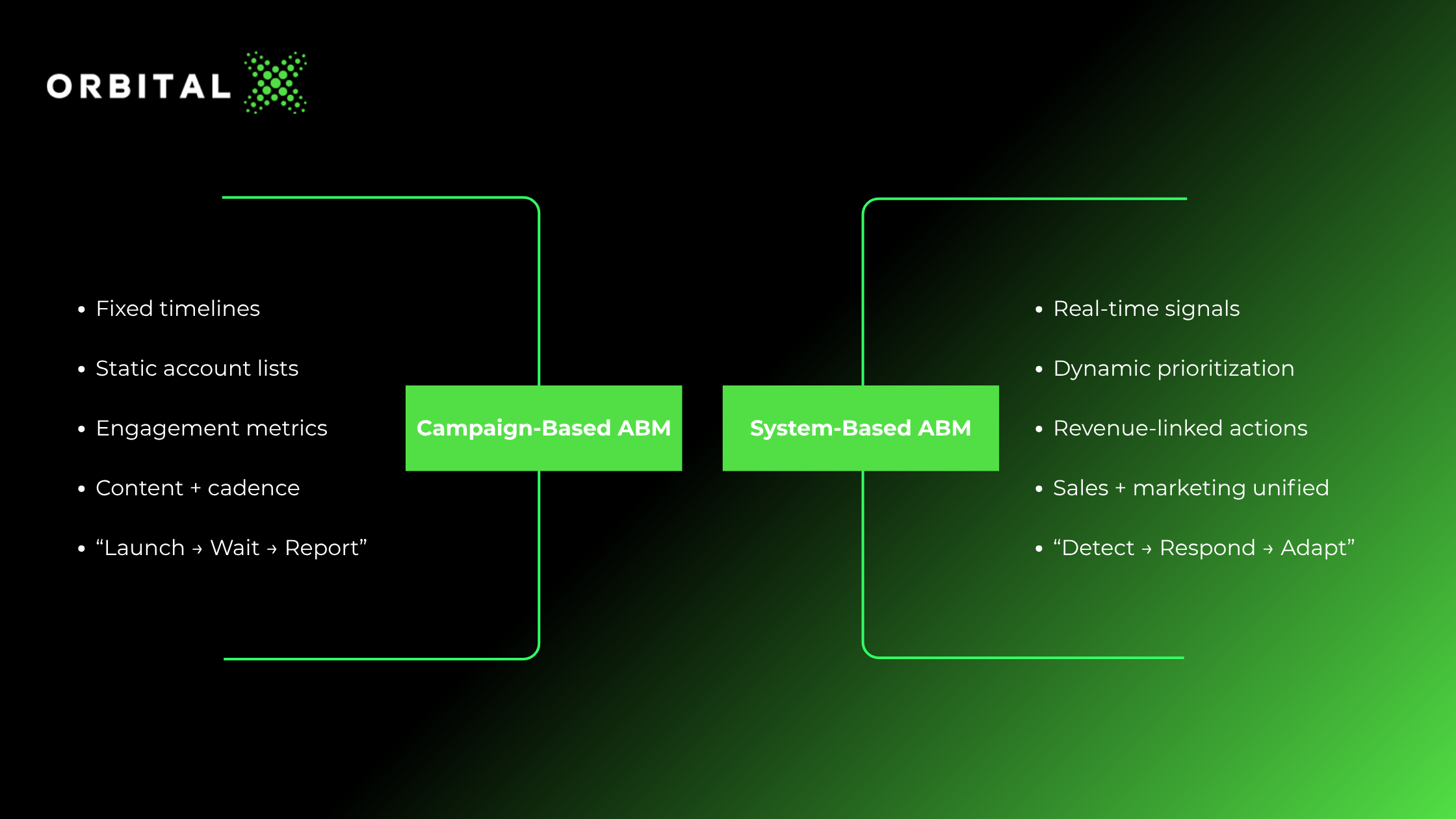
Execution moves away from the linear timeline. The old "Launch → Wait → Report" cycle is obsolete. Today's top teams operate in interactive cycles instead. Agility is the new competitive advantage, comprising:
Detect: The system spots a high-intent signal from a Tier 1 account.
Respond: It automatically triggers a personalized ad or email sequence.
Adapt: Sales and marketing review the live feedback and tweak the message on the fly.
This combination makes ABM a genuine go-to-market strategy, not just another marketing tactic. It becomes the operating system for the entire company.
.png) StackOne: From Spreadsheet Hell to Deal Velocity
StackOne: From Spreadsheet Hell to Deal Velocity
StackOne is an integration platform dealing with complex, high-stakes deals. In their world, success means hitting the right people at the exact moment they're ready to buy. But they were trapped in the campaign mindset.
They weren't lacking data. They were drowning in it. They had the lists and the high-end intent tools, but more data didn't lead to more deals; it just created noise. They were buried in spreadsheets.
Their sales reps had to rely on luck as a result. If they called at the right time, they won. If not, the lead was gone.
StackOne decided to quit pushing that boulder uphill. They partnered with OrbitalX to construct a signal-based system and moved away from the static, list-based approach that most agencies sell.
They built custom data models to identify high-intent signals and shifted to signal-based prioritization. The company also ditched scheduled sequences for real-time workflows. Instead of running campaigns, they started responding to behavior.
The results were fast, with reply-to-meeting rates jumping 15%. But the real victory was speed. Conversations happened faster because they talked to accounts that were actually ready to talk.
StackOne didn't just fix their campaigns. They constructed a system that could adapt to their targets' pace. They stopped counting how many accounts they reached and focused on reaching the right ones.
How to Evaluate ABM Services
If you're vetting an ABM agency, set aside the typical checklist. If any show you a pretty calendar, that's a red flag. A calendar is just a schedule for when they plan to poke your buyers.
But buyers don't move because your campaign went live. They move when they have an internal crisis. An agency has to show you how they detect and respond to real-time signals; otherwise, they're just trying to force a rigid structure onto a chaotic process.
Ask these four hard questions to see if they're actually built for a signal-driven world:
Are they building a calendar or a response loop? If their "strategy" looks like a timeline of quarterly launches, they're selling you the old model. It feels organized, but it's disconnected from how people actually buy things. You need a partner who knows when to back off and when to lean in based on live intent.
Does sales actually change their priorities? If your sales reps are still doing the same old cold outreach after you hire a service, that service has failed. A real partner builds a unified view so reps know exactly which account to call and why. It's about helping sales act at the perfect moment, not just feeding them more volume.
Are they chasing vanity or revenue? Clicks are cheap and impressions are easy. But revenue comes from momentum, not just engagement. You need a partner who tracks pipeline progression and RPE instead. If they can't connect their work to deal velocity, they're just optimizing for visibility while you lose money.
Is it a project or a system? You need infrastructure that compounds, not a project that expires. Campaign-based services reset every quarter, starting each new cycle from scratch. Revenue doesn't reset every quarter. You need a system that gets better at identifying signals and aligning execution over time.
Evaluation Criteria | Campaign-Based ABM Vendor (Weak Signal) | System-Based ABM Vendor (Strong Signal) |
Core Approach | Runs fixed campaigns on schedules | Responds to real-time buyer signals |
Primary Focus | Engagement & activity metrics | Revenue movement & deal velocity |
Data Usage | Static account lists + intent snapshots | Continuous signal ingestion (intent, sales, behavioral) |
Execution Model | Launch → wait → report cycles | Detect → respond → adapt loops |
Sales Involvement | Sales is downstream recipient of leads | Sales acts on shared live signals |
Measurement | Clicks, impressions, engagement scores | Pipeline progression, conversion speed, revenue impact |
Timing Model | Pre-planned campaign calendar | Buyer-driven timing (in-market detection) |
System Type | Project-based (resets quarterly) | Continuous system (compounds over time) |
The Work You Still Need to Do
Even the best signal-driven system won't save you if your message is a snooze fest. ABM doesn't manufacture demand; it amplifies it.
If your positioning is unclear, showing up at the right moment won't create momentum. It'll just accelerate rejection. You need to capitalize on buyers’ needs and position your customer as the hero of their own story.
Don't treat your positioning statement like a fill-in-the-blank exercise. That assumes there's only one right answer, but your product can fit multiple categories. You need to define your competitive alternatives. Where would they turn if you didn't exist?
When you get that brand foundation right, every dollar you spend on demand generation becomes more valuable. High-performing, signal-driven teams dig into their value prop by:
Defining a specific value boundary: Know exactly what problem you solve, for whom, and why it matters most.
Focusing on the unit of value: Talk about the buyer's perspective, not just your internal list of features.
Speaking the language of pain: Ditch the product jargon and use the language your buyers use when they're frustrated.
Building a system raises the stakes. It makes it easier to score leads, but it also makes it obvious when your message falls flat.
Get your story straight before you turn on the engine. Buyers seek human-created content and will tune out average, AI-generated noise. Your “taste” and brand POV are your competitive advantages in 2026.
Stop Buying ABM Campaigns. Start Building ABM Systems.
Real ABM catches buyers while they're actually in the market. It's the engine that drives your revenue, not a coat of paint you apply once a quarter.
If you choose a service that runs solely on campaigns, you're out of sync with your buyers. You’re betting on a calendar while competitors respond to behavior in real time. The goal isn't just to "do more" but to get sales and marketing on the same page and act on the right signals at the best time.
Quit buying one-off projects. Construct a system that compounds to stay relevant in a market that moves at the speed of signals.
Ready to find a partner to keep your ABM strategy agile? Book a 1:1 consultation with OrbitalX today.
FAQs About ABM Services
What is account-based marketing?
Think of ABM as a shared script for your sales and marketing teams. Instead of marketing shouting at everyone and sales chasing ghosts, both teams act as a unified system to engage specific high-value accounts. It’s a signal-driven architecture that ensures you’re talking to the right people at the best possible time.
How does ABM fit into an inbound marketing strategy?
Inbound is the tinder; ABM is the spark. Your inbound content captures signals, like a stakeholder researching a technical integration on your blog. You then use those high-intent triggers to power a "warm outbound" motion, reaching out to the leads that are actually in-market.
How much do ABM services typically cost?
The price tag varies, but in general, ABM services start at around $3,000 per month and can hit $50,000 a month or more. It depends on factors like the specific services you want, your account volume, and ad spend.
More Resources

Your Team Is Producing More Content Than Ever. Is Any of It Working?
AI is producing more B2B marketing content than humans now, but volume without engagement is just cost with extra steps. OrbitalX's new metric, Marketing Per Marketer (MPM), plots output against real audience engagement to show which teams are actually breaking through versus which are just running on the content treadmill.

Unlock enterprise value with AI and ABM in PE value creation
A practical guide for PE value creation teams on how AI SDR, AI-powered ABM, and AI content workflows can increase commercial capacity without scaling headcount at the same rate.

How to Evaluate Lead Generation Outsourcing Based on Pipeline Impact
Looking into lead generation outsourcing? Learn how to evaluate providers based on pipeline performance and revenue impact to improve sales outcomes.