Clicks Don’t Matter Anymore: The 2026 B2B Marketing Trends Playbook
B2B marketing is shifting from lead generation to revenue-first systems powered by AI, ABM, and real-time behavioral signals that drive measurable pipeline impact. These are the 5 trends you need to know.
Key Takeaways
Revenue as the North Star: Revenue impact is replacing MQLs and clicks as the primary measure of marketing success.
AI Scale vs. Saturation: While AI allows for unprecedented content scaling, it’s also leading to market saturation, making human-led credibility more valuable.
The AI Search Revolution: AI-driven tools like ChatGPT are changing how buyers discover information, shifting the focus from website clicks to appearing in summarized AI answers.
Video-First Strategy: Video has become the default content format, prioritized for its ability to capture attention and build trust quickly in a noisy environment.
Individual-Led Social Distribution: Social media has evolved into a distribution engine powered by individual creators and trusted voices rather than faceless corporate brands.
The B2B marketing playbook is changing rapidly, and marketers who fail to adapt are finding themselves left behind. What was once a predictable system built around linear funnels and lead volume is shifting toward more dynamic, consumer-like engagement models.
This shift isn't happening in a vacuum. AI has flooded the market with a staggering volume of content, while simultaneously, marketing budgets have tightened and executive expectations have reached an all-time high. The result is a fundamentally different environment characterized by more noise, less buyer patience, and far less tolerance for marketing activity that doesn't drive measurable results.
Against this landscape, the question isn't just, "How do we do more?" but, "What’s actually worth acting on?" To help you navigate this transition, we are exploring five shifts gaining real traction across the B2B landscape
Five Trends to Watch
1. Revenue Is the New B2B Marketing Metric
For years, marketing teams optimized for MQLs, clicks, and campaign volume. However, the landscape has shifted; companies are now looking at the revenue impact per marketer.
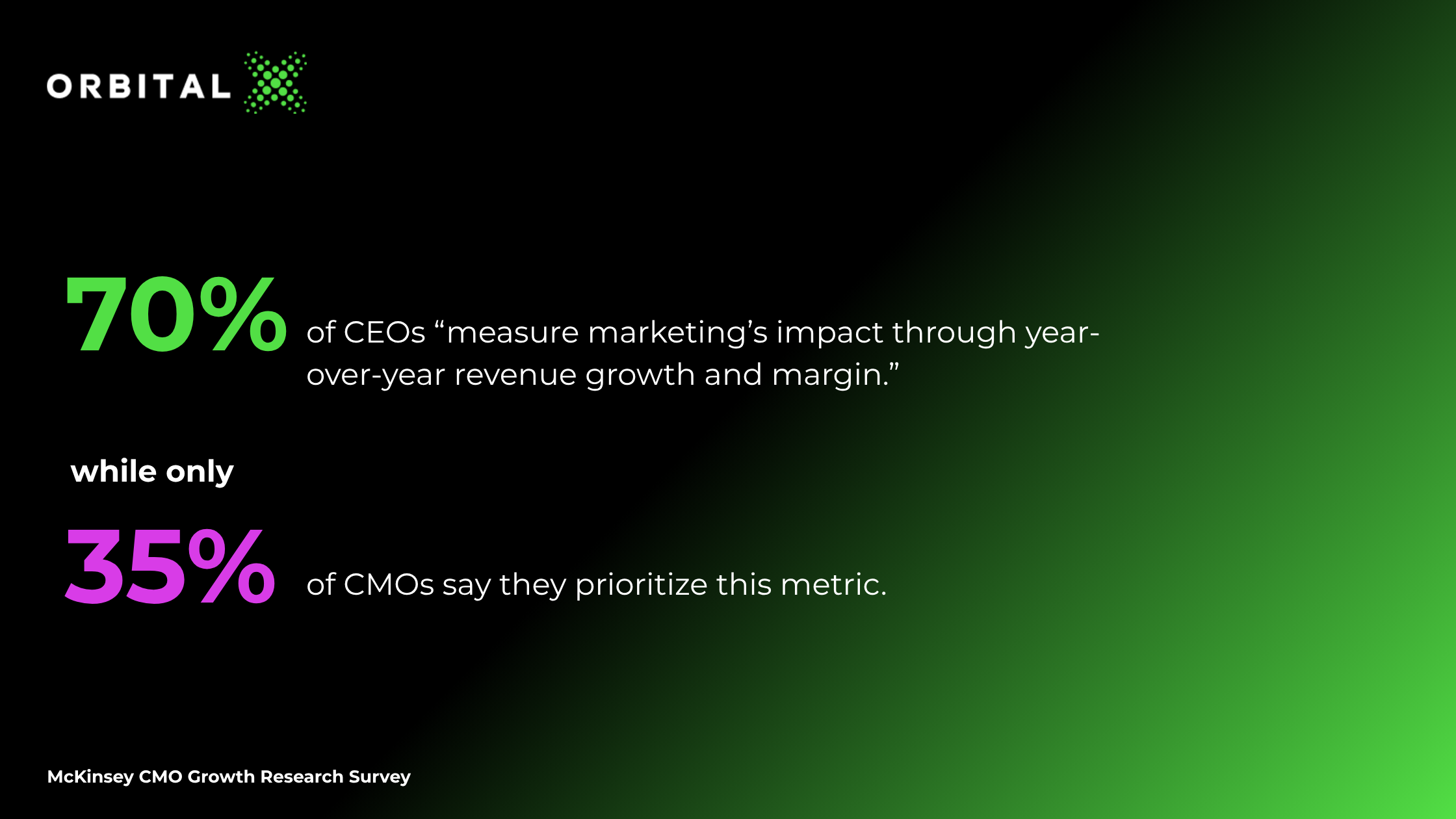
This shift reflects a broader challenge of flat budgets, smaller teams, and increased automation. As pressure builds, leaders are rethinking what "good" measurement actually looks like. According to McKinsey, 70% of CEOs measure marketing's impact through year-over-year revenue growth and margin, yet only 35% of CMOs say they prioritize this metric.
 As Shane Redding, owner of Think Direct, noted in a recent interview with OrbitalX, marketers must be much clearer about measuring business impact rather than "stuff," activity, or campaigns.
This is what it looks like in the wild
Traditional marketing metrics often show activity without demonstrating real impact. According to HubSpot, only about 13% of MQLs convert to SQLs in B2B SaaS, making them a flawed standalone proxy for demand generation success. Increasingly, B2B SaaS teams are moving toward revenue-based reporting, where success is measured by pipeline contribution, SQL quality, and CAC efficiency.
The payoff
The result is a leaner, more accountable marketing function. Teams are prioritizing fewer initiatives but executing them with clearer revenue targets and stronger coordination with sales. Rather than measuring success by the volume of activity, companies are evaluating how efficiently each marketer contributes to pipeline and growth.
This is the move here
Stop reporting on clicks and raw leads. If it doesn’t tie to pipeline, it doesn’t belong in your dashboard. Marketing is now a revenue function, which means focusing on a smaller set of high-value accounts. You must be willing to pay more to reach them because efficiency is measured in closed revenue, not cheap engagement.
How OrbitalX is leaning in
Our conceptual Marketing Per Marketer (MPM) index score is designed for lean teams to measure marketing systems around pipeline, not output. This involves prioritizing high-intent accounts, aligning marketing with sales activity, and measuring success based on revenue impact rather than campaign metrics.
2. AI Is Driving Both Content Scale and Search Saturation in Marketing
AI has fundamentally changed how content is created, allowing what used to take weeks to happen in hours. A single piece of content can now be rapidly transformed into blog posts, LinkedIn updates, automated email series, and video scripts. A December 2025 Demand Gen Report highlighted this shift, noting the rise of AI agents that manage marketing workflow segments with limited human input.
However, this efficiency has created a new challenge: a marketplace flooded with low-quality, generic content. As buyers begin to tune out sterile corporate messaging and automated noise, they’re gravitating toward credible human voices and strong, unique perspectives.
This is what it looks like in the wild
While many marketers believe AI content is the future, current performance data tells a different story. In a recent Semrush survey, 39% of SEO professionals believed AI content ranks as well as human-written blogs, and 33% claimed it performs even better.
Actual search data, however, suggests a significant gap between perception and reality:
Top-tier visibility remains human-led: Pages in the number-one search position are 80% likely to be human-written, compared to just 10% for AI-generated content.
Humans dominate the first page: Even at the tenth position, nearly two-thirds of top-ranking pages (63.9%) are written by a person.
The payoff
As AI lowers the cost of content production, the marginal value of "more content" is rapidly declining. Visibility is now concentrating around content that demonstrates clear originality, credibility, and authority. By balancing AI speed with human oversight, brands can distinguish themselves in an increasingly saturated market.
This is the move here
Quality is the only thing that stands out when the market is flooded. To win in this environment, you must combine AI-driven efficiency with strong editorial judgment and a defensible point of view. Don't just aim for volume; aim for positioning that an algorithm can’t replicate.
How OrbitalX is leaning in
We utilize AI to increase our speed and coverage, but every system is built with human influence at every step to ensure messaging quality. We believe scaling content only works if the output remains credible, targeted, and aligned with real buyer intent.
3. The Shift Toward Social Media-Driven B2B Marketing
Social media is no longer just a brand awareness channel in B2B; it’s evolved into a vital pipeline and revenue engine, as explained by B2B social media influencer and author Luan Wise in her recent appearance on our Do More With Less podcast:
This shift is fueled by a change in buyer behavior, as decision-makers now discover vendors, validate credibility, and consume thought leadership on platforms like LinkedIn well before they ever speak to a sales representative.
The impact of this shift is measurable. LinkedIn reports 82% of surveyed buyers said content from B2B creators influenced their purchase decisions. Social content is no longer about just "being seen"; it’s about driving tangible revenue impact.
.png) This is what it looks like in the wild
This is what it looks like in the wild
Vector, a B2B ads platform, demonstrated the power of this shift through a three-month influencer pilot program. With a modest budget of $12,000, the company partnered with seven influencers (a mix of three customers and four ICP thought leaders), each with approximately 13,000 followers.
The strategy was built on authenticity and trust rather than strict control. Vector provided a tight messaging brief but allowed the creators full ownership over their execution, even omitting a script to ensure the posts resonated naturally with their respective audiences.
The payoff
The results of this organic-led program were highly concentrated and impactful:
Organic reach: The campaign generated over 66,000 organic impressions.
Referral traffic: LinkedIn became Vector's top referral source for the entire quarter.
Pipeline impact: The program secured 45 demo requests, 82% of which were from ICPs, resulting in $1.1 million in pipeline from a $12,000 investment.
This is the move here
LinkedIn is a measurable demand and pipeline channel, so don’t sleep on it. To succeed on the platform, companies must combine clear messaging with trusted external voices to turn small, flexible social programs into outsized revenue. The key isn’t volume or control, but precision in narrative, authenticity, and trust.
How OrbitalX is leaning in
OrbitalX builds systems that treat social channels as demand drivers, not just soapboxes for awareness. We combine AI-enabled scaling with ICP-focused messaging and creator distribution to increase reach while keeping relevance and conversion intent intact.
4. The Rise of AI Search and Its Impact on Content Discovery and SEO
Search behavior is evolving rapidly as buyers move away from the traditional habit of clicking through multiple search results and reading long-form blog posts. Instead, they’re increasingly turning to tools like ChatGPT for synthesized, summarized answers, often making critical decisions without ever visiting a brand's website.
The environment has reached a tipping point where 50% of B2B software buyers now begin their purchasing journey in AI chatbots rather than traditional search engines. As a result, visibility is shifting from driving raw clicks to ensuring your content is interpreted as authoritative by AI systems.
This is what it looks like in the wild
Neue World, a UI/UX design company in Dubai, successfully navigated this shift by restructuring their SEO approach. They abandoned scattered blog publishing in favor of an intent-led, structured content production system.
Their strategy focused on:
Targeted Research: Utilizing keyword research and competitor gap analysis to identify high-value topics.
Content Hubs: Creating high-intent service pages and topic clusters to establish deep authority.
Optimization for Clarity: Systematically updating new and legacy articles to improve structure and relevance.
The payoff
By pairing these strategic content shifts with technical SEO improvements and robust internal linking, Neue World transformed their website into a highly authoritative resource for both humans and AI. Within six months, they achieved a 37% increase in organic clicks and a 125% growth in impressions. Furthermore, their organic keywords expanded by 77% within a single year.
This is the move here
Prioritize content that’s clear, structured, and easy for AI systems to interpret. For B2B marketing leaders, this means moving away from keyword density and focusing on direct answers and scannable formats like descriptive headings and summaries. To win in AI search, your content must be easy to extract, reuse, and trust.
How OrbitalX is leaning in
OrbitalX focuses on how content is surfaced and interpreted by AI models alongside traditional distribution. We structure insights specifically to make them easy for AI systems to extract and summarize, ensuring your brand appears in the few, high-stakes answers that buyers now rely on. Our ultimate goal is visibility across AI-driven discovery layers to support engagement on every individual channel.
5. The Shift Toward Video-Driven B2B Marketing
Video is no longer an optional extra in your marketing budget; it’s a necessity. It has become the most effective format for capturing dwindling attention spans, communicating complex ideas quickly, and building the familiarity and trust required to move a buyer.
According to HubSpot's State of Marketing Report 2026, short-form video is the top content format driving ROI, followed by long-form video and live-streaming. This shift is largely a reaction to a saturated content environment where speed, clarity, and relevance now matter far more than high-end production quality.
This is what it looks like in the wild
Look at Ahrefs, which has built one of the most successful video-first content engines on YouTube. Instead of treating the platform as a graveyard for repurposed webinars or dry product demos, they use it as a long-term demand generation engine.
Their strategy is built on several key pillars:
Educational Focus: They publish weekly instructional content designed to help users solve actual SEO problems.
Expert-Led: Tutorials are taught by in-house experts rather than polished brand spokespeople, adding human credibility.
Search Intent: Content is structured around what users are searching for, such as keyword research or blogging fundamentals, rather than pure promotion.
The payoff
By treating video as a core utility rather than a commercial, Ahrefs has secured more than 663,000 subscribers. Their videos consistently rank number one for high-intent terms like "SEO tips," providing ongoing search traffic rather than one-time spikes.
Most impressively, within one seven-month period, the channel boasted over three million minutes of watch time, the equivalent of roughly six years of undivided attention.
This is the move here
Stop treating video as a campaign add-on. To win in 2026, you must treat it as a core content channel. The focus should be on short, clear, and high-frequency content that emphasizes strong ideas and delivery over production polish.
How OrbitalX is leaning in
We build video directly into our content systems from day one. By designing ideas to be easily repurposed into short-form formats, we ensure they can be distributed across social and high-intent digital channels with ease. Our focus remains on speed, clarity, and repeatable formats that allow your message to scale without losing its edge or consistency.
Keep Your B2B Marketing Ear to the Ground
B2B marketing is undergoing a fundamental shift from output-driven activity to sophisticated systems that prioritize revenue impact, credibility, and precision. Across measurement, content, social media, and search, the common thread is a move away from volume and vanity metrics toward tangible business outcomes.
AI is accelerating this trend by increasing the overall content supply while simultaneously raising the bar for clarity, structure, and authority. For B2B marketing leaders, success in this new environment requires:
Tightening alignment between marketing and revenue functions.
Focusing on fewer but higher-impact initiatives.
Designing systems for content and distribution that are both scalable and credible.
In an era where attention is increasingly hard to earn and easy to lose, the winners will be those who prioritize efficiency and measurable results over noise.
OrbitalX ensures your marketing efforts stay ahead of the trend curve so your brand doesn't fall behind. Book a call today to learn how we can help you build a revenue-first marketing engine.
FAQs About B2B Marketing Trends
How do B2B marketing trends impact B2B sales?
The current shift in B2B marketing directly strengthens the sales pipeline by ensuring prospects are better educated before the first meeting. Key impacts include higher lead quality thanks to tighter sales-marketing alignment; accelerated deal cycle due to a focus on high-intent signals and educational content, meaning prospects enter the sales funnel with fewer objections and more specific questions; and unified growth with the removal of data silos
What are some AI tools for B2B marketing?
AI tools have moved from experimental pilots to core operational engines. Popular tools categorized, by their function, include:
Content Engines: Averi is widely used by B2B SaaS teams to build automated content workflows that rank for both traditional SEO and AI-generated answers.
Lead Generation and Scoring: 6sense and Leadinfo provide deep buyer intent data and anonymous account identification to help sales prioritize "hot" leads.
Data Orchestration and Enrichment: Clay allows teams to combine multiple data sources and use AI agents for web scraping, while ZoomInfo and Apollo.io remain market leaders for comprehensive contact databases.
Sales Engagement: Amplemarket and Persana help teams execute signal-based selling by prioritizing outreach based on real-time behavioral cues.
How can you spot market trends and stay informed?
Staying ahead of the curve requires a combination of individual insight and automated monitoring. Follow industry experts on platforms like LinkedIn and use advanced marketing analytics to identify emerging patterns in buyer behavior and content performance before they become mainstream.
Participate in industry events like webinars, roundtables, and in-person conferences to learn from peers and understand where competitors are investing. Closely monitor flagship research as well to understand high-level shifts in C-suite priorities.
Crucially, listen to customer feedback. Analyzing customer interaction data and survey responses helps identify pain points that signal broader shifts in the market.
More Resources

How to Evaluate Lead Generation Outsourcing Based on Pipeline Impact
Looking into lead generation outsourcing? Learn how to evaluate providers based on pipeline performance and revenue impact to improve sales outcomes.

Inbound Lead Generation: How It Evolved as B2B Buyers Changed
See how inbound lead generation evolved from search and content to automation, dark social, AI search, and signal-led pipeline decisions.

AI Lead Generation: What Actually Works in High-Value B2B
Learn where AI lead generation helps B2B teams improve account fit, signal timing, routing, and pipeline decisions - and where it creates noise.