How to Master Account-Based Webinars for High-Value Growth
Learn how to craft stellar webinars that close more accounts at every priority level, as well as how to measure the success of every event.
Key Takeaways
Buying committees are crowded. ABM webinars help you bring every stakeholder together to speed up alignment and decision-making.
One size fits nothing. You can scale your program by mixing custom 1:1 sessions, small 1:few workshops, and broader 1:many series.
The money is in the data. Real ROI comes after the event by syncing intent signals like poll responses directly to your CRM.
Speed is everything. Orchestration platforms should route high-intent signals to your sales team in real-time.
Modern B2B buying isn't a solo mission. It's a committee. You're typically dealing with 6 to 10 stakeholders for every deal. Each person has their own agenda. The CFO wants to cut risk while the CTO wants scalability.
It's stressful. One stakeholder who isn't convinced can stall a massive deal for months. You need a way to get everyone on the same page without chasing them individually. This is where creating first-rate watchable content becomes your best sales tool.
Account-based marketing webinars are precision-engineered environments. They aren't just presentations. They're virtual rooms designed to build trust and achieve alignment among your most valuable prospects. This guide will show you how to set up your own tiered program and track the metrics that actually show pipeline impact.
What an ABM Webinar Is (And What It Isn’t)
An ABM webinar is a multi-threaded virtual experience. Its only job is to move a specific group of high-value accounts through your sales cycle. Don't confuse it with a typical marketing event. It's a targeted sales environment for pre-qualified accounts.
Standard webinars live and die by registration volume. They want thousands of names. ABM webinars don't care about the crowd. They focus on account progression. The goal isn't to talk to anonymous attendees. It's to get the right stakeholders into a shared experience that makes internal alignment easy.
In the old world, you measured success by how many people showed up. In the ABM world, success is measured by whether your target accounts move forward in the pipeline. Once you stop chasing volume and start focusing on precision, everything changes. Your invites, your content, and your follow-ups all get a lot smarter.
Why ABM Webinars Should Be Star Players in Your Strategy
The narrower focus of ABM webinars gives you advantages that traditional marketing can't match. They're targeted sales environments built for the decision-makers of your most valuable prospects. It's about shifting from volume to precision. You're not just hosting an event; you're building a targeted sales environment.
When executed right, these sessions act as virtual environments to address the specific interests of every stakeholder at once. You move away from anonymous volume and toward content that encourages internal alignment. This then leads to actual account progression in the pipeline.
Personalized Interaction and Engagement
With these webinars, your interaction is designed to make attendees feel like you built the session just for them. Since you know exactly who’s in the virtual room, including their industry, their company’s recent hurdles, and even their job titles, you can tailor the content to an elite degree.
When a prospect hears their specific industry nuances discussed or sees a case study that mirrors their exact internal structure, engagement goes through the roof. You stop being just another vendor and start acting like a consultant who actually understands their reality.
Reach the Entire Buying Committee in One Virtual Room
Webinars give your target account's decision-makers a platform to align in real time. One of the hardest parts of B2B sales is the "internal consensus" phase. An end user might love what you do, but then they have to go sell it to the CFO, the CTO, and the head of ops.
Every time your message is repeated second-hand, it loses its edge. By addressing every stakeholder's concerns in a single session, you cut out weeks of back-and-forth internal deliberations that usually stall a deal.
Spot Active Buying Intent in Real Time
Webinars show you if a target account is actually active. Every poll they answer, every question they ask, and every minute they spend watching is a vital data point. If a CFO from a must-win account asks about integration timelines during the Q&A, that isn't just a question; it’s a massive buying signal.
In a proper ABM setup, this data doesn't sit in a marketing spreadsheet for a month. It triggers an immediate notification to the account executive (AE) so they can follow up while the lead is still hot.
Accelerated Sales Velocity
Because ABM webinars provide deep education and handle objections up front, they act as a major funnel shortcut. A high-quality session can guide a prospect to bypass the "awareness" and "interest" stages and land squarely in "consideration" or "intent." It’s the kind of acceleration that turns a disruptive idea into the logical choice in under an hour.
By putting the right context in front of the right people, sellers can multi-thread earlier and skip entire discovery phases. This leads to shorter sales cycles and significantly higher win rates.
Account Priority Supports Webinar Design
Not every target is worth the same level of investment. To keep your program profitable, you need to segment your efforts into three distinct tiers. This ensures your high-value accounts get the white-glove treatment while your broader market still receives high-value content.
Tier 1 (1:1) → Custom Strategy Sessions
These sessions are reserved for those high-contract-value targets where winning a single deal can define your entire fiscal quarter. The stakes are massive, so the webinar can't be a generic broadcast. It has to be a consultative session built specifically for the prospect's own business.
You should conduct deep-dive research into their annual reports and even the LinkedIn activity of their key stakeholders. Instead of a generic platform overview, you're presenting something like a data scalability roadmap tailored to their specific hurdles.
The invitation is the most important part. You can't invite a tier 1 C-suite executive with an automated email blast. The message needs to come from a peer (e.g., your CEO or CRO) via a personal LinkedIn message or a physical, hand-written invite.
Tier 2 (1:Few) → Industry Roundtables
Tier 2 is where your ABM program begins to scale. You're targeting small clusters of 5 to 15 accounts that share a specific commonality, like a vertical or a shared pain point. This is where you use peer validation to your advantage.
B2B buyers at the director and VP level often feel lonely in their challenges. They want to know what their peers are doing to solve the same problems. By hosting a roundtable, you stop being a vendor and become a facilitator of a high-level professional community.
Treat the invitation as an exclusive nomination to a limited-seat event. When a prospect sees other respected names in the room, their trust in your brand is borrowed from the collective credibility of the group. Use a "cameras-on" format to get them talking and identify warm intent from their questions.
Tier 3 (1:Many) → Thought Leadership Series
Tier 3 is programmatic ABM. It looks like a traditional webinar, but the targeting is much tighter. You're only spending your ad budget and outreach energy on your pre-defined ICP list.
The job here is category education. You're defining a problem and presenting a new category of solution for prospects who might not know you even exist yet. It's about shifting their thinking from reactive fixes to preventative, business-wide strategies.
Even with a larger audience, you shouldn't let the production quality feel impersonal. You can use LLM-powered live chat agents to answer specific technical questions in real time while the presenter keeps their flow. This tier identifies the "hand-raisers" who can then be moved up to tier 1 or tier 2 engagement.
For instance, say you create a thought leadership webinar series that focuses on the broad pain of scaling a manufacturing business overseas. During one of those broad sessions, a CFO from a fast-growing company spends 15 minutes in the live Q&A asking about regulatory friction. In a traditional setup, that lead might have sat in a spreadsheet for weeks. Instead, the team employs real-time intent signals to flag the account for an immediate tier 1 move.
Your team can then skip the generic "thanks for attending" email and instead reach out with a personalized video message that references the CFO’s specific questions from the webinar. Then, you could invite them to a custom strategy session built specifically around their company’s public growth data. That single "broad" webinar attendee thus turns into a high-value, six-figure deal because the system was designed to catch them while interest was at its peak.
Feature | Tier 1 (1:1) | Tier 2 (1:Few) | Tier 3 (1:Many) |
Target Audience | "The Whales" (Top 1% of accounts). | Industry Clusters (10-50 accounts). | The Entire ICP (Thousands of accounts). |
Webinar Type | Custom Strategy Session / Private Briefing. | Industry Roundtable / Lunch & Learn. | Thought Leadership / Category Education. |
Content Strategy | Hyper-Personalized. Uses the account's own data and specific hurdles. | Vertical-Specific. Focuses on peer challenges and industry trends. | Broad Pain Points. Focuses on market shifts and general solutions. |
Outreach Style | Executive-to-Executive. Personal video/InMail from your CEO. | Nomination-Based. Framed as an exclusive, limited-seat event. | Programmatic. Targeted LinkedIn ads and automated email flows. |
Interaction Level | High (Cameras on, 1:1 Q&A, collaborative). | Moderate (Peer-to-peer discussion, live polls). | Low to Moderate (Q&A via chat, AI-powered live agents). |
Primary Goal | Deal Acceleration. Moving a specific 6-figure deal to "Closed." | Intent Discovery. Finding warm leads within a specific sector. | Brand Awareness. Identifying "hand-raisers" to move up to Tier 1/2. |
Planning and Executing Account-Based Marketing Webinars That Move the Pipeline
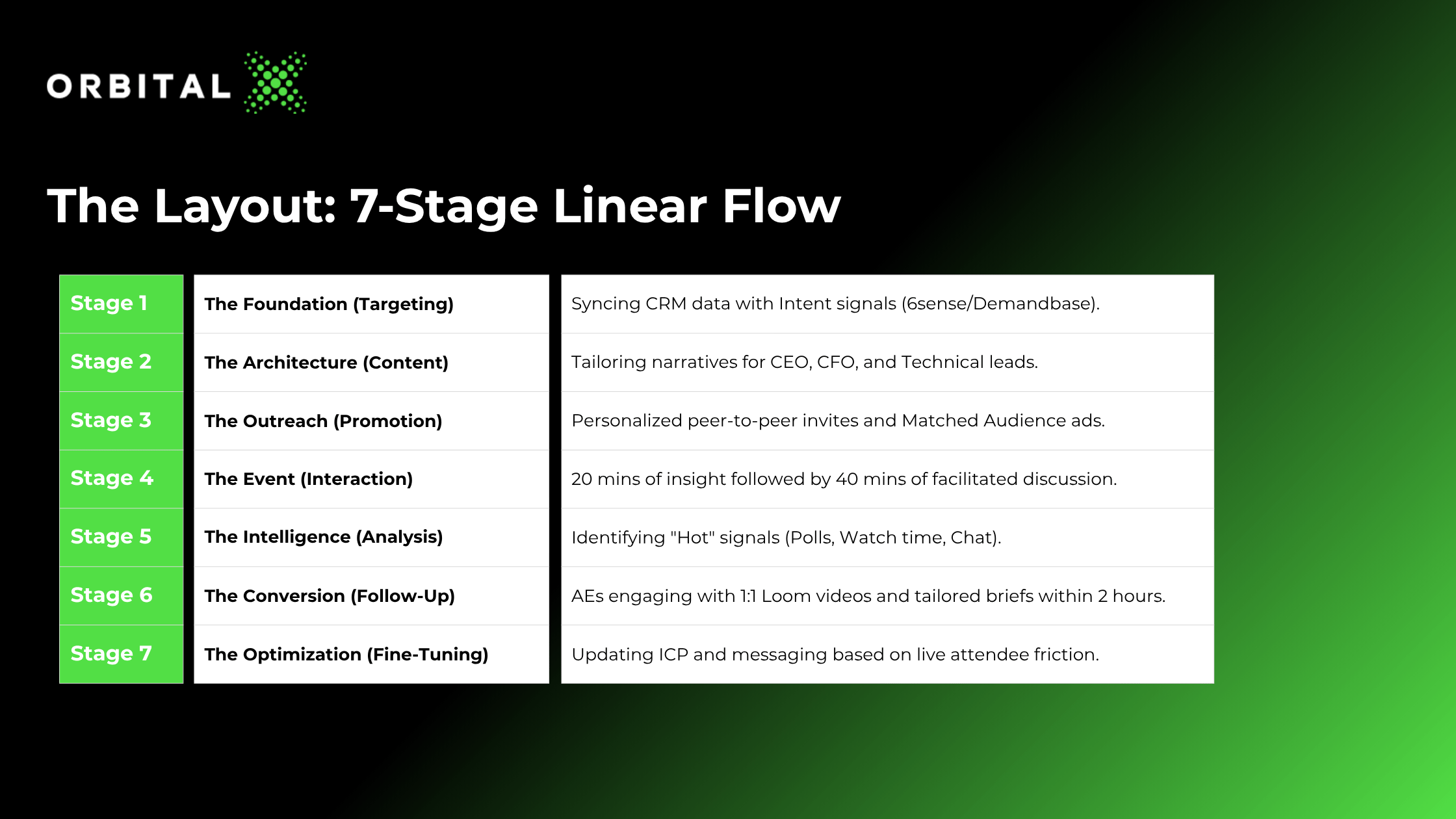
Great webinars don't happen by accident. They're built. This seven-step process ensures every detail, from the first invite to the final sales call, is synced so no lead falls through the cracks.
Step 1: Build Your Target List and Tech Stack
The foundation of any successful ABM webinar is a rigorous definition of your ideal customer profile (ICP). You shouldn’t look for just anyone who shows an interest in your category. You want to find targets that hit specific firmographic triggers.
Use intent data platforms to find companies already in an active buying cycle. If stakeholders from a high-value account are browsing your pricing page, they're your primary candidates. It's why signals drive smarter sales conversations more than generic lead lists.
Your tech stack also has to function as a unified system. Your webinar platform, CRM, and intent data need to talk to each other so interactions are captured and made actionable at the account level. Unifying platforms like OrbitalX’s DemandWEBS™ connect these signals directly to real-time sales actions.
Step 2: Craft Content that Appeals to All Stakeholders
Successful webinars use a multi-threaded narrative to satisfy the entire buying committee. You can tailor customer content by focusing on ROI for the CFO, security for the CTO, and ease of use for the actual end users. Position the presentation as a strategic briefing rather than a mere product pitch.
Don't build in isolation. The smartest teams co-create sessions with adjacent vendors who share the same audience but don't compete. This creates a "force multiplier" effect where you provide a combined value proposition that feels like a holistic industry briefing.
Imagine you sell a high-end data infrastructure tool. You know your ICP is losing sleep over new data privacy regulations, so you partner with a legal compliance software company to co-host a session.
Instead of two separate, boring product pitches, you host a single "2026 Strategic Briefing on Scalable Compliance." They bring their audience to your platform, and you do the same for them. The result is a session that feels like a holistic industry briefing rather than a sales pitch, giving your prospects a much stronger reason to show up. You split the production costs, double the reach, and provide a depth of value that a solo brand can't match.
Step 3: Promote the Event
ABM promotion requires orchestration that feels personal rather than automated. Your goal is a surround sound effect where the webinar appears across all touch points relevant to the buying committee. This includes personalized LinkedIn InMail, calendar invites from internal champions, and tailored email sequences.
To avoid wasting budget on irrelevant clicks, use LinkedIn’s Matched Audiences. This lets you run highly targeted ads that only appear in the feeds of employees at your specific target accounts. It's about being seen by the people who actually matter.
Step 4: Hold an Event That Balances Presentation With Q&A
The biggest mistake you can make is a monologue-style presentation that talks at the audience for 50 minutes. Webinars need interactivity to be truly engaging, with 67% of webinar attendees saying live Q&A sessions are their favorite part of these events. Use the 20/40 Rule as a guide: Aim for 20 minutes of high-density insight followed by 40 minutes of facilitated discussion.
Your live event is for harvesting data while engagement is at its peak. Display in-session banners to let viewers respond to polls without disrupting the speaker's flow. The responses you get give your sales team the exact hook they need for a follow-up call. You're responding to stated challenges instead of guessing pain points.
Step 5: Analyze Engagement Data Post-Webinar
The real value of an ABM webinar is found after the session ends. Attendance is a nice indicator, but the depth of engagement determines if an account is ready to move forward. You need weighted intent scoring because not all engagement is equal. Look at poll participation and watch time to decide who gets priority.
Someone who asks a technical question is a hot lead. Someone who only stayed for five minutes is cold. If you see engagement from both finance and operations at the same account, you have a high-probability opportunity that warrants immediate outreach.
Ownership must then shift smoothly from marketing to sales. High-intent accounts should automatically trigger alerts within the CRM, assigning the account to the responsible AE or SDR teams. Without predefined ownership and routing rules, even the strongest intent signals will sit idle.
Step 6: Follow up With Your Most Engaged Attendees
Success depends on closing the speed-to-lead gap. Research shows that following up within the first five minutes can generate 21 times higher qualification rates than waiting half an hour. Most programs fail here because marketing generates a signal, but sales follows up too late.
Prospects interact with multiple vendors, and a rapid post-webinar message allows you to engage when their interest is highest, before the odds of qualifying the lead plummet after that window. This means your AEs should have the engagement data in their CRM while the prospect is still warm.
The outreach shouldn't be a generic template, though. It must be as personalized as the initial invitation. It should feel like an extension of the conversation, such as offering a brief on a specific topic the attendee showed interest in during the Q&A.
Step 7: Use Attendee Data to Fine-Tune the Campaign
This final step ensures your next webinar is a more evolved, higher-converting version of the last one. Analyze the questions asked and polls answered across the entire base. If target accounts are struggling with a specific problem you didn't focus on, update your messaging.
Use the webinar as a stress test for your value proposition. Look at which types of accounts engaged deeply and which ones stayed silent. Perhaps your service is more relevant to companies undergoing a merger than it is to those just starting out. Share these insights with your leadership team to ensure your product positioning and ICP stay up to date.
 Best Practices for ABM Webinars
The following recommendations will help you fine-tune your approach to ensure your webinars deliver the ROI your investment deserves. Here’s how to get the most out of your efforts:
Lower the Barrier to Entry: In B2B marketing, we often ask for too much, too soon. A "Book a Demo" button on your registration page is a high-compliance request that implies a 30-minute commitment to a sales pitch.
Instead, frame your landing page as an industry briefing or a working session. When a prospect feels they're entering a space to learn rather than to be sold to, their defensive barriers drop.
Make the Landing Page Personal: You want the prospect to feel an immediate sense of place. Conversion rates can jump by 202% if the landing page looks like it was built just for them. Use dynamic content tools to greet visitors from specific accounts with headers and copy that reflect their industry or specific pain points.
Use Tools that do the Heavy Lifting: Use AI-powered workflows to handle the administrative side of the session. For example, you can use AI to summarize the transcript into account-specific executive summaries. Sending these out immediately after the session ends keeps the momentum going with zero extra manual effort.
Turn Content into Value Nuggets: Breaking down your webinar allows you to reach stakeholders who couldn't make the live session. Slice the presentation into digestible, two-minute LinkedIn videos to hold the lead’s attention. You can also turn the Q&A transcript into an FAQ PDF for the sales team to use in their outreach.
Measuring Success: Metrics That Matter (Beyond "Engagement Rate")
Engagement is a nice indicator, but it’s basically a vanity metric if it doesn’t move the needle for your bottom line. The below metrics tie your webinar activity directly to pipeline impact, giving you the proof you need to show your events are working.
Account Penetration
This tracks how many unique stakeholders from a single target account showed up. If you have a seven-person buying committee and you’ve engaged three or four of them, such as finance, operations, and IT, your penetration is high.
The Formula: (Unique Stakeholders from Account A Who Attended / Total Identified Buying Committee Members for Account A) x 100.
Healthy Range: Aim for 30%–60% of identified stakeholders.
Troubleshooting: If this metric is low, your messaging probably lacks a clear "what's in it for them" for the non-primary stakeholders. Clearly map value points to each role, like ROI for finance and ease of use for operators.
Pipeline Velocity
Does your webinar actually shorten the sales cycle? If accounts that attend move from the discovery stage to consideration 25% faster than those who don't, you have a mathematically proven case for more budget.
The Formula: (Number of Opportunities x Average Deal Value x Win Rate %) / Length of Sales Cycle in Days.
Healthy Range: Look for 15%–30% faster progression compared to non-attendees.
Troubleshooting: If velocity is flat, your content likely isn't addressing key objections early enough. Rework your segments to handle implementation concerns up front and make sure your sales team follows up within hours, not days.
Influenced Revenue
This measures the total dollar value of open opportunities where at least one stakeholder attended a webinar. It’s your greatest asset to prove to leadership that the webinar was a pivotal touch point that maintained momentum in a major transaction.
The Formula: The sum of the dollar value of all open or closed-won opportunities linked to at least one webinar attendee.
Healthy Range: 20%–40% of the total pipeline influenced is a solid benchmark.
Troubleshooting: Low influence means you’re either attracting the wrong audience or failing to engage the actual decision-makers. Tighten your targeting and prioritize identifying real intent signals over total registration volume.
Cost per Qualified Lead (CPQL)
Traditional CPL is often a trap. CPQL forces your team to focus on how you measure MQLs by only counting leads that fit your ICP and meet your engagement thresholds.
The Formula: Total Campaign Spend (Ads + Tech + Production) / Number of Attendees who fit the ICP.
Healthy Range: This is variable, but it’s typically 20%–50% lower than traditional paid channels when ABM is done right.
Troubleshooting: If CPQL is high, you're likely overspending on broad targeting. Shift your budget toward high-intent channels like account-based ads or sales-led invitations.
Turning "Invisible" Services Into Visible Pipeline
To see these principles in action, let's look at the partnership between OrbitalX and The Legal Director (TLD). TLD faced a classic category education problem. They offered a disruptive, fractional general counsel model that many SMEs didn't even know was an option. Their target audience, CEOs and CFOs, were mostly stuck in the traditional law firm mindset.
The Strategy: Precision-Targeted Demand Gen
OrbitalX moved away from broad awareness and deployed a high-intent ABM webinar strategy. We focused content on a "Business Person First, Lawyer Second" narrative. This addressed the specific growth pains and regulatory frictions that keep scaling businesses up at night.
The Results: Data That Speaks for Itself
By following the seven-step process and specifically focusing on targeting and engagement data, the results were immediate:
151% Organic MQL Target Achieved: The campaign didn't just meet goals; it shattered them.
100% ICP Alignment: Every senior leader engaged through the webinar was a perfect fit for TLD.
£54 Average CPQL: By using automated demand gen and LinkedIn to maintain a continuous presence, TLD drove discovery calls at a fraction of the cost of traditional ads.
“The numbers were brilliant. And we’ve already had sales calls off the back of that. We’re seeing engagement from and conversations with exactly the right people.” ~ Sarah Clark, CEO of TLD
ABM Webinars Are Your Ticket to a Fuller, Faster Pipeline
The real power of an account-based approach is its precision. Moving away from general broadcasts toward a tiered webinar strategy is the only way to scale without losing that personal touch. Whether you're running 1:1 custom strategy sessions for your high-value accounts or 1:many educational events to build awareness for your whole ICP, the goal is always account progression, not just sign-up volume. When you get it right, these virtual events do more than spark a bit of engagement. They create genuine alignment, speed up your deals, and drive pipeline impact you can concretely measure.
But turning this into a sustainable growth engine is a big shift. It requires your tech stack, your multi-threaded content, and your sales enablement to work together in total sync. It’s a complex feat that usually takes an AI-human hybrid approach to pull off.
OrbitalX is here to bridge that gap. We help B2B teams design programs that connect digital engagement signals directly to revenue through our DemandWEBS™ framework. It’s a strategy that actually works for teams that need results in weeks, not months.
Whether you’re hunting "whales" or educating an entire industry, we’ve got the expertise to get you there. Book a 1:1 consultation with us today. Let’s turn your high-value accounts into a high-velocity pipeline.
FAQs About Account-Based Marketing Webinars
What is the difference between a traditional webinar and an ABM webinar?
Traditional webinars are a volume game. You're usually chasing as many registrations as possible to fill a spreadsheet (often 1,000+ sign-ups from broad lists). ABM webinars flip that.
The goal here is precision. You're trying to get a specific group of high-value stakeholders (usually 10-20) into a shared virtual experience that moves a deal forward. Success isn’t measured by how many people showed up but by whether those target accounts progressed in your sales pipeline.
What tools do I need to run ABM webinars?
You don't need a massive, bloated tech stack. You just need a few key tools that talk to each other. Start with a webinar platform that gives you deep engagement data.
Connect that to a solid CRM like HubSpot or Salesforce to centralize your data. You also need an intent data tool to see which accounts are actually in a buying cycle. Finally, adopt an orchestration layer to turn webinar signals like poll responses or multi-attendee accounts into real-time alerts for your sales team.
How do I make sure the content isn't a boring sales pitch?
B2B buyers are tired of being talked at for 50 minutes. If you want to keep them engaged, follow the 20/40 Rule. This means you give them 20 minutes of high-density insight followed by 40 minutes of facilitated discussion.
You should also use a multi-threaded narrative. Address the CFO's concerns about ROI and the end user's need for ease of use in the same session. When you solve their specific problems instead of just listing features, you become a consultant they trust.
How do I measure the ROI of an ABM webinar?
Forget vanity metrics and focus on the ones that actually tie back to revenue. Account penetration is a big one here.
Are you reaching the right percentage of the buying committee for your top accounts? You should also track pipeline velocity to see if webinar attendees are moving through the sales cycle faster than non-attendees. You ultimately want to prove influenced revenue though. Show leadership that these sessions were a pivotal touch point in closing major deals.
More Resources

B2B Content Marketing Funnel: Stages, Strategies, and How to Build One That Converts
Build a B2B content marketing funnel that aligns content with buyer needs, connects the journey, and turns content engagement into pipeline and revenue.

B2B Referral Marketing: How to Build a Program That Drives Qualified Growth
Learn how to build a B2B referral marketing program that turns trusted relationships into qualified introductions, pipeline, and measurable revenue.

A PE-Backed Company Cut Marketing From 12 People to 3. Then Had Its Best Six Months Ever.
A marketing team cut from 12 to 3, then the best six months in the company's history. Here's the growth system behind it, and what it means for PE portfolios.