B2B Marketing Consultant: When Pipeline Is the Problem
Learn when a B2B marketing consultant can diagnose pipeline problems, when they can’t, and when your team needs a better operating system.
Key Takeaways
A B2B marketing consultant proves their worth when they diagnose the system behind pipeline performance before recommending tactics.
More campaigns don’t fix poor ICP fit, weak signals, bad handoff, slow follow-up, or CRM data nobody trusts.
The right help depends on the bottleneck. The provider’s label matters less than the problem they solve.
B2B marketing consultant ROI should be measured through operational, pipeline, and revenue outcomes. Activity metrics are secondary.
Nobody brings in a B2B marketing consultant when the pipeline story is clean.
They usually do it when marketing is busy, sales is unimpressed, the CRM looks full, and the executive call has started to turn into a blame exercise. Marketing points the finger at lead follow-up. Sales points at lead quality. RevOps points at the data. The problem is, everyone is partly right, which is why it’s hard to fix from inside one function.
It’s the boardroom Mexican standoff you want to avoid as much as possible.
A good B2B marketing consultant helps diagnose the system behind marketing performance before recommending another campaign. Sometimes that means advice. Sometimes it means execution capacity, strategic leadership, an in-house hire, a vendor, or a connected operating model. The point is to stop buying more activity before you know where the pipeline’s breaking.
Why B2B Teams Look for a Marketing Consultant in the First Place
Teams usually search for a B2B marketing consultant when the activity is visible, but the commercial result isn’t. Campaigns are running. Content is live. Paid channels are spending. Email’s going out. The CRM has names in it. But even though the wheels are turning, there’s no actual movement. It’s all wheelspin.
Then, the executive call turns into a heated argument. Marketing accuses sales follow-up. Sales blames lead quality. RevOps throws the data under the bus. Everyone has a version of the truth, and nobody has a clear answer for why pipeline still feels weak.
And whoever’s speaking definitely won’t eat humble pie and say it was their team’s fault.
Lean teams under efficiency pressure feel that poor traction more deeply, especially when growth targets remain aggressive while budget and headcount stay constrained. At that point, “more marketing” can become a very expensive way to avoid the harder question.
The first instinct is often, “Do we need a better campaign?” The necessary question is why those campaigns aren’t creating qualified pipeline.
What Is a B2B Marketing Consultant?
A B2B marketing consultant is an external specialist who helps diagnose and improve how a company attracts, engages, qualifies, and converts business buyers. These guys don’t mince words. They’ll tell you flat out where you’re messing up, what’s broken, and how to fix it, then lead the charge to do it.
That can mean ICP review, positioning, messaging, channel strategy, campaign assessment, sales handoff, CRM logic, and measurement. But these shouldn’t be treated as separate boxes to tick. A strong B2B marketing consultant connects marketing decisions to account quality, buyer timing, sales readiness, and pipeline outcomes before prescribing tactics.
What a B2B Marketing Consultant Should Actually Diagnose
A useful B2B marketing consultant shouldn’t stay politely inside the marketing lane if the problem’s somewhere else. As an outside party, they don’t have to worry about company politics. They can be blunt and call out departments when they fall short.
They need to look across the full go-to-market path, from audience selection to sales follow-up. Pipeline failure often appears between functions, so a narrow channel audit can miss the real issue.
That cross-functional view matters, because many GTM problems sit between marketing, sales, product, and operations instead of inside one team’s workflow.
An external consultant can say the thing internal teams often soften. Not what makes the cleanest departmental story, but what’s actually happening. That’s a key differentiation. They’re external and have that freedom to express their true thoughts without fear of upsetting a colleague or boss (so long as they retain their engagement).
That may sound like, “We’re performing below benchmark, and here are the four places where that’s happening.” One failure point may sit in targeting, another two in CRM data and sales follow-up, while the last is in how leadership defines success.
The consultant isn’t there to make one department look better than another. Their job is to show where the system’s breaking, why the same problem keeps coming back, and what has to change first.
What a B2B Marketing Consultant Shouldn’t Be Used for
Don’t expect a B2B marketing consultant to play fairy godmother to your Cinderella. They won’t have a magic fix for unclear positioning, weak product-market fit, messy ownership, or a team that won’t act on recommendations. That’s just buying an expensive witness to the same mess.
They also shouldn’t be used as a substitute for execution capacity. If the team already knows the problem and can’t move because everyone’s overloaded, another advisory engagement may just produce a better-looking version of the same stuck conversation.
Inconsistent pipeline, CRM distrust, random marketing activity, and sales-marketing blame are often signs of a pipeline operating problem rather than a single channel problem.
Advice works when the problem’s unclear and the team can act on it. It breaks down when the team needs ongoing signal interpretation, coordinated execution, feedback loops, and operator capacity.
The Real Problem: Marketing Activity Isn’t Translating Into Qualified Pipeline
At this point, the real question is where marketing activity is failing to become qualified pipeline.
A company can have channels, tools, campaigns, and effort while still missing a working system that turns buyer and account signals into timely pipeline action. Traffic, form fills, email engagement, and ad impressions can rise while sales receives non-ICP leads, outreach happens late, and opportunities stall.
Lead volume is a master illusionist here, able to make marketing look busy while sales still has too little worth pursuing. Imagine sending sales a lead who only joined your newsletter because you had no other prospects that week! The problem, then, isn’t pipeline generation. It’s wishful thinking with a handoff.
Simple campaign thinking breaks down when buyers move across touch points, stakeholders, and decision moments. Marketing, sales, and follow-up need to work as a connected motion.
.png) The real test is whether the right accounts are actually moving through the pipeline.
The real test is whether the right accounts are actually moving through the pipeline.
The Pipeline Failure Points a B2B Marketing Consultant Should Check First
Consulting really shines when it moves from campaign critique to the places where marketing activity leaks before it becomes pipeline.
A useful B2B marketing consultant should ask not only whether the campaign worked but also where the system failed after the campaign created activity.
Failure point | What it looks like | What to fix first |
ICP and account fit | Marketing is creating activity from accounts that look busy but can’t buy, lack urgency, or sit outside the real commercial target. | Tighten ICP, account selection, buying triggers, and qualification criteria. |
CRM data and ownership | The team can’t trust account records, lifecycle stages, contact data, or who owns the next move. | Clean the data fields that drive routing, reporting, and sales action. |
Signal interpretation | Every engagement is treated the same, so real buying intent gets buried inside general activity. | Define which behaviors indicate readiness and what action should follow. |
Routing and follow-up | The right person doesn’t see the right account while the signal is still fresh. | Clarify ownership, SLA logic, alerts, and context-rich sales tasks. |
Measurement | Reports show clicks, opens, impressions, and form fills but not movement through the pipeline. | Shift reporting toward sales acceptance, meeting conversion, deal velocity, and qualified pipeline. |
The campaign may not be the root cause. The real failure may be that high-intent accounts aren’t recognized, sales receives weak context, or reports measure volume instead of movement.
When to Hire a B2B Marketing Consultant
Hire a B2B marketing consultant when there’s enough activity to inspect but not enough clarity to trust the next move. Think of having a recipe with all the ingredients listed, but the instructions are missing.
The threshold is diagnostic: The issue has stuck around long enough that every team has a different explanation, and leadership needs a clearer read before adding budget, tools, or headcount.
You should consider a third-party consultant if:
Pipeline is inconsistent, even though campaigns are active.
Sales keeps rejecting lead quality.
CAC or CPL is rising, but the team can’t isolate why.
Funnel conversion, account progression, or deal velocity is unclear.
CRM data isn’t trusted enough to guide pipeline decisions.
The company’s entering a new market and needs a clearer read on ICP, messaging, and channel fit.
The team wants to scale demand generation but doesn’t know which part of the machine will snap first.
A B2B marketing consultant makes sense when the problem is uncertain. But if the problem is already clear and the team lacks bandwidth, another diagnosis is just like a doctor saying you need surgery and expecting you to do it yourself. You need a different kind of help in that case.
How to Decide What Kind of B2B Marketing Help You Actually Need
Don’t buy a label. Diagnose the bottleneck.
A B2B marketing consultant is one option. An agency, fractional CMO, in-house hire, execution vendor, or operating-system partner may fit better depending on what’s actually stopping pipeline from moving.
Which Kind of B2B Marketing Help Do You Need?
Option | Best when | Weak when | Bottleneck it solves | Risk if misused |
Consultant | You need diagnosis, strategy, audits, channel assessment, or GTM recommendations. | The team already knows the problem but lacks capacity to act. | Unclear strategy or cause of underperformance. | Recommendations sit in a deck and nothing changes. |
Agency | You need campaign execution, content production, paid media, creative, or channel delivery. | The real issue is data, routing, sales handoff, or pipeline architecture. | Lack of delivery capacity. | More activity is produced without better qualification. |
Fractional CMO | You need senior marketing leadership, prioritization, team direction, or board-level accountability. | There’s no execution layer to turn strategy into work. | Lack of strategic ownership. | Leadership improves, but execution stays underpowered. |
In-house hire | You need long-term ownership, internal knowledge, and consistent day-to-day execution. | The company needs several specialist skills immediately. | Durable team capacity. | One hire gets stretched across too many functions. |
Execution vendor | You need a specific task delivered, such as email, design, paid ads, SEO, or landing pages. | The team hasn’t diagnosed what should be done or why. | A narrow production gap. | Isolated outputs don’t connect to revenue. |
Operating-system partner | You need signals, prioritization, execution, and feedback to work as one pipeline motion. | The company only needs a narrow audit or one channel fix. | Disconnected signals and execution gaps. | The team overbuilds before ICP, positioning, or sales basics are ready. |
The mistake is hiring one type of help to solve a problem it wasn’t designed to solve. You wouldn’t visit a psychologist if you have a broken arm, would you?
How to Scope a B2B Marketing Consultant Engagement
“We need a marketing strategy” is too vague to be useful.
A better scope starts with what leadership needs answered: Why is paid spend rising while sales-accepted pipeline is flat? Why do sales keep rejecting lead quality? Why can’t the team trust CRM data? Why are campaigns producing activity without movement?
Before the work starts, the scope should name five things:
The business problem: Is the issue lead quality, pipeline velocity, account prioritization, channel performance, CRM data, follow-up, or measurement?
The marketing consultant’s role: Are they diagnosing, advising, implementing, coaching, designing measurement, or supporting a specific strategic decision?
The decision rights: Who can approve changes to ICP, scoring logic, routing rules, messaging, channel priorities, or reporting?
The internal inputs: What access will they need to CRM data, campaign performance, funnel conversion, sales feedback, buyer research, and leadership context?
The expected output: What should the team have at the end that it doesn’t have now?
A deck isn’t the outcome. The scope should say what the work is supposed to change: the diagnosis, the priorities, the lead quality, the handoff speed, the sales acceptance rate, or the reliability of pipeline reporting.
What a Good B2B Marketing Consultant Should Diagnose Before Recommending Tactics
If someone tries to sell you on a one-size-fits-all approach, RUN. A good B2B marketing consultant won’t walk in with a favorite tactic already loaded.
“Run LinkedIn ads” might be right. So might “build more content,” “launch outbound,” or “fix SEO.” But if that answer comes before the marketing consultant has looked at the pipeline system, they’re guessing with confidence.
The diagnosis should cover the following four areas:
ICP and Account Quality
Some pipeline problems are already baked in before the campaign launches.
If the target account list is too broad, the lead criteria are weak, or the ICP is built only on surface firmographics, marketing can produce activity sales can’t convert. Two companies can match the same basic ICP and still have different urgency, buying triggers, budget pressure, and fit.
Effort has to concentrate where fit, readiness, and commercial value overlap.
CRM Data, Scoring, and Routing
Crappy data makes good marketing look worse and bad marketing harder to detect.
If contact records are incomplete, account ownership is unclear, scoring is arbitrary, or routing rules are slow, the team will miss active buyers. The B2B marketing consultant should check whether the records behind pipeline decisions are complete, current, and trusted enough to act on.
The basic test is simple: Can the company see the right account, trust the signal, and route it to the right owner fast enough?
Signal Interpretation and Follow-up Timing
B2B buying signals aren’t self-explanatory.
A pricing page visit, comparison search, webinar attendance, review-site visit, or multi-stakeholder content pattern only matters if the team knows what to do next. Signals are useful when they change sales timing, message, priority, or routing. If they just sit in another dashboard, they’re no good to anybody..
Speed matters, but that alone doesn’t fix pipeline. Sales still needs account context, message quality, clear ownership, and targeted outreach that matches buyer readiness.
Measurement and Pipeline Accountability
The dashboard has to answer a harder question than, “Did people click?”
If it summarizes clicks, opens, impressions, and form fills but can’t explain sales acceptance, meeting conversion, pipeline created, deal velocity, or closed-won contribution, leadership has no reason to trust the number.
The real test is whether marketing is helping the pipeline move.
How to Choose the Right B2B Marketing Consultant
Beware of the services online that are straight fluff. Choose the B2B marketing consultant who can explain why the symptom keeps coming back.
The right marketing consultant should ask about pipeline quality prior to suggesting tactics. Before recommending more campaigns, they should look at CRM, qualification, routing, and handoff. They should understand long decision cycles, internal consensus, multiple stakeholders, and the way buyers move across touch points.
They should also be able to name the uncomfortable constraint. Maybe marketing’s attracting the wrong accounts. Maybe sales is too slow to follow up. Maybe the CRM isn’t trustworthy. Maybe leadership is asking for more pipeline while protecting the process that keeps blocking it. A credible consultant can say that clearly without turning it into another blame session.
Their recommendations should connect to sales acceptance, meeting conversion, qualified pipeline, deal velocity, CAC efficiency, or closed-won revenue. They should also be honest about whether the problem calls for advice, execution capacity, leadership, an in-house hire, or a connected operating model.
If a consultant promises the fastest path to more activity, be careful. If they can explain why activity isn’t becoming pipeline, keep listening.
What the First 30, 60, and 90 Days Should Prove
The first 90 days shouldn’t feel like one long discovery call.
The work moves from evidence to priority to controlled testing. By the end, the team should know what it learned, what to fix first, what to test next, and what the consultant actually delivered.
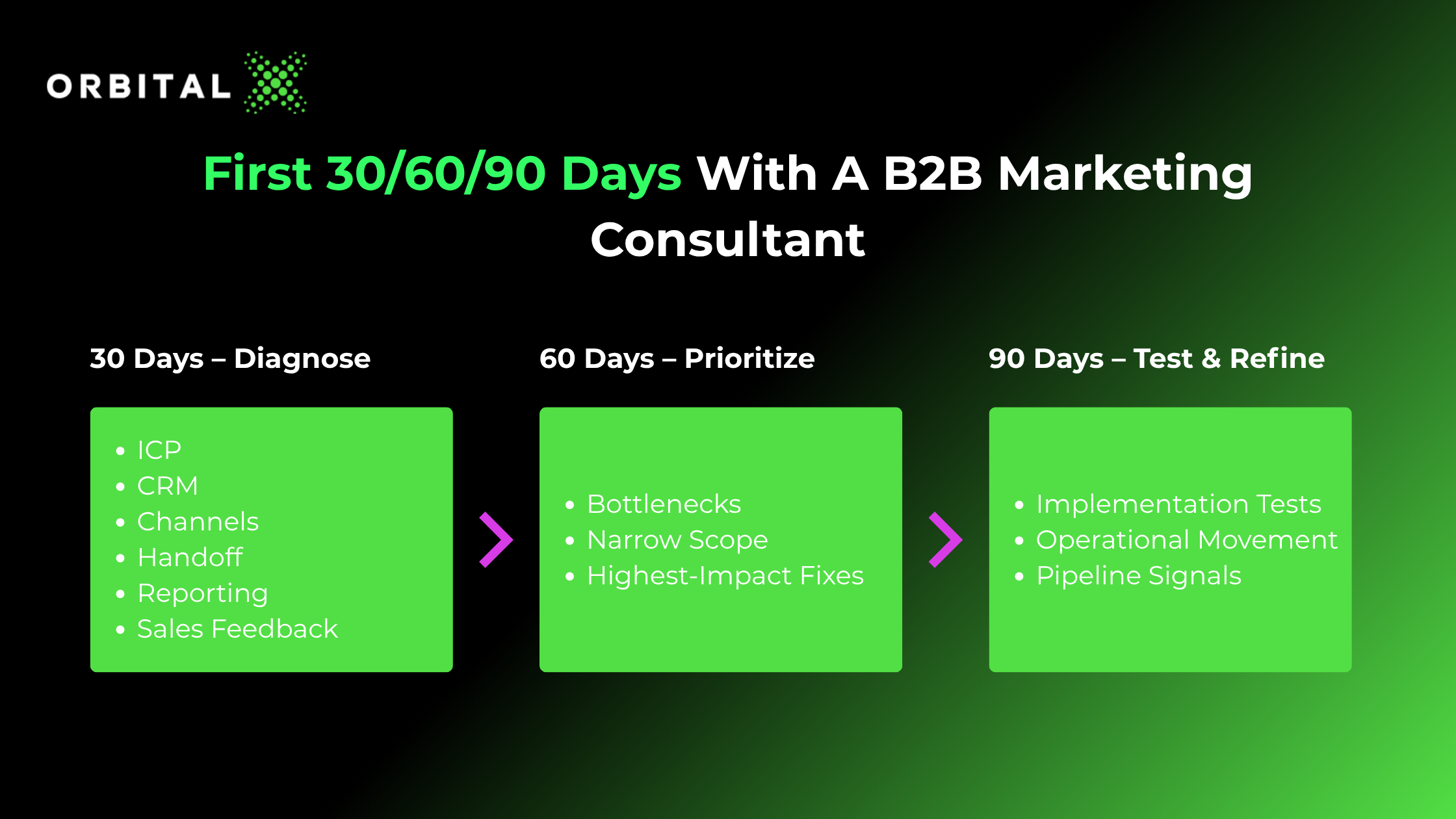 First 30 Days: Diagnose the Pipeline System
The first month should focus on evidence gathering: ICP, buyer personas, campaign data, CRM hygiene, attribution, sales feedback, funnel conversion, lead quality, and follow-up processes.
The output should be a clear diagnosis of where the system is breaking, which problems matter most, and which debates can stop.
Days 31-60: Prioritize Bottlenecks
The second phase should translate diagnosis into priority. That may mean narrowing the ICP, adjusting routing, rebuilding lead scoring, focusing on one or two channels, clarifying follow-up rules, or shifting measurement from MQL volume to account progression.
Don’t expect every issue to be fixed in 60 days. Expect fewer vague debates.
Days 61-90: Test, Measure, and Adjust
The third phase should test whether the diagnosis is correct through a sharper target account segment, a signal-triggered follow-up process, tighter CRM routing, buyer-readiness nurture, or a reporting view tied to pipeline movement.
By the end of this phase, the team should have clearer evidence about what improves pipeline quality.
How to Measure B2B Marketing Consultant ROI
In theory, B2B marketing consultant ROI should be easy to judge. Did qualified pipeline improve or not?
In practice though, it gets messy fast. A B2B marketing consultant may improve lead quality, sales acceptance, routing accuracy, or deal velocity long before those changes show up neatly in closed-won revenue.
The deck can be useful. The pipeline has to get better.
.png) Use a simple metric ladder:
Use a simple metric ladder:
Activity metrics: Traffic, impressions, clicks, downloads, email engagement, and form fills.
Operational metrics: Follow-up speed, routing accuracy, sales acceptance rate, marketing-qualified account (MQA) creation, meeting conversion, CRM data quality, and account prioritization.
Pipeline and revenue metrics: Qualified pipeline created, deal velocity, win rate, CAC efficiency, closed-won revenue, and marketing-sourced or marketing-influenced revenue.
Activity metrics explain what happened. Operational and pipeline metrics show whether the system’s actually improving.
When You Need More Than Advice: From Consulting to a Pipeline Operating System
Diagnosis is crucial, but it’s not always enough.
If the issue is disconnected data, weak signal interpretation, poor handoff timing, limited specialist bandwidth, fragmented execution, CRM data problems, and missing feedback loops, advice can leave the team knowing the problem but still unable to move.
Your team doesn’t need another advisory deck if signal interpretation, prioritization, execution, and learning still live in separate places. That’s how the same problem survives the next campaign, tool, and quarterly review.
That’s where OrbitalX steps in to clear the path forward. OrbitalX is a B2B performance marketing and demand generation partner with an AI marketing operating system plus expert operators for lean B2B teams that need better pipeline decisions without adding headcount.
Our DemandWEBS™ platform gives lean teams one operating layer for work that usually splits across tools, channels, and handoffs. It reads signals, identifies the audiences that matter, turns that intelligence into content and execution, and feeds results back into the next pipeline decision.
To discuss whether your pipeline problem needs a connected operating system plus expert operators, book a conversation with our team.
FAQs About B2B Marketing Consultants
What does a B2B marketing consultant do?
A B2B marketing consultant helps diagnose and improve how a company attracts, qualifies, and converts business buyers. The useful version goes beyond campaign advice. It explains why marketing activity is or isn’t becoming qualified pipeline, then helps the team prioritize what to fix first.
What is the difference between a B2B marketing consultant and a B2B marketing agency?
A consultant usually diagnoses, advises, and prioritizes. An agency usually executes campaigns or deliverables. The distinction can blur, so focus on the bottleneck. If you need diagnosis, hire for diagnosis. If you need delivery capacity, hire for execution. If you need both, look for a partner that can connect advice to pipeline action.
How much does a B2B marketing consultant cost?
B2B marketing consultant cost varies by scope, seniority, project length, and whether the work is advisory, fractional leadership, or execution support. Don’t judge cost in isolation. Judge it against the value of the bottleneck being solved, the internal time saved, and the pipeline improvement the work can realistically influence.
How do you know if you need more than a consultant?
A consultant may be insufficient if the problem is already clear but the team can’t act. Common signs include limited bandwidth, disconnected tools, weak handoff, messy CRM data, poor feedback loops, and too many buyer or account signals to interpret consistently. In that case, advice alone may stall.
More Resources

B2B Content Marketing Funnel: Stages, Strategies, and How to Build One That Converts
Build a B2B content marketing funnel that aligns content with buyer needs, connects the journey, and turns content engagement into pipeline and revenue.

B2B Referral Marketing: How to Build a Program That Drives Qualified Growth
Learn how to build a B2B referral marketing program that turns trusted relationships into qualified introductions, pipeline, and measurable revenue.

A PE-Backed Company Cut Marketing From 12 People to 3. Then Had Its Best Six Months Ever.
A marketing team cut from 12 to 3, then the best six months in the company's history. Here's the growth system behind it, and what it means for PE portfolios.