Building An Agile Demand Generation Strategy: The Social Chameleon of The Buyers Journey
Learn how to craft a fluid demand gen strategy that keeps pace with each stage a buyer moves through, from awareness to post-purchase.
Key Takeaways
An agile demand generation strategy must be like a social chameleon and adjust to the needs and buyer mindsets at different stages.
Demand generation and lead generation have a symbiotic relationship where the former feeds into the latter, so they need to complement each other.
Clearly connect the success of your demand generation efforts to revenue to justify the investment to your C-suite.
Demand Generation Is Not Lead Generation
If you've ever sat in a marketing meeting where someone used "demand gen" and "lead gen" interchangeably, you're right to feel confused.
The two are related but not the same thing, and confusing them is a fast way to build a strategy that underperforms on both fronts.
Demand generation focuses on building sustained interest across your target market, while lead generation converts that interest into identifiable, contactable prospects. Think of demand gen as the sales team’s yeast starter. It's top-of-funnel and mid-funnel activation that allows lead gen to “proof.” The resulting bake is higher conversion rates, shorter sales cycles, and leads who already understand and trust your brand before they ever fill out a form.
The two approaches need fundamentally different tactics, timelines, and success metrics. Demand gen is a long-term, ongoing investment in visibility and trust. It's measured by brand awareness, lead quality, account penetration, and customer lifetime value.
Lead gen, meanwhile, is more campaign-focused and measured by immediate outputs like form submissions, email sign-ups, MQLs, and cost per lead.
When companies skip the demand gen foundation and jump straight to lead gen, they often end up with high volumes of low-quality leads and wonder why their conversion rates are flat. CEO of The Legal Director Sarah Clark learned this firsthand when trying to get the word out about her company’s fractional services.
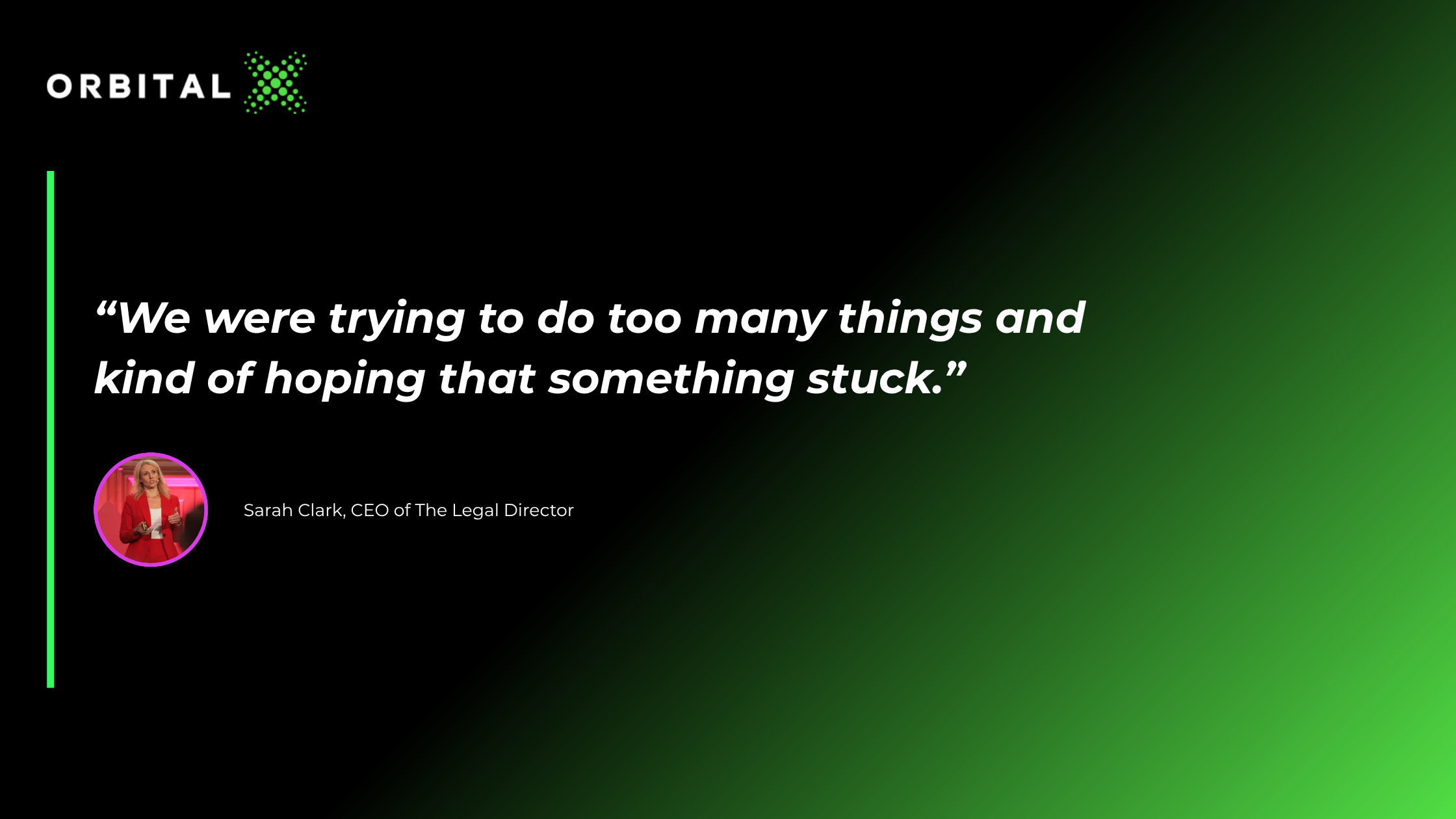
The two strategies don't compete; they compound. A strong demand gen strategy feeds lead gen a warmer, better-informed audience, which makes every conversion tactic downstream more effective.
Brand Awareness vs. Conversion
Some marketers think establishing brand awareness creates a straight shot to conversion. That’s about as reasonable as trying to clear a hedge maze by running straight through the walls.
At its core, demand generation is in the business of brand awareness, and brand awareness is in the business of shaping how potential buyers think about your offering. The goal isn't to get someone to click a CTA today; it's to make sure that, when they're finally ready to buy, your brand is the first one that comes to mind.
This requires a consistent presence across the channels your buyers use, whether that's LinkedIn, industry publications, search results, or events. You want your brand to feel ubiquitous and authoritative, not pushy or transactional.
Conversion is where demand gen hands off the baton to lead gen. Once your demand gen activity has educated, nurtured, and warmed up a prospect, they become far more receptive to conversion-focused tactics like gated content, demo requests, or direct outreach. These digital interactions are critical since they influence 70% of purchases, according to Forbes.
The mistake most companies make is trying to convert too early, before they've built the awareness and trust that makes conversion feel like the natural next step rather than a cold ask. A well-executed demand gen strategy helps conversion happen more organically because the buyer already believes in your solution before the sales conversation begins.
Lead Scoring
Lead scoring is a critical bridge between demand generation and lead generation, since it assigns point values to prospect behaviors and attributes to determine when a lead is ready to be passed to sales. It’s where the two strategies intersect operationally.
Your demand gen activities generate engagement signals like content views, webinar attendance, email opens, social interactions, and your lead scoring model turns those signals into a prioritized queue for your sales team.
A well-designed lead scoring system considers both behavioral signals (what a prospect does) and firmographic data (who they are) to ensure sales is always working the highest-probability opportunities. Factors like job title, company size, industry, budget authority, and demonstrated interest in your content all feed into the score.
Once a lead crosses a predetermined threshold, they transition from a marketing-qualified lead (MQL) to a sales-qualified lead (SQL) and enter a more direct conversion process. That means you need to set a high bar here so avoid wasting your sales team’s time with a flood of leads that passed only because you set your scoring too low.
Without well-honed lead scoring, demand gen and lead gen operate in silos, and you end up with either sales chasing cold contacts or marketing nurturing leads who were ready to buy six months ago.
The Four Stages of Demand Generation
A mature demand gen strategy is a continuous engine with four distinct stages that map to the buyer's journey:
Awareness: The goal here is to get your brand in front of the right people before they've even articulated a need.
Interest: Here, you deepen engagement with prospects who've shown initial curiosity about your category or solutions.
Consideration: At this point, you need to help prospects evaluate your offering against alternatives. This is the trust-building stage, so it should be heavy on social proof, case studies, and demos.
Decision: Finally, you convert intent into action with personalized outreach, tailored onboarding, and a frictionless purchase experience.
Each stage demands a different tactical approach, a different tone, and a different definition of success. An awareness campaign that's optimized for clicks rather than brand recall will fail. A consideration-stage touch point that leads with a product pitch rather than social proof will lose the prospect.
You want to win the demand gen game? Then your strategy has to shift and adapt as buyers move through these stages. The best demand gen tactics are built around the buyer's mindset, not the marketer's convenience.
How Demand Generation Wins
In the long term, demand gen not only fills the top of your funnel but also lowers overall spend. You may not see immediate gains when you’re dropping coin on building brand awareness (which is why you may be tempted to lean on lead gen to pacify your skeptical CFO), but over time, you’ll attract better leads, close more deals, and generate compounding returns to justify the initial investment.
Forrester has found that leaning fully into demand generation returns 50% more leads with 33% less spend. It also creates more durable customer relationships than those that rely primarily on outbound or paid lead gen tactics.
The clearest sign that a demand gen strategy is working is visible pipeline contribution. So, connecting your demand gen activity to revenue metrics isn’t optional. If your C-suite can't see a clear line between your content investment and your closed revenue, your budget is always at risk. The wins below are all ultimately revenue wins, they just arrive by different paths.
Greater Brand Awareness
While paid ads stop the moment the budget runs out, demand gen assets (i.e., content, webinars, case studies, thought leadership) continue to create impressions and build brand equity over time. That’s critical when nearly three-quarters (74%) of B2B buyers are researching half or more of their potential purchases online.
The more consistently you show up in the places where your buyers spend time, the more familiar and credible your brand becomes. And buyers who already know your brand are faster to respond, more likely to trust your claims, and less likely to need extensive persuasion before agreeing to a conversation.
Brand awareness also has compounding effects. Early-stage content that gets shared, linked to, or referenced in industry conversations continues to generate awareness long after it's published. Over time, this creates a body of work that positions your company as a go-to authority in your category. That’s the kind of moat that's very hard for competitors to copy quickly.
Honed ICP
When you generate demand at scale and track who engages the most with your content, requests demos, and ultimately converts to a customer, patterns emerge, and those patterns sharpen your understanding of who you should be targeting. This feedback loop makes your demand gen increasingly efficient over time: You stop wasting budget on audiences that’ll never buy and double down on the segments that consistently earn your best customers.
A refined ICP means better quality conversations, too. Your sales team spends less time disqualifying leads and more time talking to prospects who are genuinely ready to solve the problem your product addresses.
Increased Engagement from Leads
Leads generated through demand gen activities tend to be more meaningfully engaged than those captured through purely interruptive or transactional tactics. Because demand gen educates and nurtures prospects over time, leads qualify their own interest before they ever raise their hand.
This translates directly into higher engagement rates across the board, including higher email open rates, longer time-on-site, more questions in demo calls, and faster progression through the sales cycle.
Lower CAC
Customer acquisition cost (CAC) is one of the most important metrics a B2B company tracks, and demand gen is one of the most effective tools for cutting it. By warming prospects before they enter the sales process, demand gen shortens the sales cycle, which means less time and resources spent per deal. It also reduces the volume of leads who are unlikely to convert that burn sales capacity without producing revenue.
Feedback Loop That Drives Long-Term Growth
Arguably, the most powerful and least discussed benefit of demand generation is the feedback loop it creates.
Every piece of content you publish, every webinar you host, every campaign you run generates data: what topics resonate, which channels drive the most qualified traffic, which messages convert most effectively. That information continuously informs and improves your demand gen strategy, making each iteration smarter, more targeted, and more efficient than the last.
That’s why demand gen is a long-term investment, not a short-term tactic.
A program running for 18 months will outperform the same budget applied to a series of isolated campaigns every time.
.png) Demand Generation Strategies by Stage
Demand Generation Strategies by Stage
A demand gen strategy without stage-specific tactics is like a GPS without a destination: You're moving, but you're not going anywhere useful. Treat each stage of the buyer journey as its own distinct challenge. Give them tailored messaging, appropriate channels, and stage-matched success metrics. What works at awareness can actually harm you at decision. What converts at decision, meanwhile, could come off as an arrogant pitch at consideration.
Here's how to approach each stage strategically, including post-purchase support to hold onto those hard-earned contracts.
Awareness
This is where demand gen begins, and the primary objective is simple: Get your brand in front of the right people before they're actively looking for a solution. The challenge is, most buyers at this stage don't yet know they have a problem, or they do know but haven't prioritized solving it.
Your awareness tactics need to be educational, non-promotional, and genuinely useful if you want to break through the noise and earn attention from an audience that didn't ask for it.
AEO vs. SEO Content
SEO is important, but modern buyers are increasingly getting their information without ever clicking through to a website. Traditional SEO content aims for high search engine rankings to capture buyers who are already searching for solutions in your category. Answer engine optimization (AEO) takes this further, structuring content to appear in AI-generated answers, featured snippets, and voice search results.
For awareness-stage demand gen, a blend of SEO and AEO content is crucial, as more buyers begin their research through AI-assisted search rather than traditional keyword queries. This means writing content that directly and concisely answers the questions your buyers are asking, structured in a way that makes it easy for search engines and AI tools to pick out your brand as the authoritative answer.
Social Media Ad Campaigns
Don’t sleep on paid social, especially on LinkedIn for B2B. It lets you target audiences by job title, industry, company size, and even specific account lists.
At the awareness stage, social ad campaigns should prioritize reach and engagement over direct response. Don’t worry about getting clicks. The goal is to ensure your brand appears consistently in the feeds of your high-value leads and get them to associate your name with the problems they care about (in a good way).
Thought leadership content, short-form video, and insight-driven posts tend to outperform promotional ads at this stage, because they offer genuine value rather than a pitch. Video alone can increase website traffic by 84%.
Interest
At this point, a lead has engaged with your content, followed your company’s social media page, or visited your website. This is when demand gen gets more targeted. Now’s your chance to deepen engagement, demonstrate expertise, and begin building the kind of trust that’ll make the prospect open to a conversation when the time’s right.
The tactics at this stage are more resource-intensive than awareness, but they generate significantly higher-quality engagement. (Read: The greater the risk, the greater the reward.)
ABM (Account-Based Marketing)
ABM is non-negotiable when targeting high-value accounts. Rather than broadcasting to a broad audience, this approach concentrates your resources on a curated list of target accounts, delivering personalized content, messaging, and experiences designed to resonate with the specific challenges and priorities of each account.
At the interest stage, ABM meets buyers where they’re at, with content that speaks directly to their industry, role, and specific pain points. It makes your brand relevant rather than come off as generic or too sales-y. When done well, ABM improves company reputation, increases engagement rates and deal sizes, and accelerates the progression of high-value accounts through the funnel.
Personalized Email Campaigns
At the interest stage, it’s time to drop the broad email blasts and turn your attention to segmented, personalized sequences tailored to what a prospect has shown interest in. If someone attended your webinar on navigating international import duties, their next email should go deeper into that, maybe include a relevant white paper or video.
Personalization at this stage is about showing you paid attention, you understand where this prospect is at in their journey, and you have something genuinely useful to offer them. This kind of relevance sees higher open rates, click-through rates, and the overall quality of engagement, setting the stage for a sales conversation that feels like a natural continuation of an ongoing relationship.
Industry/Niche-Specific Webinars
Webinars are a powerhouse in B2B demand gen because they combine education, engagement, and brand authority in one format. These virtual events should create a shared experience that deepens the relationship between your brand and your audience, demonstrate your expertise in a way that static content can’t, and provide your team with rich engagement data that guides follow-up sequencing.
Group together targets in similar industries or with shared pain points and build webinars based on these characteristics. Discussing specific, relevant topics signals that your brand understands the nuances of your attendees' world, which is one of the fastest ways to build credibility with a skeptical B2B audience.
Consideration
Now, we’re cooking.
The consideration stage is where the purchase decision begins to take shape. It's also where many demand gen programs lose momentum because they don’t provide the right evidence at the right moment.
Buyers at this stage have already decided they need a solution and are deciding which one to choose. You’re being judged critically, so your demand gen strategy needs to shift from education to validation. Give targets the proof they need to confidently choose your solution over your competitors.
Build Trust Through Social Proof and Case Studies
Social proof is the currency of the consideration stage. So much so that it pushes over 92% of B2B buyers to close the deal. Testimonials, reviews, case studies, and peer recommendations all reduce the perceived risk of choosing you, and in B2B, risk reduction is often the deciding factor.
A well-crafted case study doesn't just describe what your product does; it tells the story of a buyer just like your prospect, facing the same challenges and achieving specific, measurable outcomes. Post success on your website, your social media pages, and even drop them in targeted emails. That’s the kind of reassurance a consideration-stage buyer needs.
Offer Product Demos
The product demo can be a powerful conversion tool, but only if it's positioned correctly. A demo offered too early (like at the awareness or interest stage) comes off as a premature hard sell.
At this point, though, after a prospect has been nurtured and educated, it feels like the natural (and welcome) next step. The key is to make your demo an extension of the conversation you've been having throughout the demand gen journey. Tailor it to the prospect's specific use case by using their own data in it, focus on the outcomes they care about, and design it to resolve any remaining objections or hesitations standing between them and a decision.
Intent
Here, behavioral signals like repeated site visits, pricing page views, content downloads, or direct inquiries tease that a prospect is moving toward purchasing. Since you’re almost at the finish line, your demand gen strategy should hand off to a more direct engagement approach. The quality of said handoff, though, depends entirely on the foundation built in earlier stages.
Follow-up Emails
Intent-stage follow-up emails are high-stakes communications that need to strike the right balance between urgency and respect. The target has shown clear buying signals, so your job is to acknowledge that, provide any remaining information they need, and make it easy for them to take the next step.
Keep these emails short, specific, and action-oriented. Mention the exact behaviors that triggered the outreach, such as booking an inquiry call with your sales team or running through a demo, then offer a clear, low-friction path forward to deal close. A prospect who viewed your pricing page three times in a week doesn't need another blog post; they need a straightforward invitation to have a conversation.
Personalized Video Messages
Personalized video breaks through the noise of competing voices in a way that text emails no longer can. Combining tailored messaging with an easy-to-digest format has proven to boost sales for 81% of marketers, according to Vimeo.
A 60-second video from a real salesperson that discusses specific details about the prospect's company and their apparent interest creates a human connection that can kick up your response rates by 19%. Instead of getting lost in automated sequences and AI-generated outreach, a genuine, personalized video message signals there's a real person on the other end who cares about this specific prospect, and that’s a powerful differentiator that can solidify the purchase decision.
Decision
The decision stage is where the deal is won or lost, and while much of the work has already been done by the demand gen engine, the final experience has a huge impact. The best demand gen strategies extend through the decision stage and into the post-purchase experience. Roll out the red carpet here, because a customer who has an exceptional onboarding experience becomes an advocate who fuels future demand generation through referrals and word-of-mouth.
Tailored Onboarding
A formulaic onboarding experience after a personalized, trust-building demand gen journey just feels like a betrayal.
Prospects who’ve been treated as flesh-and-blood individuals throughout their journey with you expect that same level of attention when they become customers.
Talk to your new customers one-on-one to establish expectations and timelines for integration. Structure each client’s onboarding around the specific goals, challenges, and use cases they discussed during these interactions and the sales process. Be sure to communicate openly and often, and offer training based on their preferences.
White-glove support shows your company's commitment didn't end at the contract signature. Providing this level of attention improves time-to-value, reduces early churn, and sets the tone for a long-term relationship. It also creates natural opportunities for upselling and expansion, because a customer who achieves their initial goal quickly is far willing to talk about doing more.
Brand Advocates
Every customer who feels genuinely taken care of becomes a potential advocate for your company. That means more credibility for you, and more social proof to convince future buyers. This is the ultimate output of a successful demand gen strategy.
Brand advocates extend your demand gen reach organically, generating awareness and trust in communities and conversations that your marketing team can’t on its own. Build an intentional advocacy program with reference programs, case study incentives, and community building to turn your best customers into your most powerful marketing channel. You’ll also get a bonus flywheel that compounds the returns of every other demand gen investment.
Stage | Objective | Recommended Tactics |
Awareness | Get the brand in front of the right people before they have prioritized or even articulated a specific need | * Thought Leadership: Blogs, social media posts, short-form video, and white papers optimized for SEO and AEO * Social Media Ads: Use platforms like LinkedIn to prioritize reach and brand association over direct clicks |
Interest | Deepen engagement with prospects by showing curiosity and demonstrating expertise to build trust | * ABM: Concentrate resources on a curated list of target accounts with highly personalized messaging * Personalized Emails: Use segmented sequences tailored to specific prospect behaviors, such as webinar attendance * Niche Webinars: Host virtual events that address shared pain points or specific industry nuances |
Consideration | Help prospects evaluate the offering against alternatives through validation rather than just education | * Social Proof: Highlight testimonials, reviews, and peer recommendations to reduce perceived risk * Case Studies: Tell success stories of buyers who faced similar challenges * Product Demos: Offer tailored demos that use the prospect's data to resolve specific objections |
Intent | Transition from demand generation to a direct engagement approach based on clear buying signals | * Action-Oriented Emails: Send short, specific follow-ups that mention exact behaviors (like pricing page views) that triggered outreach * Personalized Video: Send short, tailored video messages from sales reps to create a human connection |
Decision | Convert intent into action and ensure a frictionless purchase and onboarding experience | * Tailored Onboarding: Provide one-on-one sessions to establish expectations and training based on client preferences, and offer white-glove support * Advocacy: Use reference programs and community building to turn customers into marketing channels |
Key Demand Generation Metrics to Track
You can't manage what you can't measure. Name a marketer who doesn’t love that phrase.
The right demand gen metrics pinpoint what’s working and what isn’t, and connect your marketing activity directly to revenue. That’s crucial, because it gives your C-suite the visibility they need to justify continued investment and gives your team the feedback they need to continuously improve. Skip the vanity metrics like impressions and follower counts, as these create the illusion of progress without the accountability that drives results.
The following metrics help tell the complete story of how your demand gen program is performing across the full funnel, from the efficiency of your acquisition activity to the long-term value it creates.
Cost Per Acquisition (CPA)
Cost per acquisition measures the total cost of acquiring a new customer through your demand gen activities, from first touch to closed deal. It's one of the clearest indicators that your demand gen strategy is working. It also forces you to account for all the investment that goes into securing a paying customer, including content, media spend, team time, and tools.
A declining CPA over time indicates your demand gen strategy is maturing and compounding. You're attracting better-fit leads, closing them faster, and spending less to do it. Rising CPA, by contrast, is an early warning sign that something in the strategy needs to be adjusted, whether it's targeting, messaging, or channel mix.
Customer Lifetime Value (CLV)
Customer lifetime value measures the total revenue a customer is expected to generate over the course of their relationship with your company. In demand gen, CLV contextualizes your acquisition costs: A high CPA is sustainable if it's attached to a high CLV, while a low CPA is worrying if it's producing customers who churn quickly.
The most successful demand gen programs don't just optimize for acquisition; they attract the customers most likely to stay, expand, and advocate, which drives up CLV and makes every acquisition dollar go further. Track CLV by demand gen channel as well to reveal which ones net your best customers, not just the most.
Demand Generation Cycle Length
Cycle length is how long it takes a prospect to move from their first meaningful brand interaction to closed deal. This metric is particularly useful for evaluating the effectiveness of your nurture strategy.
A shortening cycle length suggests your demand gen content is doing a better job of educating and warming prospects, which translates to less sales effort needed to convert them. Conversely, a lengthening cycle length could indicate friction in the buyer's journey. Maybe content isn't addressing the right questions at the right stages, or handoffs between marketing and sales are happening too early or too late.
Lead Conversion Rates
Lead conversion rates track the percentage of leads that progress from one stage of the funnel to the next, from MQL to SQL, from SQL to opportunity, and from opportunity to closed deal. Monitor conversion rates at each transition point to pinpoint exactly where demand gen is working and where prospects are dropping off. This will give you a precise roadmap for where to invest your optimization efforts.
Low MQL-to-SQL conversion often means a targeting or lead scoring problem. Low SQL-to-opportunity conversion points to a messaging or timing problem. Low opportunity-to-close conversion signals an issue of trust or competitive positioning.
Pipeline Velocity
Pipeline velocity shows how quickly revenue flows through your demand gen pipeline. It combines deal volume and size, conversion rates, and cycle length into a single metric that reflects the overall health and momentum of your revenue engine.
A high pipeline velocity means you're closing the right deals quickly; a low pipeline velocity means there's friction somewhere in the system that's slowing down revenue. Assess pipeline velocity over time to determine whether strategic changes to your demand gen program are having the intended effect. This paints a clearer picture of the compound impact of improvements across multiple variables simultaneously.
Match Your Buyers’ Pace With a Smart Demand Gen Strategy
A great demand generation strategy isn't built in a quarter; it's carefully constructed through continuous iteration, disciplined measurement, and an unflinching commitment to meeting buyers where they’re at in their buyer’s journey. Resist the temptation to treat demand generation as a campaign and invest in it as a system instead. Successful strategies generate awareness, build trust, create a qualified pipeline, and see compounding results over time.
Go beyond optimizing within your existing markets and use the insights generated by your current demand gen activity to identify new segments to branch out to. As your understanding of your ICP deepens, new opportunities will emerge for targeted expansion that can accelerate growth without the cost and risk of broad, undifferentiated campaigns.
Adopt marketing automation, CRM integration, and AI-powered tools as well to do more with your team. Automation can handle the repetitive, rules-based work of lead scoring, email sequencing, data enrichment, and reporting to free your team to focus on the creative, strategic, and relational work. As your demand gen strategy matures, technology becomes the force multiplier that allows you to scale impact without adding headcount.
Demand gen isn’t a set-it-and-forget-it tactic, though. The channels, messages, and tactics that work today may underperform six months from now as competitive dynamics, buyer behavior, and platform algorithms evolve. Build a culture of continuous testing and rapid iteration into your demand gen strategy to sustain high performance and avoid early success followed by stagnation. Test headlines, formats, channels, timing, and audience segments, then let data drive your decisions rather than assumptions or convention.
If you’d like some help crafting a demand gen strategy that meets your targets at every stage, talk to OrbitalX, and let’s see what we can create together.
FAQs About Demand Generation Strategy
How is demand generation different from lead generation?
Demand generation focuses on top-of-funnel and mid-funnel leads. Its goal is to build brand awareness, educate your market, and create sustained interest in your product category. Lead generation is narrower and converts that interest into qualified prospects. Demand gen supports lead gen by delivering warmer, better-informed, higher-quality leads.
How long does it take to see results from a demand generation strategy?
Demand generation is a long-term investment, and the timeline for results varies depending on factors like your market maturity, content volume, channel mix, and sales cycle length. Most companies begin to see meaningful improvements within 60 to 90 days of launching a focused demand gen program. Pipeline impact typically becomes visible within three to six months, and the full compounding effect of a mature demand gen strategy often takes 12 to 18 months to materialize.
What's the difference between inbound and outbound demand generation?
Inbound demand generation uses content, SEO, social media, webinars, and other pull-based tactics to attract buyers who are actively seeking information. It brings them to your brand rather than interrupting them. Outbound demand generation uses targeted outreach in the form of paid ads, direct mail, personalized email sequences, and sales development activity to reach buyers who haven't found you on their own.
More Resources

B2B Content Marketing Funnel: Stages, Strategies, and How to Build One That Converts
Build a B2B content marketing funnel that aligns content with buyer needs, connects the journey, and turns content engagement into pipeline and revenue.

B2B Referral Marketing: How to Build a Program That Drives Qualified Growth
Learn how to build a B2B referral marketing program that turns trusted relationships into qualified introductions, pipeline, and measurable revenue.

A PE-Backed Company Cut Marketing From 12 People to 3. Then Had Its Best Six Months Ever.
A marketing team cut from 12 to 3, then the best six months in the company's history. Here's the growth system behind it, and what it means for PE portfolios.