B2B Marketing Funnel Guide: How Modern Funnels Actually Convert Buyers
Learn how to build a modern B2B marketing funnel with our no-fluff guide to connected, signal-driven systems that improve pipeline and revenue.
Key Takeaways
The modern B2B funnel isn't linear. Buyers jump across multiple channels, touch points, and decision-makers before ever talking directly to sales or marketing.
Top-of-funnel activity can be misleading. Most buyers enter your view already educated, pre-selected, or heavily influenced by external peers and review platforms.
Staged workflows are out; connected systems are in. The most effective setups continuously share data, signals, and context across marketing and sales in real time.
Stop collecting a checklist of endless tactics. Effective optimization is about finding the single biggest constraint in your funnel and fixing that specific breakdown to keep pipeline flowing.
More metrics won't save an inefficient system. Measurement only actually works when it highlights your performance gaps and explains exactly why the funnel is lagging.
The traditional B2B marketing funnel was built for a completely different internet. Remember the sound of dial-up internet? How it cut out if anybody used the phone in the house? That’s the time we’re talking about.
It assumed buyers moved in a straight, predictable line from awareness to consideration to decision, ending in a neat handoff to sales. That model worked beautifully when customer journeys were easy to track, gated content crushed it, and you controlled all the engagement.
But that's not the reality anymore. The buyer journey today is messy, fragmented, and entirely non-linear. James Ford, co-founder of OrbitalX, even notes that it now takes a staggering 80 touch points just to secure a meeting, and 266 to actually close a sale.
Think about that for a second. If you're still relying on old-school, rigid stages, you're essentially flying blind. Buyers are doing their own homework through online searches, AI tools, and peer communities long before they ever cross your radar. They enter the system pre-educated and ready to buy, turning traditional top-of-funnel tracking on its head.
The power of choice and access to information is in their hands. It’s now time we adapted to that in how we market to our ICP.
What Is a B2B Marketing Funnel?
The old-school B2B marketing funnel maps out the standard three stages of a buyer's journey: You have top-of-funnel (TOFU) for awareness, middle-of-funnel (MOFU) for consideration, and bottom-of-funnel (BOFU) for the final decision. It looks neat on a whiteboard.
But in the real world, this linear structure is getting completely upended by three massive shifts:
The funnel is already pre-filled before you even know the buyer exists. Prospects are self-educating through online searches, AI tools, and review platforms. By the time they finally touch your site, they've likely built a short list. Forrester even found that 68% of buyers lean toward a preferred vendor before sales ever joins the conversation.
Buying group marketing has officially replaced the lone MQL. You aren't selling to a single contact anymore. You're targeting an entire committee. Multiple stakeholders mean more internal friction, and 74% of B2B buying teams face “unhealthy conflict” during the purchasing process as a result.
Peer validation is your real decision driver. Buyers trust their networks way more than your landing page content. In a recent Reddit and SurveyMonkey survey of B2B buyers, 73% said they rely heavily on peer recommendations when evaluating tech vendors, ranking them far above search engines or social media. Buyers aren’t rubes who take your claims at face value. Instead, they’re turning to their peers to put them to the test.
.png) The Shift to a Connected, Looped Funnel
The Shift to a Connected, Looped Funnel
The old funnel was a factory line. The new version is more like a conversation. Many forward-thinking marketers base their funnels around a few core traits:
Connected: Systems share data in real time, turning fragmented signals into actionable insights that drive returns on investment. So, when someone visits your pricing page, the CRM logs it instantly, that same person later opens an email, and the activity is added to the same profile.
Sales sees both signals together instead of separately and so gain the full picture of a potential buyer.
Looping: Performance feedback informs continuous optimization across stages that can boost sales leads. For example, you run a LinkedIn ad campaign, see which companies actually turned into deals, adjust targeting based on that (not just who clicked on your ad), refine your messaging based on what moved deals forward, then feed that learning back into ads, emails, and sales outreach.
Rinse and repeat. The funnel becomes a living, evolving system based on new data.
Intent-driven: Focus shifts from volume to identifying and engaging high-intent prospects. In practice, that means you prioritize signals that show actual buying readiness (think: repeatedly visiting pricing pages, researching specific product features, engaging across multiple channels in a short time, showing company-wide activity not just one person).
When companies move beyond demographic approaches, they can see customer acquisition costs drop by up to 40% (among other benefits).
.png) Paula Chiocchi of Outward Media, Inc. sums up this shift nicely: “Buyers now enter, exit, and re-enter at multiple points across channels and devices…. [S]uccess comes from designing for continuous engagement — using data to recognize intent signals in real time and meet audiences where they are, not where the funnel says they ‘should’ be.”
Paula Chiocchi of Outward Media, Inc. sums up this shift nicely: “Buyers now enter, exit, and re-enter at multiple points across channels and devices…. [S]uccess comes from designing for continuous engagement — using data to recognize intent signals in real time and meet audiences where they are, not where the funnel says they ‘should’ be.”
How to Build a B2B Marketing Funnel in 8 Steps
Think of the modern funnel like a tour group. Some people stick close to the leader so they don’t miss a single piece of information. Some meander at their own pace, slowing down at certain points of interest while completely skipping others. And some prefer to do their own thing, wandering away from the defined path for a bit, only to return at the end. Basically, it requires structure without rigidity. Here’s how you build that kind of “fluid” funnel.
1. Define What "Conversion" Actually Means (Beyond Generating Leads)
You have to align marketing and sales on a shared definition of success. Focus heavily on revenue here, as both teams need to measure progress the exact same way.
Agree on one primary standard. That means focusing on metrics that matter like:
Sales-qualified opportunities (SQLs) that sales actually accepts.
Pipeline created from real opportunities, not just raw leads.
Closed-won revenue as your final measure of success.
Without this alignment, “marketing hits their ‘lead’ or SQL or ‘pipeline’ target but Sales misses quota by 30-50% because nothing from marketing actually closes,” writes Chris Walker, founder and former CEO of Refine Labs.
2. Map the Full Buyer Journey as One Continuous Flow
Start tracing how your buyers actually move in the real world. Forget your artificial internal funnel stages. Look at their real behavioral patterns from first touch to research, comparison, validation, and final purchase.
Then, audit the system to see where it breaks down:
Where prospects drop off entirely
Where your messaging shifts or feels inconsistent
Where channels fail to pass critical context forward
Spot those moments where the experience stops feeling seamless. Most funnels underperform because separate teams own disconnected stages. But, as Josh Bouk, co-owner and CEO of Americas at Blend, explains, “[Y]our buyer doesn't experience your business in stages. They experience it as one continuous relationship. When marketing goes dark the moment an opportunity is created, you're making your whole revenue engine slower than it needs to be.”
3. Align Messaging Across Every Touch Point
Since you can’t do a trust fall with every single lead, try continuity instead to build a connection. Reinforce the exact same core promise at every single stage. Your ads, landing pages, email sequences, retargeting, and sales outreach need to reflect a single narrative.
If someone clicks an ad for a specific outcome, the landing page needs to expand on that exact promise. Follow-up emails and SDR outreach must continue the same thread instead of throwing a generic angle at them.
As Tas Bober, founder of Scroll Lab, puts it bluntly,“‘We’ll figure out the landing page later’ is why your campaign underperformed.”
4. Connect Your Systems So You Can Actually See Behavior
You need full visibility across the entire journey. Set up your tools so behavior connects across channels instead of getting trapped in silos. Link your website activity (especially high-intent pages like pricing or product comparisons), CRM data, email engagement, and ad interactions.
Stop treating each signal like an isolated event. A Niselen study on marketing measurement insights showed that 62% of marketers use multiple non-integrated or inadequate attribution tools. This prevents them from truly understanding complex, cross-channel journeys. Without visibility, you're optimizing individual touch points in the dark.
5. Introduce Intent Signals Into Prioritization
Not every lead carries the same level of buying readiness. Identify and weigh the specific signals that correlate with actual purchase intent. Look for repeated visits to pricing pages, product comparisons, case studies, or integration pages. Track engagement from multiple stakeholders within the same account.
This is account-based marketing’s (ABM) time to shine. Instead of monitoring one person, ABM highlights when an entire company researches your solution. You can utilize tools and data from a descriptive intent data platform to stay on top of these B2B signals.
Prioritize accounts showing active buying behavior. Companies that prioritize lead quality see close rates of up to 40%, while those working with unqualified leads convert at around 11%, according to Leads at Scale.
.png) 6. Fix Dead Ends in the Journey
6. Fix Dead Ends in the Journey
Take inspiration from water. Map every interaction so it flows logically into the next step. Don't let momentum stall. Every touch point should feel like real progress toward a decision:
A content download triggers relevant follow-up material like a deeper case study.
A pricing page visit connects to clear proof points or objection-handling content.
A webinar attendee moves straight into a targeted nurture track or timely sales outreach.
The goal, again, is continuity. More specifically, Tom Arduino, CMO of Chief Outsiders, says “[I]t’s about enabling their journey, building trust at every touch point, and creating momentum that doesn’t stop at the point of sale.” When a touch point doesn’t naturally lead forward, intent gets lost and conversion breaks down.
7. Use Feedback From Closed-Won Deals to Refine Everything
Don't design your marketing funnel based on pure guesswork. Look closely at the deals you've already won. Figure out exactly how those buyers found you, what they did before buying, and the signals they dropped along the way.
Then, use those insights to refine everything:
Alter targeting based on real buyer profiles.
Sharpen messaging around proven conversion drivers.
Adjust ad strategy to mirror high-intent patterns.
Align sales outreach with what actually influenced decisions.
Turn your funnel from a static model into a feedback system by employing closed-loop attribution methods to make every deal highly predictable.
8. Time Your Engagement Based on Buyer Readiness
Design your system around where the buyer is in their decision process. Stop pushing the same generic message everywhere. Match your focus to their exact stage:
Funnel Stage | Focus | Goal |
Early Stage | Relevance and education | Help buyers understand the problem and your category |
Mid-Stage | Validation | Build trust through case studies, comparisons, and real outcomes |
Late Stage | Direct activation | Drive action through sales outreach, tailored offers, and deal-specific messaging |
Timing is absolutely everything. Buyers don't move in perfect sync, so adapt to intent instead of relying on uniform volume pushes. “The best media strategies today aren’t just efficient,” said Nick Rogers, VP of media strategy at The Variable. “They’re designed to inform what’s next instead of reporting on what happened.”
How to Optimize Your B2B Marketing Funnel
Adding more tactics to a broken funnel only puts a bandaid on a gushing wound. True optimization focuses on identifying exactly where performance breaks down and fixing the specific constraint that limits your pipeline.
Anna Orestova, founder of LamparaLab, found that B2B SaaS leaders often assume growth breaks down at the acquisition stage. “But when I pull the data, marketing analytics, CRM, and support data, the picture is usually more complicated,” she said. “What's broken is somewhere in the middle or the end: conversion, onboarding, retention.”
Optimization must always start with a simple question: Where are we actually underperforming?
Use Performance Gaps to Diagnose Your Funnel
Instead of looking at your funnel stages in isolation, compare how each step converts relative to the one right before it. This turns your funnel into a powerful diagnostic system where every major drop-off has a specific fix.
High traffic but low engagement points directly to a targeting or positioning inaccuracy.
Strong engagement but low conversion signals a bad offer, a weak call to action, or deep journey friction.
A healthy pipeline but a low close rate usually indicates an expectation mismatch or a qualification problem.
Optimize by Constraint, Not Checklist
Once you pinpoint the gap, focus exclusively on the variables that influence that exact stage. Forget trying to broadly improve the funnel all at once; you want to remove the single biggest bottleneck, starving your revenue:
If you’re facing conversion gaps, test your offers, your calls to action, and the clarity of the next step.
For mid-funnel drop-off, improve your follow-up speed and the relevance of your content.
When you encounter late-stage inefficiency, refine your qualification filters and tighten your sales alignment.
Take the team at Levanta, for example. They had killer top-of-funnel metrics but incredibly weak pipeline conversion. Instead of rebuilding the whole funnel, they isolated the performance drop between engagement and meetings.
They uncovered two massive constraints: delayed follow-up times and inconsistent messaging between marketing and sales. By prioritizing high-intent signals and aligning outreach across channels, their number of booked meetings skyrocketed eightfold. Optimization came from fixing what was already there.
Post-Purchase Signals Impact Funnel Performance
Most B2B funnels stop measuring at “closed-won,” but performance doesn’t end there (this isn’t marriage, after all). Post-purchase experience (onboarding, adoption, retention, and expansion) feeds directly back into acquisition efficiency and pipeline quality. In fact, Bain research shows that increasing retention by just 5% can increase profits by up to 95%, underscoring how onboarding and retention directly strengthen overall acquisition economics.
When customers don't find value fast or churn early, it kills sustainable growth. You lose out on easy upsells, miss highly valuable referrals, and force your team to spend more capital just to replace lost revenue. Over time, this drags performance metrics down and makes your customer acquisition cost look artificially high. Exceptional retention fixes this by amplifying your marketing results for free.
Art Bullard, a veteran tech executive, hits the nail on the head: “The companies that outperform long term don’t treat care as a cost center or a safety net. They treat it as a signal — of customer health, product gaps, and future revenue.”
Pro tip: OrbitalX's DemandWEBS™ can help you build a strategic, multi-channel journey grounded in your story and driven by what matters most to your audience.
Measuring B2B Marketing Funnel Success
You don’t need to take down every single number you can find. The point is to track the specific metrics that reveal exactly where your funnel is inefficient. Optimization gives you the fix, but measurement is what makes the initial diagnosis possible. You wouldn’t fix a cracked house foundation without checking the ground layer first, right?
Measure Progression, Not Just Activity
Traditional volume metrics like surface-level traffic and raw lead counts are misleading. They show size, but they don't tell you if your funnel is actually working. You need to look at how efficiently prospects move forward from one stage to the next.
Every metric you watch should answer a clear question: Where are we losing people? Where are we slow to act? To get a clear picture, focus on these five core metrics:
Metric | What It Shows |
Visitor → qualified lead rate | Whether traffic is turning into real opportunities |
Signal → meeting conversion | How effectively intent translates into sales conversations |
Funnel velocity | Delays between stages that slow pipeline creation |
Engagement depth | The difference between low-intent activity and meaningful buying behavior |
Multi-touch revenue attribution | Which interactions actually influenced conversion |
Fractional CFO Ivan Pershin is confident that “[t]he right metrics are not the ones that look comprehensive. They are the ones that change how you make decisions.” Without that lens, measurement becomes straight reporting instead of helpful insight.
What to Deprioritize
Toss out the metrics that don't connect to pipeline performance. They create an immense amount of noise. Stop stressing over traffic volume without a qualification context or MQL counts without conversion tracking.
The same goes for surface-level engagement metrics that lack clear downstream pipeline impact. These numbers frequently look incredibly healthy even while the funnel completely underperforms. Measure only what helps you decide what to fix.
Essentials to Get Right
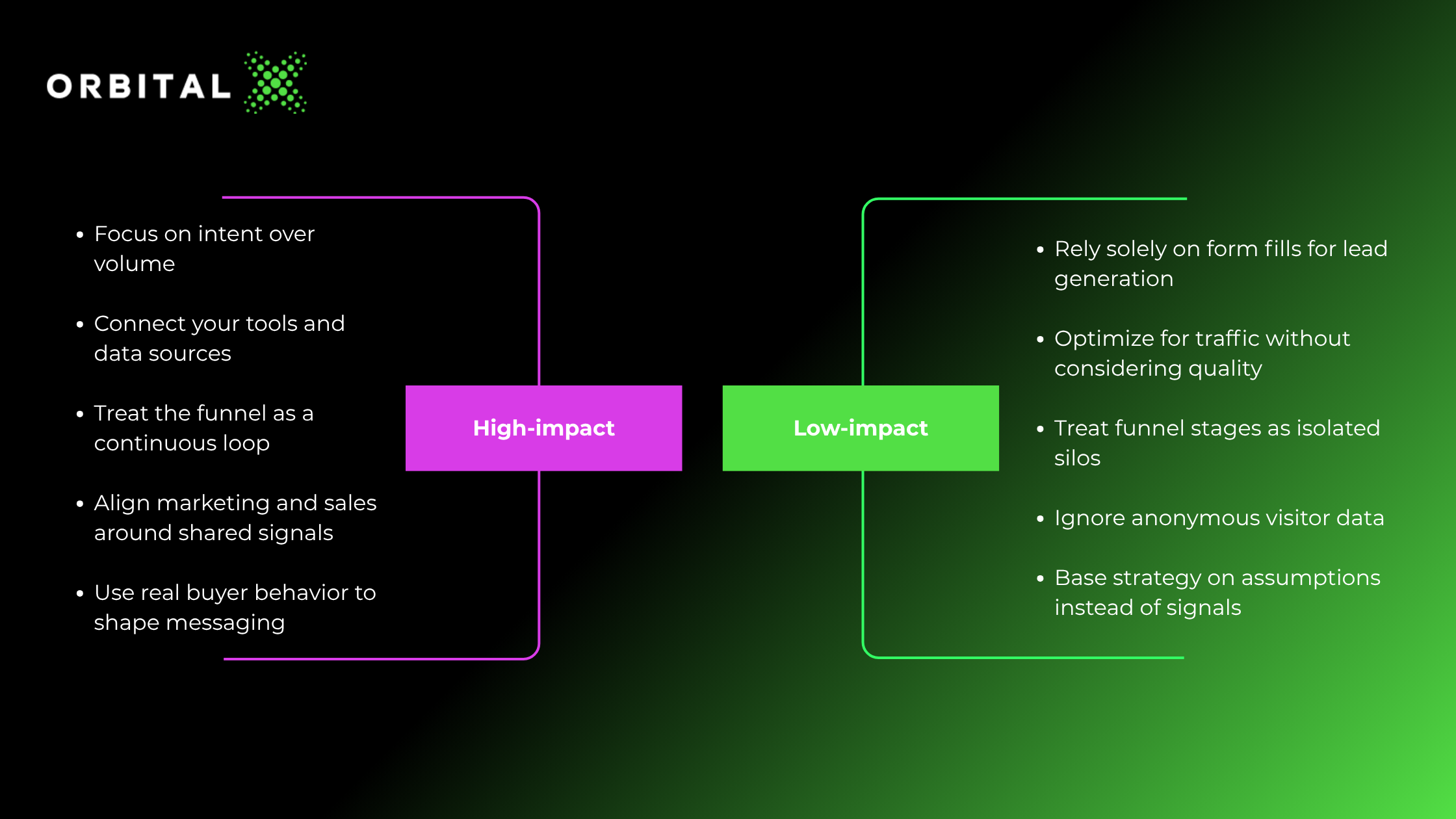
When building a high-performance system, it helps to separate the high-impact strategies from the low-impact traps.
High-Impact Focus Areas:
Prioritize intent signals over raw lead volume.
Connect your tools and data sources into a single view.
Treat the entire funnel as a continuous loop, not a linear track.
Align marketing and sales around shared account signals.
Use actual buyer behavior to shape your campaign messaging.
Low-Impact Pitfalls to Avoid:
Relying strictly on form fills for lead generation.
Optimizing for traffic numbers without considering lead quality.
Treating your standard funnel stages as isolated silos.
Ignoring anonymous visitor data that hits your site.
Basing your marketing strategy on guesses instead of real signals.
 The Shortest Point Between You and Your Leads Is Not a Straight Line
Today's B2B marketing funnel isn't broken or dead, no matter what your LinkedIn feed tells you. It's just outgrown its original design. The internet changed, and buyer behavior shifted with it.
Moving to a connected, AI-driven approach transforms your funnel from a rigid pipeline into a living loop. This kind of system gives you a full view of the journey. It allows your team to get results by:
Spotting real buyer demand much earlier in the cycle.
Engaging complex buying committees way more intelligently.
Using continuous feedback to improve your performance month over month.
That simple shift from isolated stages to an integrated loop is what separates funnels that just generate random activity from those that build revenue. You begin to execute with true precision.
At OrbitalX, we help you remove pipeline friction and tie every single buyer signal back to revenue. Ready to build a demand engine that actually works?
Let's chat. Book a call with us today.
FAQs About B2B Marketing Funnels
How do B2B marketing funnels differ from sales funnels?
Marketing funnels focus on building initial awareness, educating entire accounts, and creating demand before sales ever gets involved. A sales funnel is all about converting those qualified opportunities into closed revenue through specific, structured deal stages. Marketing fills the engine with pipeline, while sales drives win rates and handles final execution.
How do you align sales and marketing around the funnel?
Stop counting raw lead volume and unite both teams through shared revenue goals instead. Build a unified framework with clear stage ownership, integrated tech stacks, and common intent data. Marketing and sales need to co-own pipeline targets, run tight SLAs, and continuously look at conversion data to fix messy handoffs.
How long does it usually take for a B2B marketing funnel to deliver results?
You'll see early signals like account engagement and intent spikes within four to eight weeks. Real pipeline begins forming in two to three months, with repeatable impact showing up around month six. Gaining full, reliable revenue attribution typically takes 6 to 12 months or more, depending heavily on your deal complexity and sales cycle length.
Which funnel models are most effective for B2B compared to B2C businesses?
B2B requires account-based and buying group models that reflect non-linear, multi-stakeholder decisions. It keeps the focus entirely on long-term pipeline and revenue instead of quick impulses. B2C environments thrive on linear models like AIDA because they are optimized for individual decision-making, faster cycles, and volume-based conversion efficiency from awareness to purchase.
More Resources

B2B Content Marketing Funnel: Stages, Strategies, and How to Build One That Converts
Build a B2B content marketing funnel that aligns content with buyer needs, connects the journey, and turns content engagement into pipeline and revenue.

B2B Referral Marketing: How to Build a Program That Drives Qualified Growth
Learn how to build a B2B referral marketing program that turns trusted relationships into qualified introductions, pipeline, and measurable revenue.

A PE-Backed Company Cut Marketing From 12 People to 3. Then Had Its Best Six Months Ever.
A marketing team cut from 12 to 3, then the best six months in the company's history. Here's the growth system behind it, and what it means for PE portfolios.