Top 2026 B2B Marketing Strategies To Try: AI Personalization, Video Funnels, and More
A breakdown of 2026 B2B marketing strategies, from AI personalization and intent data to video, communities, and revenue-focused growth.
Key Takeaways
B2B marketing has shifted from strict lead generation to demand creation. We're moving away from catching names and focusing on intent signals. Success is now measured by pipeline and revenue impact rather than MQLs.
AI-supported hyper-personalization drives real engagement. Using a name in an email isn’t enough anymore; you have to tailor messaging and content in real time based on behavioral data.
A huge share of B2B buying decisions happens in private "dark social" communities. Trust is built where marketers can't always see it, and that’s pushing brands toward community-led growth strategies.
Video is now a full-funnel content format. It's moving beyond top-of-funnel awareness to support decisions and build trust, becoming the standard for cutting-edge teams.
High-performing teams are unifying marketing, sales, and RevOps. Everyone is focused on revenue outcomes like pipeline velocity and CAC efficiency. Siloed metrics are a thing of the past.
How B2B Marketing Is Entering a New Growth Era
“Don’t call us. We’ll call you,” has become the message of the day. There’s a power shift happening in the B2B industry, and buyers are fully embracing it. Saying it exactly how it is, buyers do not want to hear from any vendor or sales team until the very last moment.
Purchasing groups are expanding, averaging 13 internal stakeholders. These groups complete a massive portion of their research before ever reaching out to a sales rep. This means your B2B marketing strategies have to do the heavy lifting early. Successful strategies emphasize tailored experiences and engagement guided by prospect behavior.
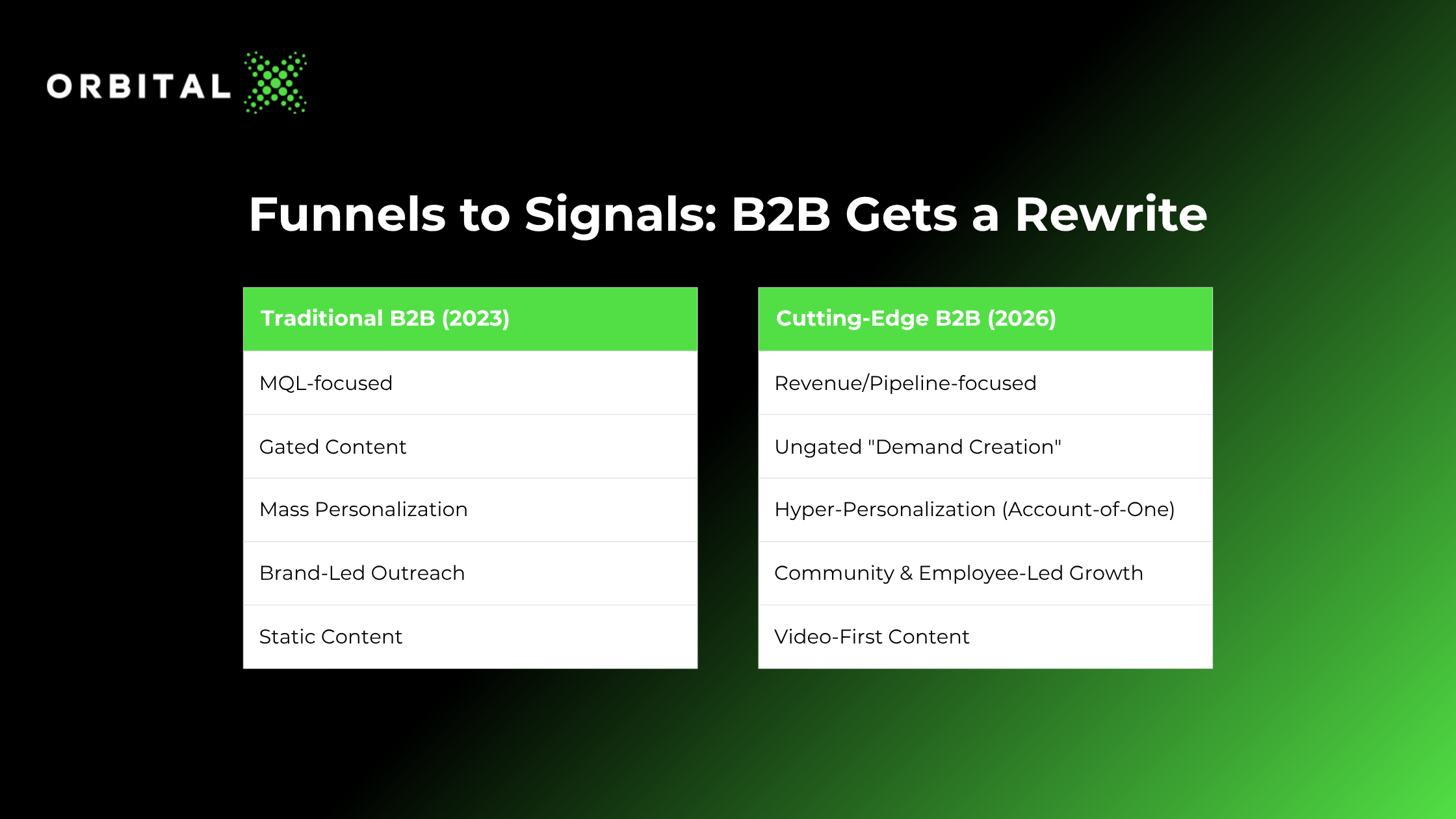
We're seeing a rewrite of the traditional funnel. A few years ago, gated content and brand-led outreach were in vogue. In 2026 though, the focus is on ungated demand creation and human-led (i.e., face to face) growth. Marketers need to be a helpful peer rather than a broad outreach machine.
Instead of waiting for someone to raise their hand, B2B marketing now focuses on shaping demand before buyers ever identify themselves. The best marketers have shifted beyond lead generation to build demand through AI-enabled systems, credibility-led messaging, and community-focused approaches.
 What Makes a Successful B2B Marketing Strategy Now
Any winning strategy today starts with a razor-sharp ICP. Without it, you're just throwing pasta at the wall and hoping it sticks. Demandbase survey data shows more than half of marketers consider advertising waste a serious problem. In fact, many estimate that up to 45% of their ad spend goes to accounts that aren't even in their target market.
A successful strategy is a customer-centric, data-driven framework designed to engage entire buying committees. You can't just sell to one person anymore. You need to reach the whole room through personalized, multi-channel content that actually teaches them something.
This system utilizes tactics that build trust over long, complex cycles. Use LinkedIn and social selling to engage decision-makers directly where they already hang out. Combine this with automated, personalized email series to guide prospects who aren't ready to buy immediately.
.png) What Works in Modern B2B Marketing Strategy and Execution
What Works in Modern B2B Marketing Strategy and Execution
The era of guessing what your buyers want is over. Here are the top five strategies defining execution in 2026:
1. AI-Powered Hyper-Personalization at Scale
AI has moved past being a chemistry class experiment. It’s now the core operating layer for marketing. Nearly three-quarters of consumers and B2B buyers expect the organizations they engage with to understand when, where, and how they want to receive personalized interactions, according to Forrester and Adobe.
Leading teams have AI analyze thousands of data points to customize every single touch point. Some are even using multi-agentic systems to create and test innovations in hours rather than weeks.
Sandler, a global sales training company, is a great example. They used AI to split their content paths for managers and individual reps. By highlighting specific pain points for each role, they saw a 25% lift in engagement and four times more SQLs. But don't just add tech for the sake of it. As Bianca Bass, CMO of Privalgo, says, "Think more clearly, more independently, more critically."
2. "Dark Social" and Community-Led Growth
Remember “the cool kids” when you were a teenager and how relieved you were when you got out of school thinking you’d never have to deal with them again? Well, they’re making a comeback.
Buyers are talking in private spaces like Slack, Reddit, and closed LinkedIn groups (and wearing pink on Wednesday isn’t enough to get you a seat at the table). This "dark social" is where recommendations actually happen. In these spaces, peers share experiences that strongly influence purchasing decisions through modern word-of-mouth.
Whitehat data shows that B2B communities help companies spend about 32% less to acquire customers. People in these communities also become customers more quickly than standard leads, and referrals or word-of-mouth from the community lead to about 22% more conversions.
.png) Smart brands are building their own spaces rather than just pushing one-way messages (“If you build it, [they] will come,” right?). Spendesk, for instance, built CFO Connect on Slack for finance leaders. They created a private ecosystem where CFOs could exchange insights, benchmark decisions, and foster peer trust.
Smart brands are building their own spaces rather than just pushing one-way messages (“If you build it, [they] will come,” right?). Spendesk, for instance, built CFO Connect on Slack for finance leaders. They created a private ecosystem where CFOs could exchange insights, benchmark decisions, and foster peer trust.
The Slack group became an always-on peer network of more than 12,000 executives supported by events and roundtables, generating high engagement and indirect product awareness without sales pressure. Instead of selling, they focused on peer trust and shared insights. This resulted in an always-on network of 12,000 executives and massive credibility for the brand.
3. Video-First Content Across the Full Funnel
Static content is fading away. Our attention spans are shorter and shorter. It’s almost frightening to consider where they’ll be in a few years from now. Back to the point…
Short-form video now serves the entire buyer journey. Eighty-two percent of marketers say video delivers a strong ROI, making it the highest-performing format.
A systematic approach might use short-form clips derived from webinars, customer interviews, or product manuals at the top of the funnel. This helps focus the message around single pain points or needs rather than broad brand messaging. These video “micro-answers” perform best on channels like LinkedIn because they meet intent mid-scroll with immediate relevance.
Videos on LinkedIn can be pretty powerful … when done right:
Native video is LinkedIn's fastest-growing format, driving up to two times more engagement than text-only posts.
The platform’s algorithm rewards native video and "dwell time" (how long someone watches). It also sidelines content with outbound links, losing up to 30% organic reach.
Videos should be shared via team members' profiles for maximum impact since personal profiles are spoiled with 65% of feed allocation (meanwhile, company page organic reach plummeted about 60%–66% over the past two years).
Early interaction is critical. Responding to video comments within the first 15 minutes of posting triggers an algorithmic boost during the crucial first hour of distribution.
Focus on "edutainment" (educational content backed by humor or storytelling). Include subtitles as well since most users watch videos with the sound turned off.
Short-form vertical videos (30 to 90 seconds) are best for top-of-funnel discovery because they’re heavily boosted by LinkedIn's TikTok-style feed. In the middle of the funnel, shift to implementation walkthroughs and comparison videos to reduce perceived risk. Finally, at the bottom of the funnel, use personalized outreach videos, customer proof stories, and onboarding walkthroughs to build trust and close deals faster.
As Kerry McDonough of Zip Co puts it, “Every video should drive to a key page or asset where buyers can go deeper and take the next step.”
From Scroll-Stoppers to Deal-Closers
Funnel Stage | Video Type | Core Purpose | Content Sources | What It Does |
Top of Funnel (Awareness) | Short-form “micro-answers” clips | Capture attention around specific pain points or objections | Webinars, customer interviews, product walkthroughs | Cuts through noise with highly relevant, scroll-stopping insights on LinkedIn; focuses on one problem at a time rather than brand messaging |
Middle of Funnel (Consideration) | Decision-support videos | Reduce uncertainty and build evaluation confidence | Product explainers, implementation walkthroughs, comparison videos | Helps buyers assess fit; prioritizes clarity over production quality as prospects actively compare solutions |
Bottom of Funnel (Decision) | Trust-building video | Accelerate final purchase decision | Personalized outreach videos, customer proof stories, onboarding walkthroughs | Makes value tangible and human; builds trust and shortens the final decision cycle |
4. Intent Data and Behavioral Trigger Automation
Why waste time twiddling your thumbs waiting for a form fill?
B2B marketing strategies rely on intent-driven lead generation, where advanced monitoring identifies when prospects are actively researching solutions. A recent benchmark study from Optifai of 939 B2B companies found that responding to leads within five minutes resulted in a 32% close rate, while waiting more than 24 hours reduced close rates to just 12%.
Hone in on high-intent account behavior across your site, map it to buying signals, and trigger immediate outreach that shows you’re aware of the problem your prospect is trying to solve. The advantage is response speed: High-performing teams collapse the gap between signal, context, and action while intent’s still active.
5. Revenue Marketing and "Demand Creation"
Optimizing for MQLs as a primary success metric is how you find yourself looking for a new job. High-performing B2B teams now operate on shared revenue ownership, where marketing, sales, and RevOps are measured against pipeline creation, conversion efficiency, and closed-won revenue rather than top-of-funnel volume.
According to Forrester, B2B companies with strong sales and marketing alignment achieve 2.4 times faster revenue growth and twice the profit growth, underscoring the financial impact of unified go-to-market execution.
This shift reframes marketing from a lead generation function into a demand system: identifying in-market accounts, increasing category relevance before intent fully surfaces, and accelerating conversion once intent signals appear. Instead of focusing on MQL handoffs, teams are increasingly designing around account-level demand signals, real-time intent data, and sales activation speed.
OrbitalX uses their proprietary DemandWEBS™ framework to turn fragmented channels into a live revenue engine. By unifying webinars, email, and social around account signals, they compress 30- to 60-day nurture cycles into minutes. It's about moving faster on signals to create a continuous growth loop.
Measuring Your B2B Marketing Strategy for ROI
You live long enough to become the hero, or you get shot down in flames. That’s marketing now, in the hyper-measurement era!
Measuring ROI today requires going beyond surface-level lead counts. You need a connected system of performance signals that show how revenue is actually created.
Research from firms like Gartner and Forrester shows high-performing teams are evaluated on efficiency and revenue impact. As Penry Price of Charcoal Advisors notes, “Measurement is one of these key areas where executives have to focus on establishing the right metrics, not look at those short wins.”
Evaluate your strategy through these core metrics:
Pipeline Velocity: This tracks how fast leads move through your sales cycle. A strong strategy creates demand while reducing friction between stages. When pipeline velocity increases without deal quality dropping, it means marketing and sales are finally in sync.
Customer Acquisition Cost (CAC): This is your efficiency lens. Focus less on the absolute spend and more on how efficiently that spend turns into revenue. The goal is to optimize spend toward channels that produce high-value customers with sustainable payback periods.
Lead-to-Close Ratio: This metric grounds your work in quality. It reveals if your targeting and messaging are aligned with actual buyer readiness. If this ratio is weak, no amount of top-of-funnel volume can fix the underlying problem.
ACV of Marketing-Sourced Deals: Tracking annual contract value (ACV) shows if you're bringing in high-value opportunities or just volume. Larger deals validate your strategy. Smaller ones may signal issues with your targeting or positioning.
LTV of Marketing-Sourced Customers: Lifetime value (LTV) shows if you're attracting customers who stick and grow. Low LTV usually means a poor fit, which leads to churn and wasted spend. High LTV indicates strong targeting and profitable, durable relationships.
Stay Ahead of the B2B Marketing Strategies Curve
Whether we like it or not, the ball is in the buyer’s court. But just because they haven’t passed to you yet doesn’t mean we should stand with our hands in our pockets like we’re waiting for a bus.
B2B marketing is moving toward systems that spot demand early and respond to it in real time. The most effective strategies combine AI-driven personalization, intent data, and community influence to engage buyers long before they ever talk to sales. Success now depends on teams aligning around shared revenue outcomes rather than checking a box for siloed marketing metrics.
The best strategists move faster on signals and create relevant experiences across every channel. They treat marketing as a continuous demand generation system instead of a string of isolated campaigns. OrbitalX turns fragmented buyer signals into a connected system that smooths the path to pipeline. Book a call to see how our DemandWEBS™ framework can help your business grow.
FAQ
How can marketing and sales work together in B2B?
Teams must align on target accounts, shared goals, and messaging. Marketing uses content and data to attract high-intent prospects, then passes them to sales. Sales provides feedback on lead quality so marketing can refine campaigns. This loop improves conversion rates and creates a seamless buyer experience.
How does B2B marketing differ from B2C?
B2B buying cycles are much longer because they involve higher costs and more decision-makers. B2B content prioritizes logic, ROI, and business value over pure emotional appeal. It also uses an account-based approach to focus on high-value organizations instead of broad audiences.
What are the most common B2B marketing mistakes?
Failing to define a clear ICP is a major error that leads to wasted budget and low-quality leads. Misalignment between sales and marketing teams also kills efficiency. Finally, underusing social proof like case studies weakens your credibility and slows down trust building.
More Resources

B2B Content Marketing Funnel: Stages, Strategies, and How to Build One That Converts
Build a B2B content marketing funnel that aligns content with buyer needs, connects the journey, and turns content engagement into pipeline and revenue.

B2B Referral Marketing: How to Build a Program That Drives Qualified Growth
Learn how to build a B2B referral marketing program that turns trusted relationships into qualified introductions, pipeline, and measurable revenue.

A PE-Backed Company Cut Marketing From 12 People to 3. Then Had Its Best Six Months Ever.
A marketing team cut from 12 to 3, then the best six months in the company's history. Here's the growth system behind it, and what it means for PE portfolios.