A Practical Guide to Account-Based Marketing Personalization at Scale
Learn how to tailor your ABM accounts at scale, whether they’re your broad Tier 3 accounts or high-value Tier 1 accounts that require special attention.
Key Takeaways
If you want your clients to notice you, you need to dive in and tailor your account-based marketing strategy to their goals and needs.
Stop blasting the entire market. Use intent signals to push past the clutter and find the prospects who actually want to buy right now.
Not every account should get the red-carpet treatment. Build a tiered framework to deliver fully bespoke campaigns to your highest-value targets. Use automation to stay relevant with the rest so you can scale.
You can’t do systematic personalization manually without burning out your team. Let technology handle the heavy lifting and scale. Let humans provide the empathy and soul that builds real trust.
B2B buyers expect marketing that speaks to them. About half (51%) of decision-makers even say personalization directly influences their buying choices.
But right now, the market is completely flooded with generic, AI-generated noise. Marketers are being asked to break through the loudest digital environment in history.
It’s brutal.
According to a recent HubSpot report, 63% of marketers admit they need more unique, human-centered content just to stand out. That’s exactly why leading organizations lean hard into personalized account-based marketing (ABM) campaigns.
A highly tailored ABM campaign combines real-time intent data with marvelously human storytelling. It hits specific pain points and addresses actual industry trends. But scaling this across hundreds of accounts?
That’s going to be hard for any internal team, however lean.
Here’s how you build ABM personalization at scale without losing your mind.
The Benefits of ABM Personalization
When you stop pushing generic messages and start aligning with a prospect's reality, you gain strategic advantages like:
Increased ROI through signal-based budget allocation: You only invest in accounts that show active buying intent, which concentrates your efforts on those most likely to close. This creates a much higher yield for every dollar spent.
Expanded deal size and lifetime value (LTV): Systematic personalization allows for value-based positioning. You stop looking like a commodity and start looking like a strategic partner. This leads to larger initial contracts and way less churn.
Shortened sales cycles: On average, a B2B sales cycle takes two to three months (six to nine for enterprise accounts). The longest part of that is building trust; prospects need to feel confident you’ll prove your worth. With tailored campaigns, you answer objections before they even come up and so shorten that timeline. Research shows personalized ABM can shrink the time to close by up to 30%.
Unified sales and marketing alignment: Hyper-personalization forces both teams to work from the same intelligence and speak the same language. Sales stops ignoring marketing and starts using it for one-to-one conversations. The prospect never feels handed off as a result.
6 Proven ABM Personalization Tactics
These six strategies will help you engage high-value accounts across key touch points in the buyer's journey. They’re designed to cut through the noise and get you noticed by the people who really matter.
1. Website Landing Page Personalization
A massive 75% of B2B buyers consider it crucial for website content to directly address their specific company needs. That means your website needs to become a shapeshifter that adopts the appropriate persona for each target account.
High-intent buyers are arriving from AI search tools like ChatGPT further along in their journey than ever before. When they land on your site, you need to meet them with a seamless experience. If a visitor from a massive cybersecurity enterprise shows up, your hero headline shouldn't be a generic "Cloud Solutions." Make it bold and helpful. It should say, "Securing the Remote Perimeter for Global Enterprise Teams."
Swap out your broad-industry logos for companies in their specific niche to trigger an immediate sense of belonging.
2. Data-Driven Programmatic Advertising
Programmatic advertising buys online ad space in real time to capitalize on intent signals. But you have to be smart here, as social media is susceptible to ad fatigue. You can’t just blast the same static banner everywhere.
If your intent data shows an account heavily researching "API Integration," shift your display ads to say "Seamless API Integration for Complex Payment Stacks." Or, if they start looking at "Pricing," pivot the ad to an ROI calculator. Do this across multiple touch points like LinkedIn and trade publications. Since the message aligns with their current internal conversations, it won't feel like an annoying ad. It’ll come off as a timely suggestion.
3. Personalized and Dynamic Email Campaigns
Dynamic emails increase open rates by 70% compared to generic copy. But you can’t write thousands of unique emails from scratch without burning out your team, or at least making them despise you. Stop doing digital mail merge on steroids. Dropping a first-name tag into a template isn’t personalization. You know this. You need clean account insights to make this work. Build a dynamic framework that combines AI research with a final human polish.
Mention a target’s specific DevOps expansion in the EMEA region and attach a breakdown of regional compliance, for instance. That proves they aren't just another row in a database. This kind of targeted email outreach is a non-negotiable part of your business development foundations.
4. In-Person and Virtual Interactions
In a B2B sales environment, trust is the primary currency. According to AdExchanger, in-person events tie for the number-one spot in lead gen ROI at 43%. Physical and high-touch virtual events build peer-to-peer relationships that automated marketing just can’t replicate.
But you have to curate the experience. Ditch the anonymous 1,000-person webinars. Host an executive roundtable for five to eight high-level decision-makers from non-competing accounts to discuss a specific industry challenge.
For physical events, go micro-scale. If you have five target accounts in New York City, don't herd them to a crowded trade show booth. Invite them to a private dinner at a top-tier restaurant with your CEO. Tailor the menu to their preferences and research the conversation topics based on their recent company news.
5. Account-Specific Social Proof
A CFO at a Fortune 500 company doesn't care that you helped a 10-person start-up save money. They want to know if you’ve solved problems for people exactly like them. Buyers trust people and communities way more than obvious marketing tactics.
You need verticalized social proof. Personalize it to their specific regulatory environment or competitive landscape. Organize your case studies by problem and profile rather than product. If you’re reaching out to a fintech lead, send a brief highlighting three other companies in their exact niche. Show their legacy architecture, specific hurdles, and the exact revenue you recovered. You can even take it a step further with named social proof. Ask a current customer to do a 15-minute peer reference call with the prospect. It’s worth more than a dozen white papers.
6. Personalized Sales Outreach
The final part of the ABM journey happens in the one-to-one interactions between the account executive (AE) and the prospect. This is where personalization must be the most value-dense.
You don’t need the standard 20-slide corporate overviews. Have the AE send a three-slide video walkthrough using Loom or Vidyard instead. HubSpot data confirms short-form video drives the highest ROI right now. Use their actual data in the demo as well. Show their current environment, point out the friction point, and present the architectural fix.
Imagine a prospect opening an email and seeing an expert doing a free audit of their API documentation right there on the screen. It turns a lukewarm lead into a high-intent opportunity because you’re already doing the work to solve their problems.
Gauge the Value of Your Efforts
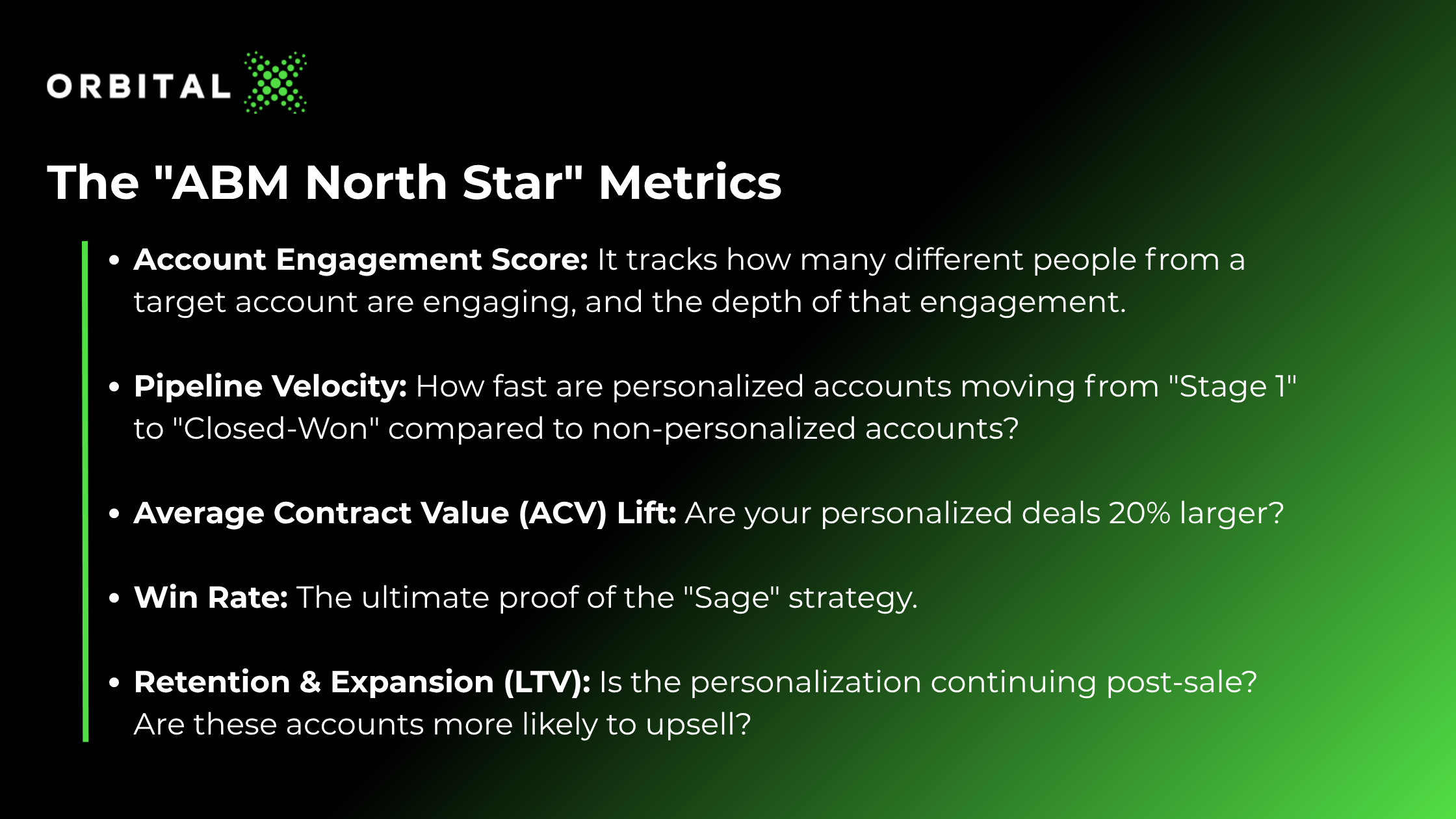
Personalization without measurement quickly becomes guesswork. To ensure these tactics drive real pipeline impact, you need to track the metrics that directly correlate with revenue:
Account engagement score: This is a composite score. It tracks how many different people from a target account are engaging and how deeply. One VP spending five minutes on a case study is worth more than 10 juniors clicking an ad.
Pipeline velocity: How fast are personalized accounts moving from "Stage 1" to "closed-won" compared to non-personalized accounts?
Average contract value (ACV) lift: Are your personalized deals 20% larger? (They should be since you’re positioning value over price.)
Win rate: The ultimate measurement of your strategy’s success.
Retention and expansion (LTV): Does the personalization continue post-sale? Are these accounts more likely to upsell?
 The 3 Tiers of ABM Personalization
Not all accounts are equally valuable, so your investment of time and resources should reflect that.
Many marketing teams run a mix of lead and account-based strategies but fail to track qualified accounts consistently. They’re essentially flying blind. A successful ABM engine relies on a tiered framework where you provide tailored marketing to your highest-value targets. You then maintain a relevant, automated presence for the broader market.
Here’s how you break it down.
Tier 1: One-to-One (Strategic ABM)
This is the crown jewel of your ABM strategy. Reserve this for the top 1% of accounts. We’re talking about deal sizes of $100,000 or more. These are the accounts that fundamentally shift your company's revenue trajectory.
The investment is high, but the potential reward is monumental. Do not use a template here. You should create a bespoke universe for each account, with every piece of content, every ad, and every outreach attempt handcrafted. You’re essentially building a mini-marketing ABM agency dedicated to winning one specific target.
You have to go way beyond basic firmographics and into deep account intelligence. Audit their 10-K filings to understand board-level priorities. Monitor their executive's LinkedIn activity to grasp personal philosophies. Analyze their job boards to see what technical gaps they’re trying to fill.
If you see a global enterprise doing a massive cloud-native migration, don’t just mention security; speak directly to the friction of securing ephemeral workloads and Kubernetes clusters. Make them feel like choosing you is a strategic alliance.
The effort: 100% bespoke.
The tactics: Custom-built landing pages and printed research reports specific to their business. Use industry-specific white papers and executive-to-executive networking.
The human touch: A dedicated account manager and marketing lead working in tandem for a single account.
Tier 2: One-to-Few (ABM Lite)
Here, you personalize for small groups of accounts, usually 5-15 companies that share a very specific DNA. That might be an industry vertical like Tier-2 Neo-banks in Western Europe or a shared tech stack like legacy Oracle users migrating to the cloud.
These targets typically bring in deal sizes from $50,000 to $100,000. You want to balance bespoke quality with operational scale here. Make your strategy modular.
Develop a core asset, such as a guide on automated threat detection. You then wrap it: For the eCommerce cluster, focus the intro on protecting customer transaction data. For the health tech cluster, tweak the same asset to focus on patient record privacy and regulatory compliance. You aren't rewriting the entire white paper. You’re just changing the cover and the forward to match their specific tribal language. This bridges the trust gap and gets them into a discovery call.
The effort: 70% templated and 30% bespoke.
The tactics: Industry-specific webinars and vertical-focused case studies. Use personalized email tracks that actually scale.
Tier 3: One-to-Many (Programmatic ABM)
The focus here is on a defined, broad market ICP. Deal sizes are under $50,000. You shouldn’t look for deep individual insights in Tier 3, just intent signals.
If 500 accounts in your database are all searching for zero-trust architecture, you automatically drop them into a perimeter-less security track. Let technology do the heavy lifting. This allows you to personalize for hundreds or thousands of accounts simultaneously.
When a prospect lands on your site, dynamic content triggers based on their company data. Headlines change. Logos of similar customers appear. The call-to-action shifts to reflect their exact stage in the journey.
The effort: 90% automated.
The tactics: Dynamic website headers based on the visitor's industry. Run automated LinkedIn ads triggered by company-level intent and use programmatic advertising.
The goal here is to leverage automation at scale and ensure no high-potential account receives a generic experience. More importantly, it frees up your human talent to focus entirely on those high-touch interactions in Tiers 1 and 2.
ABM Tier | Ideal Account Value (ACV) | Personalization Strategy | Execution Model (The Human-AI Hybrid) |
Tier 1: Strategic (One-to-One) | $100,000+ (Whale Accounts) | Deep & Bespoke: Handcrafted messaging based on intense manual research (e.g., auditing 10-K filings). | Human-Led (90% Human / 10% AI): Marketing and sales work as a single, unified 1:1 strike team. |
Tier 2: Lite (One-to-Few) | $50,000–$100,000 (High-Growth Segments) | Verticalized & Modular: Core assets (e.g., guides) “wrapped” with industry-specific context. | AI-Supported (30% Human / 70% AI): AI creates initial research and drafts; humans add nuance and soul. |
Tier 3: Programmatic (One-to-Many) | Under $50,000 (Broader Target Market) | Dynamic & Behavior-Based: Content triggered purely by broad intent signals (e.g., keyword surges). | AI-Driven (10% Human / 90% AI): Completely automated workflows triggered by data orchestration. |
Essential Tools for Scaling Your Personalization
Scaling personalization by hand is impossible. You need a serious tech stack. Building a B2B personalization engine without the right tools is like driving a car where the steering wheel, gas pedal, and brakes are controlled by different people. You’ll inevitably crash.
But don't just buy software and hope for the best. Disconnected data kills your momentum fast.
Here are the top tool categories that form the backbone of a scalable ABM system:
Intent data providers: These tools de-anonymize the 90% of the buyer's journey that happens in the shadows. They tell you exactly who’s in-market and what they want. This lets you be proactive and find opportunities before your competitors even know they exist.
Experience and CMS tools: These platforms make personalization at scale a reality. They dynamically shift your website copy based on the visitor's company data. Make every prospect feel like you built your product specifically for their industry's unique challenges.
Content automation tools: AI helps you build marketing content and sales decks incredibly fast. Adobe even found that 93% of marketers use AI for quicker content creation. But you have to add human polish. If your draft sounds like a robot, you lose trust instantly.
CRM and sales engagement tools: This is your single source of truth. Sales reps need to see exactly what marketing has done. It gives them context and ensures the rep's outreach is a helpful extension of the digital journey, not a cold, jarring interruption.
Ad platforms: Channels like LinkedIn Ads, Google Ads, and programmatic display are critical. They push personalized messaging based on account-level intent signals. But you need to watch your frequency, as social media is susceptible to ad fatigue. Keep your creative fresh so you don't become annoying background noise.
Orchestration platforms: This is your command and control center. It connects your CRM to your ad channels, email tools, and web CMS. When an intent signal pops up, a coordinated response triggers everywhere at once.
If your data can't talk, your strategy walks. Ensure your tools are integrated before you start sending out campaigns.
The Danger of Confusing Customization With Personalization
Many ABM campaigns fail, but it’s not for a lack of effort. Marketers commonly confuse customization with true personalization. You grab a name, a company, an industry, or a recent news headline and plug it into a pre-existing template to mass-produce outreach.
Relying on these static data points has very little effect on conversion.
When high-value prospects receive these emails, they delete them. You become noise, which leads to account burn. Gartner research backs this up, with 73% of B2B buyers saying they stop engaging with a vendor completely if they receive irrelevant outreach. In a landscape where your total addressable market is often narrow, you can’t afford to burn your best leads with bad automation.
True personalization is how you avoid this. It’s strategic, behavior-based, and starts with a genuine signal. It then adapts both the message and the distribution strategy to match exactly what the account is actively exploring.
Instead of sending a generic outbound sequence or serving static ads, personalize your content distribution based on early-stage behavioral signals. If your intent data shows multiple stakeholders at a target account reading up on "regulatory compliance in new regions," for instance, stop pitching your basic product overview. Dynamically promote a highly specific insight asset, like a tailored industry brief, across the channels they already use. Broadcast it on LinkedIn, in programmatic ads, and in their email inbox.
This ensures your messaging aligns perfectly with the prospect's current priorities. It builds trust and accelerates future sales conversations.
Strategy Layer | The Strategic Approach (The “Why”) | The Tactical Input (The “How”) | The Prospect Experience (The “Result”) | Business Outcome |
Customization (Mail Merge) | Mechanical Efficiency: A goal of generating high volume quickly using templates. | Static Firmographics: Uses basic tactics like {First_Name} and {Company_Name} tags. | Generic Noise: The prospect feels targeted by lazy automation, not understood. | Account Burn: Low engagement and negative brand reputation in high-value accounts. |
True Personalization (Systematic) | Relevance & Empathy: A goal of demonstrating deep understanding of a specific pain point. | Dynamic Signals: Relies on behavior-based signals (e.g., hiring, new tech stack, intent searches). | Timely Suggestion: The outreach feels like a proactive solution to their current reality. | Warm Pipeline: Higher win rates, ACV lift, and shorter sales cycles through established trust. |
Take Your ABM Personalization to the Next Level
ABM personalization requires a fundamental shift. You have to integrate intent data and build tiered content for hundreds of accounts. It requires a significant investment of time and resources.
Automation makes scaling possible, but it shouldn’t obscure human empathy. Technology provides the scale; humans provide the soul.
The best approach is an AI-human hybrid model. And with the help of a demand-gen agency like OrbitalX, you can build systematic ABM personalization without overhauling your entire department overnight.
Here’s how OrbitalX constructs human-centered campaigns with your existing stack:
Intent-first selection: We use proprietary data to identify accounts currently in an active buying window.
Creative resonance mapping: We align your core value proposition with the specific tribal language of each account tier.
Omnichannel synchronization: We ensure your LinkedIn ads, web content, and emails move in a synchronized sequence. The prospect feels an omnipresent brand experience.
Unique asset production: Our team handles the creation of value-flip decks, custom audits, and verticalized white papers.
Sales-marketing liaison: We act as the bridge, providing your AEs with the exact context needed to turn an opened email into a booked meeting.
Real-time optimization: We monitor engagement daily and pivot the creative strategy as soon as an account moves from awareness to consideration.
Transparent attribution: We report on pipeline velocity, ACV lift, and other key metrics to prove the direct impact on your bottom line.
Are you ready to audit your current strategy? Book a call with an OrbitalX consultant today.
Frequently Asked Questions About ABM Personalization
What types of account-based marketing are there?
There are three main tiers: Tier 1 is one-to-one strategic ABM for your top 1% of accounts and is 100% bespoke. Tier 2 is one-to-few ABM Lite, which targets small groups with shared DNA like a specific industry. Tier 3 is one-to-many programmatic ABM. It relies on intent signals and heavy automation to reach a broader market.
How do I create an account-based marketing strategy?
Start by nailing down your ideal customer profile. If you target everyone, you reach no one. Next, look for active buying signals to find accounts actually in the market. Build tailored content that speaks their own language. Finally, synchronize your messaging across channels. Ensure your sales and marketing teams use the same account intelligence to present a unified front.
How does ABM compare to traditional marketing?
Traditional marketing broadcasts messaging to a wide market. The goal is to reach as many people as possible and so is usually best for creating awareness. ABM uses signal-based research to focus only on accounts that show active intent. It matches their journey with human-led storytelling and highly relevant solutions. It’s surgical precision versus a megaphone.
What are the benefits of ABM?
It helps you cut through marketing noise and invest your resources where they’re more likely to see a high return. You also see expanded deal sizes and lifetime value and shorten your sales cycles. ABM can even unite sales and marketing so they provide target accounts with a seamless and uniform experience.
How do I leverage data-driven ABM to deliver more personalized customer experiences?
Ditch the standard templates. True personalization starts with intent signals to see what target accounts actively research. Then, use experience tools to dynamically change your website headlines and case studies based on their company profile. Let automation trigger highly relevant ads across platforms. Technology handles the scale, but your human empathy secures the trust.
More Resources

B2B Content Marketing Funnel: Stages, Strategies, and How to Build One That Converts
Build a B2B content marketing funnel that aligns content with buyer needs, connects the journey, and turns content engagement into pipeline and revenue.

B2B Referral Marketing: How to Build a Program That Drives Qualified Growth
Learn how to build a B2B referral marketing program that turns trusted relationships into qualified introductions, pipeline, and measurable revenue.

A PE-Backed Company Cut Marketing From 12 People to 3. Then Had Its Best Six Months Ever.
A marketing team cut from 12 to 3, then the best six months in the company's history. Here's the growth system behind it, and what it means for PE portfolios.