17 Top Account-Based Marketing Tools for a Scalable ABM Strategy
Hone your account-based marketing tech stack so your team earns big wins without drowning in software. Learn how to choose the best tools for your needs.
Key Takeaways
The best tools aren't universal. They vary based on whether you need intent data, orchestration, engagement, or attribution.
Structure by function. Organizing your stack by "signal to orchestration to activation" helps you find gaps in your team's maturity.
Connect the dots. High-performing teams use an orchestration layer to ensure ads, emails, and sales outreach respond in sync.
It’s a common story: A mid-market team felt the pressure to "go enterprise" before they were ready, so they spent six figures on a massive, all-in-one orchestration platform that they thought would automatically solve their pipeline stagnation. The result? They spend four months just trying to integrate it into their messy CRM data, only to realize they don't have a clearly defined ICP to point the tool at.
Choosing a new marketing tool used to feel like an upgrade. Now, it feels like a high-stakes gamble with your remaining budget. You’re not just looking for a platform; you’re trying to find a way to survive a "do more with less" mandate that hasn't let up for years.
The real headache isn't a lack of options but the paralysis of having too many. Every platform promises to be the one that finally connects your data and scales your pipeline. But most teams end up with a "franken-stack" of expensive, isolated tools that don't talk to each other and require a full-time operator you can't afford to hire.
The best-performing teams have realized tools are just overhead unless they fit into a connected system. You don't need the biggest stack; you need the right engine for your specific stage of maturity. This guide breaks down 17 of the top account-based marketing tools to help you stop buying features and start building a revenue machine.
How an ABM Tech Stack Actually Works
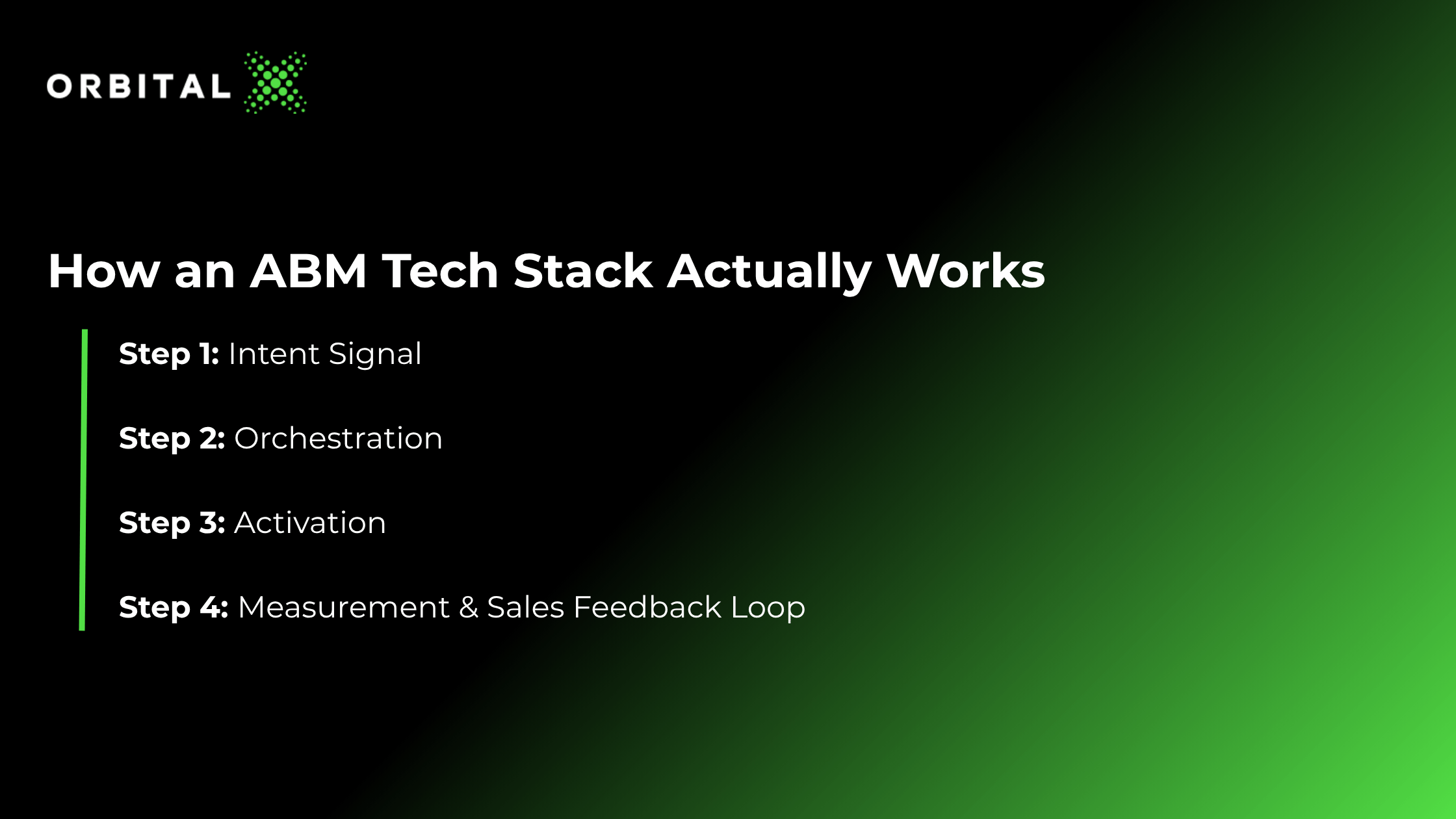 An effective ABM tech stack is a signal-driven engine where each stage feeds the next. It’s a continuous loop, not a linear funnel, that moves accounts from initial intent to closed revenue. Each tool supports a different step, from spotting interest to engaging accounts to tracking what actually leads to revenue.
Stage 1 Intent Signal (Detection Layer): This is where you spot demand before prospects even enter your pipeline. Tools in this layer capture behavioral signals, like three different people from a target account visiting the same case study page within 48 hours. Instead of reaching out cold, these signals help your team focus on accounts that are actively researching your category.
Stage 2 Orchestration (Decision Layer): Orchestration is the brain of the system, pulling together data from your CRM, website, ads, and intent tools into one view. It uses predefined rules to determine when to trigger actions, like launching ads, sending alerts, or prompting sales outreach. For example, a common rule might be, "If an account hits an intent score of 80, automatically add the VP of IT to a specific LinkedIn ad group and notify the SDR." This ensures both teams work from the same account data instead of separate dashboards.
Stage 3 Activation (Execution Layer): This is where engagement happens across channels. Tools used here enable actions like showing tailored ads, personalizing website messaging, or starting email outreach to specific stakeholders. These tools ensure a decision-maker sees relevant messaging based on their role, rather than generic campaigns meant for everyone.
Stage 4 Measurement (Optimization Layer): This stage tracks which accounts are engaging, how they move through the pipeline, and which activities lead to closed deals. It’s about more than just ROI; you’re looking at metrics like pipeline velocity and account engagement scores to see what’s moving the needle. This allows you to see what is working, double down on it, and explain to leadership exactly what is driving revenue.
17 Top Account-Based Marketing Tools for Revenue Growth
The tools you choose aren't just entries on a line item; they're the components of your revenue engine. We've grouped these 17 platforms by what they actually help you do, whether that's spotting intent, running campaigns, or proving ROI to a skeptical board. Remember, the best stack isn't the biggest; it's the one that solves your most immediate bottleneck.
ABM Orchestration Tools
Orchestration platforms act as the central command layer of an ABM program, connecting signals, campaigns, and sales actions into a unified workflow. These solutions are best suited for mid-market to enterprise teams that need to align multiple channels and stakeholders around a shared account strategy.
1. OrbitalX (DemandWEBS™)
Your tech stack is probably too big, and those disconnected systems and teams create massive silos. Your intent data lives in one place. Your CRM lives in another. Your ad platforms are completely blind to both.
OrbitalX fixes this. It’s a demand generation platform built specifically around real-time signal activation. Think of it like the brain of your entire operation. Their DemandWEBS™ engine combines machine learning with actual human go-to-market expertise, forcing your tools to work together instead of operating in isolated bubbles.
Key Features
Unified Signal Aggregation: It pulls your first-, second-, and third-party intent data into a single, prioritized view for faster decision-making.
Real-Time Signal Activation: The exact moment a target account shows a buying signal, the platform automatically launches actions. It triggers personalized ads, updates website messaging, or notifies your sales team instantly.
Pros
Blends AI insights with human strategists to continuously optimize your targeting and messaging.
Pushes prioritized accounts directly into SDR sequences in tools like Outreach or Salesloft automatically.
Enables a small, lean team to manage thousands of target accounts with hyper-personalized outreach.
Cons
It’s not a magic fix for bad strategy. That means companies need a clearly defined ideal customer profile (ICP).
Requires initial deep-dive strategy sessions to accurately map out your existing workflows.
Integrations: Salesforce, HubSpot, LinkedIn Ads, Meta Ads, Google Ads, and custom integrations for automating end-to-end pipeline tracking and ICP identification.
Pricing: Custom pricing based on your data volume and orchestration complexity.
Best For: Organizations that want to align their sales and marketing teams on one unified platform without carrying the overhead of a massive RevOps team.
2. 6sense
6sense is a predictive revenue platform that uses proprietary AI to identify in-market accounts and literally recommends your next move.
Right now, data fragmentation is a massive headache. 6sense tackles this by unifying your sales and marketing data under a single "Intent Score." Everyone looks at the same number. Everyone knows exactly who to target.
Key Features
Predictive Model Accuracy: AI-driven account scoring based on your historical win data.
Native DSP: An integrated advertising platform explicitly built for account-based display ads.
Revenue AI™ Email: Automated AI agents that handle your early-stage lead qualification.
Pros
Forces sales and marketing to actually work together by prioritizing the same accounts.
Kills ad waste. You only show ads to accounts in active buying stages.
Cons
It’s complex. You absolutely need dedicated RevOps support to run this beast.
It can take weeks to accurately calibrate the predictive models.
Integrations: Over 20, including Marketo, Eloqua, Pardot, and Userled.
Pricing: Enterprise pricing based on features and data credits.
Best For: Large enterprises with massive datasets and the budget for a dedicated RevOps team.
3. Demandbase
Demandbase is the end-to-end giant. It offers a full-funnel GTM solution by combining intent data, advertising, and orchestration capabilities into one platform.
Marketers crave smarter campaign workflows. Demandbase answers that call by eliminating tool excess. You get your data, your ads, and your orchestration under one roof.
Key Features
Account Intelligence: An incredibly extensive firmographic and technographic dataset.
Salesforce Native Integration: A deep, bi-directional sync that lives directly inside your CRM.
B2B DSP: A proprietary advertising network optimized specifically for B2B audiences.
Pros
Reduces your tech stack footprint.
Excellent global coverage for technographic data. You know exactly what tech your targets are using.
Cons
It can feel incredibly bloated for smaller teams.
Prepare for a long onboarding cycle.
Integrations: Over 50, including Ceros, Conversica, Drift, Rybbon, and Sendoso.
Pricing: Enterprise subscription based on modular product bundles.
Best For: Mature, global organizations that need a single source of truth across multiple product lines.
4. DemandScience (formerly Terminus)
DemandScience is a much broader account-based marketing and demand generation platform. It takes its original strength in multi-channel campaign execution and layers in DemandScience's data, intent signals, and content syndication.
You need to balance broad demand generation with targeted account plays. DemandScience is built for exactly that hybrid motion.
Key Features
Multi-Channel Campaign Orchestration: Coordinate display ads, email campaigns, and web experiences from a single platform.
Integrated Intent & Data Signals: Uses the DemandScience data layer to identify and prioritize in-market accounts.
Account-Based Chat: Engage known target accounts with personalized chat experiences the second they land on your site.
Pros
Perfectly blends ABM execution with broader demand generation capabilities.
Strong multi-channel coordination without a nightmare implementation process.
Cons
Less advanced predictive modeling when you compare it to platforms like 6sense.
Can feel less specialized if your team requires incredibly deep orchestration logic.
Integrations: SalesForce, Hubspot, Klarity, and Adobe Marketo Engage.
Pricing: Custom pricing based on your data, channels, and campaign scope.
Best For: Mid-market teams that want a solid balance between ABM execution and scalable demand generation, without adopting a highly complex enterprise platform.
Intent Data Tools
Not knowing when decision-makers are actually in the market to buy is a massive problem. You can have the best message in the world, but if you deliver it to an account that’s not shopping, it falls flat.
Intent data platforms are your early-warning system. They help you spot companies actively researching solutions before they ever fill out a form or enter your pipeline. But trust is an issue here. High-quality business buyer data is elusive and scarce. That’s why picking the right tool matters.
5. Bombora
Bombora sets a high standard for third-party intent data. It tracks content consumption across a massive cooperative of B2B publisher networks. It tells you who’s actively researching topics relevant to your business before they engage directly.
Key Features
18,000+ Intent Topics: You get incredibly granular tracking of specific business interests.
Company Surge Scores: A proprietary metric that identifies spikes in an account's research activity.
Native Sync: Pushes intent scores directly into your lead scoring models in tools like Marketo or HubSpot.
Pros
Enhances your targeting precision.
Helps your content teams know exactly what topics to write about based on real, active demand.
Cons
It doesn’t provide individual contact details. You’ll need a separate sales intelligence tool like ZoomInfo to find the actual human to call.
Intent surges are reported weekly. This can sometimes be too slow for high-velocity sales teams.
Integrations: Over 50, including DealSignal, Crunchbase, Winmo, Predictiv, and Zymplify.
Pricing: Subscription-based on the number of topics and data access.
Best For: Data-driven teams that want to prioritize early-stage account identification.
6. G2 Buyer Intent
G2 Buyer Intent sits further down the funnel. It captures buyer research behavior from users who are actively comparing software solutions on G2. This isn’t early-stage educational research. These are high-confidence signals from accounts evaluating vendors right now.
Key Features
Competitor Comparison Alerts: You know the moment a target account views your competitor's review page.
Review-Level Insights: See exactly which categories and product comparisons buyers are exploring.
Instant Alerts: Get Slack or CRM notifications when a Tier 1 account visits your G2 profile.
Pros
Provides incredibly high-quality, bottom-funnel signals.
Gives your sales reps the exact context they need. They know exactly why they are calling.
Cons
It’s only useful if your software category actually gets high traffic on G2.
You’ll miss early-stage buyers who haven’t reached the comparison phase of their journey yet.
Integrations: Over 20, including Snowflake, Chili Piper, Pendo, and Medallia.
Pricing: Tied to G2 profile subscriptions. Fees are based on your intent data access level.
Best For: SaaS companies in established, competitive categories where buyers heavily rely on reviews.
Engagement & Content Personalization Tools
According to HubSpot, an overwhelming 93% of marketers report that personalization improves leads or purchases. But here’s the catch: Only 13% actually hyper-personalize their marketing based on data.
Why the gap? Because doing it well at scale is incredibly hard. Teams get stuck doing basic things like dropping a first name into an email template.
Once you identify your target accounts, engagement tools step in to fix this. They let you deliver tailored experiences across all your digital touchpoints. They align your messaging with each account's specific context. Buyers today expect that every single interaction provides value up front. Here are the tools that actually help you deliver on that expectation.
7. VWO Personalize
VWO is an optimization platform built for experimentation and behavioral targeting. It’s not strictly built just for ABM, but it lets you tailor website experiences based on specific visitor segments, making it a great fit for account-based strategies.
Key Features
Behavioral Segmentation: Personalize the user experience based on traffic source, audience attributes, and how they behave on your site.
Visual Editor: A clean, no-code interface that lets you launch personalized experiences without begging a developer for help.
Pros
Strong A/B testing capabilities. You can prove which personalized messages drive revenue.
Cons
It’s part of a larger optimization suite.
It isn’t inherently account-based out of the box; you have to integrate it with your data sources first.
Pricing scales up quickly based on your total website traffic.
Integrations: Over 50, including mParticle, Woopra, Drupal, BigCommerce, and Lytics.
Pricing: Tiered pricing based on traffic, features, and your experimentation needs.
Best For: Growth teams with high ad spend that want to combine website personalization with conversion optimization.
8. Optimizely
This is a heavy hitter. Optimizely is a leading digital experience platform that combines experimentation, personalization, and content management. For ABM teams, it integrates your data and testing into a single system.
Key Features
Advanced Personalization Engine: Delivers dynamic content based on firmographic data and audience segments.
Experimentation at Scale: Run complex A/B and multivariate tests across both your web and product experiences.
Pros
It’s a highly scalable platform built for global, multi-product organizations.
Cons
The price point is very high. It might be out of reach for mid-market teams.
You’ll absolutely need dedicated technical support to use its advanced features properly.
Integrations: Over 50, including IDO Edge, BigQuery, Amplitude, LeadsRx, and Vercel.
Pricing: Enterprise pricing based on platform modules and scale.
Best For: Mature organizations ready to incorporate personalization across the entire digital journey, not just on a few landing pages.
9. PathFactory
Buyers are tired of generic content. They want real, human-centered information. PathFactory helps you create guided content journeys that accelerate buyer education. Prospects can consume multiple assets in a single session.
Key Features
Content Tracks: Intelligent asset sequences that automatically adapt to viewer behavior.
Engagement Score: A proprietary algorithm that measures active reading time, not just basic clicks.
Native Sync: Real-time data push to Salesforce and Marketo to alert your sales team about highly engaged accounts.
Pros
Provides a granular look at exactly which pages or topics an account is actually reading.
Cons
You have to put in serious initial effort to tag and organize your existing content library.
The templated nature of the tracks can feel a bit limiting for custom branding.
Integrations: 17, including Resulticks, Aprimo, Eloqua, and Marketo.
Pricing: Custom pricing based on usage.
Best For: Content-heavy organizations that want to identify and fast-track their highly engaged buyers.
10. Folloze
Folloze gives your sales team the power to act like mini-marketers. They can send hyper-personalized, high-design microsites called Buyer Experience Boards directly to their target accounts.
Key Features
No-Code Experience Boards: Drag-and-drop landing pages built for 1:1 or 1:few account targeting.
Hot Lead Alerts: Real-time notifications sent straight to your reps via Slack or your CRM the second a board is viewed.
Pros
Lets marketers quickly scale these highly tailored experiences using smart templates.
Cons
You need a heavy up-front investment in content assets to make the boards look professional.
It requires constant, ongoing collaboration between marketing and sales.
Integrations: 12, including OneTrust Cookie, D&B, Demandbase, and Qualified.
Pricing: Custom enterprise pricing.
Best For: Teams focused on seller-led ABM, where sales reps take the lead on personalizing the outreach.
Targeted Advertising Tools
Budgets are under a massive microscope right now, so you can't afford to spray and pray.
Plus, buyers are just tired. A full 64% of ABM agencies and brands say social media is the channel most susceptible to ad fatigue. You need tools that focus your spend on high-value accounts, not broad, vague audiences. By syncing with your CRM and intent data, these platforms ensure your ads only hit relevant companies and decision-makers. They improve efficiency while maintaining consistent brand visibility.
11. Metadata.io
Most ad management is incredibly tedious. You sit there tweaking bids and audiences all day.
Marketers hate this. Metadata.io fixes it.
It automates the manual labor of paid social and paid search campaigns. It also runs large-scale A/B tests simultaneously to find the highest-performing account-based combinations.
Key Features
Campaign Experimentation: Automatically creates and tests hundreds of ad permutations.
Audience Hub: Syncs dynamic account lists from your CRM directly to ad platforms.
Revenue Optimization: Reallocates your budget based on pipeline generated, not useless clicks.
Pros
Saves a demand gen manager hours a week in manual ad management.
Connects ad spend directly to Salesforce Opportunities. No more vanity metrics.
Cons
Useless if your team spends less than $10,000 a month on ads.
Hard for control-oriented marketers to trust the machine and let go of the wheel.
Integrations: 17, including G2 Intent Buyer, Aberdeen, Contentgine, S3, and Drift.
Pricing: Tiered subscription pricing.
Best For: Lean marketing teams that need to run enterprise-scale ad programs with zero manual labor.
12. Influ2
Most ABM tools target an entire account. Influ2 targets the actual person. It serves ads directly to specific decision-makers. Think the VP of IT at Nike, rather than "someone at Nike." It tells your sales reps exactly who clicked an ad. They can then follow up with name-specific outreach immediately.
Key Features
Person-Level Targeting: Show ads only to specific decision-makers.
Engagement Analytics: See exactly which individual clicked, how many times, and which ad they saw.
Sales-Marketing Bridge: Automated alerts go to SDRs when a high-value contact is warming up via ads.
Pros
Guaranteed name-level visibility for the exact C-suite executives you need to reach.
Eliminates ad waste entirely. You won't show ads to irrelevant employees.
Cons
Smaller reach because it lacks deep, account-level roll-up views.
Premium pricing for the individual-level targeting feature.
Integrations: Salesforce, HubSpot, Marketo, Outreach, Pardot, Oracle, and Act-On.
Pricing: Custom pricing based on the number of targets.
Best For: Companies with very small, high-value buying committees. Perfect if you sell $250k+ contracts.
Sales Intelligence Tools
Incomplete or inaccurate data is a major bottleneck. You simply can't run a hyper-personalized campaign if you don't even know who you’re talking to.
Sales intelligence platforms provide the foundational data that powers effective ABM outreach. They equip your sales teams with verified contact information, organizational insights, and buying signals. You actually reach a human.
13. ZoomInfo
ZoomInfo is the heavyweight of B2B contact and company data. It provides the verified emails and mobile numbers you need to get your orchestrated campaigns across the finish line.
Key Features
Intent (Streaming): Real-time signals based on first-party and co-op web consumption.
Workflows: Automated triggers that push contacts straight to your CRM the moment they match your intent criteria.
FormComplete: Automatically populates your lead forms to reduce friction while keeping your data clean.
Pros
Provides the massive total addressable market (TAM) data you need to run high-volume outbound.
Allows your sales team to jump on a warm account within minutes of an intent spike.
Cons
Automated scraping can occasionally leave you with outdated data, especially in fast-moving industries.
It’s notoriously expensive, and you’re locked into aggressive multi-year contract requirements. Current 2026 market data shows real-world annual costs frequently landing between $30,000 and $60,000 once you factor in necessary add-ons and credit limits.
Integrations: Over 30, including Bullhorn, Chorus, Clari Groove, Prioritize, and TrustRadius.
Pricing: Custom pricing based on data credits (the number of contacts you can export), user licenses, and add-ons.
Best For: High-velocity sales teams that need massive scale and want one of the most comprehensive B2B contact datasets available.
14. Apollo.io
If you don't have $50,000 laying around for data, Apollo.io is your answer. It’s a lightweight ABM tool that combines a massive prospecting database with a native dialer and an email sequencer. This is the go-to for startups wanting data and activation in a single, affordable interface.
Key Features
Living Database: Over 275 million contacts with built-in email verification.
AI Writing Assistant: Generates personalized cold outbound emails based on a prospect's LinkedIn profile.
Native Sequence Engine: Integrated email and call tasks that live right next to your contact data.
Pros
Delivers enterprise-level features at a highly affordable and accessible price point.
The UI is modern and intuitive. It requires almost zero training for new SDRs.
Cons
Lacks the enterprise depth and advanced predictive modeling you get with platforms like 6sense or Demandbase.
Accuracy for highly niche enterprise roles can be lower than what you find in specialized databases like ZoomInfo.
Integrations: Over 50, including Albato, Clay, Dropcontact, Global Database, and SMARTe.
Pricing: Freemium tier plus paid subscriptions.
Best For: Lean, high-growth startups that need to build an effective ABM engine on a budget.
Analytics & Attribution Tools
Proving your marketing actually works is getting harder. You can't just report on vanity metrics or basic lead volume anymore. You have to prove return on investment.
But B2B buying journeys are messy. You have buying committees of 10 to 13 people, and sales cycles average 92 days. A lot of research happens in "dark social" channels or through AI search summaries where you can't easily track the clicks. Your metrics are completely one-sided. Analytics platforms fix this by showing exactly how ad clicks or content views lead to actual pipeline and closed deals.
15. Dreamdata
Dreamdata connects your scattered marketing and sales data to provide real, account-level attribution insights. It gathers data from every touch point (i.e., your CRM, ads, website, and emails) and stitches it into a single, account-level timeline. It helps you understand your actual revenue impact.
Key Features
Revenue Analytics: Dashboards showing ROI by channel, campaign, and even specific content pieces.
Audience Building: Create segments based on the exact journey stage. For example, "Accounts that saw an ad and visited the site 3 times."
Conversion Sync: Pushes closed-won data back into LinkedIn or Google Ads to train their algorithms on revenue, not just leads.
Pros
Gives you crystal clear visibility into ROI.
Allows your marketing team to move budget to what actually drives revenue.
Cons
It absolutely requires clean CRM data to work properly.
Connecting those scattered data sources often requires technical developer support.
Integrations: Over 50, including Reachdesk, Sendoso, Dealfront, Albacross, and Cognism.
Pricing: Freemium model with paid subscription tiers.
Best For: Data-driven marketing leaders who need to prove their department's exact impact on the bottom line.
Lean ABM Stack Tools (for SMB & Growing Teams)
With lean teams, you don't have a massive RevOps squad to manage complex software. You’are constantly asked to do more with less. That means fewer people, tighter budgets, and much higher expectations. Buying an enterprise ABM platform when you only have two marketers is like buying a Ferrari to drive to the end of your driveway. It's expensive and completely unnecessary.
Lean ABM tools fix this. They combine core capabilities into an accessible solution. You can actually launch and scale targeted campaigns with limited resources (although they do eventually hit a wall).
16. HubSpot ABM
Data silos kill momentum. HubSpot ABM solves this by living right inside your CRM ecosystem. If you already use HubSpot, it gives you the target account lists and reporting you need to run ABM without buying another piece of software.
Key Features
Target Account Home: A unified dashboard for your sales and marketing teams to track account progress.
Tiered Properties: Native fields that let you easily categorize accounts for different plays.
LinkedIn Ads Integration: Automatically syncs your target account lists directly to LinkedIn for ad targeting.
Pros
Zero data silos or syncing issues.
Your sales reps don't have to learn a new tool. They just use the CRM they already know.
Cons
It has limited advanced ABM capabilities.
You’ll hit scaling constraints if you try to run simultaneous plays for different product lines.
Integrations: Over 50, including Fibbler, StackAdapt, Primer, MadKudu, and Turtl.
Pricing: Tiered SaaS pricing.
Best For: Lean marketing teams already using HubSpot who want to start ABM without adding more tech.
17. AdRoll ABM (formerly RollWorks)
Account-based advertising can drain your budget fast if you do it wrong. AdRoll ABM helps teams identify, target, and engage high-value accounts at scale. It combines account identification, audience segmentation, and multi-channel advertising into one streamlined interface.
Key Features
Account Identification Engine: Uses firmographic and behavioral data to surface accounts matching your ideal customer profile.
Account-Based Advertising: Delivers targeted ads across display, native, and social channels to specific buying groups.
Performance Analytics: Measures account-level engagement and campaign impact on your pipeline.
Pros
Provides a very easy entry point into ABM advertising without heavy infrastructure.
Strikes a strong balance between usability and targeting precision.
Cons
It lacks the advanced orchestration and predictive capabilities of enterprise platforms.
It's heavily focused on advertising with much less emphasis on sales outreach.
Integrations: Over 20, including Salesloft, Crossbeam, Pardot, Drift, and LeanData.
Pricing: Tiered pricing based on ad spend and platform features.
Best For: Growth-stage B2B teams looking to scale one-to-many ABM advertising without investing in a full enterprise orchestration platform.
How to Choose the Right ABM Tools for Your Team
Choosing the right ABM tools starts with identifying what's broken in your current go-to-market system, not browsing feature lists. Most teams fail because they buy tools before diagnosing the root problem. The following table can help you match common ABM bottlenecks with the tools that solve them and set you on the right path.
ABM Bottleneck | What’s Actually Broken | Tools You Need |
Account Visibility | “We don’t know which companies are showing interest.” | Intent Data (Bombora, G2, 6sense) |
Data Quality | “Our contact/account data is incomplete or outdated.” | Sales Intelligence (ZoomInfo, Apollo) |
Prioritization | “We don’t know which accounts to focus on first.” | Predictive + Intent (6sense, Demandbase) |
Orchestration Gap | “Marketing and sales aren’t acting on the same signals.” | Orchestration (DemandWEBS™, DemandScience) |
Activation Delay | “We react too late to buying signals.” | Orchestration platforms with real-time triggers (e.g., DemandWEBS™, DemandScience) |
Generic Messaging | “Our outreach doesn’t resonate.” | Personalization (Mutiny, Folloze) |
Engagement Depth | “Prospects aren’t consuming enough content.” | Content Engagement (PathFactory) |
Pipeline Attribution | “We can’t prove what’s driving revenue.” | Attribution (Dreamdata) |
When evaluating tools, focus on actionability. Many tools show you what's happening. Fewer tell you what to do next. The best platforms translate signals into triggered actions. You also need to look at Total Cost of Ownership. A tool that appears affordable upfront can become significantly more expensive as usage scales.
The Final Verdict: Choosing Your ABM Tool Stack
There’s no single best ABM tool. You need the right combination based on your current goals, team size, and maturity.
The best stack solves your most immediate bottleneck. Maybe you need to identify in-market accounts. Maybe you need to improve engagement. Or, maybe you just need to prove your ROI to the board.
Here’s a simple framework to figure out where you belong:
Early-stage teams: Start with the usual suspects: lean, all-in-one tools like HubSpot ABM or Apollo.io. These let you build momentum quickly without piling on complexity.
Growth-stage teams: Start layering in intent data like Bombora or G2. Add engagement tools like PathFactory to improve your targeting and conversion rates.
Mature enterprise teams: You probably need heavy-duty platforms like 6sense or Demandbase. These let you run massive, integrated ABM programs at scale.
As your stack grows, your biggest headache isn't adding more features. It’s getting your existing tools to talk to each other. Growth won't come from adding more tools to the tech stack. It requires integrating the right tools to eliminate friction.
Why? Because disconnected data kills momentum. Without a system linking buying signals to real action, even the most expensive tools fail to produce a consistent pipeline. You end up performing random acts of marketing.
This is where OrbitalX DemandWEBS™ steps in. It’s the central layer that connects your signals, campaigns, and sales actions in real time. The platform forces your existing tools to operate as a coordinated system rather than separate, siloed platforms. It transforms a chaotic collection of software into a unified revenue engine. By combining AI, human expertise, and real-time activation, you reduce your time-to-engagement and massively improve pipeline efficiency.
Don't buy another tool until you know how it fits into your system. Book a quick stack strategy session to evaluate your current setup. We’ll help you identify the fastest path to measurable ABM ROI.
FAQ
What is the best ABM tool for small teams?
For lean teams, the labor cost of managing complex software is usually a much bigger barrier than the subscription cost itself. Stick to lean, all-in-one platforms like HubSpot ABM or Apollo.io to keep your execution in a single interface.
However, buying these tools doesn't mean you're actually doing ABM. You can absolutely run manual account-based campaigns with them. But doing it well requires a massive amount of time and human effort. When your team is stretched thin, manual ABM becomes your biggest bottleneck.
How much does a typical ABM stack cost?
Costs scale heavily with your ABM maturity. A starter stack covering just basic data and sequencing usually runs $1,200 to $2,500 a month. Moving up to enterprise orchestration platforms easily hits $60,000 to $100,000-plus per year.
Be aware, though: These numbers are on top of what you already pay for your foundational tech. You still need your core CRM, marketing automation platform, and website CMS. Add in the variable data credits and the average $120,000 base salary for a dedicated platform manager to run it all, and your bill runs up fast.
Is HubSpot good for ABM?
It's an excellent entry point if your team already lives in the HubSpot ecosystem.
But it's not a cure-all. It has several major limitations, including lacking deep third-party intent data and advanced predictive modeling. It also struggles with complex account hierarchies and has a hard time tracking multi-threaded attribution across massive enterprise buying committees. It doesn’t natively orchestrate multi-channel ad campaigns outside of basic list syncing either.
How long does it take to see ROI from ABM tools?
Demand building is a long game. You’ll typically see early pipeline indicators like target account engagement within three to six months. However, realizing actual revenue ROI usually takes six to twelve months, and even that range heavily depends on your average enterprise sales cycle length. Other critical internal and market variables determine where you’ll land on that spectrum, including pipeline velocity, sales and marketing alignment, lead data quality, and how well-tailored your content is to target accounts.
More Resources

B2B Content Marketing Funnel: Stages, Strategies, and How to Build One That Converts
Build a B2B content marketing funnel that aligns content with buyer needs, connects the journey, and turns content engagement into pipeline and revenue.

B2B Referral Marketing: How to Build a Program That Drives Qualified Growth
Learn how to build a B2B referral marketing program that turns trusted relationships into qualified introductions, pipeline, and measurable revenue.

A PE-Backed Company Cut Marketing From 12 People to 3. Then Had Its Best Six Months Ever.
A marketing team cut from 12 to 3, then the best six months in the company's history. Here's the growth system behind it, and what it means for PE portfolios.