Account-Based Marketing Analytics the RIGHT Way: Proving Your Strategy’s Value
Show your C-suite the value of an ABM strategy and manage your tiered accounts masterfully by looking at your data through the right lens.
Key Takeaways
Marketers have to show the value of an ABM strategy in terms that the higher-ups can understand if they want to avoid a budget cut.
Segmenting analytics by engagement, customer journey, and attribution provides a clearer picture of ABM’s efficacy
Focus on certain metrics depending on what stage a target is in the pipeline and how valuable the account is to make the most of your data.
Consider adopting an all-encompassing platform to unify your sales and marketing teams and centralize your data so you have a clear view of what’s working, what isn’t, and when you need to act.
Data Analytics: ABM's Corporate Champion
B2B marketers know account-based marketing works. We have the reports on improved campaign performance and higher engagement to prove it.
But your C-suite lives in a different world. They ultimately care about revenue.
If you can't clearly show the monetary value of your efforts, your ABM strategy is heading for the chopping block. It'll be deemed too expensive or too slow to produce a quick ROI.
The Revenue Missed Connection
As Lori Sutorius Jones, president and CEO of Avocet Communications, explains, the real problem is that marketers often speak the wrong language. Most are trained to report on activity like leads, clicks, and campaign performance.
But the business doesn't function on activity. It operates on outcomes like revenue, margin, retention, and growth efficiency.
When those two stories don't connect, your credibility disappears. The higher-ups don't want marketing speak; they want concrete evidence that their investment is worth it.
ABM covers every stage of the funnel and takes time to produce results. It focuses on quality over quantity by pulling in high-value accounts rather than just a pile of leads.
Because of that, granular metrics won't accurately communicate how well it's working. You have to go beyond performance numbers to draw a definitive link between your strategy and revenue impact.
The Big 3 of ABM Analytics
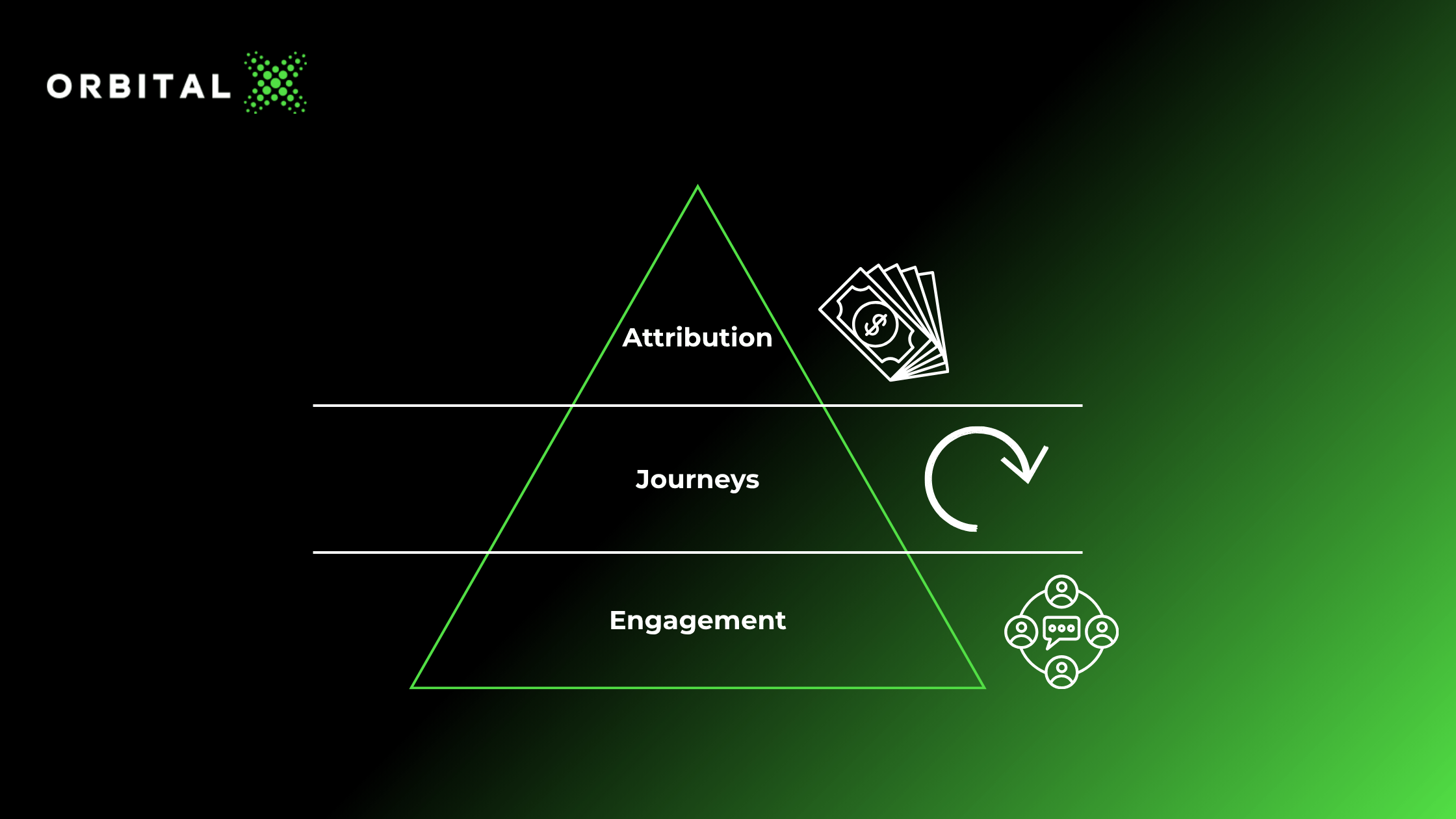
To paint a complete picture of your ABM success, you have to break the strategy into three measurable segments.
1. Engagement: The Quiet Homework
Engagement isn't just about counting clicks. It's about figuring out if target accounts are interacting with your content and where they're spending their time. You're looking to see if you're actually deepening the relationship.
Consider a SaaS firm chasing a massive enterprise account. For months, their MQL count was a big fat zero. Sales was ready to pull the plug because nobody had filled out a form.
Engagement analytics told a different story. It showed 17 different stakeholders from that one account reading the firm's "How to Migrate" blog posts every single week. These weren't just leads. They were a buying committee doing quiet homework.
If that firm had only tracked clicks, they would've walked away from a six-figure deal. Instead, they shifted tactics to an educational webinar to get the CTO to reach out directly.
2. Journeys: Finding the Friction
This segment answers a simple question: How do accounts move through the buying journey to produce outcomes we actually care about? You're looking at when, how, and why target accounts become aware, engaged, or qualified.
Say a fintech client has great awareness, but their accounts are dying in the middle of the funnel. They’d engage with a tier 1 whitepaper and then ... nothing.
By mapping the journey, they find the roadblock. Buyers are getting stuck on security and compliance questions that aren't being answered until the final contract stage. Simply moving that technical content up to the middle of the journey results in a qualified-to-closed velocity spike of 20%.
3. Attribution: The Truth Behind "Direct" Traffic
Attribution gauges if you're getting the most bang for your buck. It's about proving the ROI of your marketing investment. Without it, marketing departments are often crushed because direct traffic gets all the credit for closed deals.
 For example, imagine a company's expensive LinkedIn ads and thought leadership pieces seemed like they were doing nothing. But when they looked at multi-touch attribution, they saw the truth. Every single one of those direct buyers had first engaged with a specific LinkedIn video six months earlier.
The ads didn't secure the initial click, but they earned the trust. That trust is what made the buyer type the company's URL into their browser later on. Without this data, that successful campaign would've been headed for a red-lining.
Key Metrics to Gauge ABM's Success
Most marketers are trained to report on activity, while the C-suite operates on outcomes like revenue, margin, and growth efficiency. When your data doesn't connect to those outcomes, your credibility disappears.
You need to move past simple performance numbers. It’s crucial to draw a definitive link between your ABM strategy and actual revenue impact. Here are the metrics that actually matter for each stage of an account’s journey.
Early Stage: The Signs of Life
Account Engagement: This is your pulse check. It measures how much a target account is interacting with your brand through avenues like webpage visits, downloads, and social media likes. This helps you pinpoint intent so you can put your resources where they'll actually work. Review this weekly for your top-tier accounts to make sure they're moving through the funnel.
Basic | Intermediate | Advanced |
Ex: 3+ sessions per month from the same corporate IP address; a target contact follows your company page or likes a specific product post. | Ex: 3 to 5 unique stakeholders from the same account engage with your content within a 30-day window; a 50% increase in aggregate account activity compared to the previous month’s baseline | Ex: An executive-level contact (VP or C-Suite) engages with a specific bottom-of-funnel asset; a high intent score from third-party providers showing the account is researching competitor keywords |
Deal Velocity: This tracks how fast accounts move from the first hello to a closed deal. Total the number of days a target spends at each deal stage, then compare it to your non-ABM measurements. Review this metric every quarter to take the pulse of your campaigns. If your strategy works, you'll see a shorter sales cycle. A slow velocity usually means there's an obstacle in your pipeline that's stopping the conversion.
Basic | Intermediate | Advanced |
Ex: Lead-to-opportunity time of less than 14 days; increasing top-of-funnel activity | Ex: The time between discovery and reaching out to sales reduces by 15%; sending case study ads to accounts that have been in the evaluation stage for more than 30 days | Ex: Targeting C-suite contacts with high-level content to shorten time in the decision stage by 20%; a stable velocity for deals with an ACV 2x higher than your average |
Account Penetration Rate: This is about relationships. You need to know how many decision makers in a target account are actually building a bond with your team. If you're only reaching one or two people, the deal won't move. Aim for at least four to six stakeholders to keep the buying committee from blocking you.
Basic | Intermediate | Advanced |
Ex: 1-2 relevant contacts sign up for your newsletter; initial user capture is < 10% of the total potential seat count within the organization | Ex: 25%–40% of the total addressable users in the account are now active; the target account has shown an interest in 2+ services or products | Ex: Engagement from 3+ C-suite or VP-level stakeholders; monitoring leadership changes, new funding or initiatives, or other major activities to tailor messaging |
Mid-Stage: Proving the Value
Win Rate: This is the ultimate proof of whether your strategy is a success or a waste of time. It tells you exactly what percentage of target accounts became customers because of your efforts. Compare this against your non-ABM deals every quarter to see if your specialized campaigns are closing more lucrative business.
Average Deal Size: This should be significantly higher if you're doing ABM right. Since you're focusing on high-value targets, the contracts you close should be larger than your standard wins. It's a concrete way to prove ROI to your boss and verify that you're spending your time on the right accounts. Measure this on a quarterly basis to check your ABM strategy’s success and make adjustments when the numbers begin to drop.
Established Stage: The Long Game
Customer Lifetime Value (CLV): This metric supports ABM’s long game, estimating the total revenue your company can expect from a customer over the course of your business relationship. It’s the product of an account’s average purchase value (total revenue divided by total number of purchases) multiplied by their average purchase frequency and your average customer lifespan (one divided by your churn rate).
The higher your CLV, the better. It means you’re building lasting relationships with your customers and driving consistent revenue from them. Aim to review this KPI annually to aggregate a client’s various purchases over the course of a year, and increase to quarterly if CLV starts to slip.
Basic | Intermediate | Advanced |
Ex: Focus on customer retention; monitor LTV:CAC ratio, aiming for above 2:1 | Ex: Recover costs quickly and aim for aggressive reinvestment; aim to grow existing customers to offset churn and achieve a net revenue return of 100% | Ex: Drive referral loops; push for upsells; current customers use 3+ product modules or services |
Account Churn Rate: Nobody likes to talk about failures, but it’s important to address lost customers to pinpoint flaws in your ABM strategy and address any small problems proactively. Simply divide the number of accounts that ended their contract with you during a specific time frame by the number you started with in that same window.
Check this rate monthly to see if you’re losing them at a fast rate and take action. Devote time each quarter to dig deeper into the why behind it: Is churn concentrated in a specific segment? Can you identify any behavioral patterns in the month or two before clients left? Is there an issue with product/service fit or a messaging gap? This narrower focus helps you fix problems in your account relationships and also equips your sales team to catch customers at risk of churn before they make a clean break.
Basic | Intermediate | Advanced |
Ex: Review churn monthly, aiming to stay below 5%, and CAC | Ex: Conduct quarterly business reviews (QBRs) with high-value accounts; focus on aligning with executives’ goals and vision | Ex: Upsell and track ABM clients’ NRR percentage |
ABM Platforms That Help Unify Your Data
You need a killer tech stack to stay on top of your target accounts, create personalized campaigns, and track your progress. A robust platform is essential to serve as a single source of truth and keep your whole team on the same page. Here are the heavy hitters and the new contenders you should consider:
DemandBase is a well-established choice in the industry that excels at audience segmentation and strong campaign personalization. It provides helpful activity summaries for quick diagnostics and keeps the conversation going through continuous touch points. On the flip side, it has a complicated configuration and relies heavily on IP address recognition for intent signals, which means you'll need explicit governance rules to avoid account overlap.
6Sense is the AI-heavy option that leverages predictive analytics to identify in-market accounts and map out buying intent. It’s great for list building and deciding which accounts to prioritize because it has its own account-level intent ecosystem. However, it comes with a slow ramp-up time and can be difficult for small teams to manage since the workflows require a lot of hands-on maintenance.
AdRoll ABM pulls data from a wide range of sources to gather info about target intent. It’s easy to build audiences and tailor advertising, and it clearly outlines the buying journey stages so you can track your progress. The downside is that it has fewer Al and predictive capabilities than its rivals, so you’ll need to do more manual oversight when you're composing data reports.
DemandScience, formerly known as Terminus, is a solid choice for creating and managing multi-channel campaigns thanks to its strong coordination capabilities. It analyzes lead data in real time to narrow down your target account list effectively. But be warned, it requires dedicated resources for content creation and continuous campaign optimization across all your touchpoints.
OrbitalX is the dark horse that combines Al insights with human expertise to pinpoint which accounts actually deserve your attention. It synthesizes data intelligence to produce content tailor-made for each unique campaign. The best part? Ramp-up takes less than 30 days, and you don’t need to buy any new tools, as every action feeds back into the strategy to refine your audience and tactics.
How the Best Companies Approach ABM Analytics
When your CEO asks for a status update, you need concrete evidence to prove your ABM strategy's value and get them off your back. To fully equip yourself for those monthly or quarterly check-ins, you have to treat your data as more than just a spreadsheet. It’s about building a system that actually works for your specific business goals.
Kill the data silos: Your CRM, marketing automation, and analytics platform should be integrated so they always speak the same language. If your data can’t talk, your strategy is just a collection of guesses that won't hold up under C-suite scrutiny.
Don’t get bogged down in the short-term metrics: Yes, seeing a target account engage more with your content is good progress, but that doesn’t necessarily mean they're moving closer to a closed deal any faster. You have to look at the full context. Compare third-party activity data with your own first-party interactions to see if they’re actually doing their homework on you.
The smartest teams set different standards of success based on account tiers:
For Tier 1, use a “microscope” approach. These are your high-value accounts where success is measured by account penetration. If you only talk to one contact at a massive enterprise, you’re failing.
For these, success might look like a personalized ROI calculator built specifically for their 2026 budget where you track every minute they spend on that page.
Tier 2 is the cluster approach, where you group accounts by industry or shared pain points. Here, the success metric is pipeline velocity; how fast are these clusters moving compared to the general market?
An example would be running an invite-only virtual roundtable for retail operations directors. Success is getting 15% of that target list in the room and moving them to the next stage.
Tier 3 takes a “satellite" approach for high-fit accounts that aren't ready for a heavy lift yet. Success here is all about awareness and intent signals, like whether they're starting to search for your category keywords. You might use automated social ads to stay top-of-mind, with success defined by low churn in your target list and slowly increasing engagement scores.
Align sales and marketing for the best results: Quality data helps marketers identify high-potential accounts, while sales uses that same language for a consistent experience across every touchpoint. When both teams are looking at the same signals, they stop chasing random activity and start converting real intent into revenue.
In practice, this might look like a fintech startup on your Tier 3 list. They’re barely on your radar because they’ve never filled out a form or clicked a "Book a Demo" button. To your standard CRM, they look like ghosts.
Your system then catches a sudden spike in activity, not from your ads, but from a technical white paper on security being shared internally among 12 different people. This is "dark social" in action. It’s a buying committee quietly studying without inviting you to the party yet.
Marketing realizes this isn't just a casual lurker but an account under serious pressure to act, so you immediately flip them to Tier 1. Instead of broadly reaching ads, you send a personalized ROI calculator built specifically for their 2026 budget constraints.
Because you saw the intent before they officially raised their hand, your sales rep reaches out as a helpful advisor. They skip the mainstream discovery calls and go straight to solving the technical bottleneck that was stalling the deal. In the end, you close a six-figure contract that traditional tracking would have missed entirely.
Make Your Data Work for You
Proving the value of your ABM strategy isn't about burying your CEO in a pile of click and open rates. It's about drawing a straight line from those tiny signals to tangible revenue. When you stop chasing random activity signals and focus on the accounts that matter, your marketing starts making sense to the people who sign the checks.
Whether you're using a narrower approach for your must-win deals or taking a wider view for the rest, you need a system that removes the data silos and spurs your sales and marketing teams to act at the right time.
OrbitalX can get your strategy moving without the need to buy more tools you won't use. We combine AI with human expertise to find the deals your current stack is missing. If you're ready to see how this actually works, book a call with us today.
FAQs About Account-Based Marketing Analytics
How do I implement ABM?
ABM starts with a brutally honest look at your ICP. You have to filter for the accounts that are in the market to buy from you, rather than just chasing everyone you want. Once your list is tight, get your sales and marketing teams on the same page.
You can then decide whether to go deep for must-win deals or embrace a more clustered approach for specific industries. The goal is to move away from blunt-instrument marketing and start having helpful, value-led interactions.
Which metrics matter in ABM?
Ditch the vanity metrics like raw lead volume. You need to track account engagement instead to see if the right people are looking at your content. Deal velocity is another big signal because a winning strategy should shorten your sales cycle as targets move through the journey faster.
You should also keep an eye on account penetration. If you speak to only one member of the buying committee at a huge company, your deal is at risk. Aim to build relationships with four to six stakeholders so you aren't blocked by the rest. Watch your average deal size as well, since ABM targets should produce much larger contracts than your standard wins.
How does account-based marketing work?
ABM flips the traditional marketing funnel. You pinpoint high-value targets first and treat them like individual markets. It’s a long game that relies on building trust through personalized content and intent signals.
This focus on quality over quantity lets you reach out with the right message at the perfect moment. You end up as a helpful advisor rather than just another ABM agency hitting send on a generic email.
More Resources

B2B Content Marketing Funnel: Stages, Strategies, and How to Build One That Converts
Build a B2B content marketing funnel that aligns content with buyer needs, connects the journey, and turns content engagement into pipeline and revenue.

B2B Referral Marketing: How to Build a Program That Drives Qualified Growth
Learn how to build a B2B referral marketing program that turns trusted relationships into qualified introductions, pipeline, and measurable revenue.

A PE-Backed Company Cut Marketing From 12 People to 3. Then Had Its Best Six Months Ever.
A marketing team cut from 12 to 3, then the best six months in the company's history. Here's the growth system behind it, and what it means for PE portfolios.