B2B Marketing Metrics That Actually Help You Make Better Decisions
Too many B2B marketing metrics, not enough clarity? Learn how goal-based measurement helps leaders focus on the numbers that actually matter.
Key Takeaways
Start with a clear commercial objective, then choose the marketing metrics that measure progress toward that goal. Strong measurement begins with the decision you're trying to support.
Build a measurement framework that separates primary, supporting, diagnostic, and contextual metrics so leaders can prioritize the signals that guide better commercial decisions.
Match your metrics to the outcome you're trying to influence. Growing pipeline, improving lead quality, lowering CAC, and accelerating revenue each require different measurement strategies.
Use dashboards to support better decisions. Every metric should help marketing leaders decide where to invest, optimize, or change direction next.
Build a marketing measurement system that connects data to commercial outcomes. The strongest B2B teams use focused metrics to guide strategy, allocate budget, and demonstrate business impact.
B2B marketing has entered the age of information overload.
Teams have a wealth of dashboards, KPIs, and attribution data. But turning those insights into confident commercial decisions remains a daily challenge, especially considering how most marketers today don't trust the numbers they're using to make decisions.
In fact, 64% of B2B marketing leaders lack confidence in their marketing measurement, according to Forrester. Forbes described this phenomenon as "Death by Data", and to combat this, marketers are encouraged to focus on the metrics that really matter.
Credible measurement systems start with clear business objectives. Once the commercial outcome is defined, teams can adopt the metrics that reveal whether they're truly making progress. To take that first step forward, ask yourself, "What business decision should this data help us make?"
Start With the Business Objective
Effective B2B marketing measurement starts with a clear understanding of the business outcome a team wants to influence. Before choosing metrics, teams need to define the decision those benchmarks should support.
Opening your analytics tool without a business question is like wandering into a local pub at 10 AM. You might find something interesting, but you'll probably regret the choices that led you there.
It’s the same with marketing dashboards. Many teams jump straight into reporting software and start exploring default views, hoping a clear commercial strategy will magically appear. (Spoiler alert: It won't.) A defined objective unifies dashboard data and supports better decision-making.
Different objectives require different measurement approaches. A company focused on generating pipeline may prioritize marketing-sourced pipeline and qualified opportunities, while another emphasizing efficiency could measure CAC and cost per opportunity. Meanwhile, a team wanting to increase retention or growth will need visibility into expansion revenue, customer lifetime value, and retention rates.
A reliable measurement framework follows a clear sequence. It defines the business objective, identifies the marketing strategy that supports it, determines what success looks like, and selects the metrics that reveal progress.
According to research from Mailchimp, businesses report spending an average of 10 hours per week manually analyzing marketing data. That's 10 hours of expensive talent acting as human compilers, generating reports nobody requested to answer questions nobody asked.
The right metrics help teams understand performance, allocate resources, and make better commercial decisions. You don’t need to track 15 different metrics or collect mountains of data. What’s important is knowing what to do with it.
The Goal-Based Measurement Framework
True commercial clarity comes from respecting the order of operations. You wouldn't buy a toolkit before knowing whether you're fixing a pipe or building a deck, would you? The same goes for B2B marketing metrics. Don’t choose metrics before you’ve honed in on the business problem you're trying to solve.
Step | Question | Example |
1. Business Objective | What outcome are we trying to achieve? | Increase qualified pipeline |
2. Marketing Strategy | How will marketing contribute? | Target enterprise accounts through paid + organic channels |
3. Success Definition | What does progress look like? | More qualified opportunities created |
4. Relevant Metrics | What signals reveal progress? | Marketing-sourced pipeline, SQL rate |
5. Decision Enabled | What action does this inform? | Increase investment in highest-performing channels |
Know Which Metrics Deserve a Seat at the Executive Table
Not every metric deserves equal attention. Effective measurement requires a clear hierarchy that separates the numbers tied directly to business outcomes from the measurements that provide context, diagnose performance, or add unnecessary noise:
Primary metrics connect directly to commercial objectives and show whether marketing is contributing to meaningful business outcomes.
Supporting metrics help teams understand performance trends and identify opportunities for improvement.
Diagnostic metrics reveal why results changed and where potential issues may exist.
This distinction helps marketing leaders spend less time explaining dashboards and more time making decisions.
When every metric is treated as a priority, nothing receives the attention it needs. Picture a quarterly board meeting where the marketing team presents a 400% increase in LinkedIn impressions. Everyone celebrates the growth in audience engagement until the CFO asks, "Great, but how does this connect to revenue?"
Engagement metrics provide useful context around awareness and future demand creation. The issue is when teams mistake activity for impact instead of connecting those signals to the commercial outcomes the business cares about.
A study highlighted by Bloomberg reports that 80% of marketers say they're collecting more data than they know what to do with, known as data gluttony. Worse yet, Mailchimp's survey reveals that 70% of business owners report experiencing "metric anxiety" due to data overload or pressure to prove ROI with incomplete data.
The cure for metric anxiety is structure. If your CEO had 30 seconds to review your dashboard, they should immediately understand whether marketing is driving efficient growth. A well-constructed measurement system gives executives a clearer view of the signals that influence investment, strategy, and growth. It ensures every number has a clear purpose.
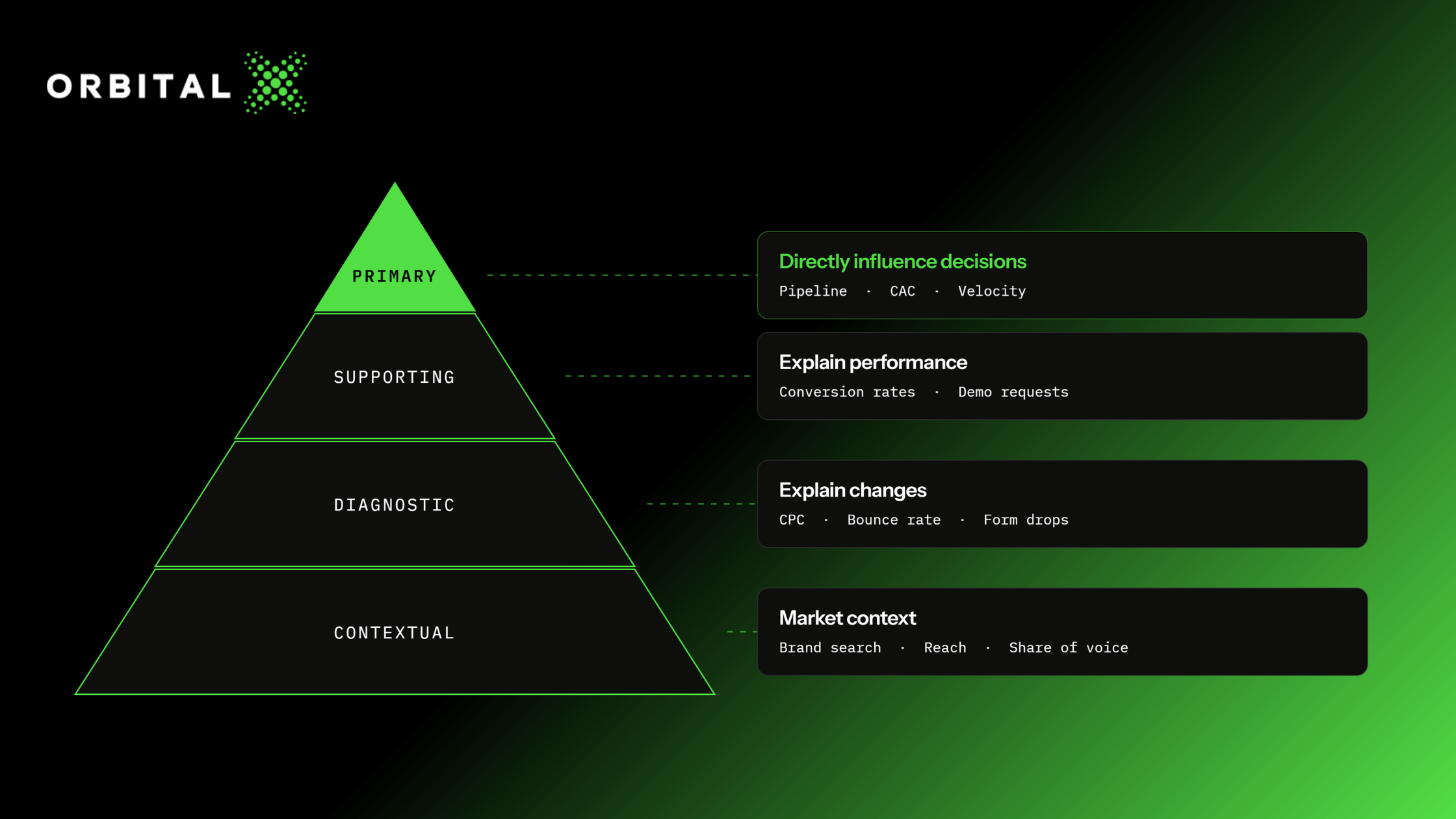
Primary Metrics
These are the heavy hitters. They connect directly to commercial objectives and influence strategic board-level conversations.
Marketing-Sourced Pipeline: The total currency value of qualified opportunities originated by marketing.
Customer Acquisition Cost (CAC): The total commercial spend required to land a new paying customer.
Revenue Influenced: The total pipeline value where marketing touchpoints actively helped move the deal forward.
Pipeline Velocity: The speed at which qualified capital moves through your revenue engine
Supporting Metrics
These give context to your primary numbers. They help functional managers understand how well specific programs are operating.
Landing Page Conversion Rate: How effectively your destination assets turn traffic into intent.
SQL Conversion Rate: The percentage of prospects that pass qualification standards.
Demo Requests: Direct hand-raises showing immediate commercial intent.
Diagnostic Metrics
Use these when something breaks. For instance, the panic of a campaign’s CPC suddenly tripling and your team has to find the friction point fast. These benchmarks explain the why behind a sudden shift in performance.
Bounce Rate and Watch Time: Indicators of content relevance and landing page friction.
Ad Frequency and CPC: Early warning signals for audience fatigue and auction pressure.
Form Completion Rate: Clues that show whether your user experience is helping or hurting conversion.
Contextual/Vanity Metrics
These look impressive in press releases, but they won't pay the rent on their own. Vanity metrics can provide useful context and help teams understand reach, awareness, and engagement. However, they aren’t direct indicators of commercial impact. Posts going viral is great, yes, but how depressing it is when the finance team asks how many bills those retweets actually pay?
Raw Impressions and Website Traffic: Useful for understanding visibility and audience reach, but they don't reveal if that attention is translating into qualified demand.
Social Likes and Shares: Helpful signals of engagement and audience response, but they rarely tell the full story of pipeline contribution or revenue impact.
The B2B Marketing Metrics That Connect Activity to Business Outcomes
The right metrics give leaders visibility into where marketing is creating momentum, where performance needs attention, and where investment should shift. They reveal where investment is working, where performance needs attention, and where teams should adjust their strategy. A dashboard filled with numbers doesn't automatically provide clarity. The value comes from understanding which signals matter and what action they should influence.
The most valuable metrics create a clear connection between marketing activity and commercial outcomes. They help teams understand whether campaigns are generating qualified demand, improving conversion through the funnel, accelerating sales velocity, or contributing to revenue over time. Understanding how these measurements work together provides a more complete view of marketing performance.
KPIs such as marketing-sourced pipeline, CAC, customer lifetime value (LTV), win rate, conversion rates, and pipeline velocity provide insight into different parts of the growth engine. However, their value comes from the decisions they drive:
Pipeline metrics help determine where to increase investment.
Conversion metrics reveal if campaigns are attracting the right audience.
CAC metrics show whether growth is becoming more or less efficient.
Forrester found that 61% of B2B marketing leaders don't believe their measurement and analytics are well aligned with organizational objectives and growth strategies. That gap is due to teams often measuring what’s easiest to extract from their tools rather than what helps them make better decisions. Effective measurement starts by asking the right commercial questions and identifying the metrics that help answer them.
To see a better return from your marketing efforts, treat metrics as decision-making tools. Connect measurement to commercial objectives, then choose the indicators that help you understand progress, diagnose challenges, and allocate resources more effectively.
Are We Creating Enough Pipeline?
You can’t pay your staff with lead volume. You need qualified pipeline that your sales team can close. The metrics that answer this question are:
Marketing-Sourced Pipeline and Influenced Pipeline: Measures the total financial value of opportunities created or progressed by marketing.
SQL and Opportunity Creation: Tracks how many accounts cross the threshold from basic interest into genuine sales dialogues.
These identify which growth channels generate real commercial pipeline so you know where to allocate your next budget increment.
Are We Attracting the Right Buyers?
Imagine bringing a stadium full of excited teenagers to a high-end enterprise software demo. The energy would be incredible, but the buying potential? Probably less so. Generating thousands of downloads from accounts that’ll never buy is a waste of time and server space.
To avoid that headache, track KPIs like:
Lead-to-Opportunity Conversion Rate: The percentage of early leads that actually turn into qualified deals.
Win Rate and ICP Account Fit: The ratio of target accounts that convert into closed-won business.
These tell you whether your targeting and messaging are pulling in enterprise buyers or just freebie-seekers who eat up sales bandwidth.
Are We Acquiring Customers Efficiently?
Remember the reckless, VC-fueled spending frenzy post-2002? Cringe. Lean, profitable growth engines are now where it’s at. You can ensure you’re on trend by monitoring:
CAC and Payback Period: How much you spend to buy a pound of gross profit, and how long it takes to recover that investment.
Cost Per Opportunity: The efficiency of your demand capture engine.
These highlight which campaigns are getting too expensive so you can trim waste or reallocate spend into more efficient channels.
Where Is Revenue Slowing Down?
Generating demand means nothing if your sales process feels like running through wet cement. A clogged B2B pipeline is like the London Underground during peak rush hour: Every platform is packed, everyone is ready to move, but the bottleneck keeps the entire system stuck.
Break through the stagnation with metrics like:
Pipeline Velocity: Calculates how fast money moves through your funnel using this straightforward formula:
.png)
Stage Conversion Rates and Sales Cycle Length: Pinpoint the exact friction points where deals stall out.
These show whether you need to fix your front-end demand creation or resolve mid-funnel sales enablement bottlenecks.
Are We Creating Long-Term Customer Value?
Acquiring a buyer is only step one. You can pop the champagne on signing day, but if that shiny, new enterprise account quietly churns nine months later, you just burnt expensive cycles to vanity-boost your short-term pipeline. Retaining and expanding them is where real growth happens.
To achieve that long-term success, monitor:
CLV and Expansion Revenue: Measure post-sale growth and account expansion.
Retention Rate and Influence on Existing Accounts: Track marketing's contribution to account health.
These help you decide whether to focus budget on net-new customer acquisition or shift resources toward expansion and retention programs.
Long-term value isn't only created after the sale though. Investments in branding, awareness, and category positioning influence future demand by making it easier to attract and convert the right buyers. But many organizations neglect these opportunities.
Forrester even found that only 31% of B2B companies run an annual brand tracker, and just 30% believe they can effectively measure how brand impacts demand or sales. Brand awareness is fruitful when it has the right context. Branded search spikes and category reach point out if your long-term demand creation efforts are paving the way for future pipeline.
Metrics Exist to Inform Decisions
Commercial Objective | Primary Metric(s) | Decision It Helps You Make |
Generate more pipeline | Marketing-sourced pipeline, SQL rate | Which channels and campaigns deserve more investment? |
Improve lead quality | Lead-to-opportunity conversion, win rate | Are we attracting the right buyers? |
Increase marketing efficiency | CAC, CAC payback, cost per opportunity | Where should budget be reduced or reallocated? |
Accelerate revenue | Pipeline velocity, sales cycle length | Where are deals slowing down? |
Improve retention and growth | Expansion revenue, retention rate, CLV | Are we creating long-term customer value? |
Refine Your Marketing With a Reliable Measurement System
B2B marketers today are drowning in data. Somewhere between dashboards, attribution reports, and campaign analytics, measurement starts to feel less like a strategic advantage and more like a reality TV reunion: lots of noise and competing opinions, but very little clarity. The difference between chaos and control is having a measurement system that tells you which signals deserve attention.
You can gain a competitive edge by building a measurement system that helps leaders make confident commercial decisions. Every metric on your dashboard should earn its spot by answering a specific business question or driving resource allocation. If a number doesn't influence an action, it's just decorative noise.
Leaders who use focused data to make clear strategic choices drive growth. That's why we built our DemandWEBS™ framework. It connects strategy, execution, and measurement around shared commercial outcomes rather than isolated marketing tasks. By giving lean teams the operating framework needed to track what drives pipeline, they can shift budget confidently and prove revenue impact without adding headcount.
If your marketing dashboards are full of data but still leave your team debating what to do next, it's time to rethink the measurement system behind them. Book a call with our team to see how OrbitalX helps B2B marketing leaders build measurement frameworks that support better decisions, stronger pipeline, and sustainable growth.
FAQs
How do you choose the right B2B marketing metrics?
Start with the business objective rather than the reporting platform. The most valuable metrics depend on the decision you're trying to make, whether that's increasing pipeline, improving lead quality, lowering acquisition costs, or accelerating revenue growth. Once the objective is clear, select the handful of metrics that reveal meaningful progress and help guide future investment.
What are the most important B2B marketing metrics for executives?
Executive teams need metrics that demonstrate commercial performance. Marketing-sourced pipeline, customer acquisition cost (CAC), pipeline velocity, win rate, and revenue influence typically provide a clearer picture of marketing's business impact than impressions, clicks, or engagement rates. Supporting metrics still have value, but they should explain performance rather than become the primary focus of leadership reporting.
Can B2B marketing metrics vary by business?
Yes. The most valuable B2B marketing metrics depend on a company's commercial objectives, growth stage, sales model, and marketing strategy. A business focused on pipeline growth may prioritize marketing-sourced pipeline and qualified opportunities, while a company emphasizing profitability may focus more closely on customer acquisition cost, conversion efficiency, and revenue contribution. The goal is to measure the metrics that best support business decisions.
Can awareness metrics still be useful in B2B marketing?
Yes. Awareness metrics can provide valuable insight when they support a defined commercial objective. For example, a company entering a new market may track branded search growth or share of voice to understand if awareness is increasing among its target audience. They're meant to inform business decisions and shouldn't be treated as standalone proof of marketing success.
How often should B2B marketing teams review their metrics?
Review cadence should match the pace of the decision being made. Operational metrics may be monitored weekly to optimize campaigns, while commercial metrics such as pipeline, acquisition costs, and revenue contribution are often reviewed monthly or quarterly to guide strategic planning. Consistent reporting is important, but the goal is to create regular opportunities to make better business decisions.
More Resources

Lead Generation for Technology Companies: How to Build a Pipeline System
Lead generation for technology companies breaks when volume is mistaken for pipeline. Here’s how to build demand that actually translates into revenue.

Forget 7 Touchpoints. B2B Buyers Now Take 80+ Interactions to Convert.
Most B2B marketers are still running their outbound math on an anecdote from a decade ago: seven touchpoints to convert a prospect into a meeting. It made for a tidy stat on a slide. It was never particularly true, and it's certainly not true now.

Lead Generation Software: Choose the Right Tools for Your Growth Strategy
Discover how to choose lead generation software that aligns with your strategy, supports your funnel, and helps build a scalable B2B pipeline.