B2B Referral Marketing: How to Build a Program That Drives Qualified Growth
Learn how to build a B2B referral marketing program that turns trusted relationships into qualified introductions, pipeline, and measurable revenue.
Key Takeaways
B2B referrals turn existing relationships and customer advocates into a formal source of qualified opportunities.
Healthy referral programs focus on relevance over volume by identifying contacts who can connect you with the right prospects.
Timing matters. Referral requests work best when customers have experienced clear value and have a credible reason to recommend you.
Beyond participation, referral programs need fast follow-up, clear ownership, and pipeline tracking to determine if introductions create business value.
Referral marketing becomes a scalable channel when it connects advocacy to the broader demand generation system.
You already know people who could open doors to high-value potential customers. So, why leave those introductions to chance?
Most B2B companies get the occasional warm intro, then cross their fingers hoping something will come of it. Organic word-of-mouth is great, but “maybe someone will mention us,” isn't a growth strategy.
That doesn’t mean you should turn your network into a referral vending machine though. You just need a simple system that makes it easier to spot the right opportunities, ask for a referral without making it awkward, and leverage genuine relationships into new introductions.
That can make all the difference in B2B, where buyers navigate complex, high-stakes decisions involving big budgets and multiple decision-makers. A trusted introduction can give you credibility and context that would be a Herculean effort with a cold email.
Keep in mind though, referrals can't replace outbound, paid, or content marketing. They meant to make the whole mix stronger. Here's how to identify the right referrers, know when and how to ask them, remove friction from introductions, and measure whether those referrals actually turn into pipeline
What Is B2B Referral Marketing?
B2B referral marketing generates new business through recommendations or introductions from people who already know and trust a company. Those referrers can include existing customers, partners, employees, and professional contacts.
Unlike informal word-of-mouth, referral marketing is a repeatable process. Instead of waiting for customers or contacts to recommend the business organically, the company identifies potential advocates, creates appropriate opportunities to ask for referrals, makes introductions easy, and tracks what happens afterward.
Forget swapping business cards over beer pints and promising to “grab a coffee sometime.” B2B referral marketing is about getting people who already know and trust your business to recommend you to someone who needs what you offer.
A referral is more than just another lead source though. The value comes from the relationship behind the introduction. When a prospect enters the conversation with some existing context about the company, its offering, or the problem it solves, sales can get their foot in the door more easily than through a completely cold interaction.
B2B referral marketing also operates differently from its B2C counterpart. It needs to account for what happens after the introduction, meaning longer sales cycles, larger commitments, and multiple stakeholders. The focus is on creating relevant introductions that can progress into qualified opportunities, pipeline, and revenue, rather than simply generating more referrals.
Channel Distinctions
Referral marketing: Encourages and facilitates structured introductions from people who already have a relationship with your business.
Word-of-mouth: Broad, informal sharing of opinions that happens organically without any set process.
Affiliate marketing: Third parties promoting a product for tracked, transactional compensation. Don't confuse this with relationship-based B2B referrals.
Partner marketing: Strategic collaboration where two businesses align to reach shared audiences. Partner referrals are one piece of that broader puzzle.
Why B2B Referrals Are a Powerful Growth Channel
Referrals give B2B companies an introduction backed by an existing relationship. Instead of starting with a lead who has no prior connection to the business, a referral provides context, credibility, and a reason for the prospect to take the conversation seriously.
The person making the introduction is effectively staking their reputation on the recommendation. That trust reduces some of the uncertainty involved in evaluating an unfamiliar vendor. Their backing also makes the initial conversation more relevant and easier to establish.
So, you can spend weeks emailing someone who’s never heard of you, or you can have a person they already trust make the connection for you. Guess which conversation is more likely to hear, “Sure, tell me more,” rather than, “Who are you?”
The value of referral marketing lies in the quality, relevance, and trust attached to each introduction, and whether that advantage carries through to pipeline and revenue.
Trust Drives Pipeline
Trust is like the “verified” badge on LinkedIn or X. It has a major influence on the buying process. SurveyMonkey and Reddit found that 73% of B2B decision-makers trust peer recommendations when researching business purchases, making them the most trusted information source measured. Similarly, research from Forrester discovered that 82% of B2B buyers trust their coworkers and management. These numbers highlight how much B2B decisions can rely on existing professional relationships.
Most B2B buyers aren't starting their search with a completely blank slate either. In fact, Gartner research revealed just 2% of B2B buyers begin their buying journey with zero vendors in mind. That’s why it’s important to make yourself known and trusted before an active purchase process begins.
Referrals can also expand your access to prospects you may struggle to reach through traditional lead generation channels like outbound or paid. Data from Harvard Business Review discovered that referred customers not only buy more but also recommend 30%–57% more new customers than those acquired through other channels. That creates a compounding growth effect that extends far beyond the initial deal. Referred prospects that are a strong fit can lead to greater conversions, sales velocity, customer value, or retention.
Who Can Refer Business to You?
B2B referrals can come from several relationships, each with different motivations, levels of access, and reasons for making an introduction. Existing customers are the most obvious source, but partners, employees, and professional contacts can also connect a business to relevant prospects.
Think of it as your own supporting cast, including former clients, partners, suppliers, colleagues, investors, and even people who know your market inside out. Some may have more influence or access than others, but they can all open a door you couldn't open yourself. So get creative and look beyond your happiest customers.
The right mix depends on your business model and target market. A SaaS company with a broad consumer base may have a large pool of potential advocates, while a professional services firm might get more value from a smaller number of highly connected clients, partners, or industry contacts.
Start by identifying the people who have both a reason to endorse your business and relationships with prospects you want to reach. Then tailor your referral strategy to how each group is most likely to make a relevant introduction.
B2B Referral Source Matrix
Referral source | Relationship strength | Prospect access | Typical referral |
Customers | High | Medium–High | Similar companies/peers |
Partners | High | High | Shared customers/complementary buyers |
Employees | Medium–High | Medium | Professional network |
Advisors/Professional contacts | Variable | High | Target accounts/introductions |
Keep in mind that having access to potential buyers doesn't automatically make someone a good referrer. The best advocates combine relationship strength with relevance. Research from LinkedIn shows that 51% of buyers are more likely to consider a seller's offering when the company grasps their unique needs. The introduction creates an opportunity to start from a position of context.
Customer and Client Referrals
Funnily enough, your best advocates may already be sitting in your CRM. Your account team just has to remember they exist for something other than renewal time. How many managers only ping clients 30 days before their contracts expire and miss months of prime advocacy momentum?
Customers and clients are often your strongest starting point for referrals since they’ve experienced your product or service firsthand. Focus on account owners, key decision-makers, or executives who’ve achieved a meaningful outcome or posted positive feedback. Combine that satisfaction with their influence on your target accounts.
Partner and Channel Referrals
Partners introduce prospects through complementary services, shared consumer bases, or industry channels. Partner referrals may sit within a broader B2B partner marketing strategy, but they can still function as a distinct referral source. Focus on who they can connect you with and why the intro makes sense for both parties.
Employee and Professional Referrals
Employees and professional contacts offer valuable intros through past work experience and networks. Advisors, consultants, and investors often hold direct relationships with key decision-makers, so take advantage of that in. Keep the focus on fit and relevance rather than pushing for sheer volume though.
How to Build a B2B Referral Program That Makes Your Company a Hot Commodity
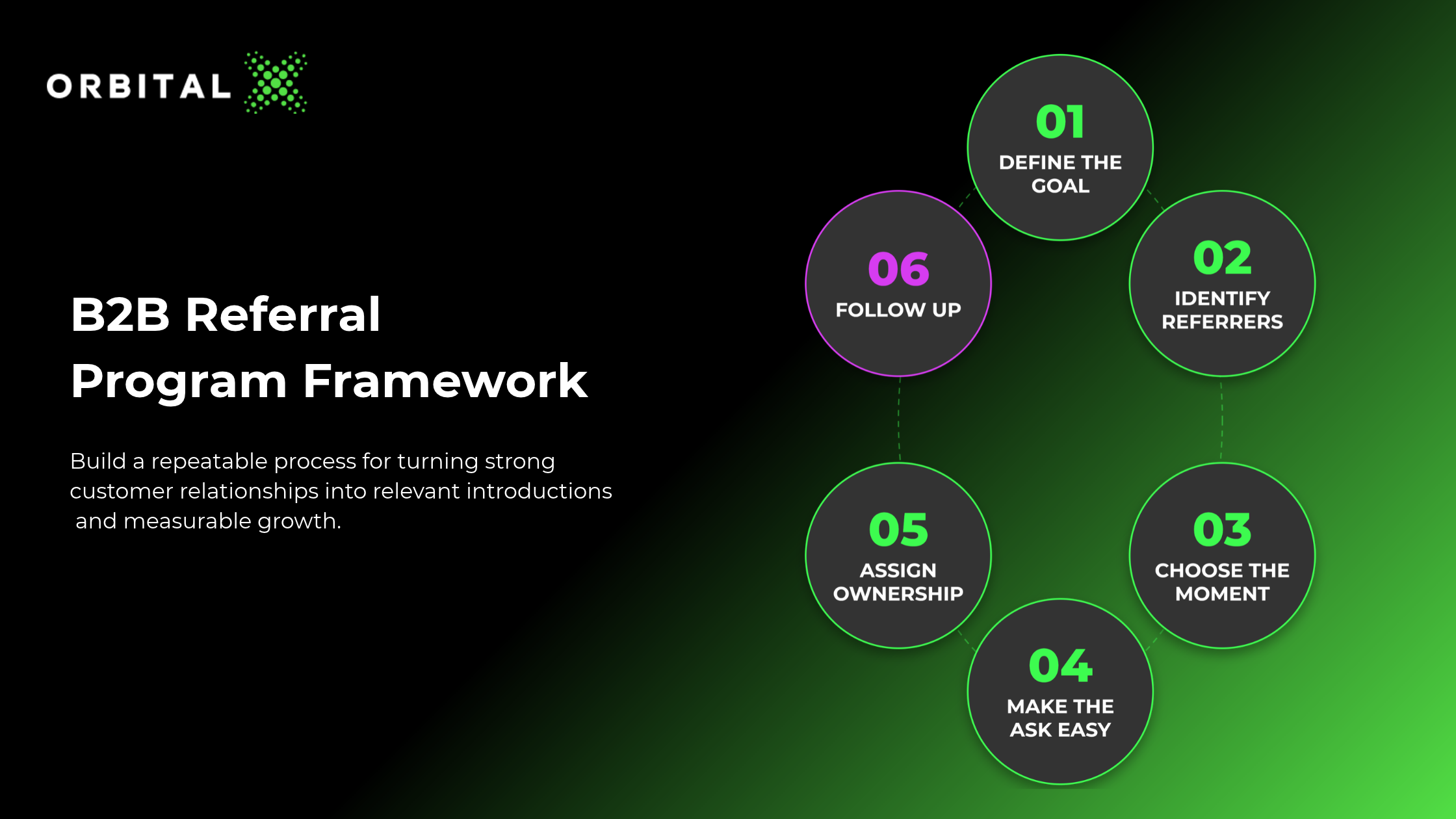
A fruitful B2B referral program turns customer advocacy into a repeatable process without making the relationship turning transactional. Start by defining what the program should generate and what a useful referral looks like. Then identify the customers, partners, employees, or professional contacts most likely to make relevant introductions. From there, determine when to ask, how the referral should happen, what support the referrer needs, and who owns the opportunity once an introduction is made.
Programs that see excellent results minimize effort for the referrer while giving sales a clear process for handling referred prospects. That means the referral experience shouldn't end once someone makes an introduction. You need to respond quickly, handle the prospect appropriately, track the opportunity, and close the loop with the person who made the referral.
This produces a system that makes advocacy easier to activate and measure, without turning every customer interaction into a sales request.
Define the Goal and Ideal Referral
Start with the commercial outcome you want. Are you looking for pipeline, revenue, or entry into a new vertical? Document what counts as a qualified referral before asking anyone to make one. You don’t want an AE to face the awkwardness of handling a referral from a key client that turns out to be a two-person shop when you sell enterprise software.
Give advocates parameters like company size, industry, or buyer role. Don't make the criteria so narrow that they have to act like sales reps, but help them recognize a potential fit at a glance. Establish an internal routing plan for poor-fit referrals so they don't waste your sales team’s time or hurt the relationship.
Identify Your Best Potential Referrers
Look deeper into your referral groups to spot people who combine satisfaction, relationship strength, and ICP access. Keep an eye out for advocacy signals like successful project milestones, renewals, expansions, testimonials, or positive feedback.
Don't assume your largest accounts are your best referrers. A smaller client whose leadership team is well connected across your target industry is often a far better referral engine than a massive enterprise account with zero external influence.
Choose the Right Moment to Ask
Don't ask just because the calendar says it's time. Reach out when the customer has a credible reason to recommend you. Strike when their positive experience is fresh so they have a genuine reason to advocate. A house painter wouldn’t wait six months after the paint dries for a customer review, would they?
Good triggers include:
Successful onboarding or project milestones
Achieving a clear, measurable outcome
Unsolicited positive feedback or praise
Contract renewals or account expansions
A finished case study or testimonial
Make the Introduction Easy
Remove all work from the advocate's plate. And definitely avoid vague requests like, "Send us anyone who might be interested." Give them simple tools like pre-written LinkedIn language, short email blurbs, or direct links.
Don't force every introduction through a rigid form either. For high-value B2B introductions, a warm greeting may be particularly useful when you're trying to open a relationship with a specific ABM target account.
Assign Program Ownership and Follow-up
Define clear rules and responsibilities before launching. Set tight SLA response times so warm intros don't sit untouched in a CRM queue. You should also establish a direct handoff:
Referral received ➔ Owner assigned ➔ Prospect contacted ➔ Opportunity tracked ➔ Outcome recorded
Track referred prospects through your usual CRM stages while preserving the original source tag. Close the loop with the advocate as well by letting them know their intro was received and handled professionally.
How to Motivate and Activate Referrers
People refer businesses for different reasons. Some want a financial reward, while others are motivated by helping a trusted contact, strengthening a professional relationship, receiving recognition, or simply recommending a company they believe in.
So, you need to design your referral program around your audience rather than assuming every referral requires a cash incentive. A £100 John Lewis gift card sounds like a pretty good way to encourage referrals… until your account champion's procurement team tells them they can't accept it.
Additionally, a program that rewards volume without considering fit just spits out more activity while neglecting pipeline quality. Incentives can encourage participation, but they shouldn't become the only reason someone acts. The right approach depends on who’s making the referral, the value of the relationship, and the type of introduction you want. The process should make it easy for advocates to participate and open referral opportunities at relevant points in the customer life cycle.
 Choose the Right Referral Incentive
Like we said, not every program needs money. In fact, offering cash to executive clients can feel transactional or violate company compliance rules. Instead, structure options based on what fits your audience, like:
Cash or direct financial rewards
Account credits or software discounts
Charitable donations in their name
Exclusive VIP access, status, or non-monetary perks
Tie rewards to clear, qualified actions like a verified meeting or closed deal to protect deal quality.
Incorporate Referral Requests Into the Customer Life Cycle
Move from individual asks to a formalized system across the entire customer life cycle. Embed potential advocacy touch points into standard account management workflows such as:
Onboarding sign-offs
Customer success reviews and QBRs
Renewal and expansion discussions
Testimonial and case study sign-offs
Train account teams to spot advocacy signals, choose the right moment, and execute the ask consistently.
How to Measure B2B Referral Marketing
Your CFO doesn't care if 20 people responded to an email saying, “Sure, I'll pass your name along.” They want to know when those mentions show up as qualified pipeline.
Referral marketing should be measured as a pipeline channel. The number of participants is a positive sign but still proves nothing. That’s how you end up in a pipeline meeting stuttering a half-baked answer about vanity metrics. While referral activity shows if the program is gaining traction, the real question is whether those referrals translate into revenue.
Start with the health of the program itself. Look at how many people are referring, how often referrals happen, and if participation is growing. Then follow those recommendations through the commercial funnel to see if they turn into opportunities and progress through the sales process to deal close.
Comparing referred opportunities with other acquisition sources adds another layer of insight. Referral volume may look healthy but produce little commercial value, just like a smaller referral program might generate fewer opportunities but a higher proportion of qualified prospects or closed business.
The aim is to connect referral activity to business impact.
-1790262086.png) B2B Referral Marketing Examples and Common Mistakes
B2B Referral Marketing Examples and Common Mistakes
Copy-pasting HubSpot's referral playbook when you're a 15-person boutique firm will earn you a dead-silent inbox. Likewise, borrowing Dropbox's referral model when you're selling complex, six-figure B2B services misses the point entirely.
Don’t copy the example programs below. They're meant there to show different ways companies make referrals work. Look at the mechanism behind each example, then identify which elements could fit your own customers, sales process, and economics.
Neglecting these principles is why referral programs fail. Asking for referrals before customers have experienced meaningful value, creating unnecessary friction, prioritizing referral volume over quality, or failing to follow up can undermine an otherwise well-designed initiative.
B2B Referral Marketing Examples
HubSpot
HubSpot builds referral mechanisms into its partner and customer ecosystem. By offering clear certification, agency partner perks, and tier status, they incentivize partners to actively introduce new client accounts.
Takeaway: Craft referral incentives around the professional growth and revenue models of the people you're asking to refer you.
Acumatica
Acumatica’s Alliance program drives growth through a dedicated partner-first channel. They provide partners with extensive resources, clear deal registration, and co-selling support so partners can make introductions without friction.
Takeaway: Make referring easy by removing the operational hurdles that stop partners from making introductions.
Salesforce
Salesforce uses its AgentExchange and consultant network as a massive advocacy engine. Consultants refer businesses because embedding Salesforce expands their own service offerings.
Takeaway: Look for referral opportunities where recommending your product directly creates more business for the person doing the referring.
Common B2B Referral Marketing Mistakes
Imagine an AE sending a warm CEO referral straight into a generic, "Hope this email finds you well," automated cadence. That lead’s temp just dropped to freezing. Avoid the awkwardness by watching out for these frequent issues:
Asking too early or too late: Requesting an intro before value is proven or waiting until the positive experience has faded
Creating too much friction: Forcing advocates through multi-step forms or long tasks
Incentivizing quantity over quality: Rewarding raw submissions so people submit poor-fit contacts for cash
Neglecting follow-up: Failing to establish who receives, qualifies, and contacts the lead
Treating referred prospects like cold leads: Ignoring the warm context and dumping the prospect into a generic email drip
Failing to close the loop: Forgetting to thank the referrer or update them on the outcome
Leverage Referrals As a Repeatable Pipeline Channel
Building a predictable growth engine requires identifying the right advocates, asking at the right moments, making introductions easy, following up quickly, and tracking revenue impact. Referrals aren’t a standalone tactic though. They belong as part of a connected B2B demand generation system.
OrbitalX helps B2B companies build connected demand generation systems that turn engagement into measurable pipeline. Through our DemandWEBS™ platform, we connect the channels, data, and execution behind sustainable growth so you don't have to rely on random word-of-mouth.
Ready to build a repeatable pipeline system? Book a call with our team today.
FAQs
Is B2B referral marketing only suitable for companies with large customer bases?
No. A B2B referral strategy can work with a small consumer base if relationships are strong and customers have access to relevant networks. For professional services, consulting, and enterprise businesses, a handful of well-connected clients may create more value than hundreds of low-engagement accounts. Look at whether existing relationships can foster credible introductions to companies that fit your ICP and need your offering.
Should B2B referral programs be managed by marketing or sales?
Neither team should solely own the entire program. Marketing can establish the program, messaging, tracking, and activation strategy, while sales is responsible for responding to and progressing referred opportunities. Customer success can also identify advocacy opportunities and make referral requests within existing relationships. The best ownership model depends on the organization, but responsibilities should be explicit.
How should B2B companies handle referrals that aren't a good fit?
Instead of rejecting poor-fit referrals immediately, establish an internal qualification process that protects the referrer's relationship. If appropriate, the business can redirect the prospect to a more suitable resource, partner, or offering. Over time, patterns in poor-fit referrals can also reveal if the program's referral criteria aren't clear or specific enough.
Can B2B referral marketing work without a formal program?
Yes. Companies can secure valuable referrals without launching a formal program, particularly when account teams consistently ask satisfied customers and professional contacts for introductions. However, an informal approach becomes difficult to scale and measure when requests depend on individual employees or relationships. A formal program provides a consistent way to identify potential advocates, make appropriate requests, record referrals, and ensure someone follows up.
How long does it take to see results from a B2B referral program?
There’s no universal time frame because referral performance depends on factors like customer relationships, sales cycle length, deal size, and how established the company's advocacy network is. Early indicators may include increased participation or referral activity, but meaningful commercial results can take longer to emerge. Companies should therefore evaluate the program across multiple stages rather than expecting immediate revenue.
More Resources

Enterprise ABM Best Practices for Continuous Optimization
Learn enterprise ABM best practices for prioritizing accounts, engaging buying committees, aligning sales and marketing, and driving account progression.

How to Measure Account Based Marketing: The Metrics That Drive Growth
Learn how to measure ABM with the metrics that matter, from account engagement and buying committee activity to pipeline progression and revenue impact.

Lead Generation for Technology Companies: How to Build a Pipeline System
Lead generation for technology companies breaks when volume is mistaken for pipeline. Here’s how to build demand that actually translates into revenue.