How to Measure Account Based Marketing: The Metrics That Drive Growth
Learn how to measure ABM with the metrics that matter, from account engagement and buying committee activity to pipeline progression and revenue impact.
Key Takeaways
Effective ABM measurement focuses on account progression, helping marketing and sales understand if target accounts are getting closer to becoming customers.
Relevant ABM metrics track account engagement, buying committee activity, pipeline progression, and revenue impact rather than lead volume alone.
Measuring engagement across multiple stakeholders provides a more accurate picture of buying intent than individual lead activity.
Attribution in ABM should focus on pipeline influence and commercial outcomes instead of trying to assign perfect credit to a single campaign or touch point.
A clear ABM measurement framework helps teams prioritize the metrics that support business growth, improve sales and marketing alignment, and guide future investment.
If your marketing strategy relies on showing the C-suite a massive spreadsheet of clicks and MQLs to justify your budget, you’re already on thin ice. A high volume of leads might look good on paper, but it doesn’t tell you if the accounts that matter are moving toward a purchase. That’s where traditional lead-generation metrics fall short.
More clicks, downloads, and form fills don’t necessarily mean an account is anywhere near buying. Chasing lead volume can give leadership a false sense of security while sales reps end up calling junior managers who just wanted a free template.
Marketers are expected to prove ROI in a single quarter, yet enterprise deals can take six months or more to close. Leadership sees a thin pipeline and starts asking for more leads, while marketing sees a long buying cycle and knows those leads won’t turn into revenue overnight. ABM has to bridge that gap without pretending enterprise revenue moves on a quarterly timeline.
Effective ABM requires a shift from tracking individual actions to measuring real account progression. It boils down to whether or not high-value accounts are actually moving closer to a closed deal.
To answer that question, you have to track the signals that show genuine momentum, namely:
Reaching the right target accounts
Increasing engagement across the whole account
Expanding involvement across the buying committee
Creating and accelerating real pipeline opportunities
Driving measurable commercial impact and revenue
The goal is to foster motivation inside high-value accounts so your sales team spends their time closing deals instead of chasing ghosts.
See also:
The Components of an ABM Measurement Framework
ABM dashboards can look busy without telling you much. An effective ABM measurement framework connects account-level engagement to pipeline and revenue outcomes. Organize your reporting around the four core categories of account engagement, buying committee engagement, pipeline and opportunity progression, and revenue and business impact. Together, these metrics reveal if target accounts are engaging with your marketing, progressing toward a purchase, and generating commercial results.
1. Account Engagement Metrics
Marketers who only care about volume end up staring blankly at a dashboard filled with thousands of anonymous website hits, trying to pick out anyone with buying power from that haystack. Instead, start with how actively target accounts interact with your marketing across channels. Key indicators include:
Engaged target accounts
Account engagement rate
Website activity
Content interactions
Event participation
2. Buying Committee Engagement Metrics
Ever had a deal go cold because an individual champion suddenly quit halfway through? It’s like a punch to the gut. That’s why you shouldn’t put all your eggs into one basket. Look at whether engagement is spreading across the stakeholders involved in the purchase. Track:
Engaged contacts per account
Engagement by role and seniority
Number of engaged buying committee members
Engagement from priority stakeholders
3. Pipeline and Opportunity Metrics
Once accounts are engaging, identify whether that activity is translating into pipeline progression. Monitor:
Opportunities created
Pipeline generated or influenced
Opportunity stage progression
Deal velocity
Stage-to-stage conversion rates
4. Revenue and Business Impact Metrics
Tie ABM activity back to the commercial results that matter. Evaluate:
Closed-won revenue
Win rate
Average deal value
Customer value
Expansion revenue
Return on ABM investment
A strong framework connects these categories to show whether engagement is deepening within priority accounts, creating pipeline, and contributing to revenue. If the numbers stop at engagement, you’re only measuring activity.
Skip Over Lead Activity to Account Engagement
Rather than measuring whether one person engaged with a campaign, businesses should evaluate whether multiple stakeholders are interacting with their brand over time. It’s like a solo marketer getting grilled by the CRO over a weak lead count, only to discover the same enterprise account has five people quietly reading the site, sharing content, and researching the company. As engagement expands across departments and seniority levels, it becomes a stronger indicator of buying intent.
Effective account engagement combines signals from multiple channels, including website visits, content consumption, webinar attendance and other event participation, advertising engagement, and sales conversations. Patterns across those signals are more meaningful than isolated interactions. For example, a single content download is like window shopping; it may represent casual interest, whereas repeated engagement from multiple stakeholders suggests growing awareness and internal discussion.
By measuring engagement at the account level, marketing and sales teams gain a more accurate view of buying intent and can prioritize the organizations showing meaningful progress toward becoming customers.
You have to aggregate signals across all touch points to catch genuine momentum though. Look for key behavioral trends across your channels, such as:
Repeated website visits from target account IP ranges
Social media engagement from key account employees
Broad content consumption across product pages
High-intent webinar registrations and live attendance
Executive participation in roundtables or trade show conversations
No single action tells the whole story. The signal comes from the combination, frequency, and consistency of engagement over time. That’s how you separate casual browsers from accounts building real commercial intent.
From Individual Signals to Account-Level Engagement
Signal | Account-Level Context |
One content download | A single indication of interest |
Multiple content interactions | Repeated interest in a specific topic |
Several contacts engaging | Interest spreading across stakeholders |
Cross-channel engagement | Consistent interaction across touch points |
Marketing + sales engagement | Increasing commercial involvement |
Sustained engagement over time | Potential buying momentum |
Isolated interactions gain meaning when engagement expands across stakeholders, channels, and time. Rather than dismissing individual lead activity outright, ABM measurement adds the account-level context needed to interpret those signals.
Track Buying Committee Engagement
Most B2B purchasing decisions involve several stakeholders, each responsible for evaluating different aspects of a potential solution. Measuring engagement across these buying committee members helps marketing and sales teams determine whether interest is spreading throughout the account or remaining isolated in one individual.
According to research cited by LinkedIn B2B Institute, the average enterprise B2B purchase decision involves 13 stakeholders. That means B2B purchasing is far from a solo sport. So, if your marketing reports only capture a single contact, you’re missing 90% of the conversation. You need to look at the committee as a whole to avoid missing critical signals. Three areas are particularly useful when evaluating buying committee engagement:
1. Understand who’s participating: Strong ABM programs look beyond engagement volume to understand who’s involved in the buying process. You can’t rely on the enthusiastic junior staff member who reads every blog post but holds zero budget authority to push the deal over the finish line.
Instead of focusing on a single champion, monitor how many people are participating, which departments they represent, and whether decision-makers are joining the conversation. This helps determine whether the account has broad stakeholder participation or remains dependent on a single contact.
2. Assess where the account stands: Buying committee engagement gives a clearer picture of account health. If all the activity is coming from a lower-level contact, the deal may need more education or a path to the people who control the budget. If executives, technical evaluators, and business leaders are all getting involved though, that's a different story. One person downloading six white papers could be a champion … or it might just be Tuesday for them.
3. Identify buying momentum: Monitoring buying committee engagement helps teams prioritize accounts showing genuine buying momentum. This provides a more complete view of what stage the account’s at while allowing marketing and sales to coordinate engagement with the people most likely to influence the final purchasing decision.
Track these key buying committee dynamics to make sure your outreach hits the right notes:
Total number of engaged contacts within the account
Seniority level and decision-making power of active users
Departmental representation across IT, finance, and operations
Rate of stakeholder expansion over time
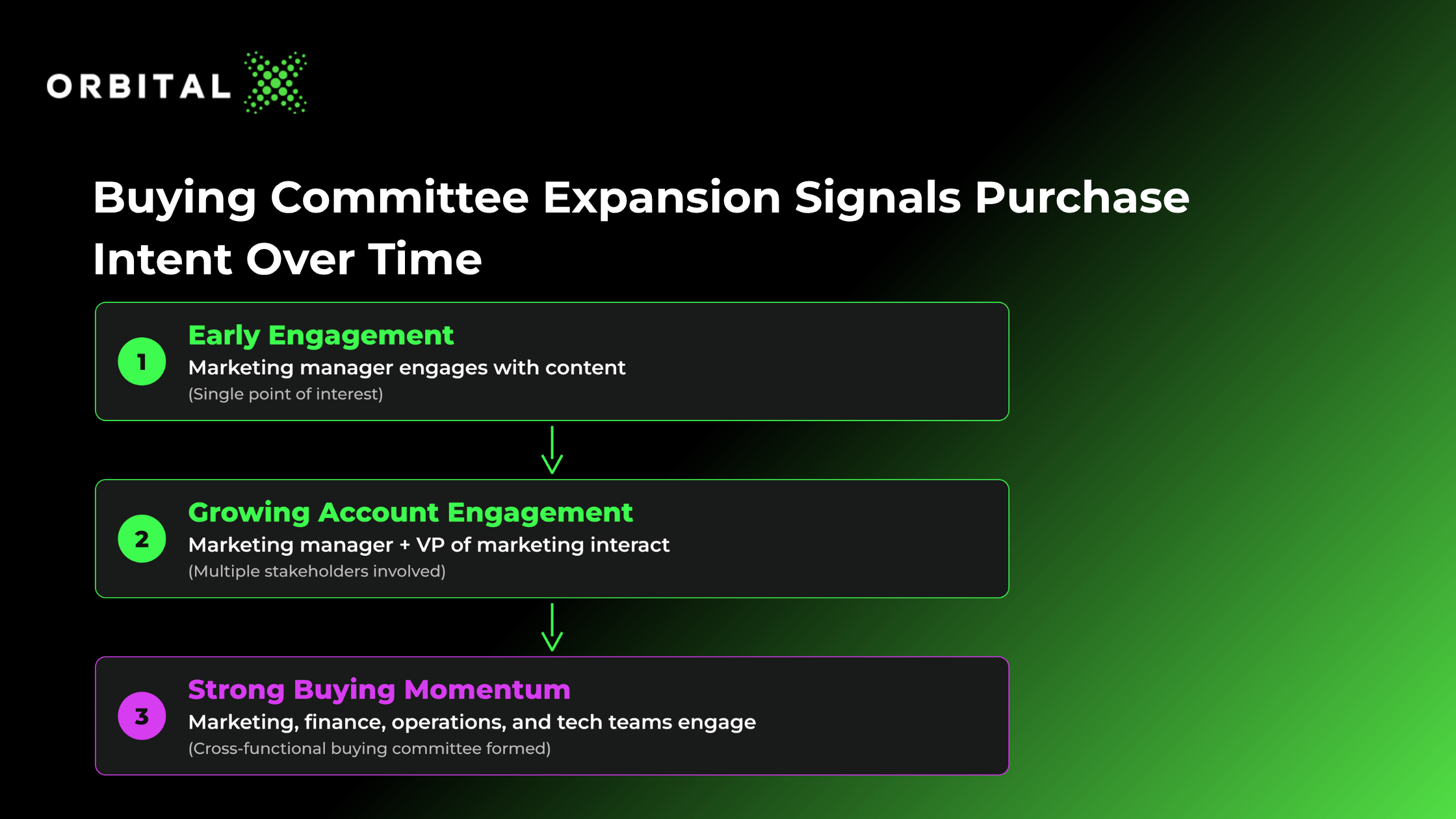
An account where a single marketing manager spends three weeks reading your blog shows mild interest. But if, a month later, the VP of marketing, the CFO, and an IT director all attend a product session, that account is now an active buying committee getting ready to spend money.
Measure Pipeline Influence and Revenue Impact
The final critical measure of ABM success is if target account engagement translates to pipeline and revenue. Engagement metrics show whether accounts are interacting with marketing, but commercial metrics reveal if those interactions are creating real business impact. By combining the two, businesses can see where investment is driving the strongest results.
Engagement is only a leading indicator though. When you’re standing in the boardroom and your CFO asks, “What did all that engagement actually generate?” they won't care how many people watched a video you posted if pipeline stays flat. You need to be able to connect marketing signals directly to commercial metrics so you can show how your programs contribute to growth.
According to Forrester, 99% of B2B organizations with dedicated ABM teams reported that the strategy produced higher ROI compared to traditional initiatives. Skip the vanity metrics. Modern revenue teams evaluate success based on commercial efficiency and deal velocity.
Marketing may influence a deal without being the final source of the lead, so revenue analysis should account for the broader role ABM plays in progressing target accounts toward a purchase. It can sway revenue by accelerating opportunities, improving deal quality, and increasing conversion rates across target accounts. To quantify that impact, track metrics like:
Qualified pipeline generated from target account lists
Total opportunity creation rate
Deal velocity and stage progression speed
Win rates on targeted accounts vs. non-targeted accounts
Closed-won revenue and customer acquisition cost (CAC) efficiency
Understand ABM Attribution Without Chasing Credit
A B2B deal leaves footprints everywhere. Marketing content, website visits, events, sales conversations, and stakeholder engagement can all contribute to an account moving forward. ABM attribution connects those signals to the account’s progression, giving marketing and sales a clear view of their combined influence. Start by defining the account-level outcomes you want to understand, then connect relevant engagement, pipeline, and revenue data to those outcomes.
Use these steps to build a practical ABM attribution approach:
Define the account-level outcome: Decide what you’re trying to attribute, such as opportunity creation, pipeline progression, closed-won revenue, or account expansion. This avoids meetings turning into sandbox arguments about who gets credit for closing a deal.
Capture engagement across the account: Bring together meaningful interactions from the target account, including content engagement, webinars, events, website activity, advertising, and sales conversations. This creates a fuller picture of activity across the buying journey.
Connect engagement to pipeline stages: Compare account engagement with opportunity creation and progression. Look for patterns between increased stakeholder activity, movement through opportunity stages, and changes in deal velocity.
Evaluate marketing and sales influence together: Review how marketing and sales activity contributed to account progression and the movement of opportunities through the pipeline. This shows teams which activities are supporting commercial movement.
Report influence alongside outcomes: Track influenced pipeline and revenue alongside the underlying account engagement and opportunity data. This keeps attribution tied to measurable commercial results and gives teams context for interpreting performance.
The point is to follow the whole journey, as in, which combination of activities moved the account from engagement to opportunity and then to revenue. That tells marketing and sales what actually moved the deal, instead of turning attribution into a never-ending hunt for the one interaction that gets the credit.
Measure What Moves Accounts Forward
Instead of creating pretty dashboards or generating massive lead counts that only look busy, successful ABM measurement identifies whether the targets that truly matter are progressing towards buying. To build an ABM measurement system that drives business growth, keep these core principles at the center of your reporting:
Measure accounts instead of individual leads.
Track engagement across the full buying committee rather than isolated champions.
Connect early engagement signals directly to pipeline velocity and closed-won revenue.
Use attribution to understand commercial influence instead of squabbling over campaign credit.
No single metric tells the full story. True insight comes from evaluating engagement, pipeline progression, revenue impact, and multi-touch influence as one connected system. Treat ABM measurement as a continuous feedback loop that sharpens your targeting, improves sales alignment, and keeps your budget focused on what’s really working.
If you’re ready to trade in vanity metrics and build a predictable pipeline engine instead, OrbitalX can help. Our DemandWEBS™ platform connects targeted account execution directly to pipeline progression and closed-won revenue. Book a call with our team today to construct a clear, revenue-focused measurement framework that moves your business forward.
FAQs
How do you measure the success of account-based marketing?
Assess the progress made within target accounts. Effective ABM measurement combines account engagement, buying committee participation, opportunity progression, pipeline generated, and revenue impact to show if high-value accounts are moving closer to becoming customers. Looking at these metrics together provides a more complete view of performance than evaluating individual campaigns or marketing activities in isolation.
What are the most important ABM metrics?
The most important ABM metrics depend on where accounts are in the buying journey. Early indicators include account engagement, buying committee coverage, and engagement across multiple channels. As accounts progress, measure opportunities created, pipeline generated, opportunity velocity, conversion rates, and closed-won revenue. Combining leading indicators with commercial outcomes provides a balanced view of ABM performance.
How long does it take to see results from ABM?
ABM results vary depending on factors like deal size, sales cycle length, and the program’s maturity. Early engagement signals may appear within weeks, while pipeline growth and revenue impact often take several months to develop. Because ABM focuses on building relationships within high-value accounts, evaluate its success over time by tracking account progression.
What is account engagement scoring in ABM?
Account engagement scoring is a method of determining how active a target account is with your business. It combines signals like website visits, content consumption, event attendance, advertising engagement, and sales interactions across multiple stakeholders. This paints a clearer picture of account activity and helps marketing and sales identify which accounts are showing stronger buying intent and deserve greater attention.
How do you measure buying committee engagement in ABM?
Rather than focusing on a single contact, businesses track the number of engaged stakeholders, their roles, seniority, departments, and changes in engagement over time. Growing participation across the buying committee often indicates stronger buying intent and gives marketing and sales greater confidence that an account is progressing toward a purchase decision.
More Resources

B2B Referral Marketing: How to Build a Program That Drives Qualified Growth
Learn how to build a B2B referral marketing program that turns trusted relationships into qualified introductions, pipeline, and measurable revenue.

Enterprise ABM Best Practices for Continuous Optimization
Learn enterprise ABM best practices for prioritizing accounts, engaging buying committees, aligning sales and marketing, and driving account progression.

Lead Generation for Technology Companies: How to Build a Pipeline System
Lead generation for technology companies breaks when volume is mistaken for pipeline. Here’s how to build demand that actually translates into revenue.