Enterprise ABM Best Practices for Continuous Optimization
Learn enterprise ABM best practices for prioritizing accounts, engaging buying committees, aligning sales and marketing, and driving account progression.
Key Takeaways
Enterprise ABM focuses on the accounts worth winning, rather than the leads you can generate.
Map the whole enterprise buying committee. A single champion won’t close the deal.
Sales and marketing should be jointly responsible for account progression.
Measure movement from target account to revenue.
Enterprise marketing teams can generate plenty of activity without creating much momentum in their highest-value accounts. The targets that matter most sit untouched, single-threaded, or stalled in the buying process.
Enterprise account-based marketing (ABM) is specifically geared toward fixing that problem and turning a small engagement spark into a roaring revenue flame. This strategy puts high-value accounts into the spotlight. So, instead of spreading budget and attention across whoever happens to raise their hand, ABM concentrates resources on the accounts with the greatest revenue potential and gets marketing and sales working from the same playbook.
Who needs more random acts of marketing? (Hint: Not you.) What you really need is to know which accounts to prioritize, what will move them along the buyer’s journey, and if they’re actually moving. Here’s how to build and execute an enterprise ABM strategy and turn your highest-value accounts into real pipeline.
See also:
What Is Enterprise Account-Based Marketing?
Enterprise is a subset of ABM, which focuses marketing and sales resources on a defined group of high-value target accounts. Rather than treating every lead as an independent prospect, the strategy considers the company as a whole, including its business priorities and the multiple people involved in its purchasing decisions.
At the enterprise level, the stakes are higher, but so is the potential reward. Enterprise accounts often have greater potential contract values, longer sales cycles, more stakeholders, and more complex buying processes. These characteristics make coordinated, account-level engagement crucial.
Enterprise ABM deals aren't a stop for a quick pint. You're trying to get a dozen people to agree on the same pub at the same time for the same reason. Meanwhile, everyone has different priorities, dietary requirements, and opinions on what to order.
To avoid squabbles and move closer to deal closure, teams should approach each target like its own market, building engagement around its priorities, buying committee, and path to purchase.
Considerations Before Launching a Motion
You can’t run standard lead generation and simply hope the right people emerge from the process.
Enterprise ABM combines three approaches:
1) One-to-one ABM creates highly tailored programs for a small number of strategically important accounts.
2) One-to-few groups similar accounts into shared programs with targeted personalization.
3) One-to-many uses scalable tactics to engage a broader group of priority accounts.
The strategy allocates resources according to account value, buying potential, and the level of engagement required. The result is a coordinated approach that gives high-value targets the attention and personalization needed to develop demand and move complex opportunities forward. That shift changes how you handle enterprise GTM, with the account becoming the core unit of focus.
Before you launch a single ad or send an email, you need to decide which accounts deserve your time and money. Demand generation creates broad market demand across your category. ABM takes a more deliberate approach, concentrating marketing and sales activity around a defined set of high-value accounts. That means using firmographic, behavioral, and engagement signals to determine where resources should go, then measuring performance through ABM metrics to see if those accounts are moving closer to revenue.
That same principle applies to how you allocate resources. Treat one-to-one, one-to-few, and one-to-many as levels of resource intensity rather than rigid boxes, and use all three based on the value and complexity of the opportunity. Personalization is only one part of the resource equation though. Account selection, orchestration, sales alignment, and measurement are what turn that focus into a well-oiled enterprise ABM program.
Build Your Enterprise ABM Strategy
Building an enterprise ABM strategy starts with identifying the accounts where a focused, coordinated approach will have the greatest commercial impact. Because enterprise deals carry higher potential value and greater complexity, account selection needs to go beyond basic ICP fit. Revenue potential, strategic importance, organizational complexity, existing relationships, and the likelihood of a viable buying opportunity all need to factor into the decision.
Define Your ICP
ICP is the starting line. Define it using firmographic, financial, technographic, and operational characteristics. But basic fit is just the beginning.
There’s a massive difference between an account that could buy and one that’s strategically worth pursuing. An accounting firm with 5,000 employees might match your technographic criteria and look like a dream account on paper. But what if a previous client review revealed that winning an account of this size required 80 hours of technical support for a tiny margin? The logo might look impressive, but the economics tell a different story.
On the flip side, a smaller enterprise account with huge expansion potential and a straightforward implementation path deserves immediate focus. ICP fit should therefore outline whether winning and serving an account makes commercial sense. Build criteria based on your business model and sales economics.
Select and Prioritize Target Accounts
Use your ICP to narrow down a list of accounts to target. Combine firmographic fit with real intent signals, existing relationships, competitive positioning, and recent organizational changes.
Teams can track visitor intent, research activity, and company updates such as funding rounds, executive hires, or mergers and acquisitions. Reviewing these behavioral signals alongside structural business changes identifies accounts that show meaningful buying potential and deserve attention.
Sales should have a seat at the table when you build and validate this list. Reps bring account politics, relationship history, and competitive context that marketing tools can’t see. From there, tier accounts according to commercial opportunity and resource intensity they warrant. Revisit the tiers regularly as account priorities, relationships, and buying signals change.
Map the Enterprise Buying Committee
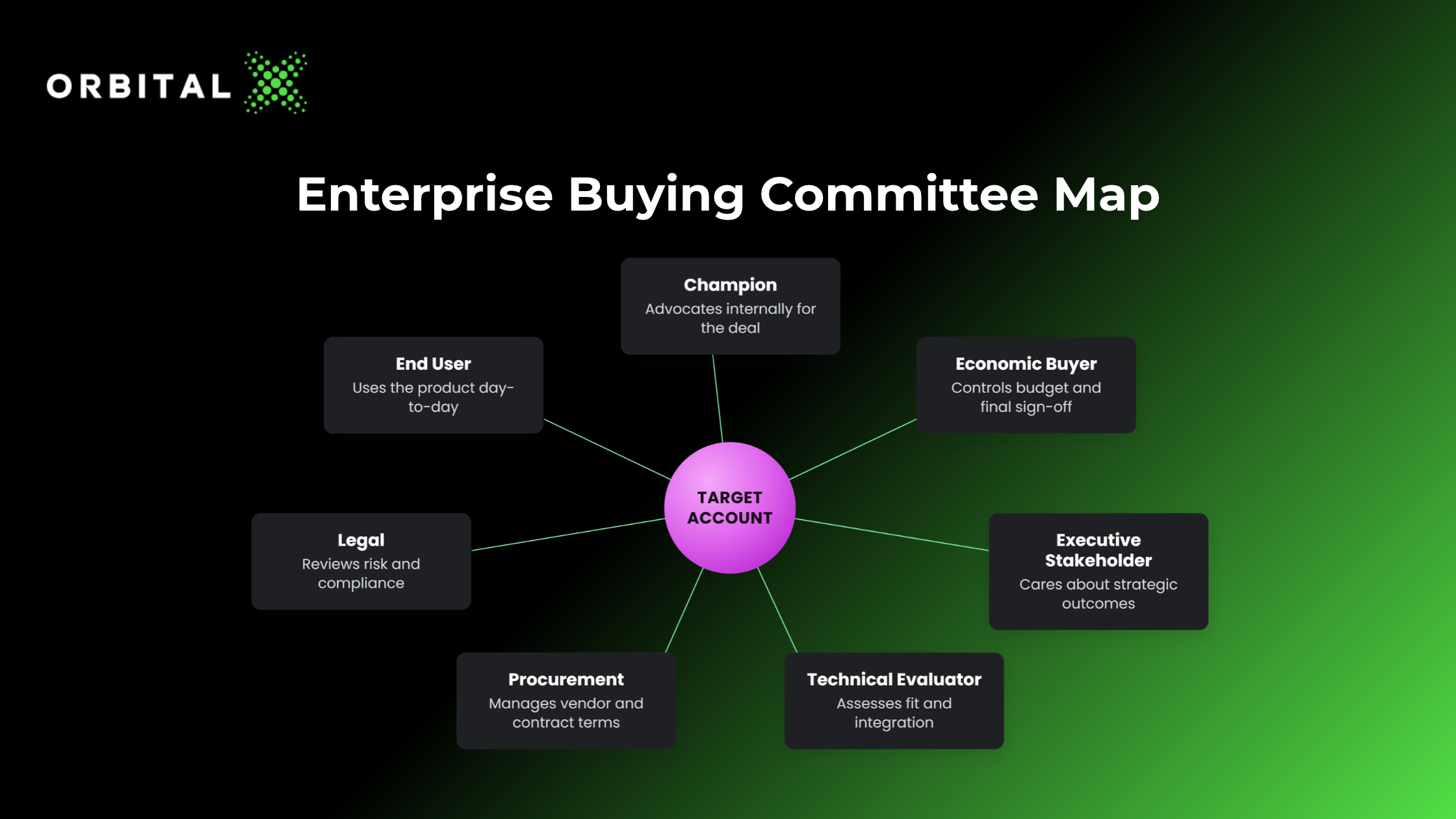
Enterprise deals rarely close through a single contact. You need to know who’s in the room, who holds the purse strings, who can kill the contract, and who might quietly derail it from the sidelines.
Buying committees typically include 6–10 people but sometimes reach up to 20 stakeholders, according to LinkedIn research. So, relying on a single champion is an easy way to watch a deal die. If your main point-of-contact leaves halfway through procurement, the emails stop getting answered, and suddenly that “hot” opportunity has gone ice cold. Ghosting champion syndrome is real.
Multi-threading helps solve this problem. It entails building relationships across executive buyers, technical evaluators, end users, procurement, and legal, while identifying gaps before they become deal blockers. When multiple buying committee members show strong engagement, you’ve moved beyond simple interest.
 Set Account-Level Objectives
ABM isn’t a marketing assembly line. Accounts stall, change priorities, and jump between stages, so objectives should reflect what each target needs next. Establish goals based on where the account sits in its buying journey. One might need a little relationship-building via nurturing, while another requires more stakeholders at the table or a nudge to get an active opportunity moving again.
Directives should be specific enough to guide real sales and marketing actions, whether that's fostering executive engagement, expanding stakeholder coverage, or moving an opportunity toward a decision. The stronger your target account strategy, the more effectively every execution activity downstream can support it.
Execute Enterprise ABM Across the Buying Journey
Enterprise ABM should change as an account moves from initial engagement to active evaluation and, eventually, a commercial decision. The priority at each stage is to understand what the target needs next and coordinate the right marketing and sales activity around it.
Early-stage accounts often need educational and category-level content, while accounts showing stronger intent may warrant more direct sales engagement, tailored content, or more aggressive stakeholder outreach. As an opportunity develops, teams can use engagement data and account intelligence to identify gaps, adjust their approach, and keep momentum moving toward a commercial outcome.
Personalize With Purpose
Superficial personalization is useless. We've all seen the cold email that starts, “Hi {First_Name}, we’d love to help {Company_Name},” followed by a subject line where the prospect's name is in all caps for some reason. That's a mail merge having a bad day and shows exactly how not to personalize. Real personalization involves making the message relevant to the account, stakeholder, and business context.
Customization fits at multiple levels:
Industry or segment
Account
Stakeholder
Buying stage
For tier-one accounts, craft experiences around their specific business priorities, regulatory challenges, or publicly stated initiatives. Instead of sending a CFO a generic white paper on cost cutting, an enterprise campaign might build a tailored hub for a specific bank based on its exact cloud migration timeline, with distinct messaging for the CFO, CTO, and risk lead. Personalization should make the interaction genuinely helpful.
Orchestrate Channels
When channels operate in silos, the buyer gets a fragmented experience instead of a coordinated one. But tossing out content through every available portal is a fast track to wasted budget and a very confused and overwhelmed buyer. Pick channels based on where your target stakeholders actually spend time, then make those avenues work together.
Combine paid media, LinkedIn, direct sales outreach, custom content, events, and retargeting so each touch point supports the next. Ads foster brand familiarity, sales outreach starts the conversation, and case studies help answer technical objections. A connected approach also gives teams room to use higher-touch tactics for top-tier accounts, such as invite-only executive dinners, when the opportunity justifies the investment. Get the Chablis chilled and ready!
Multi-Thread Accounts
Single-threaded deals are as fragile as a Jenga tower with half the pieces missing. Enterprise ABM requires active conversations across the buying committee, with messaging tailored to what each stakeholder cares about. The CFO may be focused on financial risk, whereas the end user cares about how the solution fits into their daily workflow. Each interaction should reflect those different priorities.
To hone in on committee member priorities, connect marketing signals directly to sales outreach so engagement can turn into action. If marketing spots three new managers from the same account reading technical content, for example, sales has a clear reason to reach out and expand the conversation. The deeper the stakeholder engagement, the more resilient your deal becomes.
Use AI to Scale
AI can help scale execution without giving up strategic oversight. Use it to summarize account research, uncover recent company news, draft content variations, and speed up sales prep.
Research from McKinsey revealed that always-on marketing that’s continuously managed can cut the time teams spend on execution from 60%–70% to 10%–15%. That efficiency frees your team to focus on higher-value strategy and relationship building instead of repetitive administrative grunt work (they might even leave the office on time for once).
So, while AI can scale the work, the account strategy still needs to come from your people.
.png) Align Sales and Marketing Around Target Accounts
Align Sales and Marketing Around Target Accounts
Successful enterprise ABM requires sales and marketing to use the same playbook. Inconsistent priorities or disconnected activity can create gaps in account coverage and slow deal progression.
Alignment starts with shared goals and continues into account planning, engagement, and opportunity progression. Both teams should contribute the information and expertise needed to understand the target accounts and determine how to move them forward.
Align on Accounts
It’s a classic quarterly planning standoff: Marketing claims, “The data says this account is hot,” while sales says, “I've spoken to them. They're not buying.” Both can be right, but neither team has the full picture on its own.
Solid alignment is mandatory before launching an enterprise ABM campaign. The marketing team handing sales a spreadsheet of leads and saying, “Good luck,” will only encourage a broken process. Marketing brings intent data, web activity, and market context, while sales brings relationship history, account politics, and competitive intelligence. The two departments need to decide together which accounts are worth pursuing, using both data and the account context that only sales may have.
A global logistics company, for example, might look like a perfect ICP fit with strong intent signals, but sales may know the company is locked into a five-year contract with a competitor or going through an executive restructuring. That context can materially change how the account should be prioritized and handled.
For high-priority accounts, turn that shared view into a tailored plan that covers the business context, strategic priorities, relevant stakeholders, existing relationships, current engagement, open opportunities, and planned actions. A target-account list only outlines who you're pursuing. A shared account plan tells both teams why, how, and what happens next.
Define Shared Stages
Sales and marketing need a common language for describing how an account is progressing. Otherwise, “qualified account” can mean one thing to marketing, another to sales, and something entirely different to whoever's stuck updating the CRM. Agree on clear definitions for target, engaged, and qualified accounts, active buying groups, opportunities, and pipeline. Then establish the evidence required for an account to move from one stage to the next.
Enterprise account activity can be misleading when viewed through individual contacts. A CIO downloading a report or attending an event doesn't automatically qualify a 10,000-person target account. Likewise, one IT manager showing strong engagement doesn't mean the account has an active buying group. Enterprise ABM needs to distinguish individual engagement from meaningful, account-level progression, particularly when buying committees span multiple functions and stakeholders.
Set shared criteria for when an account moves forward, stalls, changes priority, or needs a different play. Those definitions should then carry through to your measurement framework so sales and marketing use the same terminology as well as evaluate account movement against the same criteria.
Share Account Intelligence
Data needs to flow both ways. Marketing should give sales a clear view of account engagement across content, website activity, advertising, events, and changes in stakeholder activity. In turn, sales brings the context that marketing data alone can't provide, namely, new business priorities, internal relationships, buyer objections, competitive activity, and changes in timing or intent.
That context becomes especially valuable in enterprise accounts, where no single team or contact has the full picture. Marketing might see rising engagement from several people across IT and finance, while the account executive knows the company just appointed a new CIO and is evaluating its tech stack. Put those signals together, and the team has a much stronger basis for deciding what to do next than either source could provide alone.
The aim is to combine account engagement and buying-group intelligence into a clearer picture of what's happening inside the account, who’s involved, and what action makes sense next.
Review and Act
Set up a regular review cadence that matches the size and complexity of your ABM program, with more frequent cross-functional reviews for high-value enterprise opportunities. You want to turn account intelligence into action, not sit through another round of status reports.
Use each review to identify which accounts are showing meaningful movement, which have stalled or gone cold, where new stakeholders have entered the picture, and where buying-committee coverage remains thin. Look for changes in business circumstances, new opportunities, or signs that messaging and outreach need to shift. Then assign clear ownership for what happens next.
Enterprise accounts rarely follow a neat plan, so your priorities and tactics need room to change as new information comes in. The review isn't the finish line. Think of it as a benchmark that helps you decide what to do next.
Move Beyond Lead Handoffs
Traditional lead handoffs break down in enterprise sales. Passing a single “qualified lead” over the fence can make the handoff look complete while hiding what's happening across the rest of the account. One engaged contact doesn't mean the buying committee is active, the right stakeholders are involved, or the account is ready for a sales conversation.
Marketing and sales can still have distinct roles without operating as separate teams. Marketing can build awareness, generate engagement, and surface account-level signals, while sales develops relationships, uncovers buying context, and advances opportunities. The key is to keep both teams accountable for the same account objectives and use what they learn to determine where to go from there.
The alignment challenge can easily fly under the radar. In fact, Forrester found that 82% of C-suite executives believe their sales and marketing teams are aligned, yet 65% of sales and marketing professionals say they aren’t. That’s why shared accountability is so important. While enterprise ABM won’t eliminate handoff, it replaces the one-and-done transfer with an ongoing flow of account intelligence and coordinated action.
How to Measure Enterprise ABM Performance
Measuring enterprise ABM reveals if priority accounts are progressing toward commercial outcomes. Because enterprise purchases involve larger opportunities, longer buying cycles, and multiple stakeholders, measurement needs to capture progress at both the account and buying-group level.
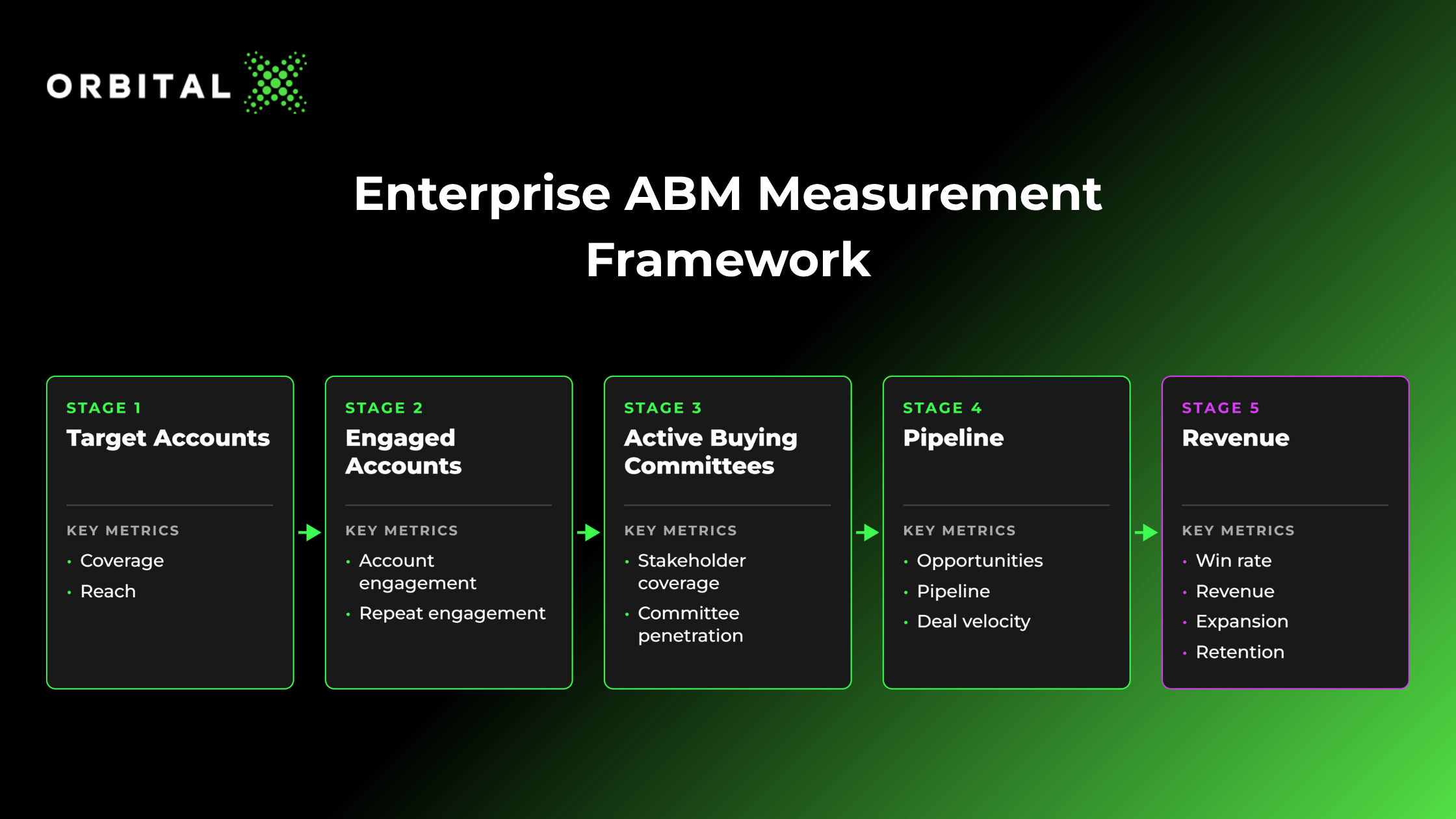
A useful measurement framework follows the account journey from target accounts to engaged accounts, active buying committees, and finally, pipeline and revenue. Each stage provides a different view of whether priority accounts are driving closer to a closed deal. This combined analysis also shows marketing and sales where momentum is being lost and whether ABM is contributing to business goals.
Measure Target Accounts
See if the program is reaching your defined target accounts across the channels and stakeholders that matter. There's no prize for running a brilliant campaign that your priority accounts never see. Track account coverage and reach, as well as early engagement rate to make sure your campaigns are getting in front of the companies you deliberately chose to pursue.
Keep reach and meaningful engagement separate. An account seeing an ad indicates you've caught someone’s attention but not if the account is interested. Look for stronger signals across relevant stakeholders and channels to understand if engagement is developing. These metrics give you an early read on whether your distribution is reaching the right market before you move on to pipeline and revenue.
Measure Account and Buying-Committee Engagement
Rather than treating every action from a contact as a standalone signal, look at interactions across the whole account. Track account-level engagement across content, website activity, advertising, and repeat interactions to see if interest is building over time. At the individual committee-member level, measure the number of engaged stakeholders, buying-committee penetration, stakeholder coverage, and engagement across relevant functions.
A single webinar recording viewing tells you very little on its own. However, repeat visits, content consumption, and ad engagement over several weeks is a much better sign that an account is genuinely interested in your business. Likewise, a highly engaged champion can be valuable, but broader engagement gives you a clearer picture of account progression. If engagement expands from one technical manager to executive, financial, and other relevant stakeholders, your multi-threading strategy is gaining traction.
A five-person buying committee isn't going to behave like a 20-person one. What matters is having enough coverage across the buying group to see whether the account is genuinely progressing. Identify meaningful patterns that show an account is paying attention.
Measure Pipeline
Pipeline numbers are a little more concrete. Track opportunities created, pipeline generated and influenced, deal velocity, and average contract value. If you analyze both generated and influenced pipeline, define the distinction explicitly so teams don't count the same contribution twice:
Generated pipeline refers to opportunities where ABM activity played a direct role in creating the opportunity.
Influenced pipeline captures opportunities where ABM engagement contributed to an opportunity already in motion.
Attribution gets more complicated with enterprise deals, though, since they involve multiple stakeholders and touch points across marketing and sales. Tellingly, only 26% of organizations run measurement and attribution separately for their ABM programs, according to Demand Gen Report.
You don't need to assign a precise revenue value to every interaction. Instead, review prioritized accounts progression toward opportunities and how their performance compares to relevant historical or non-ABM benchmarks.
Measure Revenue
Connect your ABM program to the outcomes your business ultimately cares about, namely, winning valuable customers, growing existing accounts, and retaining them. Monitor win rate, revenue generated, customer acquisition value, expansion, and retention, recognizing that revenue goals take longer to hit than earlier signals like engagement and stakeholder coverage.
Another useful way to evaluate ABM is through deal value. Research from Forrester discovered that one-third of organizations reported an 11%–20% increase in average deal size for ABM accounts, while just under one-third reported a 21%–50% increase, compared to non-ABM accounts. Follow this KPI alongside whether the program is helping create, win, expand, and retain valuable accounts.
Don't Confuse Activity With Progress
Clicks, impressions, and downloads can tell you what's happening at the activity level. However, they're also really good at making a slide deck look healthy while revenue quietly sits there, not budging a centimeter.
Although valuable, activity isn't the same thing as account progression. An MQL doesn't tell you if an account as a whole is engaged, whether the buying committee is expanding, or whether an opportunity is moving forward. Meanwhile, meaningful engagement across two strategic accounts signals far more progress. That’s why you should use them as guides that help you understand what’s happening at the account level and decide what to do next.
Ask your team four questions:
Are our target accounts engaging?
Is engagement expanding across the buying committee?
Are opportunities being created or progressing?
Is the program contributing to pipeline and revenue?
Measurement Stages
Measurement Stage | What You're Trying to Determine | Example Metrics |
Target accounts | Are we reaching the accounts we chose to pursue? | Account coverage, account reach |
Engaged accounts | Are priority accounts showing meaningful engagement? | Account engagement rate, repeat engagement, content engagement |
Active buying committees | Is engagement expanding across relevant stakeholders? | Stakeholder coverage, committee penetration, engaged stakeholders |
Pipeline | Is account engagement translating into opportunities? | Opportunities created, pipeline generated/influenced, deal velocity |
Revenue | Is the program producing commercial outcomes? | Win rate, revenue, expansion, retention |
Enterprise ABM Best Practices
Effective enterprise ABM depends on making deliberate decisions about where to invest, how much effort each account warrants, and when to change course. Basically, don’t give every account the same level of attention.
Start with a focused set of accounts your organization can meaningfully support, then match resources to commercial value, strategic importance, and buying potential. Invest appropriately based on the opportunity while maintaining accountability for commercial outcomes.
Prioritize Accounts and Allocate Resources
Don't spread your budget and team capacity too thin. This isn’t a breakfast buffet facing a butter shortage with a line of hungry people holding dry toast. Start with an account list your organization can genuinely support, then match the level of investment to each account's value, strategic importance, buying potential, and the sales capacity available to work it.
High-priority accounts may justify bespoke content, custom experiences, direct mail, or executive events, while broader account groups can be supported through scalable digital programs and lighter personalization. More expensive tactics aren't automatically more effective, so reassess your investment as account conditions change.
Align and Adapt
The sales team’s involvement shouldn’t end when a lead gets lobbed over the digital fence to them. Keep the team involved throughout the program. Regular account reviews give sales and marketing a chance to spot movement, stalled accounts, new stakeholders, coverage gaps, opportunities, and shifting priorities, then agree on who does what next.
If an account changes direction, alter the play. Adjust messaging, outreach, campaign activity, or resource allocation based on what the target is telling you rather than continuing a plan simply because it was in the original campaign playbook. Sales and marketing can maintain distinct responsibilities while staying jointly accountable for account progression. Enterprise ABM works when teams invest deliberately, stay coordinated, and adapt as the accounts themselves change.
Translate Enterprise Target Accounts Into Revenue With a Tailored ABM Strategy
Enterprise marketers have the difficult task of creating meaningful movement inside high-value accounts. Thankfully, enterprise ABM can step up to help. This strategy gives sales and marketing a shared operating model for deciding which targets deserve attention, understanding who's involved in the buying process, coordinating activity around account priorities, and adapting as those priorities change. Enterprise ABM is a strong tactic to move the right accounts toward becoming customers and generating revenue.
Ready to turn your high-potential accounts into pipeline but don’t know where to start? Orbitalx’s DemandWEBS™ platform helps B2B companies connect account strategy, demand generation, campaign execution, sales engagement, and measurement in a repeatable pipeline-generation system. Book a call with us to learn how our system can smoothly guide enterprise targets to closed deals.
FAQs
When should a company invest in enterprise ABM?
Enterprise ABM makes sense when you have a defined group of high-value accounts where winning, expanding, or retaining customers materially impacts revenue. It works best for deals with long sales cycles, multiple stakeholders, and significant sales touch points. Your business also needs solid account data, sales capacity, and marketing resources to run focused campaigns.
How many accounts should an enterprise ABM program target?
There’s no universal number of enterprise accounts to hit in an ABM program. Target account volume depends on deal value, sales bandwidth, budget, and personalization depth. A tiny group of strategic accounts might warrant one-to-one attention, while hundreds of priority accounts can be managed through scalable one-to-many plays.
What data do you need to run enterprise ABM effectively?
Enterprise ABM requires a mix of firmographic, technographic, engagement, and commercial data. Useful inputs include contract value potential, stakeholder roles, website activity, existing relationships, and organizational changes. Intent data adds another useful layer when combined with internal engagement signals.
How long does it take to see results from enterprise ABM?
Don’t expect immediate exponential growth. Timelines match your standard sales cycle. Early indicators like account reach, website activity, and buying committee engagement show up within weeks. However, opportunity creation, deal velocity improvements, and closed revenue take longer in enterprise environments. Set metrics for both early account progression and final revenue outcomes.
Can enterprise ABM work with an existing demand generation program?
Yes. In fact, enterprise ABM and demand generation complement each other. Broad demand gen builds category awareness across the market, while enterprise ABM concentrates effort on top-tier strategic accounts. Existing demand generation assets, audience insights, and infrastructure also fuel your ABM execution.
More Resources

B2B Referral Marketing: How to Build a Program That Drives Qualified Growth
Learn how to build a B2B referral marketing program that turns trusted relationships into qualified introductions, pipeline, and measurable revenue.

How to Measure Account Based Marketing: The Metrics That Drive Growth
Learn how to measure ABM with the metrics that matter, from account engagement and buying committee activity to pipeline progression and revenue impact.

Lead Generation for Technology Companies: How to Build a Pipeline System
Lead generation for technology companies breaks when volume is mistaken for pipeline. Here’s how to build demand that actually translates into revenue.