GTM Systems: The Operating Model Behind Revenue Motion
Learn what GTM systems are, how they connect data, messaging, execution, sales action, and feedback into better B2B pipeline decisions.
Key Takeaways
A GTM system connects ICP focus, data, messaging, content, channel execution, sales action, measurement, and feedback.
It’s different from a GTM strategy, CRM, RevOps process, or tech stack, which are parts of the motion. The system is how they work together.
The commercial test of a GTM system is whether it helps the team make better pipeline decisions.
GTM systems usually break when signals are captured but not prioritized, routed, acted on, measured, or fed back into the next decision.
Closing that gap requires a connected operating loop. That entails trusted data, prioritized signals, clear ownership, sales-ready context, coordinated execution, and feedback that changes the next move.
What Are GTM Systems?
GTM systems are the connected processes, data flows, tools, responsibilities, and feedback loops a company uses to execute its go-to-market motion. A GTM system shows how the business identifies the right market, prioritizes accounts, and turns insight into messaging. It also reveals how they activate channels, route signals to sales, measure outcomes, and improve the next decision.
Put simply, a GTM system is how go-to-market work moves.
A company can have a CRM, marketing automation, intent data, paid campaigns, outbound sequences, sales reports, and a documented GTM strategy but still lack a functioning GTM system. The missing part is the way information moves through the business and changes what people do next.
A useful GTM system answers operational questions such as:
Which accounts fit our ICP, and why?
Which signals suggest a real commercial opportunity?
What data is trusted enough to drive action?
What message should this account see next?
Which channel should carry that message?
Who owns follow-up?
What context does sales need?
Which outcomes should change the next campaign, audience, or workflow?
If those answers live in separate spreadsheets, meetings, dashboards, and individual habits, the company just has GTM activity. It’s like a busy restaurant kitchen trying to make orders without a head chef telling what goes where. A reliable GTM system has that coordination in spades.
A GTM system is a comprehensive operating model
A GTM tech stack is what the team uses, while a GTM system is how the work moves through the business.
That difference is obvious when a signal appears. Suppose an ICP-fit account visits a pricing page, engages with a high-intent asset, or shows a relevant market trigger. In a stack-only environment, those signals appear in analytics, enrichment software, the CRM, or Slack, but someone still has to notice and interpret it, then decide what should happen next.
In a functioning GTM system, the signal has a path. It’s checked against fit, routed to the right owner, paired with relevant context, then connected to a useful action and measured after that. The system doesn’t remove human judgment but rather gives it better inputs.
GTM system vs. GTM strategy, tech stack, CRM, and RevOps
Tools, a CRM, RevOps, and strategy remain critical, but none of them solves the whole GTM problem alone. A CRM organizes records while a stack supports execution, RevOps improves process and governance, and strategy defines direction. The GTM system unifies those parts. Think of it as a premium football club that stops buying superstar players to act as bandaids and instead finally builds a tactical playbook so the team actually passes the ball.
Term | What it is | What it doesn’t do alone |
GTM strategy | The company’s market, ICP, positioning, channel, and growth choices | Automatically coordinate daily execution |
GTM tech stack | The tools used across marketing, sales, data, and customer success | Decide which signals matter or who acts |
CRM | The system of record for accounts, contacts, opportunities, and activities | Create a full market signal-to-action loop by itself |
RevOps | The operational discipline for revenue process, data, tooling, and governance | Replace demand strategy, messaging, content, or market activation |
GTM system | The operating model connecting strategy, data, audience, content, execution, sales action, measurement, and feedback | Operate without ownership, clean data, and disciplined execution |
How GTM Systems Help When Activity Isn’t Translating Into Pipeline
Many B2B teams have plenty of movement but are short on coordinated motion.
Marketing launches campaigns, sales runs outbound, and RevOps cleans fields. Internally, intent signals appear and leadership reviews dashboards. Externally, content is published, paid channels spend, and events generate names. Despite all this activity though, pipeline quality doesn’t improve enough, sales questions the leads, and the team can’t isolate whether the issue is targeting, message, timing, handoff, channel mix, or sales execution.
Gartner’s research shows buying is nonlinear, with buyers moving across digital and human interactions. That means you need a unified system that can keep track of all those touch points. McKinsey also supports the need for omnichannel orchestration and tighter integration across marketing, sales, operations, and data.
GTM systems therefore have to connect signals across channels, buying roles, messages, and sales moments. Otherwise, the team optimizes fragments, which just produces more opens, demo requests, lead scores, dashboard views, and sales tasks. You don’t want your marketing team high-fiving over ad clicks while the sales reps down the hall complain that the leads are completely dead on arrival. A GTM system reduces that uncertainty by making the company’s response more coherent.
Related watch: What a GTM operating model looks like beyond campaign activity
In OrbitalX’s Do More With Less episode, Mark Choueke speaks with Robert Norum, ABM consultant and founder of Opportunitas, about why account-based work fails when it becomes scaled, generic campaign activity instead of a focused operating model.
Watch for a practical parallel to GTM systems. Rather than adding more activity, the point is to focus on the right accounts, align commercial teams, and build a work process that influences high-value deals.
The Core Parts of a B2B GTM System
A practical GTM system has connected layers that each feed into the next. This builds a feedback loop that improves the motion over time.
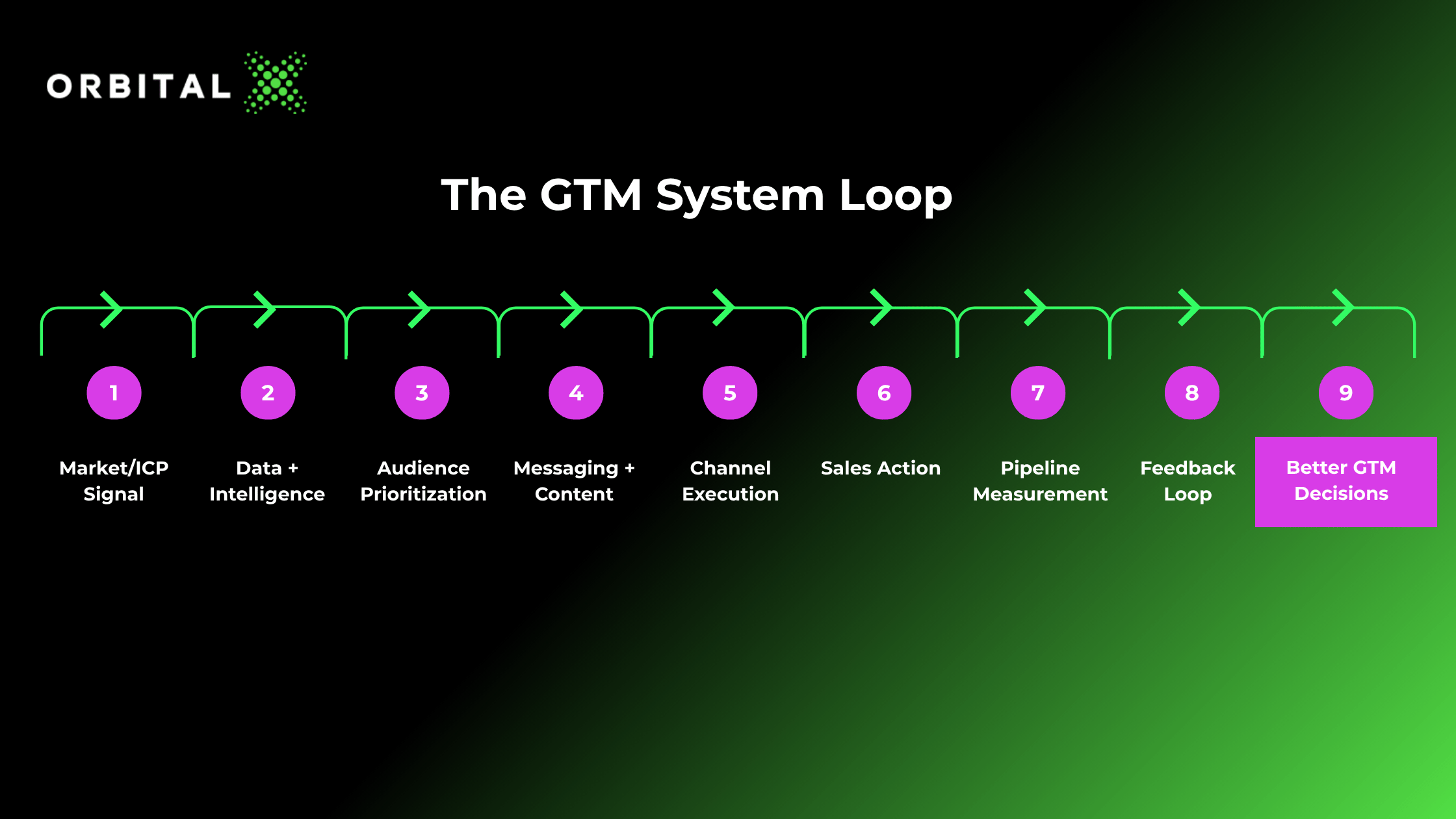 Each stage should change what happens next. If one only reports activity but doesn’t affect prioritization, messaging, routing, follow-up, or learning, it isn’t driving system work.
ICP and market-signal layer
Treating every random website click like a desperate plea for a sales call will only end in frustration. If you give the same attention to a university student downloading a white paper for a project and a VP with a real budget crisis, you’re wasting resources.
A good system starts with focus. Which companies are a strong fit? Which roles influence the buying decision? What triggers suggest the account has a reason to care now?
This layer should also separate fit from intent. A poor-fit account only shows intent while a strong fit can arrive earlier than expected. A useful GTM system looks at both whether the account is worth pursuing and whether the current signal suggests action.
Data and intelligence layer
The next layer is the data foundation. CRM records, enrichment data, intent signals, and website behavior create inputs, as do campaign engagement, sales activity, and opportunity data. But inputs don’t translate to intelligence until they’re cleaned, connected, and interpreted. Otherwise, the CRM turns into a digital junk drawer where lead details go to die.
HubSpot research found that fragmented customer data can create problems for reporting, productivity, CRM usefulness, and AI readiness. For a GTM system, if the data is incomplete, disconnected, or not trustworthy, the next action becomes guesswork.
Messaging and content layer
A GTM system also has to turn insight into relevance. ICP and signal data should influence the message a buyer receives, the content they receive, and the conversation sales opens.
Many motions weaken at this point because content isn’t mapped to the buyer’s current problem and messaging isn’t tied to account stage or segment. Sales likewise has assets but sometimes lacks the context for when to use them. Tone-deaf messaging is the B2B equivalent of someone trying to use outdated slang to sound cool to teenagers. Absolute cringe.
Channel execution layer
Channels aren’t interchangeable portals. Platforms like paid media, organic content, events, and partner activity all behave differently. The GTM system should define which channels matter for which audience, what role each channel plays, and how signals move between them.
The channel layer needs to clarify which avenues matter for which audience, what each channel is meant to do, and how signals move between them so the team avoids running disconnected campaigns. That’s a straight shot to watching a massive paid media budget disappear into a black hole without a single conversion.
Sales action and handoff layer
A signal that triggers the right next action creates commercial value. That action may be a sales task, account research, a tailored outbound message, a nurture path, or no immediate action because the signal’s too weak.
The handoff should include full context. Sales needs to know why the account matters, what changed, what the buyer engaged with, what message is relevant, and what action is expected. Picture a rep receiving a vague, automated Slack notification that just says "account active" with zero context. They’ll be hopping on a call completely blind.
Measurement and feedback loop
The final layer is feedback. Which signals led to qualified opportunities? Which messages helped move accounts? What channels produced ICP-fit pipeline? Where did sales reject leads? Where did handoffs slow down? What should change?
Without that loop, the system reports the past but won’t improve future motions. It’s no better than a corporate post-mortem that only tells why you lost the deal three months ago, rather than guiding your next move.
How to Tell Whether You Have a GTM System or Just a Stack
A stack becomes a system when signals, workflows, ownership, measurement, and feedback are connected enough to change action.
Symptom | Stack-only behavior | System behavior |
New buying signal appears | Someone notices manually or exports a list | The signal is scored, routed, and matched to a useful action |
CRM data changes | A field changes, but no campaign or sales behavior changes | Audience, routing, and messaging update accordingly |
Campaign performs well | The team reports engagement | The team identifies which accounts, messages, and follow-up paths created pipeline |
Sales rejects leads | Marketing argues source or channel quality | The system checks fit, timing, context, and handoff gaps |
Leadership asks what’s working | Each team brings a separate dashboard | A shared scorecard shows where the revenue motion is improving or breaking |
The litmus test is whether the tools change coordinated behavior. If a signal doesn’t affect prioritization, it’s pure noise. A dashboard should change decisions while the system should capture why sales rejects certain leads.
Common GTM System Failure Points
Data isn’t decision-ready
Most teams have more data than they can use but lack trust, structure, and actionability. If account records are incomplete, source fields are unreliable, buying signals are disconnected, and CRM ownership is unclear, the team can’t build consistent GTM decisions on top of that data.
Tools multiply faster than workflows mature
There’s a common B2B habit of collecting software subscriptions like shiny scout badges. But adding tools just gives a broken process an expensive top layer. It also creates more places for work to disappear. If each platform has its own logic, owner, dashboard, and definition of success, the stack will grow while the system weakens.
Signals are captured but not prioritized
More signals don’t automatically lead to better decisions. A strong system defines which signals matter, how they’re weighted against fit, what action they trigger, and when they should be ignored.
Follow-up is too slow or generic
Timing matters, but speed alone isn’t enough. A fast, context-free follow-up can still miss the buyer’s problem. That’s a fast track to a terrible discovery call where a rep gives a hot prospect the same generic pitch they use on everyone else and completely wastes the intent signal. A useful GTM system gives sales enough context to act with relevance. It tells them why this account, why now, what they engaged with, what pressure may be active, and what conversation should happen next.
Ownership is unclear
GTM systems decay when no one owns the operating model. Research from Gartner emphasizes the importance of shared data, governance, stakeholder alignment, milestone ownership, and pipeline visibility across revenue teams. RevOps can own important parts of that motion, especially process, data, tooling, and governance. The wider GTM system still needs clear accountability for how people, data, workflows, and measurement connect.
Measurement reports activity instead of system health
Although lead volume, email engagement, ad clicks, and meeting counts are useful, they don’t prove the GTM system is healthy. You need to determine if the system is helping the company make sharper decisions in the form of better account selection, routing, message fit, handoffs, and clearer learning from pipeline movement.
How to Build or Improve a GTM System
Map the revenue motion before adding tools
Resist the urge to jump straight to buying software. Remember, a new software subscription isn’t a magic wand that’ll instantly mend a broken internal process. Start with the motion instead. Define the ICP, buying committee, triggers, channels, handoffs, conversion points, and key decisions. A tool can only support the system if the team knows what the system is supposed to do.
Define signal-to-action rules
Write down what should happen when a meaningful signal appears. Which signals matter? Which accounts qualify? Who owns the next step? What context do they receive? What action is expected? What should happen if sales rejects the account or no movement follows?
Don’t try to make these rules perfect. They just need to be explicit enough to test.
Connect data and workflows around the rules
Once the decision rules are clear, link the tools to them. CRM, marketing automation, enrichment, intent data, sales engagement, paid media, and reporting should support the operating logic. If the system requires manual rescue at every handoff, it’s not a system yet.
Assign ownership and governance
Someone has to own the operating model, whether it’s GTM leadership, RevOps, marketing operations, sales operations, or a cross-functional group. The important part is clarity, because without it, every campaign update turns into a tedious, cross-departmental negotiation where nothing gets done.
Review the system on a cadence
A GTM system should improve through use. Review what moved, what stalled, what sales rejected, which messaging worked, which channels produced ICP-fit movement, and what data gaps slowed decisions. Then adjust the whole system.
Metrics for GTM System Health
Measure a GTM system by whether it improves decisions and movement. To do so, GTM systems have to connect to broader GTM efficiency. The aim is to understand if the company is allocating effort, budget, and sales attention toward the revenue motion most likely to work.
Metric category | Example metric | What it tells you | Caveat |
Fit quality | Share of pipeline from ICP-fit accounts | If targeting and audience logic are working | Requires a clear ICP and CRM hygiene |
Signal action | Time from qualified signal to first useful sales action | If signals trigger timely execution | Speed alone isn’t enough if context is weak |
Handoff quality | Acceptance and rejection reasons from sales | Whether marketing output is usable | Needs structured feedback |
Stage movement | Conversion between key funnel or opportunity stages | Where system friction appears | Must be segmented by ICP, source, channel, and motion |
Deal velocity | Time from qualified account activity to opportunity or close | Whether the system reduces friction | Influenced by deal size, sales cycle, and market |
Feedback loop | Decisions changed because of campaign, message, channel, or pipeline insight | If measurement informs action | Don’t count reports that change nothing |
Data quality | CRM completeness, duplicate rate, field reliability, source coverage | Whether the system has trustworthy inputs | Data quality is a means only |
Where OrbitalX and DemandWEBS™ Fit
Use the scorecard to test whether the system helps the team select better accounts, act at the right time, improve handoffs, and learn from revenue movement.
Many GTM systems break at this point for lean B2B teams. The ingredients may be present (CRM data, campaign activity, intent signals, content, sales capacity, reporting, and a clear growth target). But the missing layer is the operating rhythm that decides what data can be trusted, which accounts deserve attention, which signals should change priority, what message to send next, what context sales needs, and what the next feedback cycle should improve.
Adding another platform or asking the same small team to run more campaigns isn’t the solution. The real fix is turning data into audience intelligence, audience intelligence into content and execution, execution into sales action, and pipeline response into the next decision.
OrbitalX’s DemandWEBS™ supports this process. Our approach uses an AI marketing operating system alongside expert operators to connect data, intelligence, audience, content, and execution in one feedback loop. For GTM systems, DemandWEBS™ interprets signals, prioritizes audiences, and coordinates content and channels. This gives sales action better context, and measurement feeds the next move.
StackOne experienced the power of this mechanism firsthand. They had outbound motion, account data, and a technical buyer market, but the team needed a smarter way to prioritize accounts and personalize at scale. OrbitalX helped build custom workflows around ICP, growth stage, technical nuance, and signal-rich account selection.
“We stopped focusing on the number of accounts we were reaching and instead focused on reaching the right ones,” said Romain Sestier, CEO and founder of StackOne.
That separates GTM activity from a working GTM system. It drives revenue motion where data, audience decisions, content, channels, sales action, and feedback keep sharpening each other.
If your team has GTM activity but still struggles to decide what to prioritize or what should change next, book a call with OrbitalX. We’ll show you how DemandWEBS™ can support a more connected GTM operating model.
FAQs
What are GTM systems?
GTM systems are the connected processes, tools, data flows, responsibilities, and feedback loops a company uses to execute its go-to-market motion. They help turn market signals, ICP focus, messaging, content, channel execution, sales action, measurement, and learning into coordinated revenue activity instead of disconnected marketing and sales tasks.
What is the difference between a GTM system and a GTM strategy?
A GTM strategy defines who to target, how to position, which channels to use, and how growth should happen. A GTM system makes that strategy executable by defining how data, signals, content, workflows, ownership, sales action, and feedback operate day-to-day. Strategy sets direction, whereas the system turns direction into coordinated action.
Is a GTM system the same as a GTM tech stack?
No. A GTM tech stack is the collection of tools used across marketing, sales, data, and customer success. A GTM system includes tools but also defines how they connect, which signals matter, who acts, what message is used, and how outcomes improve the next decision. Tools support the system but don’t replace it.
Is a CRM a GTM system?
A CRM can be part of a GTM system, but it’s not the whole thing. The CRM records accounts, contacts, opportunities, and activity. A GTM system defines how signals, audience decisions, campaigns, sales actions, reporting, and feedback move through the business. If the CRM stores data but doesn’t change action, the system is incomplete.
Who owns a GTM system?
Ownership depends on the company, but it must be explicit. GTM leadership often owns the commercial model, with RevOps, marketing, sales, and customer success owning specific workflows. It’s a mistake to leave the system ownerless, where every team manages its own piece and no one owns the full revenue motion or feedback loop.
What should a GTM system measure?
A GTM system should measure fit quality, signal action, handoff quality, stage movement, deal velocity, feedback loops, and data quality. Beyond counting activity, the goal is to determine if the system is improving account selection, timing, execution, sales relevance, and pipeline decisions.
More Resources

B2B Content Marketing Funnel: Stages, Strategies, and How to Build One That Converts
Build a B2B content marketing funnel that aligns content with buyer needs, connects the journey, and turns content engagement into pipeline and revenue.

B2B Referral Marketing: How to Build a Program That Drives Qualified Growth
Learn how to build a B2B referral marketing program that turns trusted relationships into qualified introductions, pipeline, and measurable revenue.

A PE-Backed Company Cut Marketing From 12 People to 3. Then Had Its Best Six Months Ever.
A marketing team cut from 12 to 3, then the best six months in the company's history. Here's the growth system behind it, and what it means for PE portfolios.