B2B Content Marketing Funnel: Stages, Strategies, and How to Build One That Converts
Build a B2B content marketing funnel that aligns content with buyer needs, connects the journey, and turns content engagement into pipeline and revenue.
Key Takeaways
Map content to buyer needs, not just TOFU, MOFU, and BOFU labels.
Account for multiple stakeholders, questions, priorities, and objections throughout the B2B buying journey.
Connect content with logical pathways so buyers can find the next relevant resource.
Build the funnel around buyer questions, then audit existing content before creating new assets.
Measure content by its contribution to buyer progression, pipeline, and revenue, rather than traffic alone.
Your content calendar is full. Your pipeline still isn't.
B2B teams can spend months producing articles, guides, webinars, case studies, and white papers without giving buyers a clear path through them to the next stage in the buyer’s journey. Each content asset ends up operating on its own, answering one question while leaving the next one hanging.
B2B buying journeys are rarely tidy. Prospects research problems, compare options, pull in stakeholders … then disappear for three weeks, come back with five new questions, and eventually ask, “Can you send this to procurement?”
Your content has to be ready for all of it.
A B2B content marketing funnel connects your content to the questions buyers are asking as they move toward a decision. Each asset should have a clear role, whether that's creating demand, answering a critical question, building confidence, supporting evaluation, or helping move an account closer to revenue.
The journey doesn't end when the contract is signed, though. Content can continue and support adoption, expansion, referrals, and advocacy, giving the investment a much longer life than the original campaign or content calendar listed.
What Is a B2B Content Marketing Funnel?
You know that 40-page white paper your team spent three months creating? The one sitting behind a 10-field form that asks for a phone number, company size, job title, and probably blood type? Yeah, that's not a content funnel.
A B2B content marketing funnel is a framework for aligning content with a business’s questions, needs, and decision-making process. Rather than treating every piece of content as an isolated asset, it helps marketers understand what buyers need to know at different points in their journey and how content can help them move forward.
That’s particularly useful in B2B, where purchases can involve longer consideration periods, multiple stakeholders (5–16, according to Gartner), competing priorities, and significant perceived risk. People enter the journey at different points and need different information before they can commit to a decision. They may even skip stages, revisit earlier questions, or move between different types of content as their needs change.
The funnel therefore shouldn’t be treated as a fixed sequence that every buyer follows in order. The goal is to create a connected content experience that helps buyers reduce uncertainty, evaluate their options, and take the next relevant step. A modern content funnel provides clear answers whenever and wherever they show up, supporting your broader B2B demand generation marketing strategy.
See more:
B2B Content Marketing Funnel vs. Traditional and Inbound Marketing Funnels
Although a B2B content marketing funnel is related to broader marketing and inbound funnel models, it deals with a more specific aspect of the buyer journey. A traditional funnel provides a wider framework for understanding how prospects move from awareness to consideration and conversion. It describes the progression without necessarily specifying how a business should support each stage.
An inbound marketing funnel then applies that idea to an inbound system. It can use content alongside SEO, email, landing pages, lead capture, nurturing, automation, and other mechanisms designed to attract, engage, convert, and retain prospects.
A content marketing funnel specifically focuses on how content supports the buyer throughout that journey. It maps the questions buyers need answered and connects content to those needs as they become more informed and move closer to a decision.
Rather than representing completely separate buyer journeys, the three concepts overlap:
Traditional Funnel: Maps a prospect’s broad progression.
Inbound Funnel: Encompasses the system that drives a lead’s movement, including tech stack and distribution tactics.
Content Funnel: Delivers the substance and context that fuels that machine.
Think of a traditional marketing funnel as casting a wide net and seeing what you pull in. A B2B content funnel is more like sitting your boat at one spot where you know you can snag a big catch with the right bait. The conversation changes depending on what the prospect is trying to figure out. First is the problem, then their options, then comes the, “Okay, but can we actually buy this?” question.
You can run an incredible inbound marketing machine, but if the content inside it is all fluff, the system fails. The content layer supplies the narrative, proof, and substance that turns passive interest into pipeline.
Stages of the B2B Content Marketing Funnel
A B2B content marketing funnel typically covers four areas of the buyer and customer journey. These are awareness, consideration, decision, and post-purchase retention and expansion. Each stage reflects a different set of buyer needs, so the role of content changes as buyers become more informed and move closer to a decision.
These aren't rigid steps that every buyer follows in order. They can enter at different points, revisit earlier questions, or consume content across several stages. The purpose of the funnel is to ensure useful content is available to support the questions and decisions that arise throughout the journey.
Top of Funnel: Awareness
This is when the CFO may start asking why that beautifully researched explainer video hasn't produced a six-figure deal by last Friday. It hasn't failed, because that's not the job of awareness content. Its goal is to help the right buyers recognize a problem, understand what's at stake, and remember your brand when they're ready to investigate the solution.
Buyers at this stage know something isn't working, but they haven't named the fix yet. They're searching for definitions, causes, context, and different ways to think about the problem.
McKinsey found that roughly one-third of B2B customers expect to depend on digital-first interactions during the next year. That makes useful, easy-to-find information increasingly important in early research, when buyers are still figuring out the problem rather than evaluating solutions.
Use educational articles, introductory guides, videos, and original data to answer those early questions. Data from TopRank Marketing and Ascend2 uncovered that 93% of teams creating content with original research report it drives engagement and leads. Treat that as a signal of perceived effectiveness rather than a guaranteed outcome, but it's a good reason to consider original research when you have something genuinely useful to say.
.png) Middle of Funnel: Consideration
Middle of Funnel: Consideration
Once buyers frame their problem, they start weighing approaches. Should they build or buy? Fix the process manually or automate it?
Buyers prefer to do the heavy lifting themselves, which means your consideration-stage content needs to handle the work a sales rep used to do. Detailed buyer's guides, comparison pieces, webinar recordings, and solution explainers shine here. Leads are more inclined to consume three comparison guides and a recorded webinar at 1.5-times speed on mute long before they ever agree to book a sales call.
Show leads how different methods work in the real world and help them evaluate trade-offs without sounding like an ad.
Bottom of Funnel: Decision
The decision stage is all about risk reduction. The buying committee is down to two vendors, and the CFO is asking hard questions about ROI.
Provide validation. Detailed case studies, implementation timelines, ROI calculators, and side-by-side vendor breakdowns build confidence. Don't just slap a "Book a Demo" button on every page. Give the buying group the internal ammunition they need to defend choosing your solution to their leadership team.
Post-Purchase: Retention and Expansion
The funnel doesn't snap shut when the contract is signed. Onboarding content, customer education, training webinars, and product updates keep buyers-turned-customers engaged.
Post-purchase content supports seamless adoption. It turns passive users into champions who buy add-ons, expand seat counts, and provide the testimonials that fuel your next top-of-funnel campaign.
How to Build a B2B Content Marketing Funnel
Building a B2B content marketing funnel starts with understanding your audience and buying journey, then aligning content, pathways, and calls to action with what buyers need at each stage. From there, you can assess what already exists, identify meaningful gaps, and connect content engagement to business outcomes.
1. Define Your Audience, Buying Roles, and Journey
Start with your ICP. Who makes up the buying committee? Who holds the budget? Who will actually use the product day-to-day? Map out how these distinct roles interact during the purchase process. If your messaging only targets the end user, the executive sponsor will kill the deal every single time.
2. Map Buyer Questions and Objections
Brainstorm every single question a prospect asks before buying. Pull real inputs from:
Sales call recordings and objection logs
Customer support tickets
Search trends and community discussions
Interview feedback from actual clients
Forrester research shows that effective content must be created from the buyer’s point of view, addressing their specific challenges rather than pitching product features. Build an exhaustive map of those questions.
3. Audit Existing Content
Take stock of what you currently have before spending money on new production. Catalog your assets by topic, funnel stage, target persona, and performance.
You may find a small graveyard of forgotten PDF eBooks sitting on a shared drive, each one packed with material that could become articles, social posts, email content, sales enablement, or a newsletter series. Before commissioning another 40-page white paper, check whether the one from 18 months ago still has something useful to say.
Look for gems that need a quick update, assets with broken links, and outdated research reports that can be turned into crisp, ungated articles. A good content audit can uncover plenty of material worth refreshing, repurposing, or putting back in front of buyers.
4. Identify Content Gaps
Compare your buyer question map against your content audit. Are you missing key decision-stage proof points? Are you ignoring the CFO's financial concerns?
According to CMI, 39% of B2B marketers with underperforming strategies attribute the failure to content that isn't connected to the customer journey. Stop filling arbitrary publishing quotas and focus on closing actual information gaps.
.png) 5. Match Content and CTAs to Funnel Stages
5. Match Content and CTAs to Funnel Stages
Make sure every call to action offers a logical next step:
Awareness: Point to related research, guides, or newsletter sign-ups.
Consideration: Suggest a detailed comparison guide, webinar, or case study.
Decision: Offer an ROI calculator, a custom demo, or a direct consultation.
Don't force a decision-stage ask onto a reader who just discovered your brand five minutes ago.
6. Create Pathways Between Stages
Disconnected assets lead to dead ends. Use contextual internal links, related asset modules, and logical content hubs to invite buyers to take the next step. If someone finishes reading an article on basic problem diagnosis, give them a direct link to a comparison breakdown covering how to evaluate potential solutions.
7. Connect Content Engagement to Pipeline
Content measurement should be tied to sales intent data. Track account-level engagement, repeat visits from target companies, and multi-stakeholder reading patterns. Coordinate definitions with your sales team so everyone agrees on what constitutes a warm, pipeline-ready account.
How to Measure B2B Content Marketing Funnel Performance
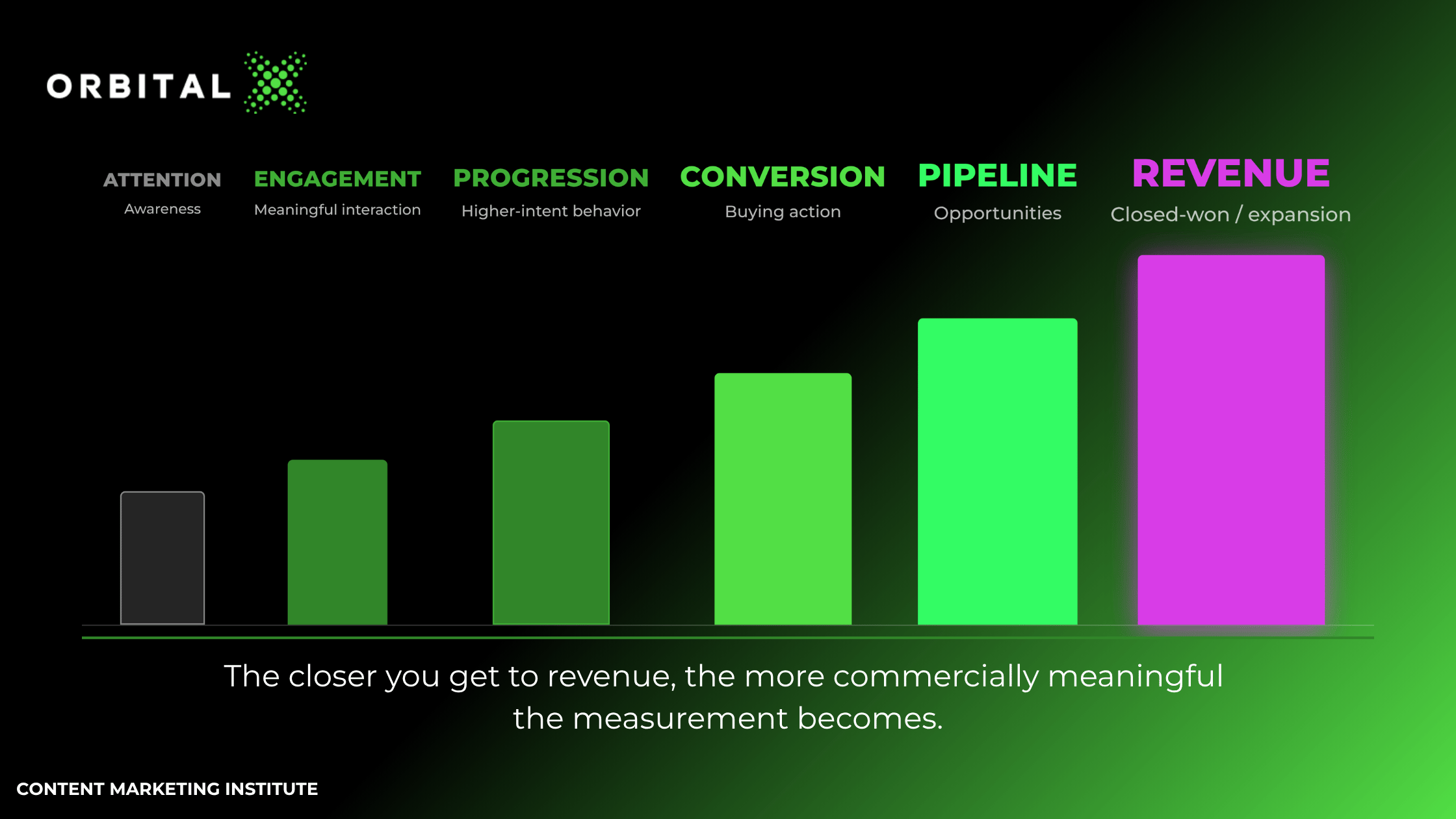
A strong content marketing measurement framework follows the funnel from awareness through engagement, progression, conversion, pipeline, and revenue. At the top, marketers can assess if content is reaching relevant audiences and target accounts. Further down, the focus shifts toward whether buyers are engaging with multiple resources, consuming higher-intent content, and progressing toward meaningful buying actions.
Sure, 10,000 page views look great in a marketing report. They’re considerably less impressive when none of those visitors can buy what you're selling. It's like boasting to your mates that a hundred people walked past your shop front, even though not a single soul stepped inside to buy anything.
Monitoring the performance of your B2B content marketing funnel requires more than tracking traffic, rankings, or individual conversions. Those metrics can tell you if content is attracting attention, but they don't necessarily show whether it’s helping the buyers who matter progress toward a purchase. B2B content needs to be measured in the context of the buyers, accounts, and revenue opportunities it reaches.
Pipeline provides a stronger connection to commercial performance. Content-sourced pipeline measures opportunities where content played a direct acquisition role, while content-influenced pipeline captures opportunities where content contributed somewhere within a broader buying journey.
Revenue is the ultimate business outcome, but content's contribution can be difficult to isolate in complex B2B journeys. In fact, CMI reported that 56% of B2B marketers struggle to attribute ROI to content, while another 56% find it difficult to track customer journeys effectively. Multiple channels and stakeholders may influence a deal over months, so measurement should provide useful evidence without pretending that one asset deserves sole credit.
Measurement Level | Core Focus | Key Metrics |
Attention | Awareness | Organic target reach, ICP traffic, account impressions |
Engagement | Meaningful Interaction | Time on page, scroll depth, return visits |
Progression | Intent Behavior | Movement to BOFU assets, multi-page sessions |
Conversion | Buying Action | Resource downloads, webinar sign-ups, demo requests |
Pipeline | Business Impact | Content-sourced and content-influenced pipeline |
Revenue | Commercial Value | Closed-won revenue, account expansion value |
You need to understand whether content is reaching the right buyers, helping them progress, and contributing to commercial outcomes. Stop obsessing over isolated metrics and track progression instead.
 B2B Content Marketing Funnel Optimization Strategies
A B2B content marketing funnel should evolve as buyer behavior, performance data, and sales feedback reveal where the experience is falling short. Optimization means finding points of friction and improving the paths that help buyers progress.
Find and Fix Stage Gaps
Look at your analytics to see where buyers lose momentum. Do high-traffic blog posts lead to zero onward clicks? You might have strong top-of-funnel reach but a total lack of consideration resources. Fix the leaks before adding more top-of-funnel traffic.
Improve Internal Pathways
Buyers don't navigate websites the way they used to. Forrester even notes the traditional “search then click” path has broken as buyers use AI tools to aggregate and answer questions directly.
Research from Forrester also revealed that 89% of B2B prospects now use generative AI throughout the buying process. That means your content needs clear structure, authoritative data, and direct answers so both human buyers and AI platforms can index and surface it. Lean into generative engine optimization (GEO) to remain visible wherever buyers research.
Test CTAs and Conversion Points
A/B test CTA copy, offer positioning, and button placements to see what yields the best results. Match the friction of the ask to the value of the asset. Don't demand a phone number for a simple one-page checklist.
Use Intent and Engagement Signals
Look at combined behaviors. An account that visits three comparison pages, reads a case study, and spends 10 minutes on your pricing page is dropping serious buyer intent signals. Use those insights to trigger timely sales outreach.
Repurpose Content Based on Performance
Recycling is for more than just plastics and cardboard. Take your best-performing long-form assets and turn them into short-form videos, LinkedIn carousels, newsletter editions, or podcast topics. Get more mileage out of ideas that have already proven they resonate.
Use Sales Feedback to Address Objections
Sit in on sales calls and listen to recorded conversations. Ask reps about the objections that keep surfacing late in the sales cycle. If marketing is celebrating a pile of content downloads while reps hear, “We don't have the budget,” “How does this integrate with our existing stack?” or “I need to get procurement involved,” that’s a content gap.
Turn those objections into targeted decision-stage content that answers the questions before they become roadblocks. A comparison guide, integration explainer, pricing FAQ, implementation guide, or customer story can give buyers the information they need while giving sales something useful to send when the same objection comes up for the fifteenth time.
Remove Friction
Clear away unnecessary form fields, slow-loading assets, and clumsy site navigation. Nobody wants to fill out 14 boxes on a form, verify their email, solve a CAPTCHA, and provide their company’s yearly revenue just to download a three-page PDF. Make it easy as pie for buyers to get the information they need without jumping through administrative hoops.
See more:
Hone Your B2B Content Into a Well-Oiled Revenue Machine
A B2B content marketing funnel should give every piece of content a clear role in the buyer journey. TOFU, MOFU, and BOFU help organize that journey, but the real value comes from connecting those stages so content helps buyers get answers, build confidence, evaluate options, and make decisions.
When content is tied to buyer needs and revenue metrics, it has a much bigger job than just filling out the blog. Each asset can support demand, influence pipeline, guide sales conversations, and continue working even after the deal closes.
That's where OrbitalX’s DemandWEBS™ platform comes in. It connects owned, paid, and earned channels in a compounding demand engine, bringing your content, audience, and buyer journey into one connected system. We’re the squad in the trenches alongside lean marketing teams.
Ready to make your content work harder? Book a call with OrbitalX to build a connected B2B demand generation system that turns audience attention into predictable, closed-won revenue.
FAQs
What is a B2B content marketing funnel?
A B2B content marketing funnel is a framework for aligning content with the questions, needs, and decision-making process of business buyers. It helps marketers plan content that supports buyers as they move from understanding a problem to evaluating solutions and making a purchase. A content marketing funnel focuses on how information helps buyers progress through that journey.
What are the stages of a B2B content marketing funnel?
A B2B content marketing funnel typically includes awareness, consideration, decision, and post-purchase retention and expansion stages. Awareness content helps buyers understand a problem or opportunity. Consideration content supports research and evaluation. Decision content provides proof and helps resolve final objections. Post-purchase content supports onboarding, adoption, expansion, and advocacy. Buyers don't necessarily move through these stages in a fixed sequence though, particularly when multiple stakeholders are involved.
What content works best at each stage of the B2B funnel?
The best content depends on what buyers need at each stage. Awareness content typically focuses on education and problem understanding. Consideration content helps buyers compare approaches and evaluate options. Decision content provides proof, validation, implementation information, and objection handling. Post-purchase content supports onboarding, education, advanced use cases, and advocacy. Match the buyer's intent and answer the questions they have at that point.
How do you measure a B2B content marketing funnel?
Measure the funnel by looking at progression from awareness and engagement through conversion, pipeline, and revenue. Useful indicators can include target-account reach, repeat engagement, movement into higher-intent content, buying-group engagement, and content-assisted conversions. At the pipeline level, distinguish between content-sourced opportunities, where content helped generate the opportunity, and content-influenced opportunities, where content contributed to the broader journey.
How can you optimize a B2B content marketing funnel?
Optimize a B2B content marketing funnel by identifying gaps, improving pathways between content, and matching CTAs to buyer intent. Engagement signals can pinpoint where buyers progress or lose momentum. Update or repurpose content based on performance, and use sales feedback to identify questions and objections that existing content doesn't address. Remove friction from navigation, forms, CTAs, and content discovery so buyers can find the information they need.
More Resources

B2B Referral Marketing: How to Build a Program That Drives Qualified Growth
Learn how to build a B2B referral marketing program that turns trusted relationships into qualified introductions, pipeline, and measurable revenue.

A PE-Backed Company Cut Marketing From 12 People to 3. Then Had Its Best Six Months Ever.
A marketing team cut from 12 to 3, then the best six months in the company's history. Here's the growth system behind it, and what it means for PE portfolios.

Enterprise ABM Best Practices for Continuous Optimization
Learn enterprise ABM best practices for prioritizing accounts, engaging buying committees, aligning sales and marketing, and driving account progression.