B2B Marketing Strategy Framework: Stop Chasing Tactics, Start Building Strategy
Build a B2B marketing strategy framework that connects audience, positioning, demand generation, sales alignment, and measurement to revenue.
Key Takeaways
A B2B marketing strategy framework connects commercial priorities to audience, positioning, demand generation, sales alignment, and revenue measurement.
The framework should guide marketing decisions before individual channels, campaigns, or tactics are selected.
A strong strategy starts with a defined ICP and clear positioning, then builds demand generation around how target buyers research and make decisions.
Sales and marketing alignment connects marketing activity to pipeline, while measurement shows commercial performance and informs future decisions.
The framework should be treated as an ongoing decision-making system that can be refined as the business learns more about its market and performance.
The campaign calendar is packed, but the sales team is twiddling their thumbs. The pipeline apparently didn’t get the memo.
B2B marketing can generate an impressive amount of activity while making surprisingly little progress. Channels pull in different directions, messaging changes with every campaign, and sales and marketing need a mediator to agree on what counts as a qualified lead. Somehow, the monthly report is still mostly green.
A B2B marketing strategy framework gives those efforts a shared direction. It structures the decisions behind your strategy, connecting who you target, what you say, how you reach buyers, and how you judge whether any of it is working.
A framework brings together five connected layers:
Market insight
Positioning
Demand generation
Sales and marketing alignment
Revenue measurement
Start with a clear business priority, whether that’s entering a new market, improving conversion, or building qualified pipeline. Then use the framework to decide where to focus your efforts, coordinate execution, and refine your approach as evidence comes in. That way, “What should we do next?” has a better answer than, “Another webinar?”
What is a B2B Marketing Strategy Framework?
A B2B marketing strategy framework is a structure for deciding how marketing should support a company’s commercial priorities. It helps teams determine where to focus, how activities should work together, and how performance should be evaluated.
A useful framework also remains flexible. Customer insights, sales feedback, market conditions, and performance data can challenge the assumptions behind a strategy. The framework gives teams a consistent way to assess that evidence and refine their decisions.
Without that structure, marketing can drift into managing promotions, campaign calendars, and an increasingly expensive collection of software subscriptions. Picture a board meeting where the CFO asks what marketing contributed to revenue. The CMO nervously opens a 40-slide deck on email open rates and LinkedIn impressions. By slide 12, the CFO is staring into their latte, searching for the answer at the bottom.
Those metrics can help explain performance, but leadership also needs to understand which buyers marketing is reaching, how opportunities are developing, and where investment is paying off. A strategic framework gives marketing, sales, and executive leadership a shared basis for making those decisions. It helps the team explain its priorities, connect execution to business outcomes, and agree what should change next.
How a B2B Marketing Strategy Framework Works
A B2B marketing strategy framework connects decisions across market insight, positioning, demand generation, sales alignment, and measurement. Each layer informs the others, helping teams refine their strategy as customer needs, sales feedback, and performance data reveal what should change.
Market understanding informs your core strategy. Strategy then dictates your market-facing activities. As buyers react and sales reps hold real-world conversations, that performance data feeds back into the loop to refine your core assumptions.
It creates operational consistency across your entire revenue engine. When your positioning changes, your demand generation moves instantly in step. When sales reports that a specific buyer segment is stalling, your targeting adapts without a three-month committee meeting.
Framework vs. Tactics: What's the Difference?
A framework structures your decisions. Your strategy establishes what you’re prioritizing and why. Tactics are the activities you use to put those choices into action.
Launching tactics without a strategy is like buying shots for random strangers at 11 PM. There’s noise, enthusiasm, and a deeply regretted bill. Whether anyone wants to speak to you the next day is another matter. Strategy starts with knowing who you want to talk to and why you’d have something useful to discuss.
For example, a B2B software company might identify mid-market professional services firms whose inefficient client onboarding delays revenue and drains staff time. It develops a framework based on that information, then builds a strategy that defines the priority audience, the problem it can solve, how to position the offer, and the commercial outcome it wants to achieve.
The tactics could include LinkedIn ads targeting operations directors, a webinar about onboarding friction, an email sequence for engaged prospects, and a customer case study demonstrating business value. Each activity has a purpose tied to the same strategic choices.
Adding three more ad formats or launching a TikTok account won’t automatically strengthen that strategy. If the work isn’t reaching relevant buyers or addressing a problem they care about, you’re ordering another round for people who are already booking their taxis.
Define Your B2B Audience and Positioning
A strong B2B marketing strategy starts by defining which companies the business should prioritize and how its offer should be positioned for the people involved in the buying process. An ICP pinpoints the organizations most likely to become valuable customers, while positioning establishes why those organizations should consider the offer.
Both elements should be treated as working inputs that can be refined through customer research, sales feedback, and won and lost deal analysis.
Build and Validate Your ICP
Your ICP determines where marketing and sales focus their effort, so build it from customer evidence. Start with closed-won accounts and look for patterns among customers that deliver lasting commercial value. Assess retention, expansion potential, profitability, strategic fit, and sales efficiency alongside revenue.
Picture a client whose contract led to celebratory drinks and a company-wide Slack announcement. Twelve months later, they’ve consumed 80% of the support team’s time, demanded three custom engineering builds, and churned anyway. The logo looked lovely on the sales deck. The margins needed a lie-down.
A large contract can still be a poor fit if serving the account costs more than the relationship can sustain. Look beyond the initial sale to understand which customers benefit from your offer and remain commercially worthwhile to support. Build your criteria around relevant indicators like:
Industry and specialization
Company size, revenue, and growth stage
Business model and the problem or use case
Technology environment and integration requirements
Customer value, cost to serve, and typical sales cycle
Then consider signals that might affect timing or priority, such as leadership changes, hiring, funding, or expansion. Be aware, these only suggest a reason to investigate an account. They don’t automatically establish buying intent.
Keep account fit separate from readiness to buy. A company can match your ICP closely without needing a solution today. Or, a prospect researching urgently may have requirements your product can’t profitably support. Enthusiasm is encouraging but isn’t a substitute for compatibility.
Test your draft ICP against closed-won, closed-lost, stalled, and high-value customer accounts. Investigate whether outcomes reflect genuine fit, timing, budget, competing priorities, or weaknesses in your own sales approach. Refine the profile as evidence accumulates, using it to guide better decisions rather than pretending it can predict every deal.
Understand the Buying Group
Identifying target accounts is only half the battle. Companies don’t make buying decisions, people do, and those people come with competing priorities, internal politics, and personal risks to manage.
Getting your account champion excited is a promising start, but they may still need to convince finance, reassure IT, and explain the whole thing to someone who missed every meeting.
Understanding the buying group means knowing who influences the purchase, what each person needs to feel confident, and when to involve them. Common roles include the economic buyer, champion, end user, technical evaluator, and stakeholders from procurement and finance. The exact mix varies by organization and purchase, and one person may wear several hats. For instance, procurement professionals act as decision-makers in 53% of business buying cycles, according to Forrester.
Build the buying committee’s informational needs into your strategy early, with evidence of business value, implementation requirements, and risk management. Helping stakeholders evaluate the offer throughout the process gives your champion a better chance of securing agreement before anyone books that lunch.
Develop Positioning and Messaging
Stop opening your pitch with product features. Nobody cares about your shiny UI or proprietary algorithm until they believe you understand the hair-pulling, expensive problem ruining their week.
Effective positioning connects your offer to outcomes that executive teams care about, including revenue growth, operational efficiency, risk mitigation, and speed to market. You need to translate product features into concrete business value. For instance:
Feature: Real-time API data syncing
Benefit: Eliminates manual CSV exports across teams
Commercial Outcome: Cuts operational reporting labor by 40% and prevents costly billing errors
Keep your core value proposition consistent across the entire account while tailoring the emphasis to specific stakeholders. Your executive messaging should highlight high-level commercial velocity, but technical evaluators need architecture and compliance proof. Meanwhile, procurement wants predictable risk profiles and clean commercial terms.
Validate your messaging by listening to real sales recordings, analyzing deal objections, and conducting direct customer conversations. Don't rely on internal assumptions. When you hear a customer describe their problem using their own language, take those exact phrases and build them straight into your market positioning.
The Five Core Layers of a B2B Marketing Strategy Framework
As previously mentioned, a B2B marketing strategy framework can be organized into the five connected layers of market insight, positioning, demand generation, sales and marketing alignment, and revenue measurement. Together, they provide a structure for turning an understanding of the market into coordinated marketing activity and measurable commercial outcomes.
Market insight establishes which accounts and buying groups the business should prioritize and what matters to them. Positioning turns that understanding into a clear commercial proposition and a reason for those buyers to consider the offer. Demand generation determines how the business creates, captures, and develops demand among that audience.
Sales and marketing alignment connects marketing activity to the wider revenue process, creating shared priorities, information, and feedback between the teams. Revenue measurement evaluates performance across pipeline, opportunities, revenue, conversion, and efficiency, giving the business evidence to inform future decisions.
The five layers also influence one another. New customer insight can change positioning, sales feedback can challenge account priorities, and performance data can reveal where the strategy needs to adapt. That creates an ongoing decision-making system that can be refined as the business learns.
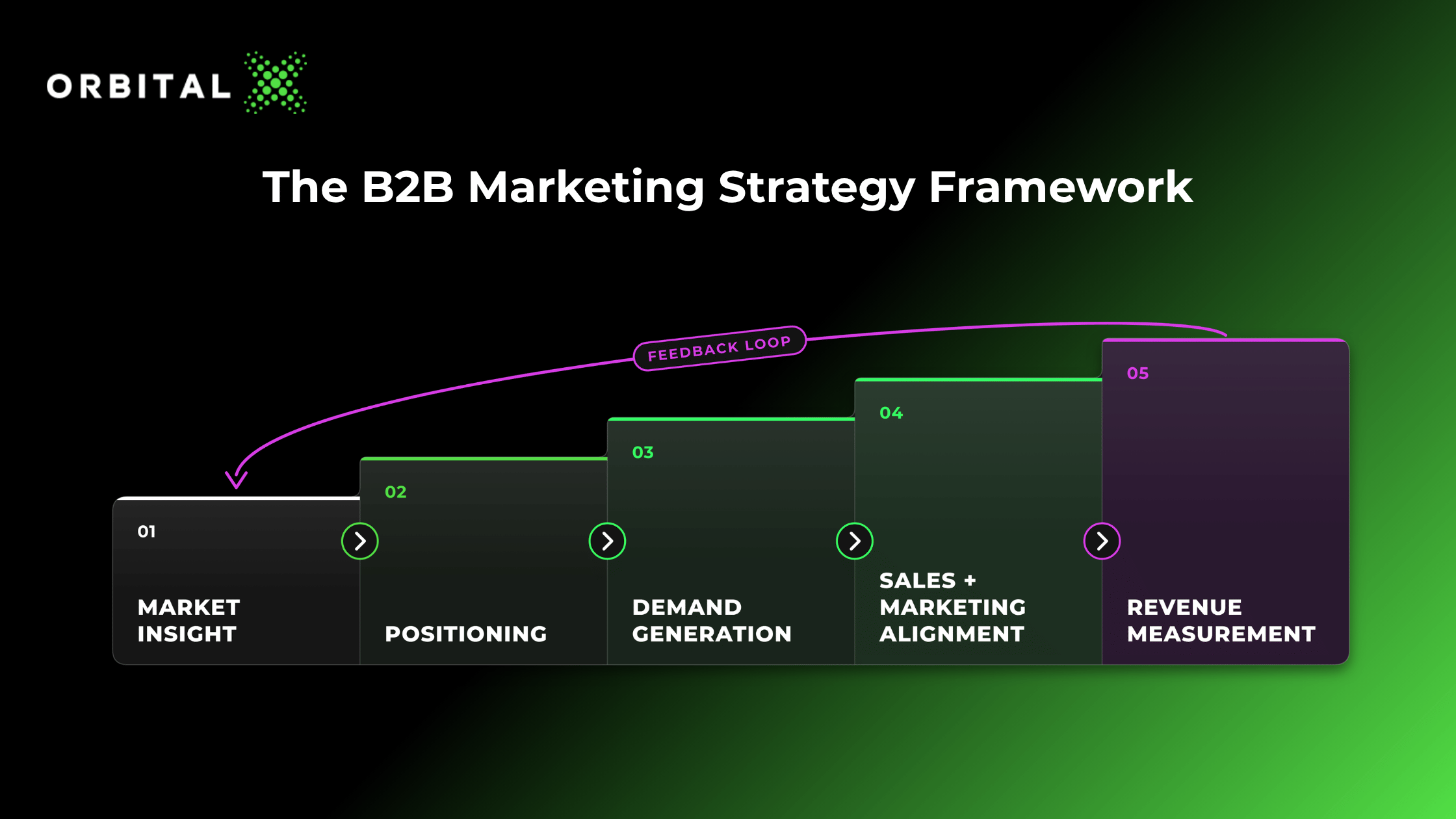 This model also provides a clear structure for asking the right strategic questions:
Market insight: Who should the business prioritize?
Positioning: Why should those buyers choose us over the status quo?
Demand generation: How do we engage those buyers on their own terms?
Sales and marketing alignment: How do we turn buyer engagement into revenue?
Revenue measurement: What commercial value are we creating, and what do we need to optimize next?
Build the Demand Generation Strategy
Demand generation is one component of a B2B marketing strategy. Within the five-layer framework, this part connects audience insight and positioning to decisions about how the business will create, capture, and develop demand. It establishes how to reach priority leads, support their buying journey, and contribute to the business’s growth objectives.
Choose Channels According to Buyer Behavior
Your buyers are under no obligation to frequent your marketing manager’s favorite platform. So, choose channels based on how they actually research, evaluate, and buy, with a clear purpose for each. For example, McKinsey research found that 41% of buyers preferred in-person options to interact with new vendors, while 40% like to use them when buying a product or service for the first time.
Speaking of in-person, leverage human interaction alongside digital research. A trusted colleague saying, “We use them, they’re good,” over coffee gives a buyer a compelling reason to investigate the recommendation. Your eighth automated email opening with, “Hope this message finds you well,” is more likely to push them to unsubscribe. The point is to understand where buyers seek useful information and whose judgment they trust.
Once you’ve chosen your channel mix, give each one a clear job with enough flexibility to adapt if its role changes (and it likely will). A webinar might introduce an unfamiliar problem to one buyer and help another evaluate your expertise. Be sure your team can sustain the mix as well, then refine it using buyer feedback and evidence of commercial progress.
Coordinate Demand Generation and ABM
Inbound, outbound, paid media, content, and events should work from the same audience priorities and positioning. If your ads promise one thing and your sales outreach pitches another, buyers shouldn’t need to play detective to work out what you actually offer.
Within this framework, B2B account-based marketing (ABM) adds focus where particular accounts justify greater attention and personalization. That decision should reflect potential account value, market concentration, sales and buying-group complexity, and the resources available to support the work.
A small group of strategically important accounts may warrant individually tailored research, messaging, and engagement. A larger group with shared needs may suit a more scalable approach. The level of personalization needs a commercial justification. “We put their logo on a landing page,” isn’t strategy.
Sales and marketing also should agree on which accounts matter, who influences the purchase, and what those buyers need to understand. Shared messaging, engagement information, and regular sales feedback help coordinate activity around each account’s situation, connecting ABM with the wider demand-generation strategy.
Craft a Repeatable Demand-Generation Process
Repeatability doesn't mean spamming your market with identical email sequences until your domain reputation dies. Repeatability means establishing a consistent operational rhythm for launching, assessing, and optimizing campaigns.
Follow this simple execution loop:
Identify the Core Problem: Focus on a specific business pain point within a clear ICP segment.
Develop Point-of-View Content: Create compelling, ungated assets that shape decision criteria.
Assign Channel Roles: Map out where owned, paid, and earned touch points will distribute the message.
Capture Intent Signals: Track account-level engagement across your content stack.
Review and Refine: Use downstream performance data to reallocate budget toward what works.
This broader B2B demand generation strategy helps turn buying-group insights into a more predictable pipeline by connecting targeting, engagement, and conversion across the full journey.
Connect Marketing to Sales and Revenue
Sales and marketing alignment links the B2B marketing strategy to the revenue process. Both teams need shared priorities, clear definitions of qualified opportunities, and useful account context to coordinate their work.
Align Sales and Marketing Around Pipeline
Effective sales and marketing alignment starts with shared account priorities and definitions of progress. Both teams should understand what qualifies an account, when engagement warrants follow-up, and what evidence is needed to recognize an opportunity.
Those definitions should reflect your sales process and business model. An account matching your ICP may be worth targeting without being ready to buy. Or, several stakeholders researching a topic can justify further investigation, but that activity alone doesn’t confirm an active purchase.
A useful handoff then gives sales enough context to understand why the account matters and what’s happened so far. Share relevant engagement, known stakeholders, previous conversations, and any confirmed problems or priorities. Distinguish what buyers have told you from what their activity suggests. “Downloaded a PDF” is an observation, whereas, “Desperate to sign by Friday” paints a clearer picture.
Keep the feedback flowing both ways too. Sales conversations can reveal if targeting is accurate, messaging resonates, and content helps buyers move forward. Use those insights to refine your framework, with both teams assessing progress against agreed opportunity and pipeline measures.
Measure Commercial Performance and Learn From It
Clicks, pageviews, downloads, and leads tell you whether buyers notice and engage with your marketing, but what happens next can feel like staring into a fog-covered path. A dashboard full of upward arrows is nice to see, but you need to connect those signals to qualified opportunities, pipeline, revenue, conversion, customer value, and efficiency.
LinkedIn revealed that 87% of B2B marketers find it increasingly difficult to measure the long-term impact of marketing campaigns. That makes careful interpretation essential.
Attribution helps teams examine how marketing interactions relate to pipeline and revenue. First-touch models credit the earliest recorded interaction, last-touch models credit the final one before a defined conversion, and multi-touch models distribute credit across several. Each offers a different perspective shaped by its assumptions and the data available. Use attribution to guide investment and test assumptions.
Cohort analysis then adds context by comparing groups over time. You might examine whether accounts in one segment convert faster, whether customers acquired through a particular campaign stay longer, or if a newer client cohort delivers higher lifetime value. Use comparable time periods and allow enough time for outcomes to develop. Reliable analysis requires clean data, consistent definitions, and clear ownership. Establish what each measure means, who maintains it, and which decisions it should inform.
Then act on what you learn. Strong engagement with weak opportunity creation might prompt a review of targeting, messaging, or follow-up. Better retention in a particular segment could justify greater investment there. Reporting should help the team decide what to keep, what to investigate, and what to change.
Assign Ownership and Review the Framework
Give the framework a clear owner, typically the CMO, head of marketing, or marketing lead. They coordinate reviews, involve the right people, and make sure agreed-upon changes reach the teams doing the work. Saying, “Everyone owns it”, sounds collaborative … until everyone assumes someone else has updated it and nothing is fixed.
Sales should contribute buyer and opportunity feedback, while revenue operations or analytics helps interpret performance. Bring in product, customer success, finance, and executive leadership when the decisions affect their responsibilities. A lean team might only need its marketing lead and founder, but a larger business may need a cross-functional review.
Use a practical starting cadence adjusted to your sales cycle and planning schedule:
Monthly performance checks: Review campaign results, opportunity creation, conversion, and pipeline progression to identify issues worth investigating.
Quarterly strategic reviews: Reassess audience assumptions, positioning, channel priorities, and investment using performance data, customer insight, and sales feedback. Check whether the framework still helps the team make useful decisions.
Review sooner if a product launch, market shift, persistent conversion decline, or repeated buyer objection challenges your assumptions. One disappointing email campaign, however, does not require an emergency reconstruction of the entire marketing strategy.
Most adjustments happen within the framework. Refining your ICP or shifting channel investment alters your strategy, but the five-layer structure guiding those decisions might not change. Marketing leaders can approve changes within their agreed remit and budget. Decisions affecting company positioning, target markets, sales priorities, or significant investment need agreement from the relevant leaders.
If the framework itself needs revisions, its owner should propose the changes and have it approved by the people whose decisions, responsibilities, or reporting would be affected.
Keep the process simple. The goal is to make better decisions and follow through without creating an entire committee that needs another committee to book its meetings.
Turn Strategy Into Revenue
A B2B marketing strategy framework gives your team a structured way to connect business goals, audience insight, positioning, demand generation, sales alignment, and revenue measurement.
When those layers work together, marketing becomes easier to prioritize, easier to measure, and much harder to waste money on. Instead of running disconnected campaigns and hoping something sticks, your team can focus budget and effort on the activity most likely to create commercial impact.
A framework provides the blueprint. Execution turns it into pipeline. OrbitalX’s DemandWEBS™ can handle both. The platform brings data intelligence, high-impact content, and coordinated execution across channels into one revenue-focused system, turning buyer intent into predictable growth.
Want to stop chasing vanity metrics and build a marketing strategy that actually drives revenue? Book a call with our team today.
FAQs
What is a B2B marketing strategy framework?
A B2B marketing strategy framework is a structure for deciding how marketing should support the business's commercial priorities. It connects decisions about target accounts, buying groups, positioning, demand generation, sales alignment, and measurement so they work toward the same outcome. The framework gives teams a consistent way to decide what matters, where to focus resources, and how to evaluate performance.
What are the five layers of a B2B marketing strategy framework?
The five layers are market insight, positioning, demand generation, sales and marketing alignment, and revenue measurement. Market insight defines the accounts and buying groups the business should prioritize and the problems that matter to them. Positioning establishes how the offer should be understood and why buyers should consider it. Demand generation determines how the business reaches those buyers and creates demand. Sales and marketing alignment connects activity to the revenue process. Revenue measurement shows commercial performance and informs future decisions.
How do you create a B2B marketing strategy framework?
Start by defining the commercial priority the marketing strategy needs to support. Then, identify the accounts and buying groups that matter most, using customer and sales evidence to develop and validate the ICP. Establish positioning and messaging around their problems, priorities, and desired outcomes. Build a demand-generation approach based on buyer behavior, available resources, and the role each channel can play. Review the results regularly and refine the strategy based on evidence.
What should a B2B marketing strategy framework measure?
A B2B marketing strategy framework should measure the commercial outcomes that matter to the business, including opportunities, pipeline, revenue, conversion, customer value, and efficiency. Activity counts like traffic, clicks, downloads, and lead volume can provide useful context but don't paint the full commercial picture on their own. Attribution can help teams understand how marketing interactions relate to pipeline and revenue, provided its limitations are understood.
What's the difference between a B2B marketing strategy and a marketing plan?
A B2B marketing strategy establishes the decisions that guide marketing, including the commercial priority, target audience, positioning, demand-generation approach, and role marketing should play in the revenue process. A marketing plan turns those decisions into specific programs and activities. It typically sets out campaigns, channels, timelines, responsibilities, budgets, and resources.
More Resources

Organic vs. Paid Marketing and How to Give Every Marketing Dollar a Job
Organic vs. paid marketing? Cut through the noise, compare the tradeoffs, and learn where to invest for stronger B2B pipeline and smarter marketing growth.

Lead Generation Companies: How to Choose the Right Partner and What to Expect
Compare lead generation companies, spot weak promises, and choose a partner that delivers qualified opportunities. Know what to buy and how to judge results.

B2B Email Marketing That Gives Your Pipeline Something to Talk About
Generate more leads through B2B email marketing with smarter targeting, relevant messages, and follow-up that turns buyer interest into qualified pipeline.