Driving B2B Revenue Growth Through Marketing and Sales Alignment in Long Sales Cycles
Learn how stronger alignment between B2B marketing and sales teams improves performance across long, complex sales cycles and accelerates revenue growth.
Key Takeaways
True sales and marketing alignment requires building a shared revenue system that links your demand generation, pipeline creation, and hard commercial outcomes.
When deals stretch out over several months, things get complicated fast. Buyer journeys turn into a maze, standard attribution becomes messy, and crucial feedback loops stall out.
When you get the structural connection right, your business sees a boost in lead quality, higher conversion rates, better forecasting accuracy, and cleaner pipeline efficiency.
The best revenue teams unite around shared revenue metrics, collective intent signals, and ongoing optimization.
High-performing revenue teams build feedback systems that continuously improve marketing and sales workflows day in and day out.
Most B2B marketing and sales teams don’t flat out refuse to talk to each other (we’re not that uncivil). Friction crops up more commonly because both groups operate on completely different information, disconnected feedback cycles, and conflicting success metrics. It's a classic case of two teams looking at the exact same buyer journey through entirely different lenses.
Marketing usually focuses on top-of-funnel campaign performance, digital engagement, and overall lead generation. Meanwhile, sales spends their time worrying about pipeline quality, immediate buying intent, late-stage objections, and fast deal progression. These disconnected perspectives create massive blind spots that slow down optimization and weaken your entire revenue performance.
The system degrades even further during long enterprise sales cycles. Buyers interact across dozens of independent channels and touch points for months before ever agreeing to speak with a sales representative.
Your attribution data then becomes highly fragmented, critical feedback arrives way too slowly, and a massive committee of stakeholders drags out the purchasing decision. To fix this, teams must build a structured demand generation strategy that aligns data across every single touch point.
Many organizations view this as a simple communication challenge. They stack the calendar with more cross-department meetings, demand retroactive reporting, and polish up their lead handoff checklists. But you can't fix a core structural issue with more calendar invites.
Real alignment is a revenue system challenge. High-performing companies don't just talk more; they build integrated operating loops where both teams actively learn from the exact same buyer signals. By combining common performance metrics and continuous optimization, they transform how they scale revenue together.
.png)
What Is B2B Marketing and Sales Alignment?
B2B marketing and sales alignment ensures both teams work toward shared revenue goals. Breakdowns happen when organizations misdiagnose where system friction actually lives. Strong alignment allows marketing and sales to operate from a single view of pipeline performance instead of pursuing separate goals.
Stacking more recurring meetings on the calendar won't build this capability. It only happens when both teams work from the same information and measure success the same way. Picture a Friday afternoon where your marketing team is popping some bubbly over a high ebook download rate while your sales team stares slack-jawed at an empty pipeline. When you can see exactly what creates pipeline and revenue, it's much easier to focus on the right accounts, spot problems early, and improve performance over time.
A functional revenue system relies on a few core blocks to keep moving. Building a predictable demand generation strategy requires both teams to align on ICPs and audience segmentation. You also need to establish:
Agreed lead qualification criteria
Consistent funnel stage definitions and common revenue metrics
Structured feedback mechanisms
Alignment issues don't just appear out of nowhere. They tend to originate in either definitions, signals, or feedback loops. The nature of your misalignment depends entirely on which part of the system has the least visibility. It usually comes down to hidden gaps in your audience definition, signal interpretation, or revenue feedback.
Imagine your marketing team throws a party for hitting lead-generation targets while sales struggles to convert those exact same names into qualified opportunities. Or picture sales rejecting fresh leads due to poor buying intent while marketing continues to invest in campaigns that look successful based on engagement metrics alone. Sound familiar?
These disconnects hurt your bottom line. They waste marketing budget, slow down optimization cycles, hinder forecasting accuracy, and make your pipeline incredibly inefficient. Strong alignment forces both teams to evaluate success using the exact same commercial outcomes rather than separate departmental KPIs.
Why Alignment Breaks in Longer B2B Sales Cycles
Many B2B sales cycles last several months, and complex enterprise deals routinely stretch past a full year. During that large window of time, everything changes. Buyer priorities shift, new stakeholders enter the mix, competitors slip into the deal, and internal approval processes get entirely re-routed.
This extended timeline puts distance between early marketing activity and final revenue outcomes. It makes it incredibly difficult for your teams to accurately assess performance or respond to changing buyer behavior in real time. There's a delay between the first digital touch point and the exact moment sales can confidently verify if an opportunity will convert. An enterprise deal dragging out over 12 months makes early campaign data feel like ancient history by the time the ink dries on the contract.
Modern buyers also interact across multiple channels and touch points before ever speaking with a representative. As buying journeys expand to involve multiple stakeholders and long periods of total inactivity, your attribution data starts to fragment. Marketing might influence demand months before an official opportunity is even created. But valuable insights from active sales conversations usually arrive way too late to improve upstream targeting, messaging, or audience strategies.
Where this friction shows up depends on where feedback slows down first inside your system. It might hit your early engagement signals, your opportunity conversion rates, or your post-deal insights. That’s why a structured approach is critical to shape a consistent buyer journey. To stop guessing along the way, teams need a tailored demand gen strategy to map those touch points cleanly.
.png)
According to Gartner, marketing and sales functions collaborate on only three out of 15 core commercial activities. Leaders frequently operate with completely conflicting priorities. That severe lack of shared visibility impacts operations across the entire business:
Marketing optimizes for raw lead volume instead of actual pipeline quality.
Sales rejects leads that look qualified on paper but demonstrate limited buying intent.
Top-level campaign metrics appear completely healthy while your actual pipeline performance declines.
Your reporting cycles become entirely retrospective instead of remaining actionable.
Alignment breaks because your feedback loops are delayed, visibility is incomplete, and both departments are effectively optimizing off entirely different timelines. As your sales cycles lengthen, solidifying shared visibility, faster feedback loops, and continuous optimization becomes more important than ever.
Three Ways to Improve B2B Marketing and Sales Alignment
Executive governance and technology infrastructure make revenue alignment practical rather than purely theoretical. Executive alignment gives you a clear framework for setting shared priorities, keeping incentives consistent across marketing, sales, and RevOps, and focusing on collective revenue outcomes over isolated department targets. That means establishing clear operating rhythms like regular revenue review cadences, keeping pipeline ownership shared, and actively stepping in to fix friction points between teams.
Your technology infrastructure, particularly your CRM and revenue automation tools, serves as the backbone for these workflows. The platforms connect inbound signals with sales engagement to give everyone a single, unified view of the buyer journey. Your CRM needs to move beyond simple reporting and serve as the system of record that makes continuous feedback, real-time decisions, and closed-loop optimization possible. These structural foundations set up the right conditions for the three core execution strategies.
1. Align on Shared Revenue Metrics and Funnel Definitions
Have you ever sat at the pub and heard a group of people who think they’re talking about the same football match but are actually arguing about different rules? That’s the marketing-sales disconnect in a nutshell.
Effective connection starts with a shared revenue definition so marketing, sales, and RevOps work from a single source of truth. Both teams need to stop looking at vanity metrics and focus on driving outcomes that directly impact business growth. Make sure you track:
Pipeline value and exact team contribution
Actual win rates and win rates broken down by lead source
Overall revenue generated and revenue per account
Standard sales cycle velocity
You also need clear, shared definitions across every single stage of your funnel. Your teams must have an identical understanding of MQLs, SQLs, opportunities, closed-won deals, and closed-lost accounts. Inconsistent definitions create immediate reporting conflicts, broken attribution data, and bad decision-making. RevOps plays a critical role here by maintaining these standards inside your CRM architecture so data stays completely clean.
That mismatch is a common obstacle, with nearly half of all chief sales officers reporting that their sales and marketing teams operate with completely different definitions of a qualified lead, according to Revenue Memo. This leads to broken tracking and makes it almost impossible to evaluate performance accurately.
Fixing this issue brings significant commercial impact. Data from the Trust Agency revealed that tightly aligned organizations get 24% faster three-year revenue growth and 27% faster profit growth than disconnected teams. Shared accountability improves forecasting accuracy, stops pipeline leakage, and helps you allocate budget effectively across the entire journey.
2. Focus on Buyer Intent and Real-Time Signals
Modern enterprise buyers don't follow a clean or linear journey. Purchasing committees today are like a group of friends trying to agree on a holiday destination using a single out-of-control WhatsApp group chat.
Traditional lead scoring models consistently fail here because they track individual behavior and single-contact attribution logic. But Gartner found that modern purchasing groups typically involve 6 to 10 distinct stakeholders, which makes isolated, lead-based scoring structurally incomplete. Account-level intent signals provide a much more accurate view of actual buying readiness.
This shift is best achieved through a structured account-based marketing framework. Marketing and sales connect around a shared target list and coordinate outreach based on in-market activity instead of random clicks. Teams should focus on capturing specific account-level intent signals like:
Patterns in website engagement and content consumption depth
Behavioral shifts across target accounts
Historical CRM interactions and active buying committee movements
Shared access to these buyer signals ensures both teams prioritize the same opportunities at the right time. It cuts down on operational friction caused by slow handoffs, inconsistent lead qualification, and basic disagreements over lead quality. Unified visibility of intent data is a structural requirement for modern revenue growth.
3. Build Continuous Feedback and Optimization Loops
Systems break down when marketing and sales operate on separate feedback cycles with different timelines, priorities, and interpretations of data. Those clean diagrams in your slide deck don’t reflect the painful reality of daily sales floor execution. This creates a gap between how demand is built and how it’s evaluated, which slows your ability to react to the market. Sales needs a clear channel to share live, structured feedback signals directly with marketing that includes:
Direct lead quality observations from current outreach
Common buyer objections and lost deal insights
Real-time competitive intelligence and emerging customer needs
Marketing must then use this conversational intelligence to refine core strategies. The data should instantly shape audience targeting, campaign structures, messaging angles, and ongoing content development. It moves optimization past shallow campaign metrics and directly upgrades the execution quality of the full journey.
Feedback loops should improve the assets sales uses to progress and close active deals. You can then turn these insights into shared revenue infrastructure, including objection-handling frameworks, competitive positioning matrices, target case studies, and ROI calculators.
High-performing organizations don't rely on retrospective quarterly alignment meetings as their primary engine for optimization. Continuous loops turn live insights into ongoing execution gains so every cycle of buyer interaction actively supports the next.
The Continuous Revenue Feedback Model
Once your organization establishes shared metrics, visible data, and open communication loops, alignment naturally shifts into a continuous revenue system that helps teams improve performance in real time. High-performing revenue operations act as unified systems that continuously capture, interpret, and act on live market feedback.
Both teams gain full visibility into the same signals, performance data, buyer insights, and pipeline intelligence to make quick commercial decisions. No more isolated silos connected only by a clunky lead handoff process (and we all know how corporate structures love to turn a basic human conversation into a multi-layered software workflow). The system becomes a live, repeating loop that dictates how modern growth teams operate day-to-day. It encompasses six operational phases.
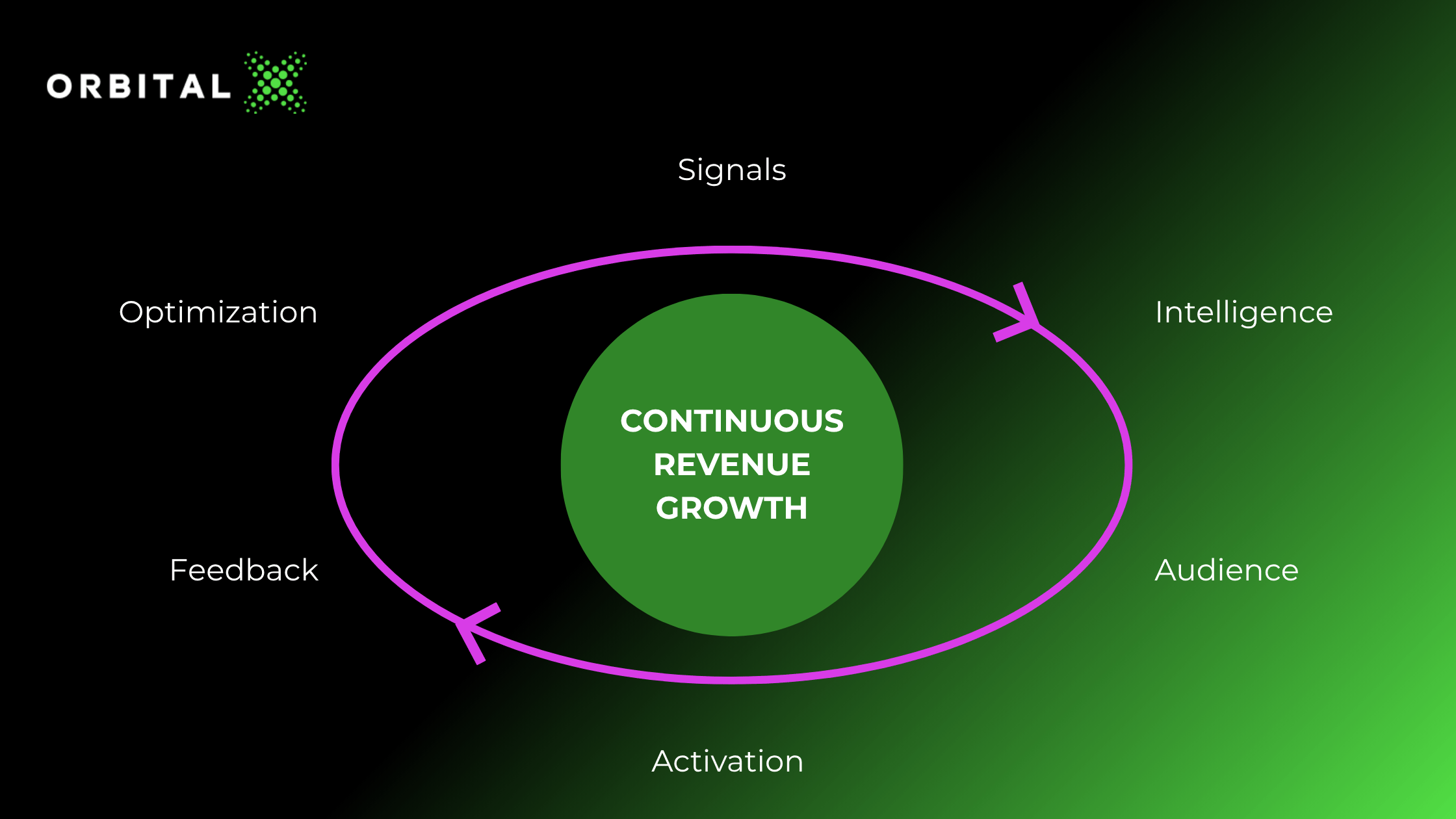
1. Signals
Signals reveal real-time buyer behavior, digital intent patterns, market activity, and emerging opportunities. These data points provide the raw information your revenue teams need to understand where market demand is developing and how buyer priorities are shifting.
Take Acme Analytics, a made-up mid-market SaaS company that sells revenue analytics software. They notice a sudden surge in digital engagement from multiple independent contacts at major enterprise fintech accounts. At the same time, their tracking flags repeated, unprompted visits to their pricing and technical integration pages.
2. Intelligence
Intelligence takes that raw pile of signals and transforms it into actionable insight. By analyzing behavioral trends, engagement depth, and account-level activity, you can identify real opportunities, prioritize your resources, and make sharper revenue decisions.
For the team at Acme Analytics, this phase gets specific. Their intelligence layer connects the dots to show coordinated engagement across multiple distinct stakeholders within those fintech accounts. This clear pattern indicates an active, account-wide evaluation rather than early-stage curiosity from a lone browser.
3. Audience
Audiences shouldn't remain static on an Excel sheet. They must be continuously refined and prioritized based on live intent signals, active buying committee movements, and overall account engagement. That keeps your teams focused purely on the opportunities most likely to generate revenue.
In the Acme Analytics example, the organization would build a dynamic priority list of these in-market fintech accounts. Marketing and sales then immediately align their efforts around this targeted segment instead of chasing random profiles.
4. Activation
Activation is the moment when insights turn into direct action. Marketing and sales engage those highly prioritized target accounts using coordinated campaigns, direct outreach, tailored content, and relevant sales conversations. This synchronized push moves buyers through their decision criteria and accelerates pipeline velocity.
At Acme, the activation phase plays out across multiple channels. Marketing runs hyper-targeted industry ad campaigns built for fintech buyers. The sales team simultaneously engages the key decision-makers inside each buying committee using personalized outbound messages and highly specific case studies.
5. Feedback
Feedback captures hard outcomes across the full revenue system. It tracks how the market responds by monitoring engagement patterns, pipeline movement, common buyer objections, competitive insights, and closed-won or closed-lost results. That provides the critical context needed to understand what's working and what's failing.
Acme's feedback loop might uncover a couple of massive data trends, such as late-stage security concerns frequently appearing in their lost deals. On the flip side, accounts that actively engage with their technical integration content convert at a much higher rate.
6. Optimization
Optimization means learning from those real-world interactions and applying the lessons to upgrade future performance. You use direct insights from buyer behavior and sales activity to refine your targeting filters, messaging angles, content development, and sales enablement resources.
Acme, for instance, uses their fresh data to adjust their go-to-market execution. They rewrite their messaging to address security compliance much earlier in the buyer journey. Then they refine their targeting criteria to prioritize fintech accounts that already show strong technical fit signals.
This model functions as a continuous learning loop rather than a rigid, linear funnel. In today's market, your long-term revenue performance depends on how quickly your organization can capture insight, adapt its motion, and improve. Clear team alignment is incredibly critical, but it's not the final destination.
Phase | What It Measures | Why It Matters |
Signals | Real-time buyer behavior | It provides the raw data needed to spot developing market demand and recognize shifting buyer priorities early. |
Intelligence | Behavioral trends and engagement depth | It transforms raw data into actionable insight to better prioritize resources and make sharper revenue decisions. |
Audience | Live intent signals | It prevents teams from working off static lists so sales and marketing stay focused on high-revenue opportunities. |
Activation | Coordinated campaign execution | It moves buyers through their decision criteria and accelerates pipeline velocity. |
Feedback | Hard system outcomes | It provides the critical context needed to uncover underlying trends and understand what’s working versus what isn’t. |
Optimization | GTM execution refinements | It closes the loop by applying real-world lessons to upgrade future performance so strategies adapt to market responses. |
The ultimate objective is building a system where marketing and sales unite on the exact same information to respond to buyer behavior in near real time. This creates a seamless, friction-free buyer journey from the very first touch point to the final contract signing.
To see how it works in practice, look at platforms built specifically around this systems-based approach like OrbitalX’s DemandWEBS™ platform. It’s a prime example of how modern revenue teams connect data and execution to optimize growth on repeat.
Build a Revenue Engine Instead of Chasing Alignment
B2B marketing and sales alignment gets harder as buying journeys grow more complex. Long sales cycles drag out timelines, and your feedback loops become slower and less direct. Communication, collaboration, and structured processes still matter, but they’re not enough to drive sustained revenue performance in modern environments.
The real constraint in your business is where feedback stops being usable. Many organizations believe they're fully aligned simply because meetings, reporting cadences, and handoff processes exist. The truth is their underlying revenue systems are broken and painfully slow to learn.
Occy struggled with this very issue. They faced disjointed systems and needed to boost their growth. Thanks to OrbitalX’s embedded team though, they managed to align demand generation and ICP targeting. That led to improved growth efficiency without adding a single extra employee.
Alignment is the necessary foundation for continuous revenue learning. That shift allows organizations to better understand, adapt, and improve their revenue performance over time.
The organizations that thrive optimize for the speed of learning. They build systems that continuously capture market signals, interpret them, and instantly feed them back into targeting, messaging, and activation loops.
Think of the modern revenue engine as a tight, continuous loop:
Buyer signals feed into intelligence.
Audience strategy dictates activation.
Feedback powers optimization.
In modern B2B growth, alignment is a byproduct of how quickly your organization can learn and adapt. It's not something you'll ever achieve through corporate process alone.
OrbitalX can help you make the shift from campaign-based execution to continuous revenue optimization. If you're ready to build a growth engine that actually works for your team, let's chat.
FAQs
What is B2B marketing and sales alignment?
B2B marketing and sales alignment ensures both teams work toward shared revenue goals using consistent definitions, metrics, buyer insights, and feedback loops. It helps marketing and sales operate from the same view of pipeline performance and revenue contribution. That unity improves lead quality, pipeline visibility, forecasting accuracy, and conversion rates while enabling faster responses to buyer behavior in longer, more complex sales cycles.
Why do marketing and sales teams become misaligned?
Misalignment typically occurs when marketing and sales use different metrics, data sources, definitions of success, and interpretations of buyer intent. Over time, this leads to fragmented decision-making and optimization of separate activities rather than shared outcomes. It also creates massive gaps in visibility across the buyer journey, making it harder to prioritize the right opportunities and maintain consistent pipeline performance.
How can companies improve B2B sales and marketing alignment?
Companies can improve alignment by agreeing on shared revenue metrics, standardizing funnel definitions, using intent data to prioritize opportunities, and building continuous feedback loops between marketing and sales. Alignment also needs shared visibility across the buyer journey and consistent interpretation of performance data. A connected approach enables both teams to focus on the same accounts, outcomes, and revenue priorities.
What is the difference between alignment and revenue optimization?
Alignment ensures marketing and sales work toward shared goals using consistent definitions, metrics, and priorities. Revenue optimization builds on that foundation by using real-time buyer signals, performance data, and feedback loops to continuously improve pipeline and revenue outcomes. Alignment creates consistency across teams, while optimization turns that consistency into ongoing performance improvement.
Why is B2B marketing and sales alignment important?
B2B marketing and sales alignment keeps both teams working toward the same revenue goals using shared metrics, data, and buyer insights. Without that unity, organizations often experience inconsistent lead quality, poor pipeline visibility, and inaccurate forecasting. Strong alignment improves conversion rates, accelerates sales cycles, and helps teams respond more effectively to changing buyer behavior across complex B2B purchasing journeys.
More Resources

Your Team Is Producing More Content Than Ever. Is Any of It Working?
AI is producing more B2B marketing content than humans now, but volume without engagement is just cost with extra steps. OrbitalX's new metric, Marketing Per Marketer (MPM), plots output against real audience engagement to show which teams are actually breaking through versus which are just running on the content treadmill.

Unlock enterprise value with AI and ABM in PE value creation
A practical guide for PE value creation teams on how AI SDR, AI-powered ABM, and AI content workflows can increase commercial capacity without scaling headcount at the same rate.

How to Evaluate Lead Generation Outsourcing Based on Pipeline Impact
Looking into lead generation outsourcing? Learn how to evaluate providers based on pipeline performance and revenue impact to improve sales outcomes.