Organic vs. Paid Marketing and How to Give Every Marketing Dollar a Job
Organic vs. paid marketing? Cut through the noise, compare the tradeoffs, and learn where to invest for stronger B2B pipeline and smarter marketing growth.
Key Takeaways
Organic marketing earns unpaid visibility, while paid marketing purchases advertising placement or distribution. Both require investment in people, content, tools, and management. “Organic” doesn’t mean “free.”
Paid can accelerate audience access, while organic assets can keep attracting interest over time. Neither guarantees customers.
Prioritize channels according to your goals, resources, existing demand, and ability to convert interest into business.
Coordinate organic and paid activity around the same buyers and commercial objectives. Then measure their contribution to qualified pipeline and revenue.
Picture the standard quarterly planning panic. You’re staring at an aggressive pipeline target with a marketing budget that feels razor-thin. Some of that money could fund organic content and SEO designed to earn visibility over time. Another chunk could go into LinkedIn or Google Ads to put your message in front of selected buyers this week. Both can work. Both can also chew through budget when nobody has decided exactly what job they’re supposed to do.
Organic marketing earns visibility without paying for placement, through channels such as search, unpaid social, and useful content people discover or share. Paid marketing, meanwhile, buys distribution through search ads, sponsored social, display, and other advertising placements. Organic often takes longer to build momentum. Paid gives you more immediate control over reach. Both still require strategy, creative, people, tools, and management.
According to McKinsey’s 2026 Global B2B Pulse Survey, B2B decision-makers use an average of ten distinct interaction and sales channels across their purchasing journey.
That makes budget allocation a commercial decision, not a channel popularity contest. This guide breaks down the key differences between organic and paid marketing, where each approach tends to perform best, the real costs and tradeoffs behind both, how to decide where your budget should go, and how to make the two work together around the same buyers and revenue goals.
What’s the Difference Between Organic and Paid Marketing?
Organic marketing attracts audiences through unpaid distribution, while paid marketing purchases ad space or access to an audience. An unpaid LinkedIn post is organic activity. Promoting that same post through advertising makes the distribution paid. The content can be identical, even when the mechanism used to reach people changes.
Organic marketing covers search visibility, unpaid social activity, and content people discover or share. Paid marketing covers search ads, social advertising, display ads, and sponsored placements. Either approach can introduce an offer, educate buyers, support evaluation, or encourage a useful next step.
The practical distinction is payment for placement. Organic activity still requires time, expertise, production, distribution, and maintenance. Paid activity adds media spend to the creative and operational work required to make a campaign useful.
That difference matters because each approach gives marketers a different mix of speed, control, durability, and cost. The right allocation depends on the buyers you need to reach, the outcome you need next, and the commercial system waiting when attention arrives.
Think of the difference like building a reputation at your local pub. Organic means showing up regularly, buying a round now and then, and having enough decent conversations that people eventually know your name. Paid means walking in with a megaphone. You’ll get heads turning faster. You’d better have something worth saying once everyone looks over.
What’s Organic Marketing?
Organic marketing earns audience attention through unpaid discovery. Think of an evaluation guide ranking for a commercial problem, or an in-house expert sharing an uncomfortably honest breakdown of industry mistakes on LinkedIn. It’s organic lead generation fueled by genuine relevance and useful distribution.
That unpaid discovery requires serious sweat equity. You need continuous buyer research, domain expertise, production hours, and ongoing upkeep. Hitting “publish” guarantees nothing. Platforms decide what gets surfaced, and algorithms can shift overnight. Your website and email list are assets you control. Search rankings and social reach still depend heavily on platforms you don’t.
What’s Paid Marketing?
Paid marketing buys placement and immediate distribution. You select target job titles, accounts, or high-intent search queries. You set budgets, supply creative, and bid for reach across channels like LinkedIn or Google Ads.
We’ve all seen a founder or over-eager VP set £20k on fire in three weeks because someone decided high-volume keywords were a magic pipeline lever. Paid media is an amplifier. A clunky value proposition becomes a clunky value proposition with a media budget, and now thousands more people get to see the problem at speed.
Media spend is only one piece of the puzzle. You also need high-converting landing pages, a compelling offer, and someone constantly tuning campaign parameters. Buying ad space buys attention, not conviction. You can target the exact title at your dream account and still fail to give that person a reason to care.
Organic vs. Paid Marketing Differences, Benefits, and Tradeoffs
Organic and paid marketing differ most in cost structure, speed of visibility, distribution control, durability, and measurement. Those differences create real tradeoffs, and their value changes according to the audience a business needs to reach and the outcome it wants to produce.
Paid marketing can put an offer in front of a selected audience quickly and gives advertisers useful levers for adjusting spend, targeting, bids, and delivery. That access depends on continued funding and the rules of the advertising platform. Faster visibility can shorten the time to a signal. It doesn’t automatically shorten the sales cycle.
Organic marketing can create assets that keep attracting attention after publication. Building and maintaining that visibility still takes resources. Search rankings move, social reach fluctuates, buyer interests change, and competitors publish stronger material. Durable doesn’t mean permanent.
Both approaches produce measurable signals. Clicks, engagement, attributed conversions, search traffic, and content consumption can all help explain what happened. They still need interpretation before anyone starts claiming revenue impact. A dashboard can tell you which touchpoint received credit. It can’t always tell you how much demand that touchpoint genuinely created.
Organic vs. Paid Marketing Comparison
Comparison | Organic Marketing | Paid Marketing |
What you invest in | Content, expertise, optimization, distribution, and maintenance | Advertising spend plus creative, campaign management, and conversion assets |
Speed of visibility | Depends on existing reach and discoverability. Building from scratch takes time | Can reach audiences quickly once campaigns are approved and running |
Distribution control | Influence visibility through relevance, optimization, and audience relationships | Adjust budgets, targeting, bids, and placements within platform limits |
Durability | Assets may keep attracting interest and still require upkeep | Paid distribution depends on continued spending. Acquired audiences and learning can retain value |
Useful applications | Answering buyer questions, building discoverability, and supporting evaluation | Testing offers, extending relevant reach, and capturing existing demand |
Measurement challenge | Connecting unpaid interactions to later commercial outcomes | Separating attributed conversions from results that advertising genuinely added |
Few things trigger more boardroom eye-twitching than hearing someone announce that organic content delivers “free leads.” Tell that to the senior product engineer who spent three days drafting a technical white paper while the product backlog quietly glared from another tab.
When comparing cost structures, don’t pretend internal labor is free. A technical article written by your best engineer or head of product carries real payroll cost. Paid media adds direct media spending to those same creative and management requirements.
Speed also runs on two clocks. There’s deployment speed, then there’s buying speed. Paid ads can drive hundreds of visitors to a landing page by this evening. If you sell enterprise software with a nine-month sales cycle, instant clicks still won’t turn into instant revenue.
Durability has caveats too. An organic article can attract views for years when you maintain its relevance. Content decays, rankings erode, and competitor viewpoints emerge. Paid ads stop delivering reach when the budget stops. The customer insights, creative learnings, and audience data gathered during the run can still retain value.
Attribution is where teams fool themselves most. Ad dashboards are very happy to claim full credit for every deal that touched a promoted post. True incremental impact is harder to prove. Did the ad influence the buyer’s decision, or did an executive who was already buying click the sponsored link on the way to your website?
Should Your Business Prioritize Organic or Paid Marketing?
Your business should prioritize organic or paid marketing according to its immediate objective, available resources, existing audience demand, and readiness to convert interest into customers. The strongest investment addresses the constraint currently slowing progress.
Paid activity may deserve emphasis when reaching a defined audience quickly would help test an offer, extend distribution, or capture relevant demand. That investment needs a credible destination and a workable response process. Paying for attention before those foundations exist can expose weaknesses very efficiently.
Organic investment may deserve emphasis when buyers need clearer explanations, stronger evidence, or more opportunities to discover the business during research. A longer planning horizon still needs priorities, ownership, and accountability. Publishing a library of content without a clear buyer problem or commercial use case is just a slower way to waste resources.
For B2B and SaaS businesses, the buying model matters too. A self-serve purchase and a sales-led evaluation need different conversion paths. The same channel mix can produce wildly different commercial outcomes depending on what happens after the click, visit, download, or demo request.
When a PE board asks for double-digit ARR growth while overhead gets squeezed, the natural reflex is to launch five new channel initiatives by Friday. It looks energetic on a slide. In practice, a two-person team fighting on five fronts usually gets battered on all of them.
Budgets are tight everywhere. Gartner’s 2025 CMO Spend Survey found that 59% of marketing leaders felt their budgets were insufficient to execute their strategy. When resources are squeezed, spreading peanut butter across every channel produces a thin mess. You need deliberate B2B marketing budget allocation.
Start by diagnosing the operational bottleneck that matters most.
Testing a New Offer. Run targeted paid campaigns. Put your positioning in front of three hundred verified buyers this week. See whether the message resonates before you spend six months building a twelve-part content pillar around an idea nobody wants.
Capturing Active Demand. If target buyers are already typing high-intent problem phrases into search engines, pay for search placement or strengthen direct comparison assets. Active demand is expensive to create and painful to hand straight to a competitor.
Building Commercial Trust. When prospects stall during discovery because they don’t understand your methodology, invest in organic thought leadership, ungated teardowns, and deep case studies that make the sales conversation easier.
Fixing Conversion Leaks. If site traffic converts to pipeline at less than 1%, pouring more media spend into the top just gives the leak more water. Fix the landing page narrative, clarify the value proposition, and tighten sales response times first.
The SaaS business model demands careful math here. In organic marketing vs. paid marketing in SaaS, a product-led growth model with a £50 monthly subscription needs tight customer acquisition cost boundaries and automated onboarding. An enterprise platform commanding a £100,000 annual contract can justify high bids on LinkedIn ads when those bids help secure conversations with specific buying committees.
How to Make Organic and Paid Marketing Work Together
Organic and paid marketing work together when they support the same audience, offer, message, and commercial objective. Integration means assigning each approach a useful role in the buying journey and creating a feedback loop between them. Running ads alongside a content calendar only gives you two active channels. Coordination comes from making those channels support the same commercial motion.
Organic content can help buyers understand a problem, evaluate possible solutions, and build confidence in a business. Paid distribution can introduce useful material to selected audiences or bring a specific offer to people showing relevant interest. The destination, next step, and follow-up process matter just as much as the source of the visit.
The relationship also improves learning. Advertising responses can surface questions, objections, and messages worth exploring through content. Organic engagement can reveal assets or ideas worth testing with paid distribution. Each signal gives the team a hypothesis to validate in the next channel.
Evaluate the combined approach through buyer progression and commercial outcomes. The point is to create a coordinated system that helps suitable prospects move forward while channel reporting shows where attention is building, where momentum stalls, and where the team needs to improve the experience.
In too many B2B organizations, organic content and paid acquisition sit on opposite sides of the room glaring at each other like rival football supporters. Content thinks performance marketing is addicted to dashboards. Performance thinks content is doing expensive arts and crafts. Sales, meanwhile, would quite like some qualified conversations before quarter-end.
According to the Content Marketing Institute’s 2025 B2B Research, 89% of B2B marketers use organic social media platforms to distribute content, while 84% use paid channels. The opportunity comes from getting those motions to work from the same buyer journey and the same commercial objective.
Take a B2B compliance software vendor. The team publishes an unsparing, practical guide on preparing for new data audits. Subject matter experts distribute it organically on LinkedIn, where the advice sparks useful debate and earns solid engagement.
The team then extracts the hooks and questions that generated the strongest response and tests them through targeted sponsored content aimed at risk officers at mid-market banks. The ad points to the full ungated guide.
At the bottom of the resource, readers can move to an audit-readiness checklist or a one-to-one gap analysis. That next step respects buyer timing. Downloading a guide doesn’t make someone ready to buy today. Treating every white paper reader like a qualified sales opportunity burns trust and gives sales reps another reason to hate the MQL spreadsheet.
This coordination creates a feedback loop.
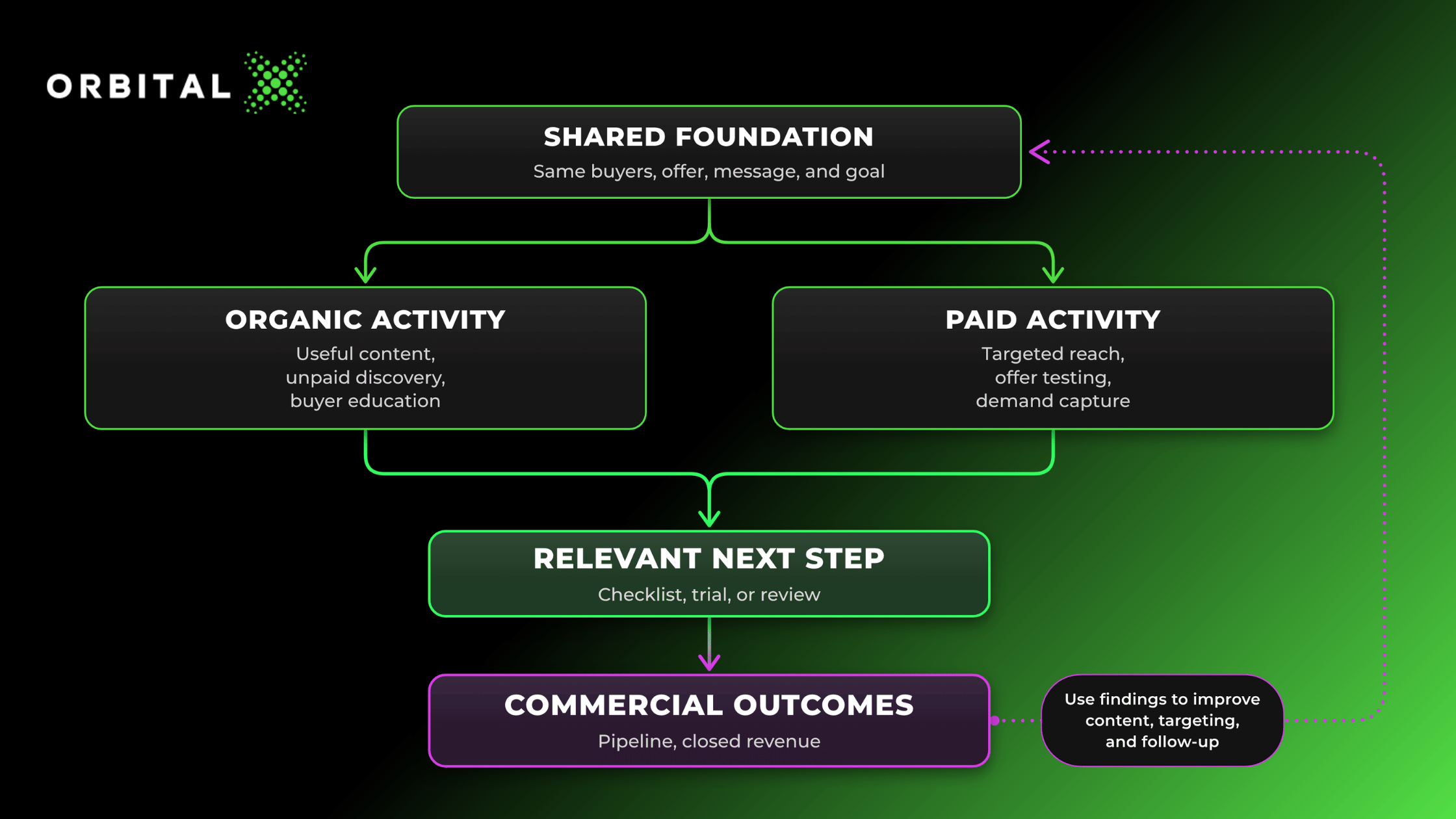 Customer objections raised in ad comments can become new sections in future organic articles. Organic search queries that expose technical friction can become ad headlines. When retargeting permissions and audience pools allow, teams can re-engage visitors who consumed high-intent content with customer proof, comparison assets, or a more useful next step.
Evaluate the whole motion through measuring demand generation performance. Look at sales acceptance rates, pipeline velocity, customer acquisition cost, and closed-won revenue across your normal sales cycle. If organic and paid are feeding the same commercial system, the reporting should eventually meet there too.
Give Every Marketing Dollar a Job
Marketing without coordinated channels turns into noisy theater surprisingly fast. Everyone stays busy, the C-suite gets a deck full of vanity metrics, and sales still asks where the real conversations are.
Give organic and paid clear jobs. Organic can build the narrative, earn discoverability, answer buyer questions, and establish commercial trust. Paid can target distribution, test positioning, extend proven ideas, and capture active intent. Both depend on a conversion foundation strong enough to turn attention into progression.
Tie the whole system to qualified pipeline and revenue. At OrbitalX, we build and run that integration through DemandWEBS™, orchestrating owned, paid, and earned distribution into a single engine for lean teams.
If you’re ready to stop guessing and give every marketing dollar a clear job, book a call with our team.
FAQs
Is organic marketing free?
Organic marketing doesn’t require payment for ad placement. It still costs money or staff time. Research, writing, design, search optimization, distribution, and maintenance all require resources. An existing team may absorb that work, although doing so reduces capacity for other priorities. Organic visibility can also decline, creating more work to refresh or redistribute assets. When comparing organic and paid marketing costs, include labor, software, production, and outside support alongside direct advertising spend.
Does paid marketing work faster than organic marketing?
Paid marketing can generate visibility quickly because advertisers purchase access to an audience without waiting for unpaid discovery to build. That speed doesn’t guarantee faster customer acquisition. A campaign still needs relevant messaging, a convincing offer, and an effective conversion process. Organic activity can also produce immediate responses when an established audience already exists. Compare timing against the commercial outcome you need and the length of your normal sales cycle.
Can paid marketing help organic growth?
Paid marketing can support organic growth by exposing useful content to relevant audiences and generating ideas for future content. Advertising responses may reveal questions, objections, or language worth exploring through search content and unpaid social activity. Buying ads doesn’t improve organic search rankings, and paid engagement doesn’t automatically become lasting demand. Treat campaign findings as hypotheses, then validate them over time through organic behavior, sales feedback, and real commercial outcomes.
How should you split your budget between organic and paid marketing?
Start with the commercial objective, available resources, and the constraint slowing progress. Separate advertising spend from the production and management costs supporting both approaches. Run focused tests with clear success criteria, then review whether the resulting pipeline quality and acquisition economics justify more investment. Protect essential content and website maintenance while testing new activity, and allow enough time to observe results across your normal sales cycle before making a major reallocation.
Is organic or paid marketing better for SaaS?
The stronger SaaS mix depends on how customers discover, evaluate, and buy the product. A self-service tool may use paid acquisition to test trial demand, supported by organic tutorials and comparison content. Enterprise software may need educational content, targeted advertising, and sales conversations across a longer evaluation. Assess the mix through activation, qualified pipeline, customer acquisition cost, retention, and customer value, then shift resources toward the constraints affecting growth most.
More Resources

Lead Generation Companies: How to Choose the Right Partner and What to Expect
Compare lead generation companies, spot weak promises, and choose a partner that delivers qualified opportunities. Know what to buy and how to judge results.

B2B Marketing Strategy Framework: Stop Chasing Tactics, Start Building Strategy
Build a B2B marketing strategy framework that connects audience, positioning, demand generation, sales alignment, and measurement to revenue.

B2B Email Marketing That Gives Your Pipeline Something to Talk About
Generate more leads through B2B email marketing with smarter targeting, relevant messages, and follow-up that turns buyer interest into qualified pipeline.