B2B Email Marketing That Gives Your Pipeline Something to Talk About
Generate more leads through B2B email marketing with smarter targeting, relevant messages, and follow-up that turns buyer interest into qualified pipeline.
Key Takeaways
B2B email marketing can start conversations with new prospects and develop interest among existing contacts.
Relevant audiences, accurate contact information, and appropriate sourcing matter more than raw list size.
Campaigns, messaging, and calls to action should reflect the recipient’s role, needs, and existing relationship with your business.
Deliverability, automation, and sales follow-up need to work together so interested prospects get an appropriate response.
Qualified engagement, opportunities, and pipeline belong alongside delivery and campaign activity when measuring performance.
Your email calendar’s packed, sends are going out like clockwork, and the sales team is still twiddling its thumbs. That disconnect hurts, because sending more email tells you very little about whether or not the right accounts are listening.
Joint research from Content Marketing Institute and MarketingProfs found that 42% of respondents identified email among the content distribution channels producing the best results for their organizations. So the channel clearly has legs. But turning distribution into qualified pipeline takes a little more thought than filling Tuesday’s slot in the campaign calendar and hoping for the best.
B2B email generally supports two closely related motions. You can either start conversations with new prospects or develop interest among contacts who already know your business. Each audience comes with different expectations, context, and reasons to engage.
Successful lead generation from email marketing requires you to build the right audience and campaigns, write copy people are likely to respond to, and connect email activity to commercial outcomes.
What is B2B Email Marketing for Lead Generation?
B2B email marketing for lead generation uses targeted correspondence to introduce relevant business offers, develop interest, and help suitable prospects take a meaningful next step. It includes outreach to new contacts and campaigns that nurture people who already know the business. The goal is to create or progress qualified opportunities by giving suitable prospects a relevant reason to engage.
Cold outreach starts a conversation with someone who hasn’t previously engaged. Nurture campaigns build on an existing relationship, such as a subscription, event registration, or earlier inquiry. These audiences have different expectations and shouldn’t receive interchangeable sequences.
After all, you wouldn’t approach an operations director you found through account research in exactly the same way you’d follow up with a newsletter subscriber who’s already read three articles on workflow automation.
An email address is a contact record, whereas a qualified lead meets established criteria for fit and interest. Opening a message or downloading a resource doesn’t automatically satisfy those criteria.
Modern B2B deals can also involve several people with very different priorities. Technical users, operations leaders, procurement teams, and finance stakeholders may all enter the conversation at different points. One generic blast across the committee is unlikely to charm everybody equally.
Email works within a wider buying journey. Content, events, advertising, and sales conversations can all influence whether a recipient responds and whether that response eventually becomes pipeline.
How to Build and Segment a Relevant B2B Email Audience
A relevant B2B email audience combines suitable companies, appropriate contacts, reliable information, and a clear basis for communicating with them. Start by defining which businesses your offer can help and which people influence the problem or purchase. List size is useful only when those contacts have a plausible reason to engage.
Audience development can involve attracting subscribers through useful resources or researching prospective customers for outbound activity. These approaches create different relationships. Someone requesting a newsletter and someone identified through account research should enter different campaigns, even when they share a job title.
Segmentation turns audience information into decisions about messaging, offers, and follow-up. Company characteristics, professional responsibilities, expressed interests, and previous interactions can help determine what each group receives.
Contact verification supports accuracy, but it doesn’t establish permission or purchase intent. Effective list management also requires attention to sourcing, applicable requirements, preferences, and people who should no longer receive marketing. The goal is a usable audience with meaningful context.
Start With the Accounts Worth Reaching
Walking into a crowded shop and shouting your software pricing at all the patrons might technically reach a lot of people, but it’s unlikely to produce many qualified opportunities. Audience building works much the same way.
Start with clear boundaries. Define your ideal customer profile around characteristics such as company size, revenue, operational pressures, industry, and the people responsible for solving the problem you address.
Define your exclusions too. A database can contain 50,000 perfectly valid contacts and still be almost useless if most of them have no credible reason to buy from you. Gartner also reported that 73% of B2B buyers actively avoid suppliers that send irrelevant outreach, so don’t be spammy. Relevance has consequences.
Segment by Relationship and Buying Role
When people join your audience through original research, events, tools, or newsletters, respect the context that brought them in. Downloading an analytical report doesn’t automatically mean somebody wants a calendar link waiting for them before breakfast tomorrow.
Outbound research needs its own context. Record where the contact came from, what observable business trigger made the account relevant, and why your offer might connect to the situation. Enrichment software can help you find people, but the strategic value comes from understanding why those people belong in the campaign.
Segmentation should also reflect the job each stakeholder needs to do. Imagine two people evaluating software at the same logistics company. The head of supply chain operations may want workflow screenshots, implementation details, and evidence around uptime. Meanwhile, the CFO only cares about payback periods, operating costs, and financial risk. Sending both of them the same message wastes two perfectly good opportunities to be useful.
Use Intent Signals With Context
Intent data can help you decide where to look more closely, especially when several signals point toward the same account. A spike in research activity from a target company, for instance, may suggest growing interest around a topic. However, it still leaves plenty of unanswered questions about who conducted the research, whether a live project exists, and how close anyone is to a buying decision.
Use those signals to prioritize research, enrich account context, and decide where a more tailored approach might be worthwhile. The signal gives you a clue. Your campaign still needs to earn the conversation.
Keep Sourcing, Compliance, and Data Hygiene Tight
Legal and platform requirements vary by market and recipient type. The UK’s Information Commissioner’s Office explains that UK rules distinguish corporate subscribers from individual subscribers such as sole traders and certain partnerships. UK GDPR requirements can also apply when personal data is processed.
In the U.S., the FTC’s CAN-SPAM guidance applies to commercial B2B email and covers areas including truthful routing information, accurate headers, physical addresses, and opt-out handling.
Keep the database clean too. Deduplicate records, update contacts as people move roles, process suppressions properly, and remove addresses that should no longer be mailed. A beautifully segmented campaign still has a problem if half the audience left the company six months ago.
B2B Email Campaign Types and When to Use Them
B2B email campaigns generate or develop leads by giving a defined audience a relevant reason to engage. The appropriate format depends on whether recipients are unfamiliar prospects, existing subscribers, event participants, or stakeholders within selected accounts. Each campaign should have a specific purpose and a next step that matches the relationship.
Cold outreach introduces a potential business conversation. Nurture campaigns help existing contacts understand a problem or evaluate an approach. Webinar and event emails connect an audience with a learning opportunity and support useful follow-up afterward. Account-based email coordinates messages around the needs of people involved in a particular company’s buying decision.
These categories can overlap. An account-based program might include event invitations and nurture, while a webinar attendee could later enter an educational sequence.
Campaign success depends on the progression it’s intended to support. A registration, reply, or resource request can be valuable without making someone ready for sales. Define the intended outcome before building the sequence.
Which B2B Email Campaign Should You Use?
Campaign | Audience Context | Main Job | Useful Next Step |
Cold outreach | Suitable prospects with no previous engagement | Start a relevant business conversation | A reply confirming interest, a relevant challenge, or the right contact |
Lead nurture | Existing contacts with an expressed interest | Help buyers understand options and evaluate fit | Exploring relevant evidence or requesting further help |
Webinar and event emails | Contacts for whom the subject is relevant | Encourage participation and continue the discussion | Registering, attending, or requesting a related conversation |
Account-based email | Relevant stakeholders within selected accounts | Address different concerns through coordinated messaging | Engaging appropriate stakeholders around the account’s needs |
Cold Outreach Sequences
Sending an AI-touched email that more or less says, “I noticed you’re a human being with a job, so naturally you’ll want our enterprise platform,” is about as fruitful as dumping your marketing budget into a waste bin.
Cold prospecting has a higher chance of success when it starts with something observable about a target business. If a mid-market manufacturer announces three new regional plants, you have a genuine reason to explore what that expansion could mean operationally.
This type of email lead generation requires a strong foundation:
Frame the message around a plausible challenge. Inventory reporting might become more complicated. Regional processes may need standardization. New systems could create integration work.
Keep the hypothesis grounded. That’s how you show you’ve done your homework without pretending you were sitting in their last executive meeting.
Follow-ups should add something of value. Share a practical breakdown, answer an implementation concern, introduce relevant evidence, or approach the problem from another useful angle. The classic “just bumping this to the top of your inbox” message rarely qualifies as a compelling sequel.
Give sequences an exit point. A small number of well-spaced, purposeful touches gives the prospect room to respond without turning your brand into their new pen pal.
When somebody replies, adapt quickly. Interested prospects need appropriate human follow-up. Referrals need careful routing to the new stakeholder. Clear declines and opt-outs belong in suppression so everybody can move on with their lives.
Lead Nurture Campaigns
If someone holds the elevator door for you, you probably won’t immediately ask them to co-sign a 30-year mortgage. Yet B2B nurture campaigns sometimes treat a single white paper download with roughly that level of emotional escalation.
Nurture sequences should build on documented interest at a sensible pace. When a buyer downloads an operational benchmarking workbook, the next message can help them use it, interpret the results, or understand what similar teams typically examine next. That creates a natural progression.
Keep B2B lead nurturing focused on the problem or evaluation journey that brought the contact into the sequence. A broader newsletter can still play a useful role, but nurture has a more specific job.
Substantive content becomes especially useful when several people influence the buying decision. Data from Edelman and LinkedIn even found that 55% of hidden decision-makers use thought leadership as part of their vendor-vetting process.
Those hidden stakeholders may include finance, procurement, legal, technical teams, and other people who’ll never fill in your demo form but can still shape the decision. Give them something worth forwarding internally.
Webinar and Event Emails
If you want busy people to show up to a webinar, give them a clear reason to sacrifice part of their calendar. Connect the event session to a recognizable workplace problem.
Explain what attendees will learn, who’ll be contributing, and what they should be able to take back to their team afterward. “Join industry leaders for an insightful discussion about transformation,” has already been sentenced to enough trash folders.
Post-event communication should then reflect what actually happened. Someone who attended, asked a detailed question, and downloaded the supporting material has given you more context than somebody who registered and missed the session. Attendees can receive answers, relevant assets, or follow-up tied to the discussion. Meanwhile, no-shows may benefit from the recording, a concise summary, or a useful takeaway from the event.
Registration tells you the subject caught somebody’s attention. Further signals, such as specific questions, pricing interest, or a request for one-to-one help, can tell you more about where the opportunity might go next.
Account-Based Email Campaigns
Account-based email coordinates communication around the people involved in a specific account. That means understanding what different stakeholders care about and giving each person a useful angle into the conversation. Operations may want implementation detail, while finance asks for commercial evidence, and an executive sponsor might need a concise strategic case they can defend internally.
Shared account context keeps those messages coherent. Marketing and sales should know who’s engaged, what they’ve seen, whether a conversation is already underway, and which questions have surfaced. Few things scream “strategic account program” quite like three departments contacting the same buyer on Tuesday with no idea the others exist.
Coordinate the messaging so each touch contributes to the account conversation and helps the buying group build confidence together.
How to Write B2B Emails That Earn a Useful Response
B2B emails earn useful responses when recipients can quickly understand why the message matters, what value is being offered, and what to do next. Effective copy connects a relevant business situation with a credible reason to engage. Acquisitions, expansion plans, regulatory changes, new product launches, hiring patterns, or public operational changes can all give you a legitimate starting point.
Then connect the situation to something useful. Personalization supports that connection when it changes the substance of the message instead of simply adding a name. Name-dropping somebody’s university, mentioning a random podcast appearance, or complimenting a post from 11 months ago just shows your research tool works. It doesn’t automatically prove your offer belongs in their inbox.
The subject line and opening should set accurate expectations. The body should develop one clear purpose, using enough context or evidence to make the offer believable. Evidence helps too. Concrete outcomes, relevant implementation examples, and verifiable proof carry more weight than a paragraph of adjectives explaining how revolutionary your platform apparently is.
End with a call to action that’s proportionate to the relationship, whether that’s answering a question, exploring a resource, or discussing a specific need. “Would you like me to send over the framework?” asks for very little. Demanding a 30-minute calendar block from a stranger asks for considerably more.
No single format suits every campaign. An unfamiliar prospect may need a concise introduction, while an existing subscriber may welcome a more detailed explanation. Judge the message by the quality of the action it produces. More opens or replies aren’t automatically better if recipients misunderstand the offer or have no relevant need.
Hypothetical Cold Outreach Example
Subject: A checklist for multi-site reporting
Hi Sam,
Your announcement mentions three new locations opening this year. If each site reports differently, comparing performance could become more complicated.
We help operations teams standardize reporting across locations. Our checklist covers metric definitions, reporting owners, and how to flag exceptions.
Would you like me to send it over?
Alex
Callout | What to Highlight | Annotation |
1. Accurate subject | “A checklist for multi-site reporting” | Names the resource and its purpose without manufacturing urgency |
2. Relevant context | The expansion announcement | Connects the approach to an observable business situation |
3. A problem hypothesis | “If each site reports differently...” | Suggests a possible challenge without pretending to know internal operations |
4. Concrete value | What the checklist covers | Gives the recipient enough detail to assess usefulness |
5. Proportionate CTA | “Would you like me to send it over?” | Requests one clear, low-commitment next step |
Keep paragraphs short enough to scan comfortably on a phone and use descriptive anchor text when you include links.
Test variables with commercial meaning. Try different hypotheses, value propositions, offers, audience segments, or next steps. You can spend three weeks debating button shades if you enjoy that sort of thing. The buyer probably has other priorities.
How to Deliver, Automate, and Follow up on B2B Emails
B2B email execution involves making messages eligible for successful delivery, managing sequences appropriately, and responding when a prospect engages. Strong copy can’t compensate for a broken sending setup or follow-up that ignores what the recipient has already done. Each campaign needs operational ownership alongside the message.
Few things create an internal marketing crisis faster than watching deliverability collapse after somebody fires a huge campaign from poorly prepared infrastructure on a Friday afternoon. The clever copy suddenly becomes much less exciting when nobody can see it.
Delivery depends on technical configuration, sending practices, audience quality, and recipient responses. Authentication helps receiving services assess the sender, but it doesn’t guarantee inbox placement. Campaign teams also need processes for handling invalid addresses, complaints, and opt-outs.
Automation should determine who enters a sequence, what happens next, and when the sequence changes or stops. A reply or booked conversation can require a different response from an unanswered message. Continuing the original sequence regardless can create confusion.
Sales handoff completes the process when a prospect meets agreed criteria. The responsible person needs the interaction history, relevant context, and a clear next action so the recipient can continue the conversation without unnecessary repetition.
1. Prepare Sending and Authentication
Get the technical foundations in order before increasing campaign volume:
SPF helps receiving systems verify which servers can send on behalf of your domain.
DKIM adds a cryptographic signature to messages.
DMARC gives domain owners a framework for handling mail that fails authentication checks.
Keep provider requirements in context too. Google’s email sender guidelines cover authentication, spam-rate expectations, and unsubscribe requirements for senders reaching personal Gmail accounts. Corporate email environments may apply their own filtering and security policies.
Authentication helps receiving systems evaluate your mail. Inbox placement still depends on factors including sending behavior, recipient engagement, reputation, and list quality.
Manage bounces, complaints, suppression, and inactive records as part of normal campaign operations. Scale sending thoughtfully so your infrastructure and reputation can support the activity.
2. Configure the Automated Workflow
Automation should respond to what recipients actually do. When somebody replies with a question, the automated sequence should adapt. Continuing to send generic nurture messages to a prospect who’s already having a real conversation with your team creates the kind of personalization nobody asked for.
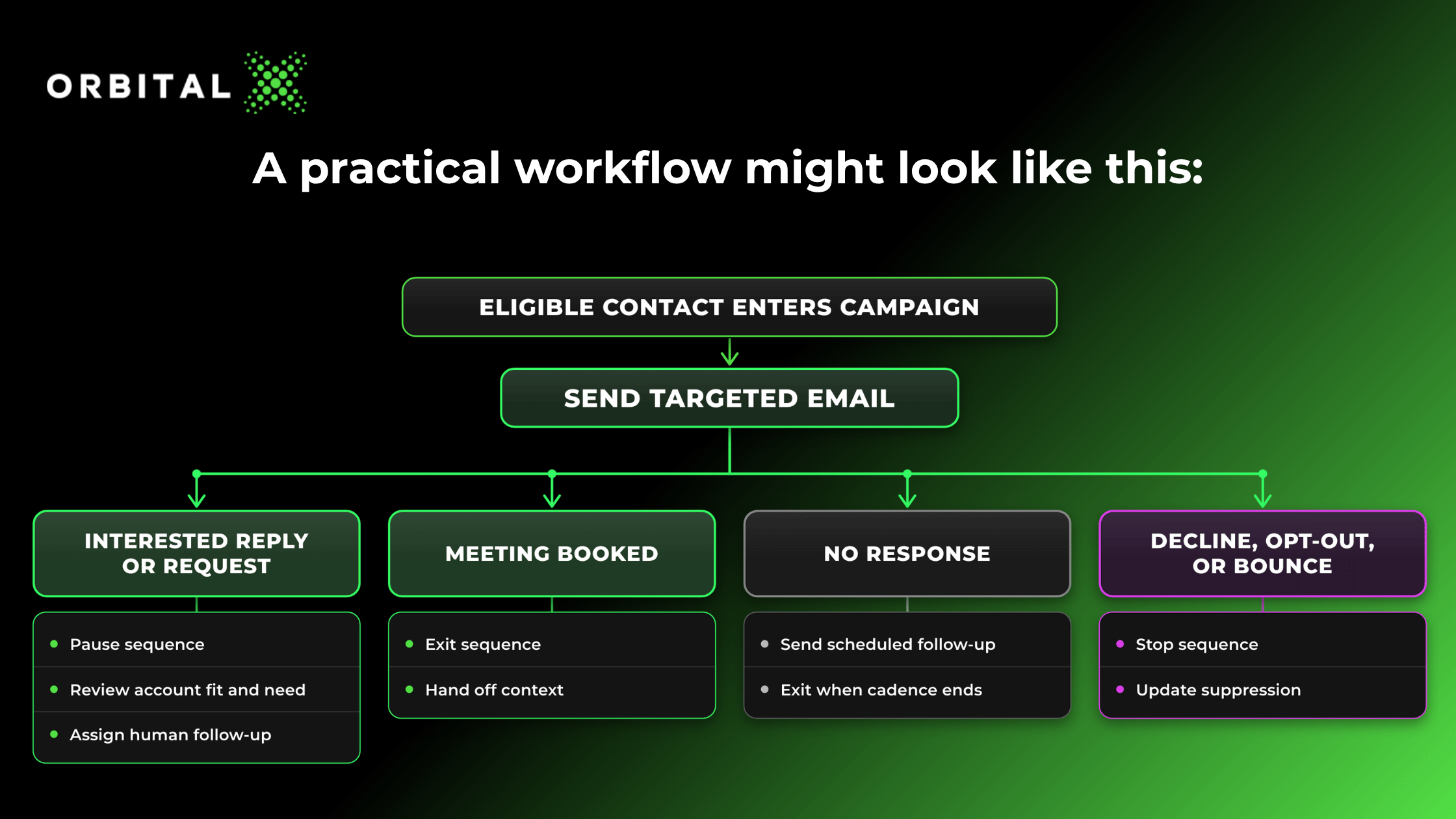 The workflow should make the next action obvious without trapping every contact inside the same automation forever.
3. Assign Ownership and Align Sales
A standalone open or click gives you an engagement signal. Sales handoff needs enough evidence to show that a human conversation makes sense. Use account fit, role, expressed need, and meaningful engagement to guide that decision.
Keep marketing and sales alignment tight around the handoff. When an interested reply arrives, send the conversation thread, company context, campaign history, and relevant activity into the CRM with a clear owner.
If sales rejects the opportunity, capture the reason. “Bad lead” teaches marketing almost nothing. “Company falls below our minimum account size” gives the campaign team something useful to work with. That feedback loop sharpens targeting over time and saves everybody from having the same argument next month.
How to Measure B2B Email Lead Generation Performance
B2B email lead generation performance should be measured against the campaign’s purpose, using delivery indicators, meaningful engagement, qualification, and commercial outcomes. A prospecting sequence and a subscriber nurture program have different starting points, so their results shouldn’t be judged by the same engagement target alone.
Delivery indicators help identify problems that prevent messages from reaching recipients. Responses and relevant next actions show whether the audience engages. Qualification and opportunity creation reveal whether that engagement has commercial value. Costs and eventual revenue help assess whether the investment is sustainable.
A reply may be negative, a meeting may never happen, and an engaged contact may not fit the offer. Reporting needs to preserve these distinctions instead of presenting every action as progress.
Group the reporting into four practical layers:
Delivery health tracks delivery rates, hard bounces, complaints, and other signals that can expose infrastructure or data-quality problems.
Useful engagement tracks positive replies, explicit information requests, and meaningful next steps while separating automated responses, declines, and unsubscribes.
Sales qualification tracks sales acceptance, meetings held, and qualified opportunities created.
Commercial contribution tracks pipeline, closed-won revenue, deal progression, and agreed attribution measures.
Email can also influence opportunities that begin elsewhere. An opportunity that originated through paid search and later engaged with a newsletter may have been influenced by email. So, separate sourced and influenced pipeline, document attribution rules, and evaluate results over a suitable buying cycle.
Engagement data from emails also needs its own interpretation. For instance, Apple’s Mail Privacy Protection can load remote content in ways that affect traditional open tracking, and security tools can scan links and generate automated clicks. A large open or click number can therefore include activity that never came from an interested human being.
Litmus even reported that 21% of marketers didn’t know their current email ROI. It’s easy to accumulate campaign activity while losing sight of what the channel contributed commercially.
Give Your Emails a Pipeline Job
A packed email calendar can create a reassuring sense that marketing is very busy. Pipeline cares about something else though.
Fruitful email programs reach relevant accounts, give buyers useful reasons to engage, interpret their signals carefully, and get promising conversations into the right hands while the context is still fresh.
OrbitalX connects audience targeting, content, email nurture, sales signals, and wider campaign execution through DemandWEBS™. For lean B2B teams, that means email gets a clear job inside the wider demand engine and every useful signal has somewhere to go. Because “great open rate” is a slightly awkward answer when the board asks what happened to pipeline.
Ready to give your email program a more commercial job? Book a call with OrbitalX today.
FAQs
What’s the difference between cold email and B2B email marketing?
Cold email reaches business contacts who haven’t previously engaged with the sender. B2B email marketing covers a wider set of activities including prospecting, newsletters, event invitations, and nurture campaigns. The audience relationship affects what people expect from the message and what kind of next step makes sense. A subscriber who requested educational updates already has context, while a new prospect needs a clear and relevant reason for the approach.
How often should you send B2B marketing emails?
B2B email frequency should reflect the audience’s expectations, the campaign’s purpose, and the value of each message. A newsletter and a prospecting sequence will usually need different cadences. Monitor qualified responses alongside unsubscribes, complaints, and negative replies, then adjust by audience segment. Sales and marketing should also coordinate activity so contacts aren’t receiving overlapping messages from several teams at once.
Can you use purchased email lists for B2B lead generation?
Buying a B2B email list doesn’t automatically establish that every contact can or should receive your campaign. Requirements vary by jurisdiction, recipient type, platform rules, and how personal data was sourced. Review provenance, accuracy, applicable permissions, suppression records, and your email provider’s policies before using purchased data. A vendor describing a contact as verified tells you something about the record’s accuracy. It doesn’t establish buying interest.
How long does B2B email marketing take to generate leads?
B2B email can produce responses soon after a campaign launches, while qualified opportunities and revenue depend on the audience, offer, and buying process. Existing subscribers with an active need may progress differently from unfamiliar prospects learning about a solution for the first time. Early reviews can focus on delivery, response quality, and meaningful next steps, with commercial evaluation expanding as opportunities have time to progress.
How much does B2B email lead generation cost?
B2B email lead generation costs can include audience research, contact data, sending infrastructure, email software, CRM integration, content production, campaign management, and sales follow-up. The total varies with audience size, campaign complexity, existing systems, and the amount of work handled internally or externally. Compare options using the same scope and include the staff time needed to research, operate, qualify, and follow up on campaigns.
More Resources
Organic vs. Paid Marketing and How to Give Every Marketing Dollar a Job
Organic vs. paid marketing? Cut through the noise, compare the tradeoffs, and learn where to invest for stronger B2B pipeline and smarter marketing growth.

Lead Generation Companies: How to Choose the Right Partner and What to Expect
Compare lead generation companies, spot weak promises, and choose a partner that delivers qualified opportunities. Know what to buy and how to judge results.

B2B Marketing Strategy Framework: Stop Chasing Tactics, Start Building Strategy
Build a B2B marketing strategy framework that connects audience, positioning, demand generation, sales alignment, and measurement to revenue.