ABM vs. Lead Generation: Which Strategy Is Right for Your Business?
Compare ABM vs. lead generation, explore their key differences, and learn when to use each strategy to generate qualified B2B pipeline growth.
Key Takeaways
Lead generation focuses on attracting individual prospects, while ABM concentrates resources on engaging specific, high-value accounts.
Which strategy to invest in depends on your ICP, average contract value (ACV), sales cycle, and GTM strategy.
Lead generation scales broad demand creation, while ABM prioritizes personalized engagement with strategic buying committees.
Combining both strategies often delivers stronger pipeline performance than treating them as competing approaches.
Many B2B marketers view ABM and lead generation as rival siblings fighting over the last slice of pizza. But there’s no winner-takes-all showdown here. Lead generation creates demand across the market, while ABM concentrates attention where the biggest opportunities are. When used in tandem, they can turn broad demand into focused account engagement and, ultimately, pipeline.
Neither approach is inherently superior, though, since they have very different scopes. With lead generation, you attract and qualify individual prospects at scale. ABM, meanwhile, focuses sales and marketing resources on engaging a carefully selected group of high-value accounts. The right fit depends on your ACV, sales cycle complexity, ICP, and overall GTM strategy.
Instead of picking sides, revenue leaders need to understand how each motion works. This guide breaks down the key differences, advantages, ideal use cases, and how to decide whether lead generation, ABM, or a hybrid model fits your growth goals.
What Is Lead Generation?
Lead generation is a tactic for attracting potential customers, grabbing their attention, and qualifying them before they become sales opportunities. Rather than targeting specific companies from the outset, this strategy focuses on identifying individuals who have demonstrated interest in a product or service through activities such as downloading content, submitting a form, registering for an event, or engaging with marketing campaigns.
Lead gen can include both inbound and outbound tactics. Inbound strategies attract prospects through channels such as SEO, content marketing, webinars, and social media, while outbound strategies push messages to potential buyers who fit general audience criteria using channels like cold email, paid advertising, prospecting databases, or sales outreach. These are important avenues since Gartner research shows that 67% of B2B buyers now prefer a rep-free sales experience. Traditional lead generation relies heavily on digital content, automated nurture streams, and self-service education to build interest before a seller ever steps in. The objective is to generate a consistent flow of qualified leads that sales teams can evaluate and convert into customers.
Lead gen typically follows a structured process that moves prospects from initial awareness through qualification before they become sales opportunities. That scalable approach is highly effective for organizations with broad target markets, shorter sales cycles, or products and services that appeal to a wide range of potential buyers.
It’s also fundamentally person-centric. You’re casting a net into the market to capture individuals who self-identify as having a problem that you can solve. That said, it’s ineffective without a proper strategy. Just imagine someone at the local pub on a Friday evening trying to chat up literally everyone who walks through the door. You might meet some interesting people, but most of the conversation goes nowhere.
You don’t need to pre-select 20 target accounts and stalk them for six months or collect a bunch of business cards from networking events. With lead gen, you're aiming to build a scalable, repeatable demand engine that consistently generates qualified opportunities across your entire addressable market.
How Lead Generation Works
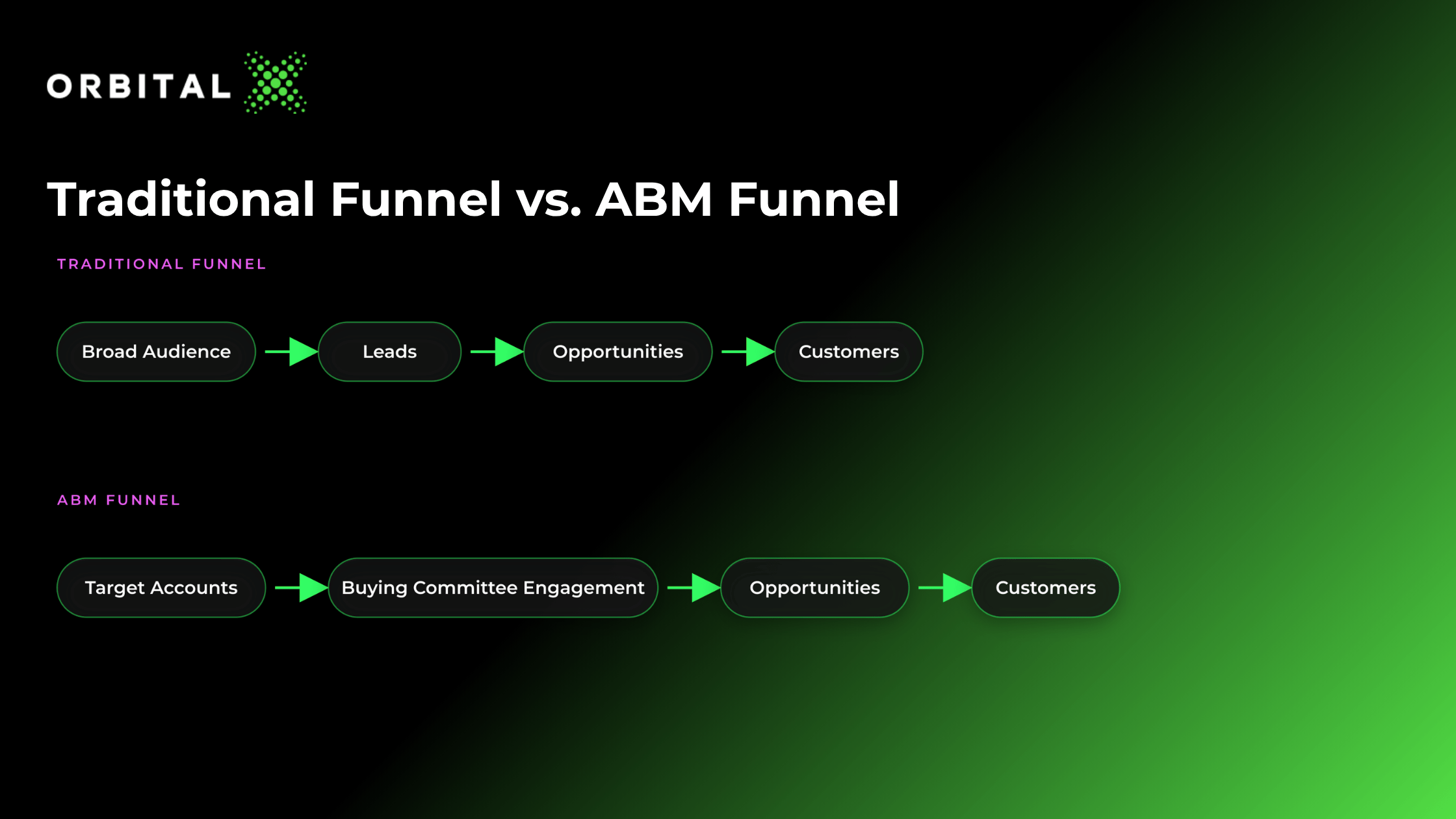
The traditional lead generation model works as a classic top-down funnel:
Attract a broad audience: Capture attention across search, social, paid media, and outbound channels.
Capture contact information: Exchange gated content, event registrations, or demo requests for buyer details.
Qualify individual leads: Evaluate buyer fit and intent using lead scoring models.
Nurture prospects: Deliver automated, multi-channel sequences and retargeting ads until the buyer signals readiness.
Pass qualified opportunities to sales: Hand off vetted leads to account executives for discovery and closing.
This funnel progressively narrows down a large pool of individuals into a smaller group of validated buyers.
For organizations pursuing a relatively small number of high-value accounts, casting a wide net isn't always the most effective way to build pipeline. While marketing might celebrate passing 500 downloadable ebook leads to the sales team, the sales director would look like someone just dumped a bucket of cold tea on their desk.
That's when account-based marketing’s different approach takes the stage.
What Is Account-Based Marketing (ABM)?
ABM is a B2B marketing strategy that focuses sales and marketing resources on a defined group of high-value target accounts. Instead of generating as many leads as possible, this tactic prioritizes engaging organizations that are the most likely to become valuable customers.
ABM begins by identifying accounts that closely match a company's ICP. Marketing and sales teams then coordinate their efforts to deliver personalized campaigns, content, and outreach tailored to the needs, challenges, and buying priorities of each account. Because B2B purchasing decisions often involve multiple stakeholders and external influencers, according to Forrester, ABM seeks to engage buying committees rather than individual contacts. It essentially flips the traditional funnel upside down.
Success depends on building meaningful engagement with target accounts, creating qualified pipeline, and driving revenue from strategically important customers. This approach is well suited to organizations with higher ACVs, longer sales cycles, or complex buying processes where personalized engagement can have a greater impact than broad-based marketing.
See more:
Traditional funnel vs. ABM funnel
How ABM Works
An account-based motion requires the sales and marketing departments to operate as a single revenue team from day one. That entails:
Define the ICP: Identify the specific firmographics, technographics, and triggers of your ideal accounts.
Build a target account list: Select the exact target companies that fit your revenue goals.
Map buying committees: Identify key decision-makers, champions, and influencers within each account.
Deliver personalized campaigns: Deploy customized content, bespoke ads, and coordinated sales outreach.
Measure account engagement and pipeline: Track account-level movement, meeting creation, and closed-won revenue.
Both sales and marketing share responsibility for account progression, so there’s no handoff over a fence.
ABM vs. Lead Generation Key Differences
ABM and lead generation generate pipeline, but they take vastly different approaches to reaching potential customers. Lead gen focuses on attracting and qualifying individual prospects before passing them to sales, whereas ABM begins by identifying high-value target accounts and coordinating sales and marketing efforts to engage multiple stakeholders within those organizations.
These polarizing scopes influence nearly every aspect of their execution, from targeting and personalization to measurement and resource allocation. Lead gen is typically designed to create a scalable flow of opportunities across a broad market, making it a good option for organizations with larger addressable audiences or shorter sales cycles. ABM, by contrast, concentrates resources on a smaller number of carefully selected accounts where the potential commercial value justifies a more personalized approach.
Put an ABM strategist and a traditional growth marketer in the same room, and you'll get a debate more heated than whether milk goes in before or after the tea.
The right strategy to adopt depends on factors such as ACV, ICP, sales cycle complexity, available resources, and overall GTM strategy. Many B2B organizations combine both approaches, using each where it delivers the greatest impact. Review their differences to evaluate which strategy (or combination of) best supports your revenue objectives.
Category | Lead Generation | Account-Based Marketing |
Target | Individual leads | Named target accounts |
Audience | Broad market | Narrow, defined account list |
Personalization | Segmented by persona/industry | Highly tailored to specific accounts |
Primary Goal | Scalable lead and contact volume | Qualified pipeline from high-value accounts |
Sales & Marketing Alignment | Sequential handoff (marketing to sales) | Shared ownership from day one |
Success Metrics | MQLs, CPL, SQLs, conversion rate | MQAs, account engagement, pipeline, revenue |
Best Fit | Large TAM, lower ACV, shorter sales cycle | High ACV, enterprise buyers, complex sales |
Momentum ITSMA revealed that 81% of B2B marketers report higher ROI from ABM than from any traditional marketing initiatives. However, they also found only 52% of companies actually measure ABM ROI properly. ABM can deliver massive returns, but only when you measure account-level pipeline impact rather than counting form fills. So, basically, do it right or don’t do it at all.
Targeting
Lead generation casts a wide net based on broad demographics, buyer personas, and online behavioral intent. The goal is to capture as many interested individuals as possible across your total addressable market (TAM).
ABM ignores the broad market. It starts with a fixed, prioritized list of target accounts that strictly fit your ICP. Instead of waiting for buyers to find you, you actively seek out the exact companies you want to close.
Personalization
Personalization in lead generation operates at the segment level. You customize email copy or landing pages by industry, job title, or campaign topic.
ABM goes deeper to address the specific headache keeping an executive awake at 2 AM. Content, campaign messaging, and sales outreach are built around account-specific pain points, strategic goals, and internal account dynamics.
Sales and Marketing Alignment
Lead generation relies on a linear handoff. Marketing runs campaigns to attract prospects, qualifies them into MQLs, and then hands them off to sales to convert into opportunities.
With ABM, the handoff is eliminated. Sales and marketing collaborate continuously, agreeing on target account selection, campaign timing, custom messaging, and direct sales execution.
Success Metrics
Lead generation performance tracks top-of-funnel volume and cost efficiency. Common metrics include CPL, MQL volume, lead-to-opportunity conversion rates, and SQLs.
ABM measures account-level progression and commercial value. Key indicators include MQAs, multi-stakeholder account engagement, win rates, contract value, and pipeline velocity.
Resource Requirements
Lead generation scales efficiently because assets and campaigns are reused across broad audiences. It requires less up-front research per prospect.
ABM, meanwhile, requires a higher immediate investment for each account. Developing bespoke messaging, mapping decision-makers, and executing coordinated multi-channel campaigns takes substantial time and strategic effort. But as anyone who’s bought a tailored suit on Savile Row knows, it takes more time and money up front, but it pays for itself in the attention and authority it earns.
ABM or Lead Generation: Which Approach Is Right for Your Business?
Whether to jump on the ABM or lead generation bandwagon depends on your business model, customer base, and GTM strategy. Factors including your ICP, ACV, sales cycle length, TAM, and available resources influence which strategy is likely to generate the strongest results.
The right approach is the one that aligns with your objectives, size, target market, resources, and overall growth strategy. For some businesses, that means prioritizing scalable lead generation. For others, it means investing in a targeted ABM strategy. For an ambitious marketer like yourself, it could be both. After all, your CFO isn't asking for your philosophy on brand building. They just want to know why CAC is creeping up while deal size stays flat.
ABM vs. Lead Generation Decision Matrix
Business Characteristic | Lead Generation | ABM | Hybrid Approach |
Large TAM | Best Fit | ||
Lower ACV | Best Fit | ||
Short Sales Cycle | Best Fit | ||
Broad Market Appeal | Best Fit | ||
High ACV/Enterprise | Best Fit | ||
Multiple Stakeholders | Best Fit | ||
Complex Buying Cycles | Best Fit | ||
Mixed Customer Segments | Best Fit | ||
Mature GTM Strategy | Best Fit |
Choose Lead Generation If…
Lead generation is usually the best path when you need to drive predictable volume across a large addressable market. Opt for this strategy when:
You have a large TAM with thousands of potential customers. (If your average contract value is £5k, spending six months researching a single company's buying committee will bankrupt you.)
Your ACV is low to mid-market, where high-touch account research isn't cost-effective.
Your product features a short sales cycle with simple, single-buyer decision-making.
You need a predictable, scalable inbound lead volume engine to keep sales reps busy.
Lead generation offers scale and repeatability, but lead quality can vary, and campaigns are less tailored to individual prospects.
Choose ABM If…
ABM is the right call when landing a small group of strategic accounts can transform your revenue trajectory. Opt for ABM when:
You target enterprise accounts with high ACVs that justify high-touch personalization.
Buying decisions require consensus from large committees across multiple departments.
Sales cycles span six to eighteen months.
Your total target market consists of hundreds of defined companies rather than tens of thousands.
ABM maximizes account progression and win rates with target accounts but requires tight sales alignment and up-front intel on each target.
Choose a Hybrid Approach If…
Mature B2B marketing teams don’t limit themselves to a single motion. They combine both strategies to capture immediate market demand while systematically pursuing high-value targets. A hybrid model allows you to:
Use broad lead generation to capture inbound demand and identify emerging intent signals across the market.
Upgrade high-fit inbound leads directly into targeted ABM plays.
Apply account insights gathered from ABM programs to sharpen messaging for broader demand campaigns.
How ABM and Lead Generation Measure Success
Lead generation and ABM need different performance metrics to capture the success of their differing objectives. Lead generation monitors the generation and conversion of individual prospects, while ABM tracks engagement and revenue across target accounts.
Gartner discovered that only 52% of senior marketing leaders can prove the value of their efforts. By measuring the right metrics for each approach, marketing and sales teams can show success more accurately, align reporting with business goals, and optimize the right parts of their go-to-market strategy.
Lead Generation KPIs | Account-Based Marketing KPIs |
Marketing Qualified Leads (MQLs) | Marketing Qualified Accounts (MQAs) |
Cost per Lead (CPL) | Target Account Engagement Score |
Lead Velocity | Pipeline Influence & Coverage |
Form Conversion Rates | Average Deal Size/Revenue per Account |
Sales Qualified Leads (SQLs) | Account Pipeline Velocity |
Evaluating an ABM strategy using CPL or MQL volume makes a high-value program look inefficient. Assessing lead generation using account-coverage depth misses overall volume velocity. Align your KPIs with your operating model to paint a clear picture of the fruits of your efforts.
Lead Generation KPIs
Judge lead generation based on efficiency and contact progression through the funnel:
MQLs & SQLs: The volume of qualified individuals entering and moving through the pipeline
Cost per Lead (CPL): Marketing spend required to capture an engaged contact
Lead Velocity Rate: The month-over-month growth rate of qualified leads
Lead-to-Customer Conversion Rate: The percentage of captured leads that ultimately close.
ABM KPIs
Review account penetration and commercial output to assess ABM:
Marketing Qualified Accounts (MQAs): Target accounts displaying meaningful, multi-stakeholder intent signals
Account Engagement: Engagement depth across target buying committee members
Pipeline Influence & Velocity: How effectively account campaigns accelerate pipeline movement and shorten deal cycles
Contract Value/Revenue per Account: Expansion in deal size driven by account-level personalization
How ABM and Lead Generation Work Together
ABM and lead generation see the best results when they work cohesively in the same pipeline generation strategy. Use lead generation for wide-reaching broadcasting and ABM to hone in on accounts that are highly likely to drive significant revenue.
Lead gen provides the market intelligence needed to identify potential opportunities. Content engagement, website activity, inbound conversions, and other demand signals can help sales and marketing teams understand which prospects and accounts show genuine interest. Those insights then inform ABM efforts by helping teams prioritize high-fit accounts and personalize engagement more effectively.
At the same time, ABM improves lead generation by providing deeper insights into ICPs, buying behaviors, messaging effectiveness, and account-level engagement patterns. That information helps organizations refine targeting, create more relevant content, and improve the efficiency of future demand generation campaigns.
Forrester research found that companies with close alignment across customer-facing motions saw 2.4 times greater revenue growth and twice the profitability growth compared to those with poor or no alignment. So, a disconnected approach is about as effective as a Vauxhall spinning its wheels in the mud.
High-performing B2B organizations build unified pipeline systems where both strategies reinforce each other. Lead generation creates awareness and captures demand across the market, and ABM ensures the highest-value opportunities receive the attention needed to convert into revenue. That allows businesses to balance scale with personalization for a more resilient GTM strategy.
.png)
How Lead Generation Fuels ABM
Lead generation acts as an early warning network for your ABM program. Broad content, search campaigns, and digital events generate buyer engagement signals across your market.
When three different directors from the same enterprise target spend 20 minutes on your pricing page, that isn't casual reading. That's a buying committee forming right in front of your eyes. Instead of treating each user as a standalone lead, your revenue team can evaluate the account. If it fits your ICP, you trigger an ABM play to engage the rest of that company's buying committee.
How ABM Improves Lead Generation
ABM programs produce high-resolution insights into how enterprise buyers make decisions. Deep account engagement reveals which pain points resonate, which content formats move buying committees, and which value propositions win deals.
Marketing teams feed these insights back into broad demand generation campaigns. Take those battle-tested narrative hooks and use them to refine your ad campaigns so you stop wasting spend on bland copy. Refining your ICP definitions, audience segments, and messaging based on ABM wins ensures your lead generation spend pulls in higher-quality prospects from the start.
Build a Pipeline Strategy That Fits Your Business
Don’t mistake these strategies as the marketing versions of the Montagues and the Capulets. ABM and lead generation are complementary pipeline motions designed for different buying scenarios:
Lead generation delivers scalable reach across addressable markets.
ABM focuses high-touch energy on the high-value accounts with the potential for major revenue growth.
Constructing a predictable pipeline requires more than picking a campaign strategy though. You need to build an integrated operating system that connects your strategy, technology, marketing, sales, and measurement around shared commercial metrics.
That connected approach is why OrbitalX built the DemandWEBS™ platform. Our solution gives lean B2B marketing teams a unified operating framework to read market signals, run targeted account plays, capture broader demand, and build predictable pipeline without adding head count or bloat.
If you’re ready to skip the guesswork and build a pipeline engine that produces worthwhile results, book a call with OrbitalX today.
Frequently Asked Questions
Is ABM better than lead generation?
ABM isn’t inherently better than lead generation or vice versa. The right approach depends on factors like target market size, average deal value, sales cycle complexity, and available resources. Lead generation excels at creating demand among a wide audience, while ABM focuses resources on specific, high-value accounts. Many B2B organizations combine both strategies to balance scalable demand generation with personalized engagement and account-level targeting.
What is the difference between ABM and lead generation?
The main difference between ABM and lead generation is their scope. Lead generation targets individual prospects and aims to produce a steady flow of potential customers through channels like content, advertising, and inbound campaigns. ABM identifies high-value target accounts, then coordinates tailored marketing and sales efforts to engage multiple stakeholders within those organizations and drive account-level pipeline.
Can ABM and lead generation be used together?
Yes, ABM and lead generation can work together as connected parts of a broader pipeline generation strategy. Lead generation helps businesses attract demand, capture engagement signals, and identify potential opportunities across the market. ABM then uses those insights to prioritize high-fit accounts and deliver personalized engagement. Together, these approaches help businesses unite market reach, targeting precision, and revenue-focused growth.
Which companies should use ABM instead of lead generation?
ABM is typically best suited for companies selling high-value solutions with longer sales cycles, complex buying committees, and clearly defined ICPs. Lead generation is more effective for businesses with larger target markets, lower average contract values, or simpler purchasing decisions. Companies should evaluate their GTM strategy, customer journey, resources, and sales process before deciding which approach fits best.
How do you measure ABM success compared to lead generation?
ABM and lead generation require different success metrics because they seek different outcomes. Lead generation is often assessed through metrics such as MQLs, cost per lead, conversion rates, and SQLs. ABM needs more account-level metrics like marketing qualified accounts, account engagement, pipeline influence, revenue per account, and how effectively strategic accounts progress through the buying journey.
More Resources

B2B Content Marketing Funnel: Stages, Strategies, and How to Build One That Converts
Build a B2B content marketing funnel that aligns content with buyer needs, connects the journey, and turns content engagement into pipeline and revenue.

B2B Referral Marketing: How to Build a Program That Drives Qualified Growth
Learn how to build a B2B referral marketing program that turns trusted relationships into qualified introductions, pipeline, and measurable revenue.

A PE-Backed Company Cut Marketing From 12 People to 3. Then Had Its Best Six Months Ever.
A marketing team cut from 12 to 3, then the best six months in the company's history. Here's the growth system behind it, and what it means for PE portfolios.