B2B Go-To-Market Strategy: The Decisions That Turn Market Plans Into Pipeline
Build a B2B go-to-market strategy that prioritizes accounts, aligns revenue teams, controls costs, and turns signals into pipeline.
Key Takeaways
A B2B go-to-market strategy defines the market you’ll pursue, the accounts that matter most, the positioning you’ll take, the motions worth funding, and how the revenue team will turn market attention into qualified pipeline.
A useful strategy doesn't list every channel, tactic, campaign, or tool. It clarifies where the business will focus, what the team will deliberately avoid, and how market response will shape the next move.
ABM belongs high in B2B GTM planning because complex deals are often won at the account and buying-group level. Chasing isolated individual leads leaves the motion too narrow for that buying reality.
Costs and skills are strategic inputs. Paid media, outbound, content, ABM, partnerships, events, and automation all require different operators, timelines, data quality, and measurement discipline.
A GTM strategy is working if it helps the team turn market signals, account intelligence, content, sales action, and feedback into better pipeline decisions.
A B2B go-to-market strategy is the commercial plan for reaching, engaging, converting, and retaining the right business customers. It clarifies which market to pursue, which accounts to prioritize, what problem the company will own, how they’ll position the offer, which channels and sales motions they’ll use, what resources are required, and how they’ll measure success.
Sound simple? It’s actually a little more complicated than that.
Many GTM strategies look complete on paper and yet fail in practice. They feature an ICP, market summary, personas, positioning statement, channels, content plan, sales target, and dashboard, but those pieces don't change how the team behaves. Budget is spread too broadly, sales keeps chasing weak-fit accounts, and content continues to answer generic category questions. CRM data also sits in fields nobody trusts, leaving leadership without a clear view of the failure point across targeting, message, timing, channel mix, sales execution, and the offer itself.
A practical B2B GTM strategy eliminates that uncertainty. It tells the team which accounts deserve attention, what message is appropriate for those accounts, and where to reach them. It also clarifies who owns the next step, what the motion will cost, which skills are required, and which signals should determine the next move.
A go-to-market strategy is a broader, cross-functional plan covering target customers, market analysis, value proposition, sales channels, pricing, distribution, customer support, milestones, KPIs, budget, and feedback loops. That scope distinguishes GTM strategy from marketing strategy. GTM covers the wider path to bringing an offer to market, while marketing strategy focuses more on demand, messaging, campaigns, brand, and communication.
For B2B companies, the strategy requires an additional layer, since the buyer is rarely one person. Gartner found that B2B buying groups range from five to 16 people across as many as four functions, and 74% of B2B buyer teams experience conflict throughout the buying process.
GTM strategy goes beyond a product launch checklist in the B2B industry. It also has to work as a revenue decision system.
Don’t Confuse B2B GTM Strategy With Similar Terms
Treating related GTM concepts as interchangeable is a powder keg for costly misunderstandings and mistakes. A GTM strategy, marketing plan, sales plan, and GTM system connect across the revenue motion, with each one doing a different job.
Concept | What it decides | What it doesn't do alone |
B2B GTM strategy | Which market, accounts, positioning, motions, resources, and success measures will guide growth | Coordination still depends on operating system, ownership, and feedback |
Marketing plan | Which campaigns, content, channels, programs, and timelines marketing will execute | Marketing alone doesn't define the full revenue motion |
Sales plan | How sales coverage, territories, quotas, pipeline stages, and deal execution will work | Sales alone doesn't create market demand or account intelligence |
GTM system | How data, tools, workflows, ownership, sales action, and feedback make the strategy move | The system can't substitute for strategic choices |
A marketing plan focuses on communication, campaigns, channels, brand, and demand. A GTM strategy is broader. It connects sales, marketing, product, pricing, distribution, customer experience, measurement, and feedback.
A sales plan is also narrower than a GTM strategy. It defines how the sales organization will pursue revenue across capacity, coverage, quotas, pipeline management, qualification, handoff, deal process, and forecasting.
GTM systems have a separate job. Strategy decides the direction of the business, while the system decides how execution moves. A company with a strong GTM strategy can still fail if data, handoffs, account prioritization, content, sales timing, and feedback stay disconnected.
Even if every box is checked, that doesn't prove the B2B GTM strategy is ready. The true measure is whether the strategy changes what the team does next.
The Core Elements of a B2B Go-To-Market Strategy
A good B2B GTM strategy needs to make each major planning element operational. Market focus should determine which accounts the team will stop pursuing, while positioning decides what belief the team has to change, and channel selection guides where budget, skills, and sales effort actually go.
That same test applies to every element that follows. If an element doesn’t change account priority, messaging, ownership, investment, or feedback, it’s not yet doing strategic work.
1. Market and ICP focus
Imagine sitting in an executive meeting and leadership declares your target market is “everyone with a budget.” Every marketer in the room would immediately die inside. That’s why a narrow ICP is so important.
The strategy starts by defining the arena for competition and the customers the company is best positioned to win. That entails more in-depth information than industry, company size, geography, and revenue. A practical ICP clarifies pain points, urgency, use case, technical fit, commercial value, growth stage, budget pressure, buying complexity, and the reason an account has to act now.
B2B strategy weakens if the ICP is too broad and tries to include everyone. A target like “mid-market SaaS” contains companies with a wide variety of funding positions, sales cycles, risk profiles, tech stacks, hiring patterns, and reasons to buy. Smart strategy has to separate available market from targets worth pursuing.
A B2B account carries more than a company record. It’s a buying network made up of internal stakeholders, external influencers, procurement pressure, AI-assisted research, peer validation, and risk review. Forrester uncovered that “73% of purchases involve three or more departments,” including about 13 internal participants and nine external participants.
For GTM strategy, that means the account is a changing commercial context.
2. Account prioritization and ABM
Account-based marketing (ABM) deserves a prime spot in a B2B GTM strategy because it changes the unit of focus. Rather than casting a wide net and hoping for a major catch, ABM has you spearfish the exact 50 accounts that actually pay your bills. The question moves from, “How do we generate more leads?” to, “Which accounts are worth coordinated effort, and what would make them more likely to move?”
That shift changes planning around multi-stakeholder deals. Gartner revealed how achieving group consensus leads to a 2.5 times greater likelihood of closing a high-quality deal. They also found that buying-group relevance encourages consensus, while individual-level content focus can increase conflict.
In a GTM strategy, ABM sets account tiers, buying groups and accompanying content requirements, decision triggers, sales coordination (including channel mix), and the rules for investment in an account.
A lean B2B team might run a one-to-few ABM motion around a focused cluster of high-fit accounts and avoid deep personalization across hundreds of companies. On the other end of the spectrum, a mature enterprise motion could justify one-to-one account plans for strategic accounts. The right answer depends on deal size, sales capacity, data quality, content depth, and the level of sales involvement the team is able to sustain. Agencies like OrbitalX can help companies hone in on their audience targets and craft stories tailored to their specific needs and pain points.
3. Positioning and competitive narrative
A GTM strategy defines the market argument the company has to win. Can you imagine a sales team asking why a particular account should choose their company over a competitor, only for marketing to hand them a 40-page brand deck filled with fluff? Headache, incoming.
Positioning explains why the buyer cares, why the problem is urgent now, why current alternatives are insufficient, and why this approach is different. Without that narrative, every downstream motion gets more expensive. Paid media has to work harder, outbound is ignored, content turns interchangeable, and sales has to rebuild context in every conversation.
Many GTM plans stay too shallow at this point. They mention differentiation without defining the buyer’s current belief, the alternative the buyer is comparing against, or the decision criteria the company has to shape.
A strong positioning section answers:
What problem does the buyer think they have?
What problem do we believe they actually have?
What cost does that problem create?
What belief must change before they buy?
What proof will make that belief credible?
Which competitor, status quo, or internal objection must we beat?
4. Buying committee and decision journey
A B2B GTM strategy has to define how buying actually happens inside the accounts the company wants to win. That entails identifying the economic buyer, champion, technical evaluator, financial stakeholder, end user, procurement influence, and likely blockers. Role labels help, but they’re not enough on their own.
The strategy also has to clarify what each role must believe, which proof reduces perceived risk, how far self-directed research can carry the buyer, and where sales needs to add context. That keeps the buying committee from becoming a persona exercise and turns it into a plan for consensus.
The buyer journey is becoming more AI-assisted and self-directed. Gartner reports that 67% of B2B buyers prefer a rep-free experience, while Forrester says 94% of business buyers use AI during the buying process. Sales still has a critical role, but it’s shifting toward validation, context, and risk reduction. Buyers may gather more information on their own, yet Gartner’s finding that 69% use sales reps to validate AI-generated insights shows why salespeople are still needed when the buying group has to test information against business context, pricing, implementation, internal consensus, and commercial risk.
An poorly outlined buying group lets the strategy look active as pipeline stalls. Marketing educates one role, while sales needs access to another. Paid campaigns reach the right title but miss the buying network, leaving the team with one strong champion and no clear path to consensus.
5. GTM motion and channel selection
Channels aren't interchangeable pipes. Think of them like picking a team for pub trivia. Instead of five people with general knowledge, you’d want one sports fanatic, one history expert, and someone who actually knows science. Similarly, paid search, LinkedIn ads, and webinars behave differently from SEO, partnerships, communities, and ABM. Each has a different cost profile, speed, data requirement, skill requirement, and measurement problem.
A GTM strategy should explain why each selected motion deserves investment:
Paid media can accelerate learning and demand capture when the team has budget, creative testing and conversion tracking, landing page discipline, and channel-economics expertise.
In focused account segments, outbound adds speed through account selection, trigger logic, messaging, and strong follow-up quality.
Content and SEO create compounding reach around real buyer questions and intentional distribution.
Events and webinars add trust after the team converts attendance into account context and disciplined follow-up.
Channel selection now has to be treated through orchestration, with coverage alone treated as incomplete. The buyer journey has ballooned to include an average of 10 channels, according to McKinsey, and inconsistent information or lack of knowledgeable support are leading drivers of supplier switching.
Naming channels leaves the actual channel decision unfinished.
6. Pricing, packaging, and offer logic
Pricing is a significant steering wheel in GTM strategy. It decides which buyers are able to say yes, which stakeholders require proof, how much risk the deal carries, and the likely pace of the sales motion through procurement.
Pricing and packaging influence who can buy and how quickly, which stakeholders need to approve, what sales has to prove, and whether the offer fits the buyer’s risk tolerance. A high-ACV enterprise offer typically requires consultative selling, ROI proof, executive sponsorship, procurement alignment, and long-cycle nurture. But a lower-friction offer relies more on product experience, self-serve education, or sales-assisted conversion.
The GTM strategy defines the offer’s operating logic around speed, expansion, land-and-expand, premium positioning, strategic account penetration, or broad market reach.
7. Content and messaging system
A publishing calendar alone is insufficient. Dumping 50 generic blog posts online is like handing out paper flyers in a rainstorm. It's messy, expensive, and gets completely ignored. Content in a GTM strategy drives tangible decisions:
Early-stage content helps buyers understand the problem.
Mid-stage content helps them compare approaches.
Late-stage content reduces risk, builds internal consensus, and gives sales stronger objection handling.
ABM content has to be relevant to a target account or segment beyond a lightly edited generic asset.
The strategy also defines how messaging adapts by segment, role, stage, and signal. A CFO requires a different message from a marketing operations lead. A first-touch visitor requires a different message from an account already engaging with pricing, comparison, and customer proof.
Content earns its place in the GTM strategy by changing buyer understanding or sales action.
8. Sales process, handoff, and ownership
A GTM strategy outlines what happens when interest appears. It specifically answers:
Who owns the next move?
What context does sales receive?
Which signals trigger a task?
How fast should follow-up happen?
Which message is used?
What happens if sales rejects the lead or account?
Strategies commonly break at this handoff. Marketing sees engagement, sales sees weak context, RevOps sees messy data, and leadership sees dashboard movement with too little pipeline. Each team has a version of the truth.
A strong GTM strategy clarifies handoff rules, qualification logic, account ownership, feedback loops, and the information sales requires to act with relevance.
9. Measurement and feedback
The wrong GTM dashboard can make a weak strategy look healthy.
Traffic, impressions, opens, and raw lead volume show activity but don't prove the strategy is effective. Better GTM measurement shows whether the business is selecting better accounts, reaching the right buying groups, and improving message fit. It also reveals if the motion creates sales-accepted opportunities, reduces wasted effort, improves win rates, shortens sales cycles, or learns faster from closed-won and closed-lost patterns.
The measurement layer reduces decision friction and avoids another reporting ritual. Bain discovered a wide execution gap where 82% of B2B companies say they run sales plays, yet just 21% recognize the full value of those plays. Companies with a genuine sales play system of targeted, repeatable GTM motions saw 2.2 times the average growth rate compared with those without one.
Other industry data argues that the performance gap is moving toward companies that operationalize account-based governance, AI, personalization, and commercial execution within a coherent system, away from disconnected initiatives.
A useful GTM dashboard helps the team decide which accounts deserve attention, which signal should trigger action, and what needs to change in the next cycle.
10. Execution capacity and skills
A lean team attempting to run paid ads, custom ABM, daily podcasts, and an event roadshow will burn out before Q2. A GTM strategy has to be honest about the motion the team is able to sustain:
If the team chooses paid media, that entails media buying, creative testing, copy, landing pages, conversion tracking, and analytics.
Outbound requires account research, trigger logic, message quality, SDR capacity, CRM discipline, and fast follow-up.
ABM depends on account intelligence, buying-group mapping, sales alignment, personalized content, campaign coordination, and account-level measurement.
Content and SEO call for research, editorial judgment, subject-matter expertise, distribution, and patience.
Lean teams commonly overreach at this point, choosing a grown-up GTM motion with a small-team operating model. The strategy has to make the cost of complexity visible ahead of team commitment.
GTM Decision-to-Learning Map
A practical GTM strategy turns decisions into action and action into learning.
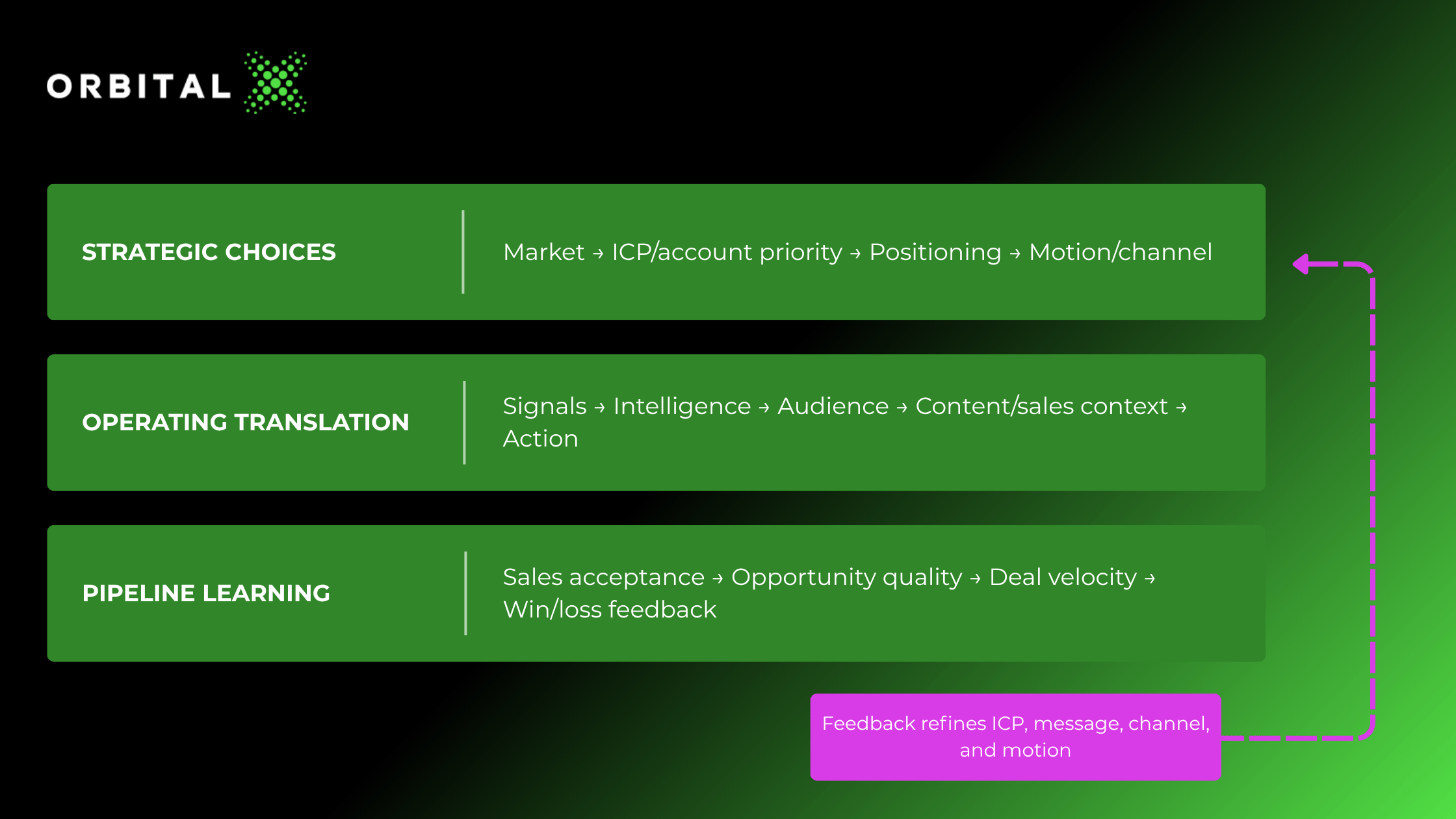 A B2B GTM strategy should move beyond the first row. Strategic choices gain value as they travel through operating translation and return as pipeline learning.
Your “Next Monday” GTM Scorecard
A GTM decision should change what the team does from one week to the next.
Score each proposed decision from 1 to 5.
1 = no operational effect 3 = partially defined 5 = clearly changes execution |
Facet | Question |
Account focus | Does it change which accounts get priority? |
Message focus | Does it change what the buyer hears? |
Channel focus | Does it change where budget or effort goes? |
Sales action | Does it change what sales does next? |
Data requirement | Does it clarify what data must be trusted? |
Learning loop | Does it define what feedback changes next cycle? |
6–12: this may sound strategic, but it won't change the motion yet. 13–22: plausible GTM assumption with operating detail still missing. 23–30: executable GTM decision. The team can act on it, measure it, and learn from it. |
The scorecard exists to keep strategy from turning into important-sounding language with no behavioral effect.
Related watch:
In the Do More With Less episode “Why Strategy Fails When Businesses Stop Thinking,” Nick Eades, the chief strategy officer at Freemarket, gives a simple warning for any GTM team: “Complexity is not to be admired, it is to be avoided.”
That warning applies directly to B2B go-to-market strategy. Companies shouldn’t aim to build a larger plan with more channels, slides, and activity. The goal, as Nick also notes, is to “get uncomfortably clear” about the market, accounts, message, motion, and feedback loop the team will actually run.
Budget Shows Only One Layer of a B2B GTM Strategy’s Total Cost
The cost of a B2B GTM strategy goes beyond the budget assigned to ads, content, outbound, events, or tools. The biggest expense is backing a motion the team can’t operate long enough or well enough to learn from.
A paid motion without conversion insight burns through spend, whereas ABM with poor account intelligence turns into expensive personalization theatre. Automation layered on immature processes scales weak handoffs, and content with vague sales context creates a library with little revenue value.
Recent budget data highlights those trade-offs, but the numbers should support the decision rather than overwhelm it. Gartner’s research indicates a constrained environment, with marketing budgets at about 7.8% of company revenue, and AI receiving 15.3% of marketing budgets. Yet only 30% of CMOs describe their AI readiness as mature or fully developed, and more than half also report budgetary or resource constraints in their strategies.
Capability matters as much as budget. The CMO Survey, for instance, highlights resourcing and training constraints as barriers to marketing capability, while Forrester points to process rigidity and manual workflows as hidden execution costs. Those costs show up as slow routing, weak prioritization, repeated manual work, poor data trust, and decisions that arrive after the buyer has moved.
Don’t waste your time analyzing the average GTM budget. The real cost question is which motion the team can fund, operate, measure, and improve deeply enough to create qualified pipeline.
The Four Layers of GTM Cost
GTM motions tend to fail when visible spend is funded and the capability, system, and learning layers are neglected.
.png)
GTM motion cost intelligence:
Before committing to a GTM motion, check these four areas:
Budgetary pressure asks how much room the team actually has inside the broader B2B marketing budget.
Capability gap asks if the team has the people and skills to execute this motion.
System readiness asks if data, routing, RevOps, and reporting are strong enough.
Learning speed asks how quickly this motion will show performance.
Use this checklist to test whether the team is ready to scale a motion or only ready to buy the visible layer:
GTM motion | Visible cost | Capability cost | Hidden failure mode |
Paid media | Media spend, creative, landing pages | Media buying, offer testing, conversion analytics | Spend scales ahead of learning |
ABM | Account data, research, personalization, sales time | Account intelligence, sales alignment, content ops | “Personalization” becomes generic campaign activity |
Outbound | Data, SDR time, sequences, tools | Trigger logic, messaging, sales management, CRM discipline | Sales burns time on bad-match accounts |
Content/Search | Research, writing, editing, distribution | SME access, editorial judgment, search and distribution strategy | Content informs but fails to move pipeline |
Events/Webinars | Production, speakers, promotion, follow-up | Audience targeting, sales follow-up, enablement | Attendance becomes vanity activity |
Automation/AI | Tools, implementation, integrations | RevOps, data governance, lifecycle design | Broken handoffs get automated |
Visible-layer funding alone makes a motion expensive.
The Highest-Impact Drivers of B2B GTM Success
The elements that have the greatest effect on a GTM strategy are rarely the flashiest ones. The real drivers are:
Account focus: A company that knows exactly which accounts it's positioned to win builds sharper messaging, better sales plays, tighter content, and more efficient paid targeting. A company that spreads across too many segments makes every motion weaker.
Positioning: If buyers can't quickly understand why the problem matters and why this approach is different, every channel becomes more expensive.
Buying-group relevance: B2B deals usually require internal consensus beyond individual interest. Group-relevant content builds consensus, while individual-level relevance risks worsening conflict.
Channel discipline: Don’t waste your time counting current channels. The real question is which ones the team can execute deeply enough to affect pipeline.
Feedback speed: A GTM strategy should learn from sales rejections, win-loss data, message response, conversion quality, and customer signals. If feedback doesn't change the next audience, message, channel, or sales play, the strategy isn't learning.
What Makes a B2B GTM Strategy Work in Practice?
A B2B GTM strategy works in practice when its decisions stay connected through execution and feedback. Account priorities shape what each buying group needs to hear. That context then guides channel and sales action, while pipeline evidence informs the next strategic choice.
A team needs enough consistency to learn and flexibility to avoid locking in a plan that no longer fits. When the segment, message, or channel changes before the team has gathered enough comparable evidence, the result becomes hard to interpret. It’s difficult to tell whether the strategy was wrong, execution was weak, the data was unreliable, follow-up was slow, capacity was too thin, or the motion simply didn't produce a reliable signal.
The motion can still stall after the GTM plan looks complete. The ICP is named, the channels are listed, and the dashboard is live, yet target-account priorities don't change as signal quality changes. Sales can't see which message fits each account either, and paid campaigns optimize for cheap form fills without proving they create account-quality pipeline. Content sits outside the buying-group map meanwhile, and CRM data is incomplete or untrusted, sales rejects leads, and that feedback never changes targeting or campaigns.
Before replacing the strategy, identify where the connection failed:
Strategy choice
Was the segment wrong?
Was the message unclear?
Did the offer and pricing fit the buying problem?
Execution and operating system
Did the channel fit the motion?
Did sales act quickly enough?
Did the buying group include the people needed to move the decision forward?
Was the data reliable enough to guide action?
Did the team have the skills and capacity to run the motion as designed?
Measurement and learning
Was the metric tied to pipeline movement, or was it only reporting activity?
Did feedback change targeting, campaigns, or sales action?
Had the motion produced enough comparable evidence to support a decision?
A team can add dashboards, ads, outbound tasks, and meetings without fixing any of those problems. That diagnosis should show whether the strategy itself needs to change or if a logical choice was lost in the data, handoffs, timing, or capacity needed to carry it through.
The Operating Layer Behind a Working GTM Motion
A clear strategy defines commercial choices. The operating layer keeps those decisions connected as they move through data, account intelligence, audience decisions, content, sales context, execution, and feedback.
That transforms a target-account strategy into coordinated daily action:
Account intelligence updates who deserves priority as signals change.
Buying-group context shapes the message and proof.
Channel decisions reflect speed, cost, signal quality, and follow-up requirements.
Content carries that context into the buyer's decision, while measurement shows what the team should change next.
Keeping strategy, planning, execution, measurement, and feedback linked gives the team a way to spot deviations and course-correct before disconnected activity becomes the default.
For ABM, the operating layer keeps account priorities responsive to changing signals and buying-group context. Those priorities shape who the team targets, what each buying group needs to understand, which proof can move the decision forward, and when sales should act.
Adaptive B2B GTM programs use account and buying-group signals to refine priority, content relevance, and cross-channel coordination as conditions change.
OrbitalX’s DemandWEBS™ and expert operators support that work by synthesizing account intelligence into audience decisions, content and sales context, coordinated execution, and feedback that sharpens the next move:
Data captures what’s known about the market, accounts, buyers, and their behavior.
Intelligence interprets those inputs and identifies which accounts and buying-group members deserve attention.
Audience decisions turn that interpretation into a clear focus for targeting.
Content gives those buyers the message, proof, and context they need.
Execution carries those choices into paid, owned, outbound, partner, and sales-led activity.
Feedback from sales and pipeline outcomes carries what the team has learned back into the next cycle, where it can change the next account priority, message, channel, or workflow.
Once that loop is working, the strategy becomes a repeatable way to decide who to pursue, what to say, how to follow up, and what to change next.
StackOne’s story: Right accounts over activity volume
The StackOne team needed a sharper way to identify the right accounts, interpret technical context, and turn that intelligence into better outbound execution.
Thanks to OrbitalX’s experience building proprietary data models for high-performing GTM teams, StackOne’s outbound-to-meeting-booked rate increased by 15%. Their custom workflows honed in on ICP-aligned accounts and contacts and developed a more reliable outbound engine.
That’s what separates GTM activity from GTM motion. Activity asks, “How many accounts did we reach?” While a well-constructed operating model asks, “Were these the right accounts? Did the timing make sense? Did sales have the right context? Did the outcome teach us what to do next?”
Go to Market With a Strong Plan Backing You
A B2B go-to-market strategy has to move beyond a static planning document. It gives the revenue team a way to make better decisions about priority accounts, buyers who require influence, motions worth funding, missing skills, signals that deserve action, and feedback that changes the next cycle.
If that strategy is clear on paper but hard to execute, the next problem doesn't need another planning session. You have to dig into the operating layer between the strategy and the pipeline.
The DemandWEBS™ platform gives lean B2B teams an operating layer where account intelligence, audience prioritization, content, execution, and feedback work together in one motion.
Book a call with OrbitalX to see how that operating model could advance your next stage of growth.
FAQ
What is a B2B go-to-market strategy?
A B2B go-to-market strategy is the plan that defines which market, accounts, positioning, channels, sales motion, resources, and metrics will guide how a company reaches and converts business customers. It should include ICP and market focus, account prioritization, positioning, buying committee insight, channel and sales motion selection, and pricing and packaging logic. It also needs to cover content and messaging, handoff rules, measurement, feedback loops, and execution capacity.
How is a GTM strategy different from a marketing strategy?
A GTM strategy is broader. It details how the company brings an offer to market across sales, marketing, product, pricing, distribution, customer support, and measurement. A marketing strategy focuses more specifically on demand, messaging, campaigns, content, and brand communication.
Is ABM part of a B2B go-to-market strategy?
ABM is commonly a core part of B2B GTM strategy for companies selling to high-value accounts, complex buying committees, or segments that require coordinated sales and marketing effort. That’s why ABM has to be treated as more than a campaign tactic and instead recognized as an account-prioritization and execution model.
Who owns B2B GTM strategy?
Ownership usually sits with executive revenue leadership, and the strategy has to involve marketing, sales, product, customer success, RevOps, and finance. If one department owns the document but no one owns the cross-functional execution, the strategy will weaken.
How do you measure B2B GTM strategy performance?
Measure whether the strategy improves account quality, sales acceptance, and qualified pipeline. Then look at win rates, sales cycle length, CAC payback, customer fit, and feedback speed. Activity metrics can help diagnose motion, but they shouldn't be treated as proof that the strategy’s working.
More Resources

B2B Content Marketing Funnel: Stages, Strategies, and How to Build One That Converts
Build a B2B content marketing funnel that aligns content with buyer needs, connects the journey, and turns content engagement into pipeline and revenue.

B2B Referral Marketing: How to Build a Program That Drives Qualified Growth
Learn how to build a B2B referral marketing program that turns trusted relationships into qualified introductions, pipeline, and measurable revenue.

A PE-Backed Company Cut Marketing From 12 People to 3. Then Had Its Best Six Months Ever.
A marketing team cut from 12 to 3, then the best six months in the company's history. Here's the growth system behind it, and what it means for PE portfolios.