B2B Lead Generation Emails: Templates, Examples, and Strategies
B2B lead generation email templates, examples, and strategies for writing relevant, personalized emails that generate replies and support demand generation.
Key Takeaways
Effective lead generation email templates are built around the prospect's problem, context, and stage in the buying process. They should provide a useful starting structure without making every email sound identical.
Different outreach situations require different approaches, from cold outbound and referrals to reengagement and event-triggered follow-up.
Personalization should make the message more relevant, not turn the email into a performance of how much research you did.
High-yield email sequences give prospects a reason to keep engaging instead of sending the same pitch five times.
An email template can save your team hours of manual typing. Lovely. So can copying and pasting the same email forever, but nobody’s calling that a demand-generation strategy.
Relying on rigid, copy-pasted scripts is a fast track to leads ignoring you. Smart lead generation emails give sales and marketing teams a reliable structure that leaves plenty of room for relevance, context, and personal touches.
The best framework is the one that fits the prospect in front of you. That’s why it’s crucial to choose, adapt, and execute templates based on the specific situation, audience, offer, and buying context you’re working with.
What Makes Lead Generation Email Templates Effective
A lead generation email template gives sales and marketing teams a repeatable structure for beginning conversations without forcing the same message onto every prospect. Well-crafted templates make the recipient’s situation the starting point. That means identifying a relevant problem, trigger, priority, or observation before introducing the company or its offer.
If your inbox is full of “Hope this email finds you well” lines, you’re not alone. Somewhere between the rainy London bus stop and the fifth identical sales email of the morning, most buyers have developed a finely tuned instinct for spotting a template.
The value proposition should outline why the message is relevant to that particular prospect. A strong template is also able to adapt the message by role, account, industry, buying stage, or recent business event.
The call to action, meanwhile, should fit the level of engagement. Someone receiving a first cold email is likely to be more receptive to a useful resource, question, or low-commitment next step than a request to book a 30-minute demo.
A winning email framework follows a natural, human progression:
Relevant observation: Prove you know who they are and why you're reaching out at this time.
Problem/Trigger: Highlight a specific challenge or recent event affecting the recipient’s team.
Value: Offer a clear, context-rich perspective or fix.
Proof or context: Show evidence or grounding that validates your point.
Low-friction CTA: Ask a simple question instead of demanding a time slot on their calendar.
The difference between a reusable framework and a rigid script comes down to intent. Rigid scripts treat every recipient like a nameless row in a spreadsheet. On the other hand, reusable frameworks act as dynamic scaffolding. They guide your message structure while forcing you to plug in real account context.
When tailoring outreach, it's also easy to fall into the trap of "personalization theater." Inserting merge tags like prospect name, company name, or college mascot doesn't make an email relevant. The criterion here is meaningful context. Genuine customization adapts the core problem, proof, and offer based on what that specific buyer cares about in their day-to-day work.
And tailored messaging yields results. Belkins discovered that personalized subject lines alone achieved a 46% open rate versus 35% for non-personalized subject lines. You should take open rate data with a grain of salt due to platform privacy mechanisms like Apple Mail Privacy Protection. Nevertheless, the gap highlights the basic truth that initial relevance dictates whether your message gets read at all.
The Anatomy of a Lead Generation Email
Visual Component | Email Content Example | Functional Role |
Component 1 | Saw you're expanding your UK outbound sales team this quarter. | Relevant Observation: Establishes context immediately |
Component 2 | Scaling rep head count often leads to inconsistent lead quality and messy CRM data. | Problem: Highlights a real operational pain point |
Component 3 | We help lean GTM teams maintain target criteria without adding manual admin. | Value: Introduces a clear, relevant solution |
Component 4 | We recently helped a similar SaaS team double pipeline efficiency in under 60 days. | Proof/Context: Offers concise, credible evidence |
Component 5 | Open to seeing the research we compiled on this transition? | Low-Friction CTA: Keeps the friction low and easy to answer |
Lead Generation Email Templates by Situation
Different lead generation situations call for different email structures. A cold prospect with no prior interaction needs a different opening and CTA than someone who’s attended a webinar, accepted a referral, or gone quiet after an earlier conversation. The right template gives the sender a starting point for that specific context.
Check out the following templates for common B2B outreach situations, treating them as adjustable frameworks. Whether you choose one from the list below or craft your own, your template needs to reflect the recipient's role, company, situation, and reason for contact. Keep the copy concise, make the value relevant, and give the recipient a clear next step that fits their context. A template should make good outreach easier to execute without making every email sound like it came from a bot.
Cold Outbound Email Template
Best for: Reaching out to high-fit prospects who have no prior interaction or relationship with your business.
Template:
Subject: Thoughts on [specific process/initiative]?
Hi [First Name],
[Relevant observation about their team, role, or current public initiative].
When scaling [department/process], many [job titles] hit a wall with [specific operational challenge]. We recently helped [Similar Company] resolve this exact bottleneck by [concise solution approach]. Open to taking a quick look at the breakdown of how they did it?
Why it works: It avoids generic company intros by opening with an observation about the recipient's specific world. The request asks for interest, not a meeting. We’ve all seen the SDR who opens with, “We’re an industry-leading provider…” and then wonders why the reply rate has fallen off a cliff. Swap the corporate throat-clearing for one sharp observation about the prospect’s business, and you’ve at least given them a reason to keep reading.
Personalize: Tailor the initial observation and match the similar company example to their niche.
Problem-Agitate-Solve (PAS) Template
Best for: Highlighting an operational pain point the prospect likely deals with daily.
Template:
Subject: [Specific operational problem] at [Company Name]?
Hi [First Name],
Most [job titles] we talk to are dealing with [specific problem].
The real headache goes beyond the [problem] itself, since it usually leads to [secondary business consequence, e.g., missed targets, burnt-out reps, or wasted budget].
We built a framework specifically to tackle [specific problem] without [common drawback/headache]. Think it’d be worth a quick, 2-minute read if I send the framework over?
Why it works: There’s a fine line between highlighting a business problem and sounding like a soap opera villain predicting the imminent collapse of civilization. The PAS format grounds the struggle in a real company outcome and avoids manufactured panic or fear.
Personalize: Make the secondary consequence hyper-relevant to the prospect's level of seniority.
AIDA Formula Template
Best for: Introducing a clear value proposition by guiding the recipient through a logical narrative flow.
Template:
Subject: [Observation/Insight regarding target initiative]
Hi [First Name],
[Attention: Relevant observation about their market or role].
[Interest: Industry insight or trend affecting their current priorities].
[Desire: How a similar team achieved specific operational improvement without extra complexity].
[Action: Simple question to gauge interest].
Why it works: It structures the attention, interest, desire, and action variables naturally without feeling like four distinct, clunky blocks. If your B2B storytelling sounds like a quarterly board report, you'll lose people by the second line. Keep the narrative moving like casual chat over tea.
Personalize: Swap out the industry trend so it aligns directly with the target account's current focus.
Referral or Mutual Connection Template
Best for: Reaching out when you have a genuine mutual connection or internal referral.
Template:
Subject: [Mutual Connection Name] suggested we connect
Hi [First Name],
[Mutual Connection Name] and I were speaking recently about [topic/challenge], and your name came up regarding what you're building at [Company Name].
They mentioned you might be looking at ways to streamline [specific area]. We specialize in helping teams tackle [specific area] by [brief value statement].
Open to a brief chat next week to exchange notes?
Why it works: A real mutual contact immediately breaks down the initial friction of cold outreach and starts to build trust. A genuine name-drop opens doors. A fake one gets you blacklisted faster than showing up to a dinner party in a crop top.
Personalize: State explicitly why the mutual connection thought the intro made sense. Never fake a referral.
Event-Triggered Email Template
Best for: Reaching out following a verifiable, strategic event like funding, leadership changes, or expansions.
Template:
Subject: Congrats on [verifiable event]/Quick question
Hi [First Name],
I saw that [Company Name] recently [verifiable event, e.g., expanded into the UK market/hired a new sales lead].
Usually, when teams hit this milestone, keeping [process/metric] consistent becomes a top priority. We help [job titles] maintain [metric] during rapid shifts like this.
Would it make sense to share how we supported [Similar Company] through a similar shift?
Why it works: It connects a real business event directly to a logical operational priority instead of sending a surface-level "congratulations." When a SaaS company announces a Series B, for instance, leadership pops champagne while the GTM team gets crushed under doubled targets. Capitalize on the operational scramble.
Personalize: Identify the actual business operational pain that follows the specific trigger event.
Before-After-Bridge (BAB) Template
Best for: Helping a prospect visualize a transition from a chaotic current state to a streamlined future state.
Template:
Subject: Moving past [current pain point]
Hi [First Name],
Right now, most [job titles] are spending hours on [current frustrating state].
Imagine having [desired future state, e.g., unified data, automated routing, clear visibility] without having to overhaul your tech stack.
We bridge that gap by [concise solution approach].
Open to seeing how this works in practice?
Why it works: BAB focuses on the transformation rather than listing product features. Show leads what life’s like outside spreadsheet hell. Make the contrast so stark they wonder why they didn’t make a change sooner.
Personalize: Make the "before" state ultra-specific to the day-to-day admin your prospect hates doing most.
Reengagement Email Template
Best for: Following up with a prospect who previously engaged or expressed interest but has since gone quiet.
Template:
Subject: New update regarding [previous topic/conversation]
Hi [First Name],
Reaching out again regarding our earlier conversation about [previous topic].
Since we last spoke, we put together a new resource on [relevant topic/insight] that addresses [specific challenge you discussed].
I thought this might be useful given your focus on [priority]. Is it worth re-opening the discussion?
Why it works: We've all had prospects go colder than a leftover takeaway pizza. The answer isn't to send another “just following up” message into the void. Give them a genuine reason to reengage.
Personalize: Directly cite a specific detail or priority from your previous conversation.
No-Ask Value Email Template
Best for: Building trust with target accounts without immediately pushing for a meeting.
Template:
Subject: Benchmark resource for [prospect's industry/role]
Hi [First Name],
We just published a breakdown analyzing how [industry segment] teams are tackling [specific problem] this year.
No sales pitch attached. Just thought this breakdown on [key insight] would be relevant to what you're running at [Company Name].
Here's the direct link if you'd like to check it out: [link].
Why it works: It delivers helpful, up-front value without making demands on the reader's calendar, building genuine goodwill.
Personalize: Highlight the one statistic or takeaway inside the resource that matters most to their job title.
Break-up Email Template
Best for: Respectfully closing out an outbound cadence when a prospect hasn't responded.
Template:
Subject: Closing the loop on [topic]
Hi [First Name],
I haven't heard back, so I'm assuming [topic/priority] isn't a focus for [Company Name] right now.
I'll stop my outreach for now so I don't clutter your inbox. If things shift down the line, feel free to reach back out.
Best of luck with [current quarter goal].
Why it works: It gives the recipient an easy and pressure-free way to close the conversation or reply if the timing was simply off. You're essentially opening an exit door while leaving a warm impression for next quarter when their budget resets.
Personalize: Keep it polite, clean, and totally free of passive-aggressive guilt trips.
Cold vs. Warm Lead Generation Email Templates
Cold and warm leads demand different degrees of context and familiarity in the email. A cold prospect may not know the sender, recognize the company, or understand why they're being contacted. Meanwhile, a warm lead has already interacted with the business in some way, whether through a content download, webinar, event, referral, previous conversation, or other engagement.
Cold outreach is similar to introducing yourself to a stranger at an industry conference. Warm outreach is grabbing a pint with an old colleague. One requires a bit of context before you ask for anything, while the other probably starts with, “Right, you’ll never believe what’s happened.”
The CTA can also need altering, since a cold email may introduce a low-commitment next step, whereas a warm lead may be ready for a more direct conversation. The aim is to give each recipient enough context to make the message relevant to where they are in the relationship.
Precision targeting, message relevance, and proper contextual framing are non-negotiable if you want your outreach to be successful. Research from B2B Data Index puts average reply rates in the single digits, with well-executed campaigns across 14 industries averaging just 3%–7%. You don’t need a generic template turning your uphill battle into a Sisyphean task.
Component | Cold Lead | Warm Lead |
Context | Little or no prior interaction | Existing engagement, event attendance, or relationship |
Opening | Relevant observation, external trigger, or shared problem | Direct reference to their past interaction or engagement |
Proof | Quick credibility markers, similar case studies, or benchmarks | Building on existing familiarity and shared context |
CTA | Low-friction next step (e.g., resource, brief question) | Direct next step (e.g., feedback call, review, or strategy discussion) |
Despite what their names imply, cold and warm outreach aren't worlds apart. Both work best when the message starts with the recipient's priorities rather than launching into a feature dump about your platform. Warm emails draw on previous interactions though, so you can skip the introductions and get straight to a more meaningful sales conversation.
How to Personalize Lead Generation Email Templates
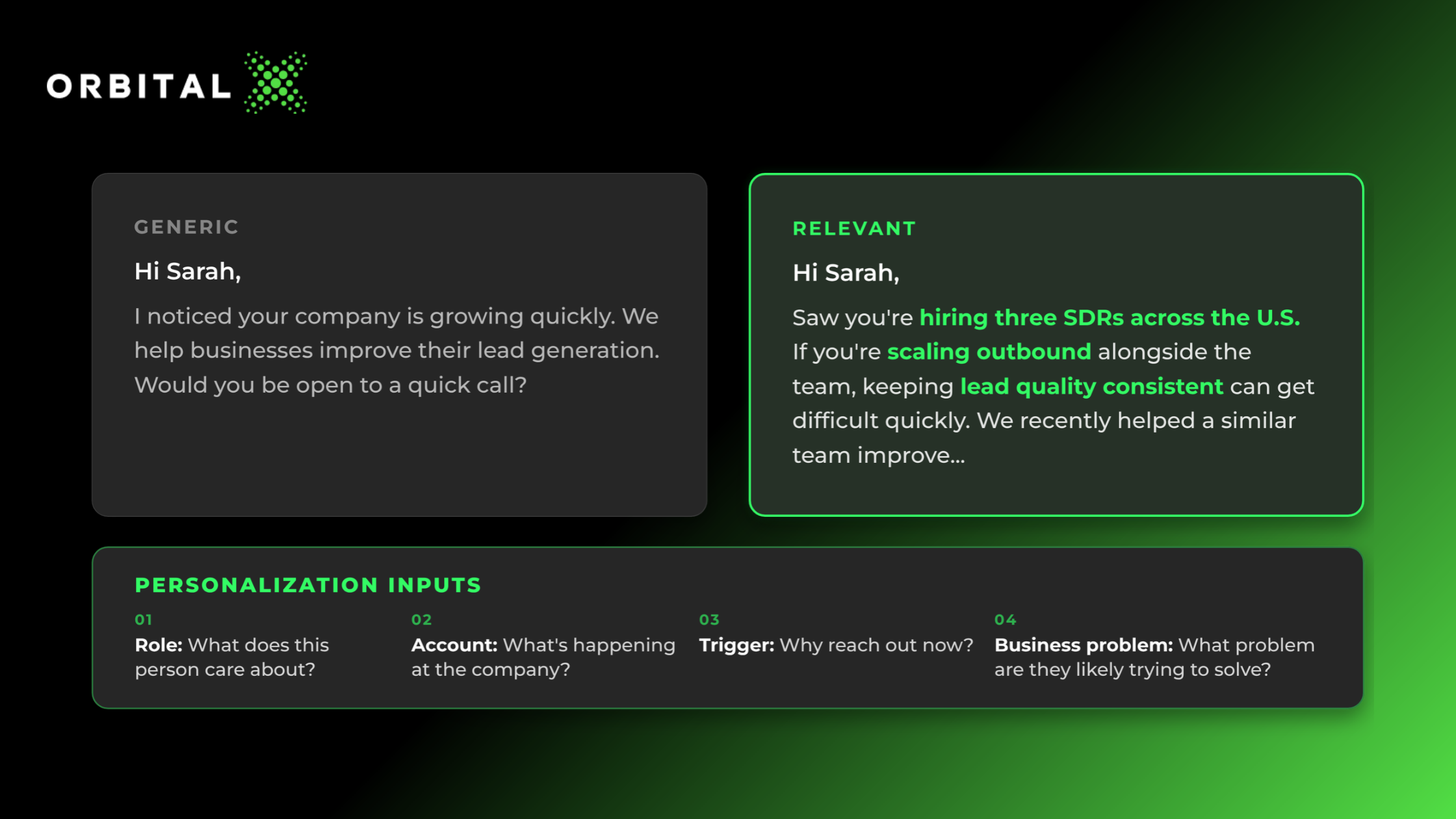
Personalization makes a lead generation email more relevant by changing the message based on something meaningful about the recipient. That could be their role, a company priority, a recent business event, an existing relationship, or a problem that matters to their team.
“Hi {First_Name}” followed by a paragraph praising your “industry-leading” company isn't personalization. It's mail merge wearing a fake moustache.
Genuine tailoring gives the recipient a reason to believe the message was written for their specific situation. A sales leader might care about pipeline efficiency, but a marketing leader at the same company will have different priorities. A recent funding announcement, product launch, leadership change, or hiring push can also provide a legitimate foundation for tailoring the outreach.
Putting in that effort is worth it. According to HubSpot, employing personalization tactics like dynamic content and tailored messaging improved email performance for over 80% of marketers.
Make sure to keep personalization proportionate to the outreach. Overloading an email with researched details can make the message feel intrusive or performative. Use relevant information to improve the message, as opposed to demonstrating how much information you found about the prospect.
To properly personalize your messaging, incorporate these five practical layers:
Role: Address the specific metrics and challenges tied to their job title.
Account: Focus on company size, business model, or market movements.
Trigger: Capitalize on recent hiring pushes, product updates, or news.
Existing Relationship: Reference prior touch points, shared connections, or past event activity.
Business Problem: Target the core operational friction slowing them down.
 How to Build a Lead Generation Email Sequence
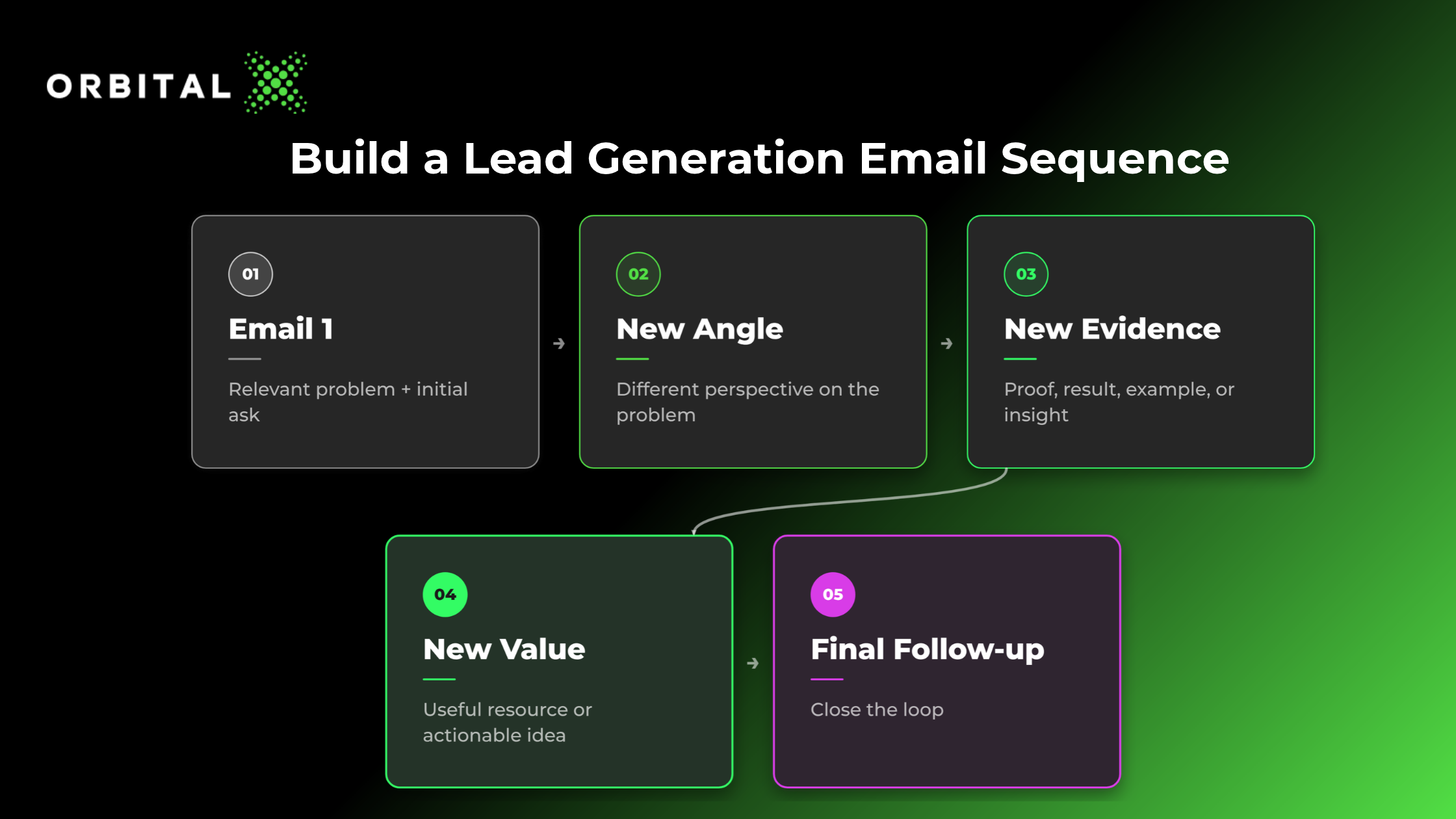
A lead generation email sequence should build a case over multiple touches. Start by giving a clear reason for contacting the prospect, then use each follow-up to introduce a new angle, piece of evidence, useful insight, or other motivation to respond.
A simple sequence can follow five stages:
Intro email: Establish relevance and make the initial ask.
New angle: Approach the problem from a different perspective.
New evidence: Add proof or a customer example.
New value: Introduce a useful resource or specific observation.
Final follow-up: Close the loop without resorting to manufactured urgency or increasingly desperate variations of the original pitch.
The key is to give prospects a reason to read each message independently while keeping them interconnected. If removing an email from the sequence changes nothing, it probably didn't need to be there. Anyone who’s inherited a 12-touch sequence knows the horror of 12 emails, four variations of “just checking in,” and one increasingly desperate attempt to convince a stranger that this is really their last follow-up. By email eight, the prospect isn't nurturing. They're just looking for the spam button.
 Don’t brute-force repetition. Sequencing is about narrative progression. Space your touches logically over several weeks, depending on your market's typical buying pace, and ensure every email earns its place in the inbox.
Lead Generation Email Subject Lines and Opening Lines
Subject lines and opening lines have one job, which is to convince the prospect to keep reading. Winning hooks are specific and don’t rely on generic personalization or exaggerated claims.
A good subject line can point to a recognizable problem, recent trigger, relevant observation, or useful question. If the recipient can immediately see why the email might matter to them, you've done your work right.
The opening line should then deliver on that promise. Reference something meaningful about the prospect, their company, market, or situation. A recent funding announcement, leadership change, product launch, hiring pattern, or obvious business challenge provides a natural reason to reach out.
Avoid forcing personalization into the message simply because your sales tool allows it. Craft subject lines and openings that make the email feel relevant without the effort being obvious.
Solid Subject Line and Opening Line Combos
Focus: Hiring and Growth
Subject Line: Scaling the UK SDR team
Opening Line: Saw you're bringing on three new account reps this month, Louis.
Focus: Operational Friction
Subject Line: Quick question re: CRM routing
Opening Line: Most RevOps leaders we talk to spend half their week cleaning up bad routing data before reps can even place a call.
Focus: Industry Shifts
Subject Line: [Industry] outbound changes
Opening Line: With cold reply rates dipping across SaaS, keeping data quality high has become the main lever for outreach.
Focus: Event/Content Follow-up
Subject Line: Ideas from the [Event Name] session
Opening Line: Caught your question during the panel yesterday regarding pipeline velocity.
Lead Generation Email Deliverability and Compliance
An ace lead generation email is worthless if it doesn't reach the inbox. There’s nothing like spending two hours perfecting the angle, polishing the opening line, and convincing yourself you’ve cracked cold email, only to discover your masterpiece went straight to spam because nobody bothered to configure the domain properly.
Deliverability depends on a combination of sender authentication, reputation, recipient engagement, sending behavior, and compliance. Marketers should make sure their domains are properly configured with SPF, DKIM, and DMARC, as well as use clear sender identities and truthful subject lines. Outreach should include appropriate unsubscribe mechanisms and follow the laws and regulations that apply to the recipients being contacted.
Technical setup is no longer optional. Google's sender requirements specify that bulk senders targeting personal Gmail accounts must set up SPF and DKIM authentication, keep a DMARC record, provide clear unsubscribe options, and maintain spam rates strictly below 0.1% (and never exceeding 0.3%).
Sensible sending practices are also important. Avoid sudden volume increases, monitor bounce and spam-complaint rates, and maintain a healthy sender reputation over time. When conducting commercial B2B outreach in the U.S., businesses must strictly comply with federal standards, such as the FTC's CAN-SPAM Act. So, take the time to ensure your messages contain accurate sender identification, truthful subject lines, a valid physical mailing address, and a clear opt-out mechanism.
Good deliverability relies on getting the fundamentals right, from proper authentication and responsible sending practices to relevant content and a healthy sender reputation.
Give Your Outbound Emails More Purpose
Templates give lead generation emails essential structure, but it works only when you incorporate relevance, thoughtful personalization, and purposeful sequencing. A template can keep everyone on the same page, but it can't magically make a prospect care. The right outreach model depends on your audience, offer, business context, and the reason you're contacting the recipient in the first place.
Email templates should serve as flexible frameworks. The strongest GTM engines combine repeatable email frameworks with real account intelligence, robust data, and genuine buyer context.
Move beyond disconnected outreach tactics. Our DemandWEBS™ platform connects your content, email, business development, and social touch points into a unified demand-generation system.
Want to turn outbound email into a stronger, demand generation engine? Book a call with OrbitalX to see how we can help unify your targeting and messaging into one fruitful strategy.
FAQs
Is cold email still effective in 2026?
Yes, but effective cold email depends on relevance, targeting, deliverability, and the quality of the offer. Generic mass outreach is easily ignored, while focused emails built around a specific business problem, trigger, or observation can still generate conversations. Strong cold email also requires realistic expectations. The goal is to earn a response or small next step from the right prospect.
What is the 30/30/50 rule for cold emails?
The 30/30/50 rule isn't a universally established cold-email framework, so it shouldn't be treated as a proven formula. Cold-email performance is better approached using a foundation of audience relevance, message quality, deliverability, personalization, and a low-friction CTA. Avoid rigid formulas unless credible evidence shows they consistently apply to your audience and offer.
How do you test and optimize lead generation emails?
Test one meaningful variable at a time, such as the subject line, opening angle, value proposition, CTA, or level of personalization. Measure results against the email's purpose, including replies, positive responses, meetings, or downstream pipeline. Give tests enough time and volume to produce useful evidence, then apply what you learn to future messaging.
How do you write a cold email?
Start with a specific reason for contacting the prospect. Reference a relevant problem, trigger, observation, or business situation, then offer a concise next step. Keep the message focused on the recipient rather than your company. Avoid generic introductions, unnecessary product descriptions, and oversized asks. A strong cold email should be easy to understand and respond to, and relevant enough that the recipient can see why you sent it.
What are some B2B lead generation email examples?
Useful B2B email examples include cold outbound, problem-solution, referral, event-triggered, reengagement, value-first, and break-up emails. The right template depends on the situation, relationship, and intended outcome. Templates should provide only the starting structure. Personalize the message around the prospect's role, account, business problem, or relevant trigger, then adjust the CTA to match how familiar the recipient is with your company.
More Resources

B2B Product Marketing: Strategy and Execution
Learn how B2B product marketing connects positioning, GTM, sales enablement, and customer outcomes to drive commercial growth.

Risk Tiers and Bureaucracy? The B2B Guide to Earning Market Trust via the EU AI Act
The EU AI Act explained for business leaders: risk-based AI rules, global scope, and how governance maturity enables compliant, scalable AI adoption.

ICP Scoring Rubric: How to Score, Rank, and Prioritize Your Best Customers
Learn how to build an ICP scoring rubric, weight criteria, rank accounts, set tiers, and prioritize sales and marketing attention.