B2B Product Marketing: Strategy and Execution
Learn how B2B product marketing connects positioning, GTM, sales enablement, and customer outcomes to drive commercial growth.
Key Takeaways
B2B product marketing unifies sales, marketing, product, and customer success around a shared commercial narrative.
Strong product marketing starts with a clear ICP, unique positioning, and evidence that the product solves a relevant business problem.
B2B buyers need messaging that helps multiple stakeholders understand value, reduce risk, and build an internal case for purchasing.
Effective product launches are coordinated GTM motions, with sales enablement happening before the launch goes public.
Product marketing drives commercial outcomes like revenue, pipeline, win rates, and customer expansion.
See:
What Is B2B Product Marketing?
Your engineers built a masterpiece. Your buyers would like to know whether it’ll make Tuesdays less painful. B2B product marketing links those two conversations. It combines customer and market research, product positioning, messaging, go-to-market planning, sales enablement, and customer adoption to help turn product value into commercial results.
Product marketing encompasses marketing, sales, product, and customer success teams. It helps them maintain a shared understanding of who the product is for, what problem it solves, the value it creates, and why it's different from competitive alternatives.
The process entails researching customers and competitors, crafting positioning and messaging, supporting launches, equipping sales teams, and incorporating market feedback into product and commercial decisions. Beyond acquisition, B2B product marketing empowers marketers to help customers understand new capabilities, use cases, and sources of value.
Rather than acting as a glorified production line for slide decks and product sheets, product marketing owns the commercial narrative. It translates complex technical features into clear business value that buyers actually care about.
B2B Product Marketing vs. General B2B Marketing
Somewhere in a budget meeting, a marketer is pitching a sleek billboard in Soho while someone asks if the migration guide is ready. Both have a point. Getting noticed and giving buyers confidence in the product take different kinds of work:
Broad B2B marketing covers brand, category awareness, demand generation, and customer acquisition.
Product marketing focuses more closely on the product’s target market, differentiated value, and the evidence buyers need to evaluate it.
The two work together throughout the buyer’s journey. Customer insights and positioning help shape broader campaigns, while those campaigns carry the product story to relevant audiences. The billboard and the migration guide should support the same promise.
The Critical Role of B2B Product Marketing
B2B buying decisions don't happen on impulse. They involve long review periods, rigid security checks, and endless internal debates that can stall a deal for months. Buying committees need far more than basic feature checklists to be convinced. You have to give them a clear bridge connecting their problem to your product, the commercial outcome, and verified proof.
When product marketing gets this right, it gives sales reps a sharp, credible narrative for live deal conversations. Instead of winging calls or pitching generic slides, reps can navigate complex buying committees, answer tough, competitive questions, and help buyers build a rock-solid business case internally.
How B2B Product Marketing Differs From B2C Product Marketing
B2B product marketing typically operates in a more complex buying environment than its B2C counterpart. Purchases often involve multiple stakeholders, greater financial or operational risk, and longer evaluation periods. Product marketing needs to help people with different priorities understand the value of and build confidence in the purchase.
The core proposition should remain consistent, but the emphasis and evidence can change for each stakeholder. A finance leader may need proof of cost savings, for example, while a technical evaluator wants information about integration, security, and implementation. Stakeholders who jump into the deal late need fast, accessible explanations on product value so they can get up to speed without derailing momentum.
Picture a lean software team closing in on a £100k deal. The users love the demo, finance has approved the budget, and someone’s already eyeing the celebratory drinks. Then IT asks for clarification on the SOC 2 report, and the contract spends four weeks in security review. Buyer enthusiasm only gets you so far when another stakeholder still needs answers.
These buyers also need to justify their decisions internally. According to Forrester’s research findings, “89% of purchases involve two or more departments,” alone, never mind buying committee size. Case studies, demos, product data, and credible third-party validation help them assess expected outcomes and risks, including switching costs and operational disruption. Connecting claims directly to ROI, risk reduction, or productivity helps the entire committee reach consensus with confidence.
Buyer’s journeys are often nonlinear in B2B too. Prospects research independently, compare alternatives, revisit requirements, and bring in colleagues at different stages. That’s why messaging needs to stay consistent while providing the right information for each stakeholder to evaluate the offering.
Both B2B and B2C buying involve logic, emotion, trust, and perceived value. But B2B product marketing must account for these influences across an organizational purchasing decision.
Core Components of a B2B Product Marketing Strategy
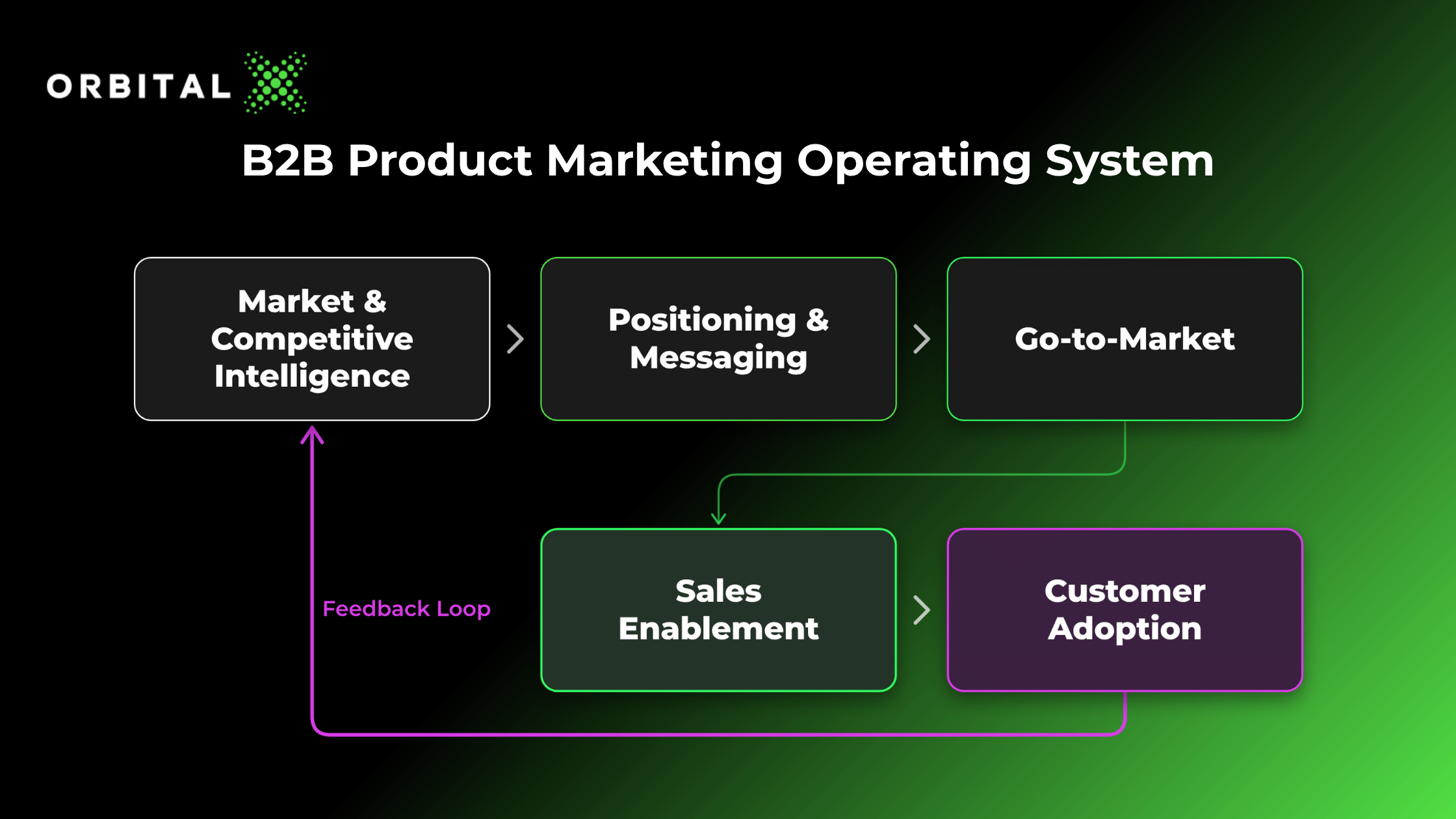
A B2B product marketing strategy connects market understanding, positioning, go-to-market execution, sales support, and customer adoption. Rather than treating these as separate activities, it creates a system that converts customer insight into product value and business wins.
 Positioning and Messaging
“Next-Gen AI-Driven Synergy” sounds expensive, but it doesn’t tell anyone what the software actually does. Buyers need to understand clearly which problem an offering solves, why it’s a better fit than the alternatives, and see evidence that backs it up.
Strong positioning connects those answers to a clear proposition. Specific customer results, relevant use cases, and demonstrable capabilities give buyers something they can evaluate and defend internally.
That clarity guides the wider strategy. Marketing builds campaigns around the same value proposition, sales applies it in buyer conversations, and customer success helps customers achieve the outcomes discussed during the sale.
Market and Competitive Intelligence
Market intelligence shouldn't sit in a forgotten folder after an annual strategy session. By analyzing sales call transcripts, win/loss data, customer interviews, and competitor moves, product marketing spots emerging buyer patterns, unaddressed pain points, and critical buying triggers.
This continuous stream of intelligence feeds directly back into product roadmap decisions, sharpens GTM execution, and keeps positioning well ahead of competitors.
Go-to-Market Strategy
A GTM plan turns strategic positioning into an active, coordinated commercial expansion strategy. It maps target segments, campaign angles, distribution channels, and cross-functional deliverables across specific buyer evaluation stages.
Rather than measuring GTM success by launch-day noise or web traffic, strong product marketing ties every GTM initiative directly to pipeline creation and closed-won targets.
Sales Enablement
Somewhere in the shared Google Drive sits a pristine 40-page product deck. Meanwhile, a rep is closing deals with three slides saved to their desktop in 2022. Before uploading another PDF, find out why those three slides keep winning the job.
Sales enablement makes product positioning useful in live buyer conversations. Focused battle cards, demo guidance, stakeholder-specific messaging, and concise objection responses help reps explain value and address concerns. Build these resources around the questions sales actually hears, and make them easy to find, use, and keep current.
Customer Adoption
Product marketing doesn't end when a contract is signed. Post-acquisition data provides a true acid test for your original value proposition.
By tracking onboarding speed, feature usage, and time-to-value, product marketing sees whether real customer usage matches the promises made during the sales cycle. Insights from user adoption feed back into the engine, refining messaging, spotting expansion opportunities, and driving long-term retention.
Defining Your Ideal Customer Profile and Buyer Personas
An ideal customer profile (ICP) defines the types of organizations most likely to benefit from a B2B offering. It combines characteristics like industry, company size, business model, and tech environment with the problems the product solves. A useful ICP helps teams prioritize accounts with strong problem-product fit.
Meanwhile, buyer personas describe the people involved in evaluating, purchasing, and using the product, including their priorities, objections, and information needs. Stakeholder maps show how those people influence a particular purchasing decision. Together, they help product marketing identify which companies to target and who within them needs to understand the product’s value.
Buying triggers add context about timing. For instance, an organization may fit the ICP without actively looking for a solution. A contract renewal, leadership change, or new operational requirement could prompt it to evaluate alternatives.
These profiles should be tested and refined using customer and revenue evidence. Conversion, product adoption, retention, and expansion data can reveal patterns in customer fit, while sales conversations and win/loss interviews help explain those patterns.
Defining audience targets requires three distinct lenses to work together:
ICP: Clarifies which companies to target based on firmographics, tech stack, and structural pain points.
Buyer Personas: Map the specific people within those accounts, detailing their job motivations, day-to-day friction, and evaluation criteria.
Stakeholder Maps: Outline how these people interact during a purchase, separating end users, technical gatekeepers, budget holders, and executive sign-offs.
Job titles alone don't equal buying authority. A Director of Operations might hold budget for one initiative but act purely as an advisor on another. Understanding these underlying dynamics keeps teams from wasting effort on contacts who lack real purchasing influence.
Company fit doesn't automatically mean purchase readiness. An account can match your ICP perfectly, yet remain completely inactive until a specific buying trigger occurs, like a budget cycle update, an executive hire, or a contract expiration.
Analyzing CRM conversion trends, retention metrics, and churn data reveals where your actual product fit lives. If accounts in a specific sector systematically convert faster and retain longer, refine your ICP around those traits and double down on messaging tailored to that group.
B2B Product Marketing Channels and Content Types
B2B product marketing channels and content should help buyers understand a problem, evaluate solutions, compare alternatives, and build confidence in a purchasing decision. The right mix depends on the product, audience, buying process, and stage of the customer journey.
Across each of the buyer stages, effective product marketing content prioritizes relevance, clarity, and evidence. Prospects need information that helps them understand the problem, assess the solution, differentiate it from alternatives, and make a case for the purchase internally.
Content for Discovery and Education
At the top of the funnel, buyers often struggle with an operational bottleneck without fully understanding its root cause. Discovery content focuses on clarifying market shifts, diagnosing operational gaps, and setting up the business case for solving the problem.
Channels like LinkedIn, industry podcasts, expert webinars, research reports, and opinionated thought leadership work best here. The aim is educating prospects and helping them view their problem through a clearer lens rather than forcing an immediate product pitch.
Content for Evaluation
Once buyers acknowledge the problem, they shift toward evaluating solutions. Evaluation content answers three critical questions:
Can this fix our specific issue?
Is it compatible with our environment?
Why should we choose this option over alternatives?
This phase requires detailed product pages, interactive walkthroughs, clear ROI models, competitor comparison pages, and customer case studies. Third-party validation, customer proof, and direct feature comparisons build buyer confidence and back up your positioning.
Content for Sales and Conversion
During late-stage evaluation, buying committees need resources that resolve internal doubts and remove risk from the deal. Conversion content equips internal champions to handle objections and build a bulletproof business case for executive sign-off.
Key formats include competitive battle cards, security documentation, one-pagers, implementation blueprints, and customized demo guides. Success at this stage is measured by how effectively content helps reps close live deals.
Sales Enablement and Cross-Functional Alignment
Product marketing helps multiple teams communicate a consistent product story across acquisition, sales conversations, and customer adoption:
It gives sales the positioning, competitive context, and proof needed to explain value and address buyer objections.
Direct exposure to sales calls and win/loss interviews helps product marketing understand buyer questions, customer language, and competitive concerns.
The customer success team adds insight into adoption challenges and whether the product experience matches the expectations set during the sale.
Getting useful work done means reviewing what buyers were told, where expectations went astray, and who will fix it. Clear ownership turns that discussion into tangible changes to campaigns, sales guidance, and customer onboarding.
For instance, if customer success notices that new accounts regularly struggle to set up an integration during onboarding, they raise the issue with product marketing. Product marketing realizes sales reps have been framing the feature as an instant "one-click" setup.
Product marketing then updates the sales deck and demo script to set clear implementation expectations, while product engineering reviews the workflow to address underlying usability friction. Establishing explicit ownership around messaging updates keeps customer expectations aligned with real product performance.
How to Plan and Execute a B2B Product Launch
A B2B product launch is a coordinated go-to-market motion designed to introduce a product, feature, or major update to a defined audience and achieve a measurable business outcome. The level of planning and investment should reflect the scale and commercial importance of the release.
A strong launch should be an ongoing commercial process rather than a one-day announcement. What the team learns after launch should inform adjustments to the current motion and improve future launches.
Define the Launch Scope and Business Objective
Before picking promotional channels or drafting copy, define the commercial objective and scope of the release. Not every update requires a massive global campaign, so tier your releases based on business impact:
Tier 1 (Major Platform Release): Full cross-functional GTM campaign aimed at net-new pipeline and market repositioning.
Tier 2 (Significant Feature Additions): Focused campaign targeted at specific customer segments to drive expansion and upsell.
Tier 3 (Incremental Enhancements): In-app notices, release notes, and product documentation updates designed for user adoption.
Aligning your launch tier with clear business goals (such as qualified pipeline, expansion ARR, or user activation) ensures marketing spend matches commercial impact.
Build the Launch Plan
A successful launch requires a unified go-to-market strategy that aligns product, marketing, sales, and support milestones.
Illustrative timeline for a major release. Adjust to launch scope.
Timing | Key milestones |
4–6 weeks before launch | Confirm objectives, audience, positioning, owners, and launch date. |
1–3 weeks before launch | Finalize campaign assets, train sales, and prepare support. |
Launch day | Coordinate the release, publish assets, and activate planned campaigns. |
1–4 weeks after launch | Review early results, buyer feedback, and adoption. Adjust messaging and follow-up. |
Map dependencies clearly so positioning and customer messaging are approved before campaign assets go into production, and sales enablement is complete before public announcements go live.
Equip Sales Before Going Public
Your sales reps should never learn about a new feature from a public LinkedIn post or press release. Internal sales teams need training on positioning, target account lists, competitive context, updated demo flows, and objection handling weeks before launch day. Reps must feel confident pitching the new capability and guiding buyers before prospects start asking about it.
Measure, Learn, and Refine
Launch day is just the starting line. Post-launch focus shifts to tracking commercial conversion across the funnel.
Review sales feedback, win/loss patterns, and early product usage data to spot friction points. Use these real-world insights to sharpen messaging, adjust sales decks, and refine future GTM plays.
How to Measure B2B Product Marketing Performance
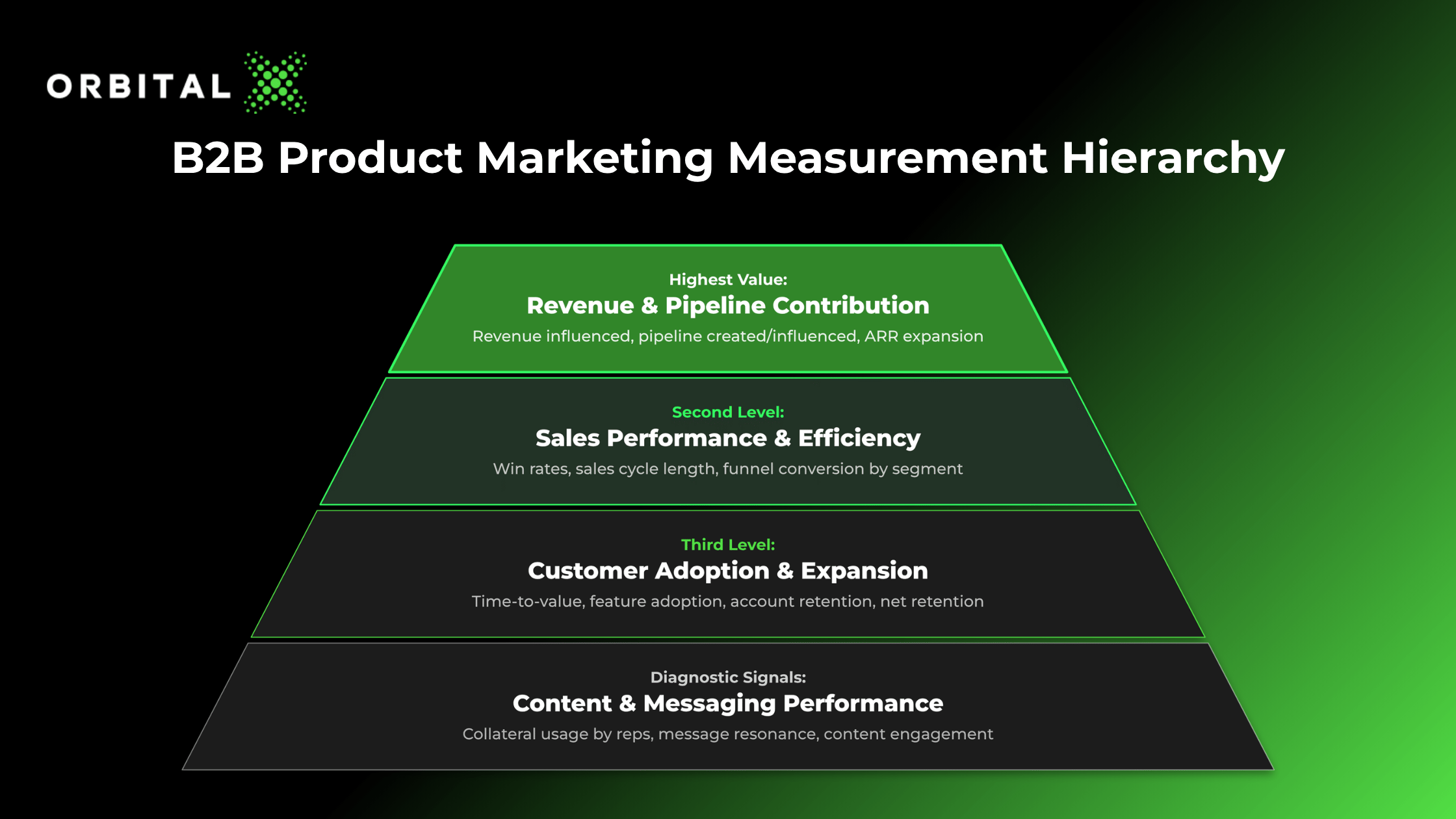
B2B product marketing performance should be measured by its contribution to commercial outcomes, not just content volume or engagement. A useful measurement framework connects PMM activity to revenue and pipeline, sales performance, customer outcomes, and content or messaging signals. The key is to show how lower-level signals can influence commercial outcomes without pretending PMM controls every downstream result.
To gauge product marketing performance, monitor KPIs like marketing contribution to revenue, marketing-influenced sales pipeline, and revenue growth rate. Tactical metrics like downloads, page views, and time on page are useful diagnostic signals but can’t prove commercial value on their own.
 Pipeline and Revenue
Walk into a budget review with click-through rates as your headline achievement, and the CFO will ask what they did for revenue before the tea’s cooled. You need a credible answer.
According to data from Product Marketing Alliance, 55.4% of product marketers are measured on new revenue generation. Track pipeline created or influenced, revenue influenced, and conversion across target segments to assess commercial contribution. Product marketing rarely controls these results alone, so tie changes in positioning and GTM execution to observed performance without claiming credit for every deal.
Sales Efficiency
Product Marketing Alliance also found that 37% of product marketers are measured on win rate, up from 28.1% in 2024.
Track win rates against key competitors, opportunity-stage conversion, and average sales cycle length to assess whether positioning and enablement are helping deals progress. Sales feedback can help explain the patterns, although pricing, product fit, and other factors also influence results.
Product Adoption and Expansion
Post-sale metrics tell if your product story aligns with actual customer experiences. Tracking user onboarding, feature adoption rates, time to value, and account expansion shows how effectively product marketing supports long-term account growth. High retention and expansion prove that customers are realizing the value promised during the sale.
Content and Messaging Performance
Metrics like slide views, asset usage by sales reps, and content engagement help diagnose performance gaps. High engagement on an asset is a great signal, but it only matters if that asset helps reps move buyers to the next stage. Treat content usage as a diagnostic tool to refine assets, not as the ultimate measure of success.
Turn Product Marketing Into Commercial Impact
The positioning workshop was lovely. The slides were immaculate. Now, someone has to buy the darn thing. Product marketing earns its keep when that carefully crafted story reaches the right buyers, gives sales something useful to say, and helps customers get the value they were promised.
To put this strategic framework into practice without drowning in disconnected tactics, lean B2B teams can turn to DemandWEBS™. As OrbitalX’s core operating engine, it connects product positioning directly with targeted demand generation. It places your value proposition right in front of high-intent B2B audiences across owned, paid, and earned channels, turning market strategy into a continuous, compounding revenue motion.
For lean marketing teams working under tight resource constraints, DemandWEBS™ aligns product marketing, demand gen, sales enablement, and pipeline analytics into a single cohesive workflow. Rather than managing siloed campaigns, you get a direct path from product positioning to measurable business growth.
Ready to turn your product positioning into a scalable revenue motion? Book a call with OrbitalX today.
FAQs
What is the difference between B2B marketing and B2B product marketing?
B2B marketing covers the broader process of building awareness, generating demand, attracting prospects, and supporting customer acquisition. B2B product marketing focuses specifically on connecting a product with its target market. It defines positioning, messaging, differentiation, and value, then applies those insights across GTM, sales, launches, and adoption.
What are the main responsibilities of a B2B product marketer?
A B2B product marketer typically owns or contributes to customer and market research, product positioning, messaging, GTM strategy, product launches, sales enablement, and customer adoption. The role connects product capabilities with customer needs and commercial outcomes. Product marketers also gather intelligence from customers, sales teams, competitors, and product usage to improve positioning and GTM decisions.
What makes B2B product marketing effective?
Effective B2B product marketing starts with a clear understanding of the target customer, the problem they need to solve, and the alternatives available to them. Strong positioning connects that problem to differentiated product value and credible proof. A good strategy also aligns marketing, sales, product, and customer success around a consistent commercial narrative.
What metrics should B2B product marketers track?
B2B product marketers should track metrics across the commercial journey, starting with pipeline and revenue, then sales performance, customer outcomes, and content signals. Relevant measures include pipeline created or influenced, revenue influenced, win rate, sales cycle length, funnel conversions, retention, upsells, and cross-sells. Content engagement, asset usage, and message resonance can help diagnose what buyers respond to.
How does product marketing support a product launch?
Product marketing supports a launch by connecting the release to a defined audience, business objective, and go-to-market plan. It helps establish positioning and messaging, identify priority segments, coordinate channels and campaigns, prepare sales teams, and provide customer-facing education. Sales should receive product knowledge, competitive context, objection handling, demonstrations, and proof before the launch reaches the market.
More Resources

Risk Tiers and Bureaucracy? The B2B Guide to Earning Market Trust via the EU AI Act
The EU AI Act explained for business leaders: risk-based AI rules, global scope, and how governance maturity enables compliant, scalable AI adoption.

ICP Scoring Rubric: How to Score, Rank, and Prioritize Your Best Customers
Learn how to build an ICP scoring rubric, weight criteria, rank accounts, set tiers, and prioritize sales and marketing attention.

B2B Lead Generation Emails: Templates, Examples, and Strategies
B2B lead generation email templates, examples, and strategies for writing relevant, personalized emails that generate replies and support demand generation.