Risk Tiers and Bureaucracy? The B2B Guide to Earning Market Trust via the EU AI Act
The EU AI Act explained for business leaders: risk-based AI rules, global scope, and how governance maturity enables compliant, scalable AI adoption.
Key Takeaways
The EU AI Act (also known as EU’s General Data Protection Regulation) applies based on where AI is used or made available, rather than where a company is headquartered. Companies outside the EU can still fall under the Act’s jurisdiction if their systems reach EU users or markets.
The law uses a risk-based approach, meaning rules depend on how hazardous an AI system is. Higher-risk systems face stricter requirements, while minimal-risk ones have almost none.
To stay in compliance, companies need to construct mature internal governance and compliance systems. Beyond legal understanding, that entails working processes, documentation, and oversight.
Responsible AI is moving beyond a European legal requirement and becoming a global baseline expectation. Even outside the new law, ethical AI usage is increasingly tied to trust, procurement, and market access.
Once a fun experiment, AI is now the core engine humming inside your GTM tech stack, engineering workflows, and customer operations. Recent research from Deloitte shows AI is already moving beyond experimentation into scaled deployment across most organizations. Tech moves fast, so rules have to catch up.
Enter the EU AI Act. It’s a governing body’s attempt to regulate AI usage to maintain ethical boundaries. But there’s no need to sink into legal panic. Think of AI governance as the guardrails on a Formula 1 track instead. Rather than forcing you to drive slower, they exist to stop you from flying off the cliff while you try to double revenue without doubling headcount.
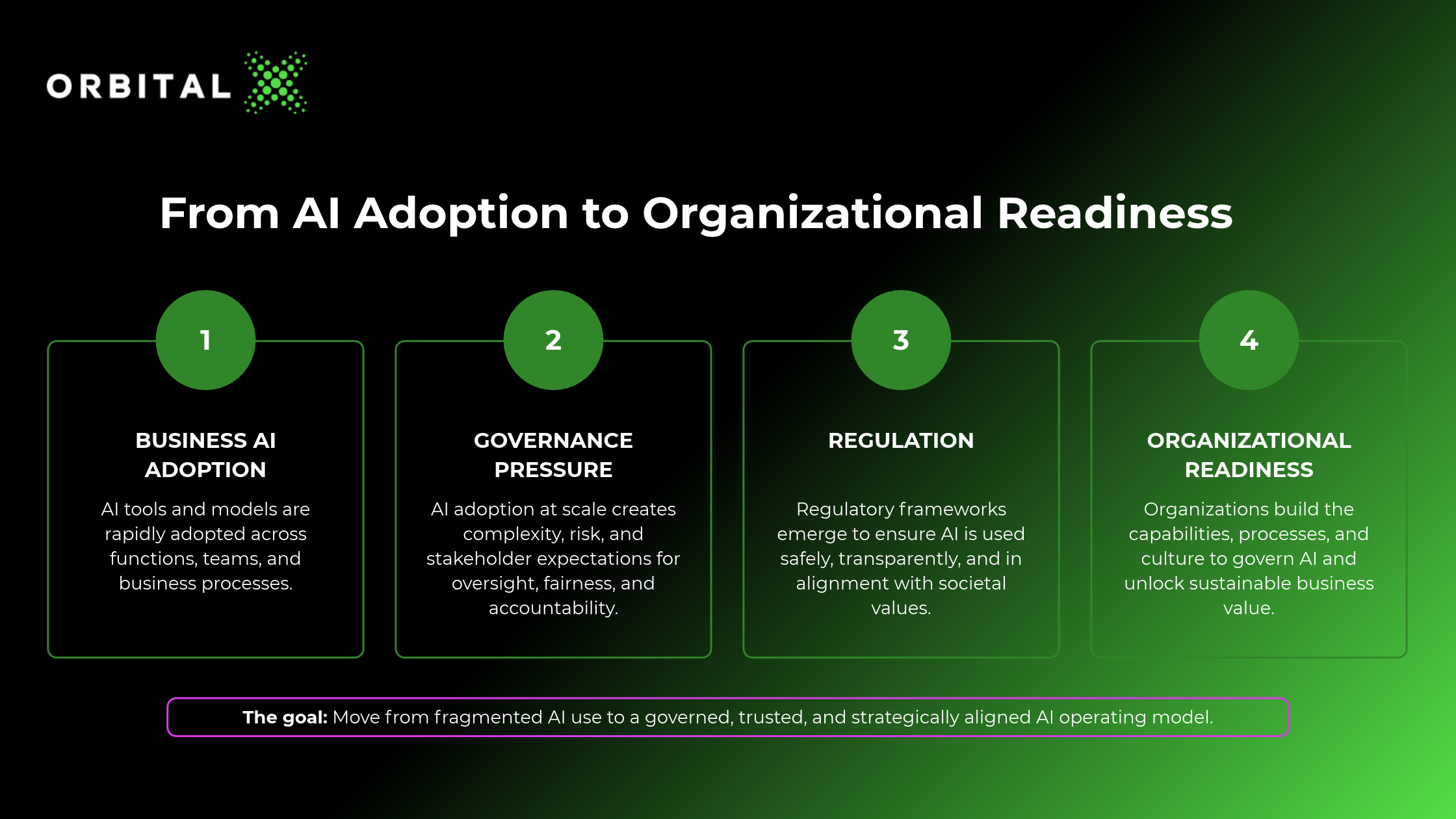
AI is now embedded across almost every business function, including marketing, HR, customer service, operations, and software development. As adoption accelerates, governments are introducing regulatory frameworks like the EU AI Act to ensure AI is used responsibly, safely, and transparently. (Here, “governance” refers to the internal systems, processes, and accountability structures organizations use to manage AI safely and consistently.)
In layman’s terms, that means AI governance is no longer just a legal consideration but a core business capability. Understanding this shift and the implications of new legislation like the Act will help you evaluate risk, improve transparency, and prepare for evolving regulatory expectations.
What Is the EU AI Act?
DISCLAIMER - Information shared in this article is researched and accurate to the date of publication. This content does not serve as legal advice.
The EU AI Act is the first comprehensive attempt to regulate AI through a risk-based approach. Its requirements scale depending on potential impact rather than applying uniform rules to all systems.
While many organizations assume the legislation only applies within Europe, its scope can actually extend beyond the Union’s borders when AI systems, products, or services are placed on the EU market or affect individuals within the region. This makes it relevant to not only European companies but also global SaaS providers, multinational organizations, and teams big or small who use AI tools in everyday operations.
AI systems with a higher potential impact on people, rights, or safety require stronger governance, transparency, and oversight, while lower-risk systems face lighter obligations. Rather than restricting innovation, the Act creates clearer expectations so organizations can adopt AI with greater confidence.
Think of it like a bouncer at an exclusive London pub. If you’re just there to read the menu and order a drink, you walk right in. If you tell the bouncer you want to handle the pub’s till, you need to meet with the manager and face a full background check.
The framework initially shook up the tech world when the Act came into effect in 2024. But it’s a slow burn, with key risk tiers continuing to be unveiled in 2026 and 2027. The law makes a clean distinction between the people who build the tools and those who use them. In the eyes of the law, you're either a provider, who develops the model or a deployer, who integrates it into everyday workflows.
 How the EU AI Act Classifies AI Risk
The EU AI Act classifies AI systems based on their potential impact on individuals, organizations, and society. This risk-based structure is the central principle of the legislation and ensures governance requirements scale with potential harm.
The Act recognizes four levels of risk, outlined as Unacceptable, High, Limited, and Minimal. These categories forgo separating AI types to represent a range of governance. Low-impact systems require minimal oversight, while those that affect rights, safety, or access to essential services require stronger safeguards such as documentation, transparency, and human oversight.
Most organizations operate in lower-risk categories, with only a small subset of systems falling into restricted or prohibited use. Understanding the classification model is essential because it determines how all obligations under the Act are applied.
This isn't a simple binary switch but a continuum that matches regulatory pressure with real-world impact. If your tech sits near the lower end, you basically get a free pass. If it touches lives, careers, or cash though, the governance burden increases fast.
Unacceptable Risk
AI systems in this category are generally prohibited because they conflict with fundamental rights (Skynet has entered the chat). These are narrow use cases that don’t reflect typical commercial AI applications, and most organizations will never encounter them.
“Unacceptable” means an absolute ban on tools that threaten human rights, and the standard B2B marketing engine won't touch this list. So, unless you’re building a dystopian social scoring setup or deploying real-time biometric tracking for rogue law enforcement in public spaces, you don't need to worry about this classification.
High Risk
High-risk AI systems are permitted but subject to strong governance because they may materially affect rights, safety, or access to essential services. They require documentation, transparency, human oversight, and monitoring.
This is where things get interesting for enterprises. High-risk systems are legal, but companies must keep an immaculate paper trail. Consider an AI tool designed to screen CVs and rank job applicants, or an algorithm that scores creditworthiness for corporate loans. If the AI makes a bad call (or an obvious hallucination,) a real human bears the cost. That’s why compliance demands spotless documentation, constant monitoring, and a responsible human in the loop.
Limited Risk
Limited-risk systems are primarily governed through transparency requirements. The aim is to make it clear to people when they’re interacting with AI or AI-generated content. It’s like ordering a pint at a pub and being told up front it's non-alcoholic. People don't mind as long as you don't try to trick them.
Trust is the currency of choice here. If you use customer-facing chatbots to handle product queries, you need to tell the user they’re talking to a machine. The same rule applies if you publish synthetic images or heavily modified content. Audiences must receive clear context so they don't feel cheated. Transparency ensures people know what they're engaging with.
Minimal Risk
Minimal-risk systems cover most everyday AI usage and generally face few or no regulatory obligations. These include AI-powered productivity assistants, writing and content generation tools, translation services, and workflow automations that don’t meaningfully affect people's rights or safety.
The vast majority of business tools live right here, so you can let out that breath you were holding. Your translation software, transcription tools, and email spam filters carry zero regulatory baggage under the Act, and these low-impact use cases escape the paperwork trap completely.
Risk Category | What It Covers | Governance Requirement |
Unacceptable Risk | AI systems that pose clear threats to safety, rights, or fundamental freedoms | Prohibited or banned |
High Risk | AI used in sensitive areas (e.g., hiring, credit scoring, critical infrastructure) | Strict obligations, including risk management, documentation, oversight, and conformity assessments |
Limited Risk | AI with transparency obligations (e.g., chatbots, content generation tools) | Disclosure requirements so users know they’re interacting with AI |
Minimal Risk | Low-impact AI applications (e.g., spam filters, basic automation) | No specific obligations under the Act |
Who Needs to Comply With the EU AI Act?
The EU AI Act applies to all organizations involved in the AI life cycle where systems connect to the European market. That includes developing, supplying, distributing, importing, integrating, or using AI systems available in the EU or that affect EU citizens.
It can apply to any non-EU organizations so long as their systems or services are used in or impact the Union. That encompasses countless SaaS platforms, enterprise vendors, B2B agencies, multinational organizations, procurement teams, and internal functions such as HR, marketing, and operations teams worldwide.
For example, a U.S. software company that sells an AI hiring tool to employers in Germany, or an Australian SaaS platform that uses AI to profile EU customers for marketing still fall under the Act’s scope even without a physical office, staff, or legal entity in Europe. So if you thought your Delaware corporation protected you from the lawmakers of Brussels, think again. The framework follows your market connection, not your headquarters.
You need to know if the Act applies to you because noncompliance can lead to enforcement actions that scale with the severity of the violation. You could face financial penalties, restrictions on bringing AI systems to market in the EU, or requirements to change or withdraw how a system operates.
In higher-risk cases, regulators can limit deployment until compliance issues are resolved. For businesses, that means compliance can't be treated as a one-time exercise. AI systems must continue to meet regulatory requirements as they're updated, monitored, and used.
This ecosystem approach hits enterprise SaaS vendors and global procurement teams simultaneously. According to McKinsey research, four in five enterprises now use AI in at least one business function, signaling widespread AI adoption across global organizations of all sectors. As these systems move from simple internal tasks to automated workflows that handle customer interactions, non-EU businesses face real exposure.
How Businesses Can Prepare for the EU AI Act
Most organizations already use AI through embedded SaaS tools across their operations, even when it’s not formally recognized as an “AI system.” Think of reps and content managers testing shiny new Chrome extensions without telling IT, leaving unmapped AI tools scattered across the entire tech stack.
That’s why preparation for the EU AI Act is less about introducing new technology and more about gaining control over what already exists. Luckily, you can get your company ready in five steps.
1. Visibility: Identify Where AI Is Already in Use
Start by mapping AI across SaaS tools, embedded systems, and third-party platforms. This typically appears as employees using AI features inside everyday tools, SaaS platforms generating automated outputs, and third-party systems feeding recommendations directly into business workflows. Most exposure sits inside existing workflows rather than standalone AI products.
2. Accountability: Assign Ownership for AI Oversight
Establish who’s responsible for AI-related decisions across business units, IT, procurement, and risk functions. For example, procurement can assess vendors, IT can manage implementation and security, and compliance can monitor regulatory requirements, while business leaders remain accountable for outcomes. Without clearly defined ownership, important decisions fall between teams, increasing operational risk.
3. Classification: Understand What the AI Is Doing
Distinguish between AI that automates decisions, supports them, or generates outputs without decision-making authority. For example, using AI to recommend products to a sales team requires different oversight than letting AI make hiring decisions or approve financial transactions. Classifying AI by its role helps organizations apply the right governance and risk controls.
4. Governance: Establish Rules for Safe and Consistent Use
Set internal policies for how AI can be used, including approval processes, human oversight, and risk thresholds. So, you might require human review before AI-generated content is published, prohibit employees from entering sensitive customer data into public AI tools, and define which AI applications require executive or legal approval before deployment.
5. Documentation and Transparency: Create an Auditable Record
Document where AI is used and what for, as well as the level of human involvement. That could mean maintaining an inventory of AI tools, identifying the business processes they support, recording who owns each system, and noting where human review is required. Clear documentation makes it easier to demonstrate compliance, investigate issues, and adapt as regulations evolve.
Preparation starts with organizational visibility.
You should aim to create operational clarity around AI that’s already embedded in the business. The NIST AI Risk Management Framework (AI RMF 1.0) explains that enterprise readiness begins with clear visibility, defined accountability, and ongoing oversight rather than rip-and-replace technical updates.
In many cases, the first step is simply documenting the AI tools your teams already use, how, and who’s responsible for them.
Area | Current State | Recommended Action | Business Benefit |
AI Inventory | Unknown or fragmented | Map where AI is used across tools, teams, and vendors | Visibility of risk and opportunity |
Governance | Informal or unclear ownership | Assign responsibility for AI oversight and decision-making | Clear accountability |
Documentation | Inconsistent or absent | Record where AI is used and for what purpose | Transparency and audit readiness |
Transparency | Ad hoc disclosure | Define when and how AI use is communicated internally/externally | Trust and clarity |
Human Oversight | Varies by team | Identify where human review is required in AI-driven decisions | Lower decision risk |
Vendor Due Diligence | Limited AI awareness in procurement | Assess AI capabilities and risks in all third-party tools | Reduced third-party exposure |
Internal Policy | No formal guidance | Create lightweight AI usage principles for teams | Safer, consistent adoption |
Employee Awareness | Uneven understanding | Train teams on responsible AI use and literacy | Reduced misuse/shadow AI |
Responsible AI Starts With Good Governance
AI adoption is scaling faster than most organizations can build the governance needed to manage it safely. Without clear rules, companies must find their own paths forward, which creates unnecessary risk, duplicated effort, and inconsistent decisions. Governance provides the traffic signals that keep AI moving in the same direction.
Organizations usually roll out governance at the top first, with leadership setting boundaries on what AI can and can’t be used for, who owns decisions, and where accountability sits. That gives the company a baseline so teams aren’t improvising risk decisions in isolation.
From there, organizational governance is pushed into execution. Teams apply those rules to their workflows, tools, and processes rather than treating governance as a separate policy layer. This is when theory becomes operational.
But employee buy-in depends on whether governance helps or hinders daily work. People adopt the framework when it reduces uncertainty, clarifies what’s allowed, and makes decision-making easier. If it feels like friction or useless bureaucracy, it’s bypassed. If it removes guesswork, it’s adopted and used.
As governance becomes distributed over time, it creates a balance where leadership sets direction and oversight, while teams carry it out inside the systems they already use. That symbiotic relationship allows AI to scale without its human counterparts losing control. Data from Forrester drives this point home, stating the most effective AI governance relies on tight, day-to-day coordination between business leaders, technical leads, and risk teams and is strongest when those responsibilities are embedded into operational workflows.
Future-Proofing Your Company’s AI Use and Governance
The EU AI Act is part of a wider global shift toward structured governance of LLM’s across business environments. As AI continues to take root across organizations, regulatory frameworks will keep adapting to new needs. Don’t just react to each regulation. To keep your business ahead of the curve, you need to actively invest in building AI oversight mechanisms capable of absorbing ongoing change. That shift in strategy builds structural resilience.
Treating AI governance as a core business capability builds long-term customer trust and unlocks better business outcomes, according to Forrester. The future belongs to lean teams who use structured operating models to turn regulatory changes into real market trust.
Don’t let fragmented AI adoption stall your marketing momentum. OrbitalX knows how to wield AI to support marketing initiatives within the bounds of ethical practices. Our DemandWEBS™ platform combines AI with human expertise to tailor campaigns to your needs and drive sustainable growth while abiding by regulations. Book a call with OrbitalX to remove the headache of AI legal compliance.
Frequently Asked Questions
Does the EU AI Act apply to companies outside Europe?
Yes. The EU AI Act can apply to organizations based outside the European Union if they develop, sell, or use AI systems that are made available in the EU or that affect individuals within that region. For many global businesses, eligibility depends on whether their AI activities have a connection to the European market.
Does the EU AI Act regulate ChatGPT and generative AI?
Generative AI tools such as ChatGPT can fall within the scope of the EU AI Act, but the legal obligations depend on how the technology is developed, provided, and used. The Act doesn’t treat every generative AI application the same though. Requirements vary according to the AI system's role, capabilities, and the level of risk associated with its intended use.
Are all AI systems considered high risk?
No. In fact, most AI systems are classified as lower risk. The EU AI Act uses a risk-based approach that demands stronger governance only when AI could significantly affect people's rights, safety, or access to essential services. Everyday business tools used for productivity, content creation, or workflow automation typically fall into lower-risk categories with fewer obligations.
What's the difference between an AI provider and an AI deployer?
An AI provider is an organization that develops or places an AI system on the market, while a deployer is an organization that uses that system within its own operations. A software company offering an AI-powered product would generally be considered a provider, whereas a business using that product for hiring, customer service, or internal processes would be labeled a deployer.
How should businesses prepare for the EU AI Act?
Preparation starts with understanding how AI is already in use across the organization. Businesses should identify AI-enabled tools, clarify who’s responsible for oversight, document key use cases, and review third-party vendors that provide AI capabilities. Establishing clear governance practices today helps organizations adapt more effectively as AI regulations and business expectations continue to evolve.
More Resources

B2B Product Marketing: Strategy and Execution
Learn how B2B product marketing connects positioning, GTM, sales enablement, and customer outcomes to drive commercial growth.

ICP Scoring Rubric: How to Score, Rank, and Prioritize Your Best Customers
Learn how to build an ICP scoring rubric, weight criteria, rank accounts, set tiers, and prioritize sales and marketing attention.

B2B Lead Generation Emails: Templates, Examples, and Strategies
B2B lead generation email templates, examples, and strategies for writing relevant, personalized emails that generate replies and support demand generation.