Inbound Lead Generation: How It Evolved as B2B Buyers Changed
See how inbound lead generation evolved from search and content to automation, dark social, AI search, and signal-led pipeline decisions.
Key Takeaways
Inbound lead generation grew from a long marketing shift away from company-led promotion toward buyer-led discovery, permission, trust, and usefulness.
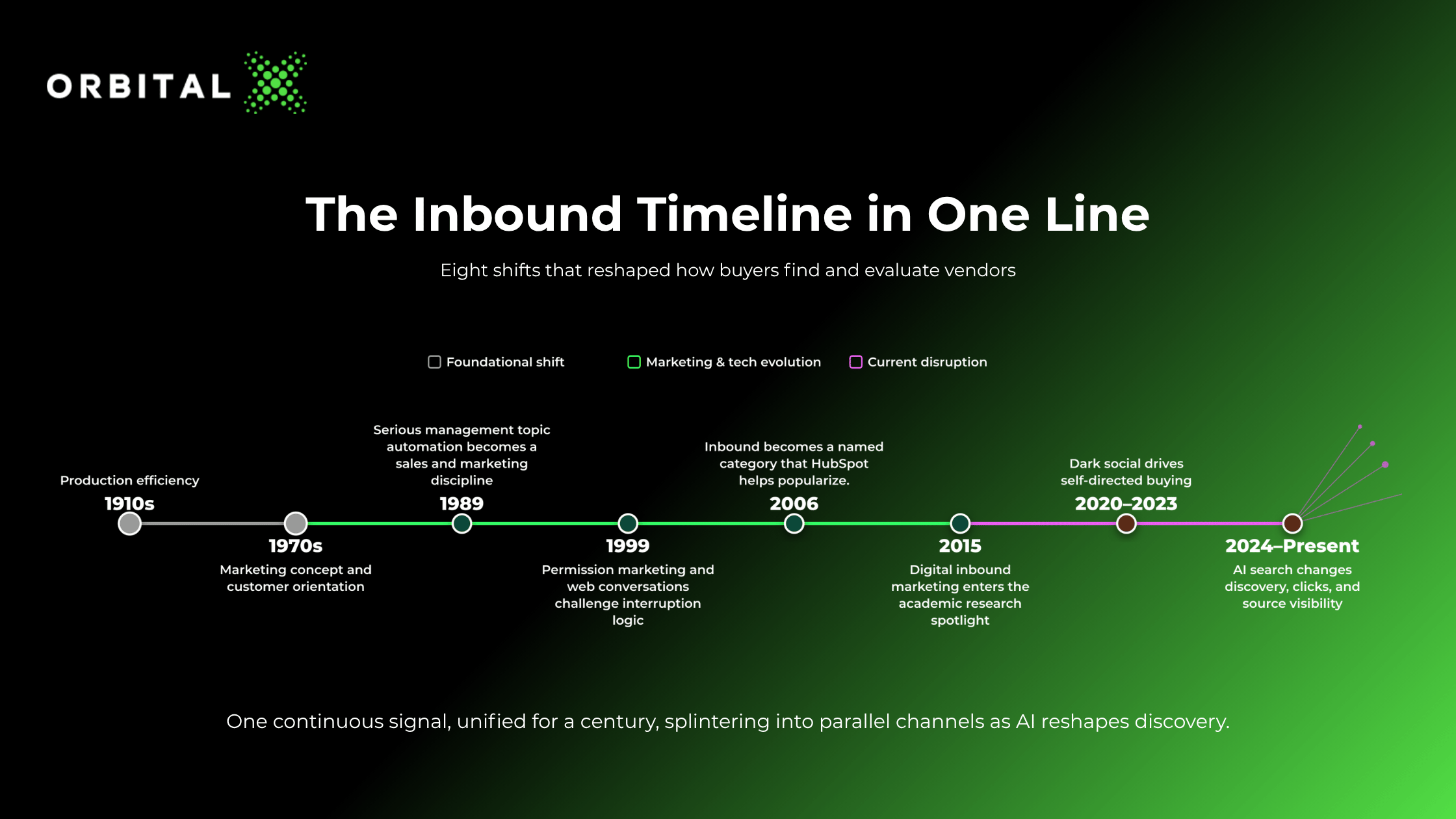
The story starts before the term “inbound” became popular. By 1989, Harvard Business Review was already treating sales and marketing automation as a serious management frontier.
From 2006 to 2015, inbound became a named digital playbook across search, blogs, useful content, landing pages, forms, social media, SEO, and nurture, making lead capture measurable at scale.
From 2015 to 2023, visible lead capture became less complete. Buyers used more stakeholders, validation channels, peer conversations, and private research before speaking to sellers.
Beginning in 2024, AI search changed discovery again. Ranking still matters, but AI summaries and answer engines weaken the old assumption that visibility automatically becomes traffic. Modern inbound needs a way to interpret fragmented signals.
Inbound lead generation is often explained as a mix of channels that includes SEO, content, social, webinars, landing pages, forms, chat, and nurture. That definition misses some pretty crucial points though.
Inbound’s been around for a long time now, and it’s changed as buyers altered how they discovered information, built trust, and decided when to speak to sales reps.
That history matters because old inbound signals have become less complete. A buyer can learn from AI summaries, search results, LinkedIn posts, webinars, newsletters, review sites, and communities rather than talk to a sales rep. They can also move through private messages, internal stakeholders, outside advisors, and sales conversations before ever filling out a form. Some of that behavior appears in marketing systems, but much of it doesn't.
Inbound didn't stop working. The buyer became harder to read.
Inbound Lead Generation Explained
Inbound lead generation is the process of attracting potential buyers through useful, discoverable, or trust-building experiences. Those experiences then convert interest into a trackable sales or marketing opportunity. Common paths cover organic search, educational content, webinars, newsletters, social content, and thought leadership. It also encompasses referrals, comparison pages, communities, chats, and website conversion paths.
Inbound vs. outbound lead generation
Inbound starts when the buyer discovers, engages with, or requests value from the company. Outbound begins when the seller initiates contact with a target buyer or account.
Thriving B2B teams often blend both. A buyer might discover a company through content, ask peers about it, and visit a comparison page, then receive a sales message based on that activity. The clean textbook divide is less important than the operating question of what the buyer signaled and what should happen next.
That’s especially important since an “inbound lead” can mean very different things. A newsletter sign-up, webinar registration, demo request, chatbot conversation, and pricing page form aren't the same signal, so they shouldn't trigger the same response.
Before Inbound: Marketing Was Already Moving Toward the Buyer
Marketing didn't always begin with the buyer’s problem. The common marketing-era model began with production efficiency, moved into product and sales-promotion thinking, and later shifted to the marketing concept, where companies paid more attention to what customers wanted before deciding what to make and sell. It was similar to aggressive door-to-door vacuum salespeople pushing products nobody asked for.
Great Ideas for Teaching Marketing places the production era around 1910, the sales and promotional era into the 1970s and 1980s, and the marketing concept era from around the 1970s onward. Academic marketing history is more nuanced than a simple era chart though. Marketing ideas changed over the 20th century through different schools of thought, including marketing management, consumer behavior, systems, exchange, and marketing history. Inbound was one digital expression of a longer movement that took marketing away from company-controlled persuasion and toward buyer-controlled discovery.
1989 to the Late 1990s: Automation and Databases Prepared the Ground
A good starting point for the modern inbound infrastructure is 1989. At the time, Harvard Business Review described sales and marketing as the “next frontier” for automation. Armed with clunky desktops and spreadsheets stored on floppy disks, it focused on applying information systems to improve sales and marketing after automation had already changed functions like engineering and manufacturing.
Ironically, modern inbound eventually depended on the same premise. When buyers and customers leave signals, companies can collect, organize, and act on them.
The dominant channels were still sales teams, direct marketing, advertising, trade shows, call centers, databases, and early customer-management systems. The buyer had more access to information than before, but businesses still controlled much of the education process.
Why this worked: Companies could become more systematic. They were able to segment more intelligently, keep better records, coordinate follow-up, and move beyond purely manual selling motions.
What weakened: The company-controlled model. As the commercial web matured in the 1990s, buyers no longer had to wait for a salesperson, brochure, event, or ad to answer every question.
1999 to 2006: Permission, Search, and Conversations Changed the Starting Point
The World Wide Web expanded the number of avenues buyers had to begin their journey.
By 1999, permission marketing was already part of the mainstream digital-marketing debate. Wired framed the idea around buyers giving consent and expecting relevance and control. While that wasn't inbound lead generation, it anticipated one of inbound’s core assumptions that buyers shouldn't be treated only as interrupted audiences.
That same year, The Cluetrain Manifesto pushed the idea further. Its website went live in 1999 and argued that networked markets were becoming more informed, conversational, and difficult to control through old corporate language. Its famous “markets are conversations” idea wasn't a lead-generation framework though. Instead, it captured the web’s challenge to one-way promotion.
Search made that challenge actionable. Buyers could ask their own questions, compare options, and read before contacting sales. As that behavior became normal, company websites shifted from static brochures to educational destinations.
Why this worked: The buyer’s information environment was less crowded than it is now. A genuinely helpful page could answer questions competitors hadn’t addressed properly. Search intent could connect a problem-aware buyer to a company at the right moment.
What weakened: The assumption that discoverability and usefulness alone would remain differentiators. As more companies learned to publish, being helpful moved from an advantage to the bare minimum.
2006 to 2015: Inbound Became a Named Digital Playbook
A second major marker is 2006.
HubSpot’s origin story explains how, at its founding, buyers were responding less to interruption and wanted helpful information they could find on their own terms. They could download a PDF without that act triggering three phone calls and five emails from a hungry SDR.
HubSpot then helped popularize the inbound label, and by the late 2000s and early 2010s, it became a repeatable digital playbook. The core components included SEO, blogs, landing pages, gated assets, lead magnets, social media, newsletters, email nurture, analytics, and marketing automation.
2015 saw more and more academic developments in the field. A paper published at the time in the Expert Journal of Marketing described digital inbound marketing as a response to changing online behavior. It connected inbound to content and social media marketing, SEO, and online brand communication and argued that customers were increasingly choosing to interact with companies that offered useful value. This made it clear that inbound had moved beyond business phrasing.
Why this worked: It made lead capture measurable. Traffic became visits, visits led to form fills, form fills turned into MQLs, and MQLs became nurture paths and sales handoffs. Marketing could report volume and progression in a way that leadership could see.
What weakened: The meaning of the visible lead. A guide download could show interest without urgency, just as a webinar registration could signal education without buying intent. A high score could still capture activity without fit.
The buyer behavior shift was subtle. Buyers still wanted useful information, but they became faster at filtering generic content and more selective about when to identify themselves. Marketers realized that lead volume differed from lead quality. From that point, measuring MQLs effectively became a question of real sales signal, with MQL counts treated as incomplete.
2010 to 2016: Marketing Automation Industrialized the Playbook
Inbound’s next phase moved beyond content to become process.
As more contacts entered databases, teams needed a way to manage them. Marketing automation platforms, CRM workflows, email nurture, lead scoring, sales alerts, segmentation, and routing rules promised to make inbound scalable. An article published in the Journal of Direct, Data and Digital Marketing Practice defined marketing automation as a way to connect tracking, scoring, nurturing, campaign management, reporting, and sales-readiness processes, with email treated as one part of the system.
This was the industrialization of the inbound playbook. A buyer could download a guide, then receive nurture emails, accumulate a score, trigger a sales alert, and enter a life cycle stage. Internally, teams could report that people visited the site and, more importantly, that they moved through a defined process.
Why this worked: It helped teams act on more visible demand than a person could manually sort. A returning visitor could be recognized, a webinar attendee could enter a relevant path, and a sales-ready request could route quickly. A cold contact, by contrast, would stay in nurture until later.
What weakened: The belief that process equates to understanding. Marketers realized that, if scoring rewarded shallow activity, it created false confidence. Further, when forms captured poor-fit contacts, nurture kept those contacts warm. Messy CRM data made routing unreliable, and alerts lost credibility when every small signal triggered sales follow-up.
Buyer engagement became more scattered as well. A lead might read a blog, attend a webinar, return through search, ignore email, watch a video, and later ask a peer for advice. Automation could record parts of that path but couldn't always explain what it meant. Teams learned that automation should improve the next commercial action, beyond increasing the number of touches.
2015 to 2020: Trust Moved Beyond the Seller Website
By the second half of the 2010s, buyers were still using search and content, but the website was no longer the only source of trust.
Platforms like LinkedIn, webinars, podcasts, review sites, communities and peer recommendations, and partner content became part of the decision environment. The buyer’s question changed from, “What’s this problem?” to, “Who can I believe?”
Suddenly, buyers put their faith in a rogue Reddit thread or a private WhatsApp group rather than a glossy corporate website. That evolution put more emphasis on seller credibility and reach. Companies had to expand where they broadcast their messaging and also prove their trustworthiness to prospects.
Why this worked: Buyers could validate claims through more than the company’s own content. A webinar could show expertise, while a customer story could reduce risk. A LinkedIn post could then travel into private conversations, and a practical framework could help a buying group align internally.
What weakened: Inbound became harder to attribute. A lead source might show a webinar registration, while the real confidence came from a peer recommendation, a customer proof point, or several internal conversations.
Buyers started to be active across more channels, which created more pressure for commercial teams. It quickly became clear that the lead source field rarely tells the full trust story.
Marketers were forced to stop treating distribution as an afterthought. Inbound content had to travel through trust-bearing channels and couldn't sit passively in a resource center waiting for search traffic. Webinars became especially useful because they could turn attendance, watch time, questions and poll answers, CTA clicks, and even no-shows and replay behavior into follow-up context. A strong webinar lead generation program gives sales registration context, topic interest, and account readiness.
2012 to 2023: Dark Social Made Influence Hard to See
The phrase “dark social” dates back to 2012, when Alexis Madrigal used it in an article in The Atlantic. It described sharing activity that analytics systems couldn't easily attribute, especially through private channels like email and messaging apps.
Dark social isn't a fallback explanation for every unattributed lead though. Imagine trying to explain to a CFO why a six-figure deal came from "Direct/None" in Google Analytics. Instead, it reminds marketers that people often share, validate, and discuss content in places marketing systems can't fully see.
By the late 2010s and early 2020s, that problem ballooned for B2B teams. Buyers still visited websites, downloaded content, registered for events, and requested demos. But they also did research through Slack groups, LinkedIn DMs, WhatsApp threads, and peer calls. The same buying work continued through internal meetings, screenshots, forwarded newsletters, and untagged recommendations.
The form fill was reduced to a small window into a larger decision process.
A form just shows the team that someone converted. It doesn't explain why the account’s interested, who else influenced the decision, how long the buying group has been researching, which objections have already formed, or what proof the account still needs.
Recommended watch:
In our Critical Moments interview series, host Stuart Dale spoke with Tijs van Santen about building GTM precision before scale.
The conversation is a useful companion to this period because it moves from buyer self-education into a practical GTM problem. Sales and marketing processes have to mirror how buyers actually move, including the private research and peer sharing that rarely appears cleanly in attribution reports.
Why this worked: It reduced buyer risk. Prospects could learn without raising their hand too early, validate options with peers, and create internal confidence before contacting a company.
What weakened: Attribution confidence. Not all influence became visible, and meaningful engagement didn’t always create a conversion. Some buying work happened outside the tools marketing controlled.
The marketing lesson was to create content and proof buyers want to carry into private conversations. Content designed to capture an email address still has a role, but it can't carry the whole job. Dark social proved that influence can matter commercially even when it doesn't appear cleanly in a lead-source report.
2024 to Present: AI Search Altered Discovery … Again
AI search is the newest shift, and it's still unfolding. For years, inbound teams assumed that ranking in search created a reasonably direct path to traffic. A buyer searched, saw results, clicked a page, and maybe converted. That path still exists, but it no longer encompasses the whole search experience.
AI summaries, answer engines, and generative research tools have compressed discovery. A buyer can receive a synthesized answer before they click, then ask a tool to compare options, explain a category, or summarize seller differences. By the time they visit a site or speak to sales, they’re already armed with sharp questions and plenty of knowledge.
Traditional SEO now has its work cut out for it. Pew Research Center even found that users are less likely to click traditional Google results when an AI summary appears. Traditional result clicks happen in 8% of visits with an AI summary, compared to 15% with no AI summary.
The research base is still young, but the click path is changing nevertheless. A 2026 study, for instance, reported 13.7% overall AI overview activation, rising to 64.7% for question-form queries. Another paper argues that AI search is changing exposure to sources and information markets.
These studies don't prove SEO is dead. Rather, they show that visibility, clicks, and source traffic are becoming less predictable.
In B2B, buyers lean on GenAI as part of their research. They just ask ChatGPT or Claude to compare five competitors while sipping morning coffee, completely skipping website visits. However, many still want to validate AI-generated insights with sales reps, according to Gartner. Prospects also reportedly use multiple information sources, which reinforces the need for content, proof, and human validation to work together.
Why this works: It reduces effort. Buyers can formulate a first impression faster and arrive at sales conversations with more context.
What weakened: The old assumption that discovery always produces a visible visit, and that a visible visit always precedes a lead. Some buyers learn from the market before touching a company’s site. Others arrive more informed, skeptical, and selective. Companies now need to optimize for answer quality, proof, specificity, and trust before rankings and clicks.
Inbound Lead Generation Timeline
Period | Era | Buyer behavior shift | What marketers started measuring | Assumption challenged |
Pre-1989 | Marketing moves toward customer orientation | Customers become more central to marketing thought | Market needs, segmentation, customer response | Company-led promotion is enough |
1989–late 1990s | Automation and databases prepare the groundwork | Buyer and customer data become more actionable | Records, segments, campaigns, follow-up | More activity means better understanding |
1999–2006 | Permission, search, and web conversations | Buyers start controlling more of the discovery process | Opt-ins, visits, subscriptions, early web engagement | Being discoverable signals intent |
2006–2015 | Inbound becomes a named digital playbook | Buyers use search and content before sales | Traffic, forms, leads, MQLs, nurture paths | More leads mean greater buyer readiness |
2010–2016 | Automation industrializes inbound | Buyers leave more measurable traces across channels | Scores, workflows, life cycle stages, routing | A score accurately reflects fit and intent |
2015–2020 | Trust moves beyond the website | Buyers validate through peers, webinars, reviews, communities, and stakeholders | Source attribution, engagement, event participation | Lead source explains how trust formed |
2012–2023 | Dark social and self-directed buying expand | Buyers research and share privately before raising their hand | Direct traffic, anonymous activity, sales feedback | Attribution tools capture the full influence path |
2024–2026 | AI search and answer engines reshape discovery | Buyers get synthesized answers before clicking pages | Search visibility, AI citations, click behavior | Ranking reliably produces traffic |
What Stayed the Same as Inbound Kept Changing
The tools changed. The commercial test didn't.
Every era of inbound lead generation depended on trust, relevance, timing, context, and actionability. A buyer first had to believe the company understood the problem. The next step was to match the buyer’s stage, and the signal then had to be interpreted correctly. Sales also needed enough context to act well.
The early web era was all about usefulness.
The content boom condemned shallow capture, while automation rewarded timing and punished bad data.
Social proof boosted credibility, and the dark funnel pushed content that buyers could share privately.
AI search now rewards authority and specificity.
The mistake is treating the latest channel as the strategy. Inbound has never worked through one channel alone publishing content, gating an asset, automating email, hosting a webinar, posting alone. Portals like LinkedIn, chatbots, AI search optimization, and gated and published content are surfaces. The strategy is getting them to help the right buyers make progress and help the company decide what to do next.
Modern inbound is focused on the interpretation across multiple channels. Strong teams ask whether an account is a fit, what problem the behavior suggests, which stakeholder is showing interest, what stage the signal indicates, what sales should know, and what the pipeline outcome teaches.
Modern Inbound Lead Generation’s Next Evolution
Modern inbound has to become a signal system.
That doesn't mean every signal deserves sales attention. Rather, each meaningful signal needs enough context to support a better decision:
A target account visiting a pricing page carries a different implication than a poor-fit student downloading a guide.
A webinar question about implementation reveals a specific evaluation concern, while a no-show registration provides much less context for follow-up.
A LinkedIn comment from a buying committee member indicates different intent compared to a generic like.
From lead capture to signal interpretation
Creating inbound leads is only the starting point. The next job is to understand what kind of interest those leads represent. You wouldn’t plan an exclusive, high-class party and then let anyone in without vetting their invite, would you? It’s crucial to sort real intent from casual curiosity.
That requires context for the account itself, channels used, trust level, routing logic, and sales info, as well as feedback. A demo request from an ICP-match account that has engaged with comparison content shouldn't be treated like a top-of-funnel content download. Conversely, a returning anonymous account shouldn't be ignored because they haven’t submitted a form yet. Chatbots are an example of this newer signal layer, showing how inbound capture can move from passive forms to active qualification through real-time conversations, intent capture, routing, and handoff.
Measurement is crucial here. You need to determine if your team can use the signal to decide what should happen next, and whether the demand gen funnel works as a decision system beyond the role of a reporting diagram.
Signal Fragmentation Flowtable
Signal layer | Meaning |
Discovery signal | Search query, AI summary exposure, LinkedIn post, webinar attendance, resource view, chatbot conversation, review page visit, or peer referral. |
Trust or validation source | Customer story, peer recommendation, analyst or expert content, community discussion, sales conversation, or comparison proof. |
Visible or hidden intent | Visible intent includes form fills, demo requests, chat, meetings booked, and webinar questions. Hidden intent includes private sharing, account research, internal stakeholder discussion, AI-assisted evaluation, and anonymous repeat visits. |
CRM, automation, and routing layer | Is the account a fit? Is the role relevant? Is the topic high intent? Should this go to sales, nurture, retargeting, or monitoring? |
Sales follow-up and context | What should the rep know? What problem does the account appear to care about? Which stakeholders are visible or missing? |
Feedback loop | Did the lead become accepted? Did it convert to opportunity? Why was it disqualified? What content, channel, audience, or routing rule should change? |
Modern inbound rarely breaks down because teams lack activity. The failure usually appears when discovery, trust, intent, routing, sales action, and feedback sit in separate places.
Where OrbitalX Fits When Inbound Becomes a Signal Problem
The inbound problem for lean B2B teams today is bigger than just managing another channel.
They need to move beyond asking, “How do we generate more inbound leads?” to, “How do we know which inbound signals deserve action, which accounts deserve attention, and what should happen next?”
OrbitalX’s DemandWEBS™ platform is built for that operating gap. It connects data, intelligence, audience, content, execution, and the feedback loop into one operating sequence. Our expert operators support that process by helping teams turn fragmented activity into better pipeline decisions.
The job is broader than creating content or launching campaigns. You need to connect CRM data, audience intelligence, content strategy, channel execution, sales timing, and pipeline feedback so your team can learn what’s actually driving qualified demand.
Inbound Hasn't Disappeared, But You Now Need to Dig Deeper Into Buyers
The history of inbound lead generation didn't follow a simple timeline of channels replacing one another. Instead:
Automation changed how teams acted on signals.
Search changed how buyers found answers.
Content changed how vendors earned attention.
Marketing automation changed how interest moved through systems.
Social proof changed where trust formed.
Dark social changed what marketers could see.
AI search is now changing how discovery becomes traffic.
Each era altered what buyers could do before speaking with a seller. They gained greater access to information, more ways to validate claims, new, private paths to discuss options, and more tools to form an initial opinion. Inbound had to evolve each time because the visible lead showed less of the real buying process.
FAQ
What is inbound lead generation?
Inbound lead generation is the process of attracting potential buyers through useful, discoverable, or trust-building experiences and converting that interest into a lead, conversation, or sales opportunity. Common channels include SEO, content, webinars, social media, newsletters, referrals, comparison pages, product education, chat, and website conversion paths.
How has inbound lead generation changed?
Inbound lead generation has moved from simple search-and-content capture toward a fragmented signal system. Early inbound relied on blogs, SEO, and downloadable assets. Later phases added gated content, marketing automation, webinars, social proof, communities, dark social, and AI-assisted discovery. Buyers now research more independently and reveal only part of their journey through visible forms.
Is inbound lead generation still effective?
Inbound lead generation can still be effective when it creates relevant demand from the right accounts and connects that interest to useful follow-up. It yields weaker results when teams measure only traffic, form fills, or MQL volume without checking account fit, buyer intent, sales context, and pipeline quality.
What is the difference between inbound and outbound lead generation?
Inbound lead generation starts with buyer-initiated discovery or engagement through search, content, events, referrals, social proof, or another buyer-led path. In outbound, the seller makes the first move toward a target buyer or account. B2B teams often combine the two, using inbound signals to make later outbound follow-up more relevant and timely.
What is an example of an inbound lead?
An inbound lead could be a buyer at a target account who finds a comparison page through search, attends a webinar, returns to the website, and then requests a demo. The form submission is the visible conversion, but earlier content, events, peer recommendations, or AI-assisted research may explain why that buyer was ready to act.
How do you measure inbound lead quality?
Inbound lead quality should be measured beyond lead volume. Useful indicators include account fit, buying role, topic intent, source context, engagement depth, sales acceptance, qualification reason, meeting conversion, opportunity creation, pipeline progression, and sales feedback. The best measurement systems show which inbound signals lead to sales-usable pipeline, with channel contact volume treated as incomplete.
More Resources

B2B Product Marketing: Strategy and Execution
Learn how B2B product marketing connects positioning, GTM, sales enablement, and customer outcomes to drive commercial growth.

Risk Tiers and Bureaucracy? The B2B Guide to Earning Market Trust via the EU AI Act
The EU AI Act explained for business leaders: risk-based AI rules, global scope, and how governance maturity enables compliant, scalable AI adoption.

ICP Scoring Rubric: How to Score, Rank, and Prioritize Your Best Customers
Learn how to build an ICP scoring rubric, weight criteria, rank accounts, set tiers, and prioritize sales and marketing attention.