AI Lead Generation: What Actually Works in High-Value B2B
Learn where AI lead generation helps B2B teams improve account fit, signal timing, routing, and pipeline decisions - and where it creates noise.
Key Takeaways
AI lead generation is meant to improve the next commercial decision. It excels in account prioritization, signal interpretation, data enrichment, contextual personalization, routing, and feedback from pipeline outcomes.
AI agents are suited to workflows with clear boundaries. Autonomous pipeline generation still needs clean data, governance, human review, and measurable proof.
Increasing AI activity requires strong ICP, CRM data, follow-up timing, and sales handoff to remain productive.
Buyer trust is still integral, so AI-generated insight has to survive human validation, commercial context, and sales usefulness.
“AI lead generation” has become a noisy category. One vendor says agents will book meetings while your team sleeps. Another claims AI can personalize every email, and someone else offers a guide if you comment on a LinkedIn post. The promise is usually the same, pushing more leads, less work, and faster pipeline.
That framing sets the wrong bar.
In high-value B2B, most teams already have plenty (if not too many) ways to create activity, ranging from tools and campaigns to CRM data, outbound sequences, and landing pages. The problem is those inputs don't reliably produce sales-usable pipeline. The wrong accounts receive attention, good signals arrive too late, and sales doesn't trust the score. A "lead" exists in the CRM, but nobody is clear on why it matters now.
AI already has the capacity to generate leads. The next stage of its evolution is helping lean B2B teams improve account attention, buyer context, follow-up timing, and opportunity learning. That’s when AI begins to earn its commercial value.
What AI lead generation means now
AI lead generation uses artificial intelligence to help identify, enrich, prioritize, engage, qualify, route, and learn from potential buyers. That may involve predictive lead scoring, account research and personalization, intent or signal monitoring, website chat, or lead routing.
This broad category stretches its capabilities across a lead generation system. An AI SDR, chatbot, or lead database with a better interface only captures one part of it.
Prospecting tools can expand the pool of relevant accounts. Lead-scoring models help sales prioritize attention, AI agents make follow-up faster, and conversational AI qualifies and routes visitors in real time. Their value grows when each handoff carries buyer context and a clear reason for the recommendation.
AI lead generation needs a higher expectation than just "generate more leads." In high-value B2B, that standard is improving the next commercial decision.
How AI improves the next commercial decision
The clearest way to judge the value of AI lead generation is to ask what decision it improves. For instance:
Which accounts are most likely to become real opportunities?
Why does a signal matter now?
What should sales understand about the account, the buyer, the likely need, and the next useful action?
How much delay remains between intent and follow-up?
What did the campaign reveal about the audience, message, offer, or channel?
Gartner reported that sales organizations providing AI-driven next best actions were more likely to see commercial growth. Instead of replacing sellers, companies apply AI for account research, personalized messaging, signal monitoring, and next-best-action recommendations, while sellers remain critical for empathy, judgment, contextual understanding, and value framing. For B2B lead generation, that means AI is strongest when it helps the system understand what to do next.
Gartner’s research also found that AI saves sellers nearly five hours per week. Teams can turn that capacity into commercial value by reinvesting it in account strategy, buyer conversations, and higher-value follow-up. Automating research, drafting, and list preparation proves its worth by giving sellers more time to work the accounts that matter.
In a connected operating model, that reinvestment then compounds. When the system links account fit, timing, buyer context, routing, human judgment, and feedback, AI-driven productivity gains improve both the speed and quality of the next commercial action.
Where AI shines in high-value B2B lead generation
AI proves its worth when it improves a specific part of the lead generation decision chain. Instead of launching AI everywhere and seeing surface-level gains, teams should apply it where it improves fit, timing, context, action, or feedback.
Find better-fit accounts and prospects
Equipped with clear account logic and reliable data, AI can help teams identify companies and contacts that resemble their best customers, match ICP criteria, or show signals that deserve closer attention. (So, no wasting weeks pitching enterprise software to a local bakery.)
Good AI prospecting starts with fit. The system needs to understand firmographics, buying triggers, technology context, role relevance, segment fit, account value, and past opportunity feedback.
The same logic applies to database reactivation. AI can help find dormant contacts or old accounts worth revisiting, but only if CRM history is clean and suppression rules are clear. Otherwise, it can reawaken poor-fit leads, stale opportunities, or accounts that have already shown they are not a commercial priority.
Be careful not to mistake "more prospects" with genuine progress either. A list of 5,000 contacts has little value when the team lacks a way to tell which 200 deserve effort, why they matter, and what sales should do with them. A useful AI system must clearly answer which accounts deserve coordinated effort now. How many contacts can be added in the current month should remain secondary.
Interpret signals and timing
Maybe you’ve experienced the Friday afternoon panic of a high-value account visiting your pricing page four times, but the sales team’s already clocked out for the day. B2B buyers rarely announce their intent neatly. They research, ask peers, attend webinars, engage on social media, and sometimes return months later through another channel. The signal is fragmented long before anyone shows up as a clean lead. Modern inbound lead generation increasingly depends on interpreting buyer behavior across channels, even activity that never produces a visible form fill.
AI helps interpret those patterns. It could uncover repeated engagement from the same account, identify role-level activity across a buying group, connect CRM history with recent behavior, or flag accounts where timing appears to have changed.
Signal interpretation differs from signal collection though. A pricing page visit, webinar question, or content download shows activity but doesn't automatically indicate buying intent. Value comes from the weight assigned to the signal, the conditions surrounding it, and the action that follows.
AI supports better timing by showing when an account moves from passive awareness to a more active state. The system still needs human judgment though, since some signals require sales action, some need nurturing, and others deserve suppression because the account is a poor fit.
Enrich context before outreach
AI boosts outreach by giving the team better context about the company, recent changes, the role involved, the likely problem, relevant technology or market triggers, and prior account engagement.
Shallow personalization just adds a company name, recent blog title, or generic role reference without making the message useful. (That makes the automation obvious, just fyi.)
Enrichment should make the message both more specific and restrained. The sender doesn't need to prove they scraped the internet. The goal is to prove the next action is relevant to the buyer's situation.
For example, AI can show sales that a target account has recently expanded into a new market, hired a new revenue leader, visited product pages multiple times, and engaged with content about implementation risk, which drives a better first touch. That context changes the conversation and justifies the follow-up.
Improve follow-up and next best actions
AI can also convert signals into timely follow-up. That’s especially important since good signals frequently die between tools.
A marketing program notices when a target account engages with a webinar, a second stakeholder visits the site, or a known contact reactivates after months of silence. But the next step remains unclear, so you end up with sales getting a vague alert, marketing sending a generic nurture, and nobody owning the timing. The opportunity disappears into activity reporting. AI can cut down on that failure with a recommended next best action, such as:
Routing the account to sales
Enriching it before outreach
Suppressing it from automation
Moving it into an account sequence
Sending a specific follow-up
Waiting for another signal
Routing’s value lies in the handoff between insight and action. Who sees the signal, what context travels with it, and how quickly does the next step happen? When introduced into workflows, automation increases perceived buyer value and coordinated engagement, according to research from Discover.
Lean B2B teams need to settle on criteria for AI to decide how a meaningful buyer signal translates into a coordinated response that sales and marketing can measure against pipeline.
Conversational qualification and chat-assisted capture
The Journal of Business Research recently discovered that conversational chatbots can outperform traditional landing pages in some contexts, including lead quality. This shifts the conversation away from raw, top-of-funnel volume toward better qualification.
A chatbot is designed to help a visitor get answers, share context, qualify intent, and route the next step. If it acts as a generic form replacement or captures information that’s irrelevant or never reaches sales, it’s a waste of money. When chatbot-led qualification is central to a lead generation strategy, its thinking needs to focus on routing, CRM integration, sales handoff, and qualification logic.
AI lead generation reality map
Don’t be dazzled by impressive-sounding AI features. Instead, ask where each capability sits between trust and data risk. Does it mainly increase output or improve a pipeline decision? Does it carry low execution risk, or does it touch trust, data, and handoff moments where mistakes are expensive?
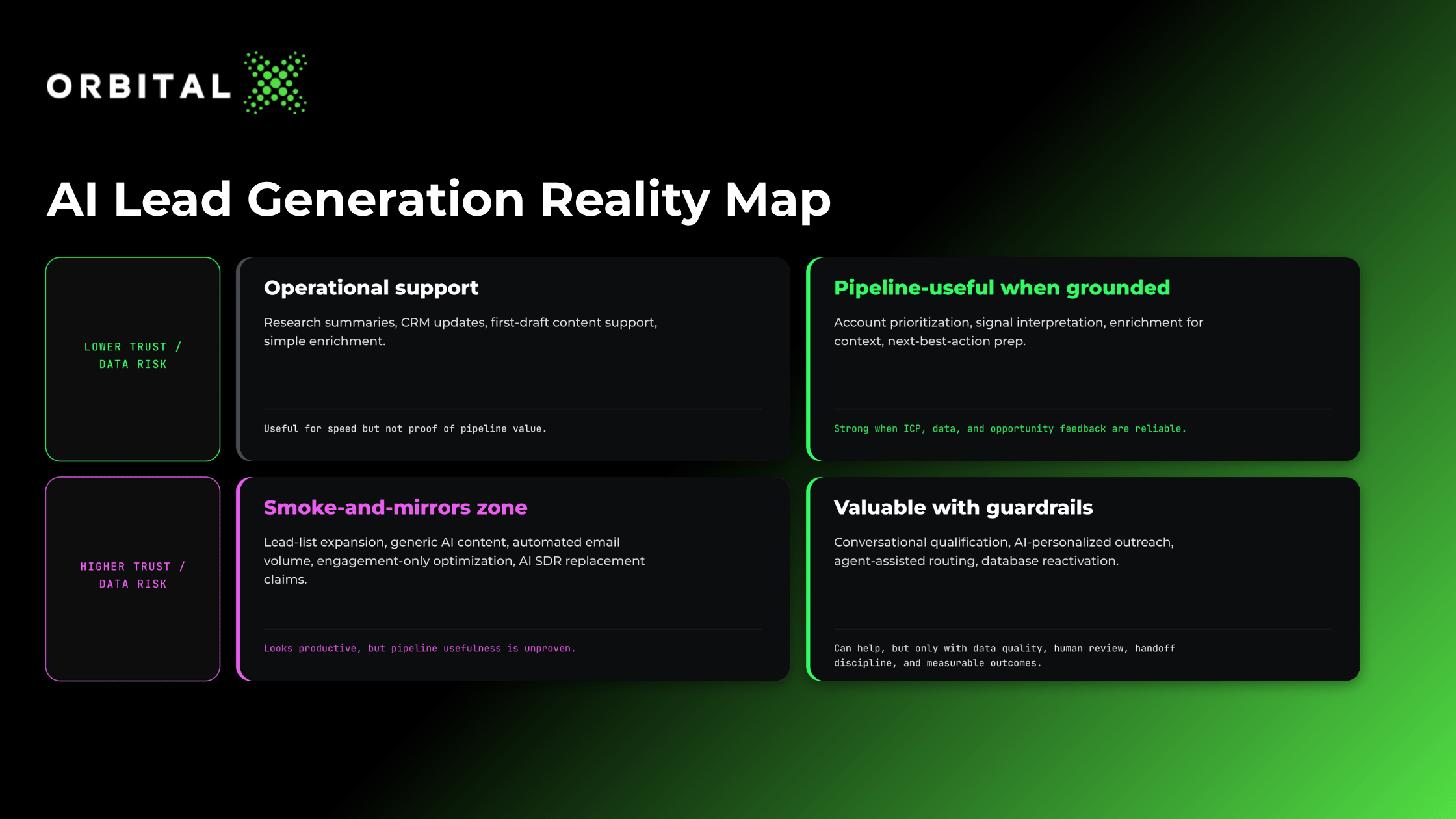
Some impressive-looking use cases may create little pipeline value while carrying high trust, data, and handoff risk. Others are useful for operations yet weak as proof, and some gain value through the system around them.
Where AI lead generation turns into smoke and mirrors
Most AI lead generation failures look productive. Dashboards move, sequences send, agents act, and lead counts rise. But it’s easy for visible work to increase while pipeline quality stays flat.
More contacts without better conversion capacity
AI can easily secure more contacts. Too many times, sales teams end up drowning in 5,000 unvetted leads, turning their CRM into a digital toxic waste dump. The harder ask is if those contacts can be converted into qualified opportunities. Tellingly, research shows more prospecting can cut conversion performance when time and attention are limited.
Companies see a similar outcome when AI expands the top of the funnel. If lead volume grows faster than the team's ability to prioritize, route, and follow up, it may produce more waste than value.
A lead generation system has capacity limits. Sales can only give careful attention to a finite amount of accounts, and marketing can intelligently nurture only a certain number of segments. CRM data stays useful only when the inputs are clean, so pushing more volume into a weak system just makes it louder without making it stronger.
AI outreach without buyer context
Speed and polish don't necessarily translate to better outreach. Those templated, automated AI cold emails just sound like an overly polite robot trying to blend in at an upscale dinner party. AI-written outreach can be faster, cheaper, and more grammatically correct while remaining commercially empty. Context decides usefulness. A message is useful when it reflects something real about the account, buying situation, role, likely problem, or timing.
Buyers are increasingly sensitive to generic automation and quick to recognize it. They can identify messages assembled from public facts without any real understanding of them. A sentence that references a funding announcement, a LinkedIn post, or a company page doesn't create relevance by itself.
AI-mediated communication that feels opaque, manipulative, or inauthentic creates risk. Generated interactions may look polished but end up reducing confidence if buyers distrust what sits behind them. Personalization works only when the data is true, the inference is explainable, and the message reflects a real buying context.
Agents sold as autonomy without proof
AI agents have become a loud, dominating theme in today’s marketing conversation. In the era of agent washing, many vendors are often no better than someone re-skinning an Excel macro and calling it “self-aware.” Some agent workflows are undoubtedly useful for bounded tasks such as research, routing preparation, meeting notes, CRM updates, or follow-up suggestions.
Problems arise with the jump from agent-assisted workflow to autonomous pipeline generation. Gartner, for instance, has warned about agent washing, where vendors relabel assistants, automation, or chatbots as agents without reasonable agentic abilities. Research from Bain also shows that many fully autonomous production models still depend on human approval, exception handling, or guardrails. The focus shifts away from, "Where can we use AI?" to, "Which decisions can be safely delegated?"
In lead generation, delegation should start with risk, data quality, and review. An agent may be able to draft a research summary, enrich a record, classify a signal, or recommend a next step safely. Higher-risk decisions, though, encompass account priority, high-stakes outreach, life cycle stage changes, and buyer escalation without human review.
Recommended watch:
In this “Do More With Less” episode, host Mark Choueke speaks with Lauren Hawker Zafer, COO at Squirro and host of “Redefining AI,” about what’s needed to move AI from experimentation into true application. In AI lead generation, a pilot, model, or agent earns its place when it changes how the business prioritizes, routes, follows up, or learns from real opportunities.
Content volume mistaken for demand
AI makes content production easier. Demand generation doesn't automatically improve with it.
More content can help if it answers buyer questions, clarifies positioning, improves discoverability, supports sales conversations, or helps prospects validate a decision. Grounded in real buyer context and strong editorial judgment, it also helps sales teams explain complex issues more clearly.
On the other hand, AI content could also flood the market with generic explanations and lookalike posts. You need to determine if your AI-produced content helps buyers understand a problem, recognize fit, trust you as a vendor, and take a useful next step.
Engagement metrics mistaken for pipeline proof
AI can improve clicks, opens, replies, form fills, meetings, or content production, but none of those metrics proves revenue impact on their own.
A lead generation system should ask more pointed questions like:
Did account fit improve?
Did sales receive better context and follow up faster?
Did lead-to-opportunity movement improve?
Did the team learn which signals mattered? How did the feedback change the next audience, message, or route?
That’s why lead generation metrics need to separate activity from pipeline usefulness. Remember, engagement helps interpret intent. It’s not the target.
Build the foundation AI needs to improve pipeline
Companies can see the best results from AI lead generation when it has a defined ICP, connected data, relevant messaging, reliable handoffs, timely follow-up, and outcome-based measurement to give it clear commercial direction.
Establish clean, connected data
Reliable data gives AI a consistent basis for scoring, enrichment, and routing.
Duplicated, incomplete, outdated, or inconsistent CRM records make AI scoring and routing unreliable. That’s how three different SDRs end up emailing the same VP of procurement on the same morning with three completely different pitches. When website behavior, campaign engagement, CRM history, firmographic data, and sales feedback sit in disconnected systems, AI only sees the fragments without context. Data quality forms the causal infrastructure of AI lead generation.
A model can't prioritize accounts correctly when the account history is wrong. Stale enrichment data weakens personalization, and inconsistent life cycle stages make confident routing impossible. Learning from pipeline outcomes depends on connecting opportunities back to the signals that created them.
Research on AI in customer relationship management points to the same foundation. Customer data centralization, retraining, ethics, user involvement, multichannel integration, and correct information management aren't optional extras. They determine how usable AI output becomes.
Rather than removing the need for clean data, AI raises the cost of ignoring it.
Define ICP and qualification rules
Clear qualification rules tell AI what commercial quality looks like. Without them, the model tends to optimize around whichever proxy is easiest to measure. That may be engagement, title, company size, form completion, or historical conversion patterns that reflect old bias and past targeting mistakes.
Strong AI lead generation starts with your commercial definition of quality. Which accounts are worth coordinated effort? Which roles matter in the buying group? Which signals suggest urgency? Which weak behaviors still carry useful signals? Which leads should be suppressed because they look active despite poor fit?
These rules ensure AI is a master of targeting.
Design routing and handoffs around the next action
A clean handoff turns an AI-qualified signal into a timely action with a clear owner. A system may identify a high-fit account, enrich the contact, score the behavior, and then recommend follow-up. The value disappears when the output lands as a vague CRM task, generic nurture, or late sales alert.
B2B marketing automation helps when it turns a meaningful signal into a coordinated response. A signal is detected, context is enriched, a route is selected, an owner is assigned, follow-up is prepared, and the outcome is tracked. For lean teams, this marks the difference between intelligence and pure noise. A signal left in a dashboard ends up as reporting. One that reaches the right person with context, however, changes pipeline.
Apply human judgment to trust-critical moments
As previously discussed, Gartner discovered that, while many buyers want digital, lower-friction buying experiences, 69% still prefer to validate AI-generated insights with sales reps. Forrester also reports that buyers use AI during the buying process and validate outputs through trusted sources such as peers, product experts, and analysts.
Skilled salespeople interpret context, validate risk, build confidence, and frame value. Who in their right mind would let an unsupervised autonomous bot handle complex contract nuances when a six-figure deal is on the line? Removing judgment from trust-critical moments risks weakening the buyer's decision.
Use pipeline feedback to improve the next cycle
AI improves when the system learns from what happened. Your team should be able to find a concrete answer to questions like:
Which scored leads became opportunities, and which strong-looking signals produced poor-fit conversations?
What content helped sales?
Where did routing arrive too late?
Which AI-personalized messages created useful replies?
Which segments generated activity without pipeline?
Feedback separates automation from learning. With it, AI lead generation refines audience selection, scoring, routing, content, and follow-up over time. The practical measurement question asks whether demand actually becomes pipeline.
How to evaluate an AI lead generation tool or workflow
Before adopting a tool, agent, workflow, or campaign proposal, test what task it performs, what data it relies on, where human review is required, and how its output can be traced to pipeline.
.png) A tool or workflow that passes these tests has a credible path from AI output to a sales-usable action and pipeline learning.
A tool or workflow that passes these tests has a credible path from AI output to a sales-usable action and pipeline learning.
What “good” looks like: AI as a signal-to-pipeline system
Good AI lead generation is a structured program that turns scattered data into better pipeline decisions. A useful signal-to-pipeline system starts with data inputs such as CRM history, firmographics, engagement, intent signals, content behavior, and sales notes. The system has to identify what changed, which signals matter, and which accounts deserve attention now.
Account prioritization then shapes the audience decision. Content and personalization translate context into a relevant message, proof point, or next best action. Routing and follow-up move the signal into action by clarifying who owns it, what they know, and how quickly they respond. Human validation protects trust-critical moments that require judgment or value framing.
Finally, opportunity feedback tells the system which signals, messages, and actions actually produced pipeline so the next cycle is smarter than the last. At that point, lead generation has integrated into a broader GTM system connecting signal, action, measurement, and feedback.
.png) That flow is hard to sustain when every step lives in a different tool, team, dashboard, or workflow. The problem extends beyond AI lead generation software too. A team may have scoring, enrichment, agents, content tools, intent data, CRM workflows, and sales sequences but still struggle to turn activity into pipeline when the pieces make decisions in isolation.
That flow is hard to sustain when every step lives in a different tool, team, dashboard, or workflow. The problem extends beyond AI lead generation software too. A team may have scoring, enrichment, agents, content tools, intent data, CRM workflows, and sales sequences but still struggle to turn activity into pipeline when the pieces make decisions in isolation.
OrbitalX closes that operating gap.
Most AI lead generation tools solve one part of the chain. They enrich, score, write, route, or automate. The harder B2B problem is making the chain work as one operating model. Intelligence has to inform audience decisions, content has to guide execution, and execution has to feed the next learning cycle.
Our DemandWEBS™ system addresses the operating gap around individual AI lead generation tools. The model combines an AI marketing operating system with expert operators to give lean B2B teams a clearer basis for deciding where attention should go and what should happen next.
Automated lead generation that actually works? Yes, please
AI already supports contact finding, data enrichment, behavioral scoring, message drafting, workflow triggers, visitor qualification, and agent-assisted work. So, instead of judging it based on lead creation, assess how much the automation improves pipeline decision quality.
With the right data and oversight, AI can help your team identify better-fit accounts, interpret timing, preserve buyer context, route follow-up, protect trust, and learn from opportunity outcomes. If it only creates more contacts, content, automated outreach, or dashboards, it’s just scaling the same broken motion at a fast pace.
For high-value B2B, a disciplined signal-to-pipeline system yields stronger results. If your team is experimenting with AI lead generation but struggling to turn scoring, enrichment, content, agents, and follow-up into sales-usable pipeline, book a call with OrbitalX. We’ll help you hone in on where your current signal, routing, content, and feedback loop is breaking, then determine what operating model would turn that activity into better pipeline decisions.
FAQ
What is AI lead generation?
AI lead generation is the use of artificial intelligence to help identify, enrich, prioritize, engage, qualify, route, and learn from potential buyers. It can involve lead scoring, data enrichment, AI-assisted outreach, chat qualification, intent monitoring, and agent workflows. The goal in B2B is better commercial judgment, with lead volume treated as an input.
Does AI lead generation actually work for B2B companies?
AI lead generation only works when the surrounding system is strong. It needs clear ICP logic, clean data, reliable enrichment, useful signal interpretation, fast routing, sales follow-up, and feedback from opportunity outcomes. The real test of AI’s value in lead generation is whether it improves a decision the business already needs to make.
Are AI agents useful for lead generation?
AI agents can be useful for bounded lead generation workflows such as research, enrichment, CRM updates, signal monitoring, routing suggestions, and follow-up preparation. The risk begins when agents are treated as autonomous pipeline engines. High-value B2B still needs data governance, clear task boundaries, human review, and measurable outcomes before agent-led workflows earn trust.
Can AI replace SDRs or salespeople?
AI can support SDRs and sales teams but shouldn't be treated as a full replacement in high-value B2B. Salespeople still matter for judgment, buyer confidence, value framing, objection handling, and trust-critical moments. To combine both, clarify each role, with AI handling analytical and orchestration work while people protect context, confidence, and commercial nuance.
What is the biggest risk with AI lead generation?
The biggest risk is scaling the wrong motion faster. AI can multiply poor-fit contacts, generic outreach, weak personalization, bad CRM data, and noisy engagement metrics. If the team lacks clear ICP, routing, sales handoff, and pipeline feedback, AI won't fix the system. It will make the system look busier while the pipeline problem remains unresolved.
How should B2B teams measure AI lead generation?
B2B teams should measure AI lead generation through account quality, sales usability, follow-up speed, lead-to-opportunity movement, opportunity creation, conversion readiness, and feedback-loop improvement. Raw lead volume, email output, content volume, or engagement don't provide enough evidence. Ask how AI improves decisions about who to target, when to act, what to do next, and how those decisions affect pipeline outcomes.
More Resources

B2B Product Marketing: Strategy and Execution
Learn how B2B product marketing connects positioning, GTM, sales enablement, and customer outcomes to drive commercial growth.

Risk Tiers and Bureaucracy? The B2B Guide to Earning Market Trust via the EU AI Act
The EU AI Act explained for business leaders: risk-based AI rules, global scope, and how governance maturity enables compliant, scalable AI adoption.

ICP Scoring Rubric: How to Score, Rank, and Prioritize Your Best Customers
Learn how to build an ICP scoring rubric, weight criteria, rank accounts, set tiers, and prioritize sales and marketing attention.