The Demand Gen Funnel: How to Measure Whether Demand Becomes Pipeline
Learn how to structure a B2B demand generation funnel, measure each stage, avoid vanity metrics, and connect awareness, engagement, conversion, sales handoff, and pipeline quality.
Key Takeaways
A demand generation funnel organizes how B2B teams create, capture, convert, and learn from demand. It connects awareness, engagement, demand capture, qualification, sales handoff, pipeline movement, and feedback.
The funnel works best as a measurement model. Real B2B buying rarely follows a clean journey because it’s non-linear, multi-stakeholder, and difficult to attribute.
Activity metrics need signal quality, sales usability, and pipeline context. More impressions, clicks, downloads, or MQLs don’t automatically mean better demand.
Demand creation and demand capture need different measurement logic. Creation asks whether the right market is becoming easier to reach and educate. Capture asks whether existing or emerging intent is converting into usable opportunities.
A demand generation funnel can make marketing look like NASA mission control while the pipeline is still held together like one of those corporate team bonding activity structures using spaghetti and sellotape to form a tower.
Campaigns are running. Content is being published. Paid channels are burning cash with the quiet dignity of a red carpet HBO series finale. CRM stages are moving. Dashboards are blinking. The funnel slide looks clean enough to make leadership briefly forget the pipeline is coughing blood in the next room. None of that proves the right accounts are becoming more aware, more engaged, more sales-ready, or more likely to turn into quality pipeline.
Used badly, the funnel is a PowerPoint conga line. Awareness shuffles into engagement, engagement shuffles into conversion, everyone claps, and sales still has nothing useful to work with. When used well though, it shows whether demand activity is translating into usable demand.
If you don’t have a solid idea of what a demand generation funnel is, what stages it includes, how to structure one, and which metrics to read, you came to the right place. You’ll also learn what most funnel diagrams avoid, which is deciding what to scale, fix, pause, hand to sales, or investigate next.
What Is a Demand Generation Funnel?
Think of a demand generation funnel like trying to manage a polite but chaotic queue at a bus stop during a sudden downpour. It’s a way to organize how a B2B company creates awareness, educates potential buyers, captures demand, qualifies interest, hands useful context to sales, tracks pipeline movement, and learns from the results.
It’s the careful balance of not having too much awareness content and just enough of your assets or budget catered to capture.
That’s the clean definition. The trouble starts when the funnel has to prove something useful. A stage change looks neat in a report. But it only matters if the account, signal, handoff, or opportunity became stronger along the way.
Demand generation builds awareness and interest over time instead of reducing marketing to one heroic lead-capture moment. Early-stage activity shouldn’t be dragged into court for failing to convert immediately. Later-stage activity shouldn’t be judged only by whether a record has appeared in CRM.
For a B2B team, the funnel has to answer practical questions. Are we reaching the right accounts? Are they engaging with the right problems? Are we capturing intent at the right moments? Are conversions commercially meaningful? Does sales receive enough context to act? Do opportunities move, or do they stall after entering CRM?
A funnel that counts every touch but can’t explain which signals matter is just reporting with better furniture. The operating model begins when the funnel helps the team decide what changed, what matters, and what should happen next.
Demand Gen Funnel vs. Lead Gen Funnel
It’s old school versus new school. But aren’t they the same thing? No.
Maybe sort of.
A lead generation funnel usually focuses on capturing contact information and turning anonymous interest into known leads. A demand generation funnel has a harder job. It has to evaluate market awareness, education, account fit, buying-role fit, intent quality, and sales readiness. Then, it has to keep following the evidence through handoff context, opportunity quality, pipeline movement, and feedback.
If lead gen is like frantically collecting business cards at a noisy mixer, demand gen is getting those people to actually want to buy you a drink.
Common funnel language often separates demand creation, demand capture, and conversion. But when the team treats stage labels like evidence instead of placeholders waiting to be proven, that’s when things start to come apart at the seams.
Lead volume can start lying politely. More contacts may look good in a report. That gets less impressive when they sit outside the ICP, lack urgency, represent the wrong buying role, or arrive without useful sales context. At that point, the funnel hasn’t created much sales-usable demand.
Why the Funnel Helps Even When Buyers Don’t Move in a Straight Line
Having to explain the most recent Kardashian scandals from the beginning sounds exhausting. It’s more fun gossiping with people already in the know. The demand gen funnel gives marketing, sales, RevOps, and leadership a shared way to discuss the same messy system. Where is demand being created? Where is it captured? Where does quality drop? Where does the handoff start to wobble?
That shared structure helps because B2B buying rarely behaves like the slide says it should. Multiple people inside one account may research separately. Some activity is anonymous. Some demand shows up through direct traffic, partner influence, word of mouth, or a sales conversation that marketing can’t fully see.
The funnel doesn’t need to explain every buyer path. It needs to help the team read the visible signals well enough to make better decisions.
Why a Demand Gen Funnel Matters for B2B Teams
No marketer wants to be behind the times. Demand generation is very much in vogue. More than that, it’s proven to be profitable where typical lead gen has become more expensive at the channel level.
A demand gen funnel matters because it gives a lean B2B team a way to separate visible marketing movement from actual commercial progress.
Without that discipline, reporting logs into the CRM, clears its throat, and introduces itself as pipeline evidence. Awareness, engagement, MQL volume, and CRM activity all rise. The dashboard looks busy enough to ask for a promotion. And yet, sales still ignores the leads, opportunities continue to stall, and pipeline grows in name only while quietly disappointing everyone in the room.
Signals can fire without giving sales a strong reason to prioritize the account:
Activity tells you something happened.
Evidence says whether that activity matters. Impressions prove the message was seen but don’t prove the right accounts saw it.
Content views suggest attention, and attention stays cheap until it connects to buying readiness.
Form fills create a visible conversion moment.
Fit, urgency, authority, and sales usefulness still have to be checked.
MQLs show that a scoring or routing rule was triggered.
A good demand gen funnel doesn’t just chuck activity metrics into the sea and pretend it’s achieved enlightenment. It puts them where they belong. Activity becomes useful when it’s connected to signal quality, account fit, and buying role. It becomes commercially meaningful when sales accepts it, opportunities form, and pipeline starts moving for reasons the team can actually explain.
That’s the funnel’s chance to break up the usual revenue team whodunnit dinner. Sales says the leads are weak. Marketing says sales isn’t following up. RevOps points at CRM hygiene. Leadership asks why spend is rising without enough pipeline confidence. Everyone has a suspect. The funnel’s job is to work out whether the problem is in the audience, the offer, the handoff, the CRM, or the pipeline stage with the candlestick.
A better funnel isolates the break. If reach is high while ICP fit is weak, the problem may be audience or channel quality. If engagement is strong while conversion is weak, the problem may be the content path, CTA, offer relevance, or timing. If conversion is good while sales acceptance is low, the problem may be qualification, role fit, routing, or handoff context.
Rather than turning sales or marketing into the villain, it makes the problem visible enough to fix.
.png)
The Stages of a B2B Demand Generation Funnel
Most B2B demand generation funnels include the same core stages. These usually cover awareness, engagement, demand capture, conversion or qualification, sales handoff, opportunity movement, and feedback. It’s old hat for you by this point.
However, a stage only earns its place when it shows what became stronger, what stayed weak, and what the team should do next.
Awareness/Demand Creation
This is everyone’s favorite part, because you can have fun and try things, run content experiments, and play with interesting slogans and tactics. Like a kid in a candy store!
Awareness, or demand creation, is where the team reaches and educates the right market before active buying intent is obvious. The mistake is treating visibility like demand because it put on a blazer and walked into the CRM. Reach isn’t relevance. Traffic isn’t account quality.
At this stage, the useful question is whether the right accounts and roles are becoming easier to see and reach. The deeper test is if the market is becoming easier to educate on the right problem.
Engagement/Education
The measurement stage. You’re looking at open rates and starting to see a funnel emerge from the work you put in … or staring at a dashboard full of email opens while the actual sales pipeline is bone dry.
Engagement shows people are interacting with the company’s ideas, content, events, website, or campaigns. Common signals include return visits, content consumption, webinar attendance, email engagement, and high-intent page views. Stronger engagement analysis also looks at topic clustering and account-level measurement.
Granted, that isn’t proof the buying committee has assembled and agreed to take a sales call. But it’s still better than shouting into the market and hoping the right people heard something. In B2B, engagement is harder to interpret because account and user behavior rarely tell one clean story. Decisions involve groups, long cycles, and conversations inside the account that marketing can’t fully see.
Demand Capture
Here’s where the proof becomes pudding. The marketer’s heart is thumping, waiting for numbers to trickle over this stage of the funnel.
Demand capture is when the team converts existing or emerging intent into visible action. That can include demo requests, contact forms, pricing-page visits, comparison-page visits, and paid search conversions. It can also include retargeting conversions, event follow-up, direct traffic, branded search, or other high-intent behaviors.
Capture is easier to measure than creation because the response finally leaves fingerprints. That makes the report feel useful, sometimes too much. Teams often overvalue what they can attribute cleanly and undervalue the earlier work that made the buyer easier to capture in the first place.
Conversion/Qualification
Ignore the sales rep licking their lips in anticipation for that hot lead they’ve been waiting for.
Conversion turns a visible response into a known record, lead, meeting request, trial request, or other measurable action. Qualification asks whether the response is commercially meaningful.
This is where many funnels start wearing a nicer suit than they deserve. A landing page conversion rate can rise while lead quality falls. A scoring rule can fire off more records to sales and still produce the same collective sigh from the sales team. Qualification has to drag the useful questions back into the room. It has to bring fit, role, problem clarity, intent level, timing, account context, and next-step value into the measurement.
Sales Handoff/Sales Acceptance
Now for the exciting part. You get to see a number on a marketing dashboard become a pipeline number.
The sales handoff isn’t complete when a record moves from marketing to sales. Sales needs enough context to act.
A stronger handoff explains why this account matters now. What did they engage with? What problem does the engagement suggest? Which role is involved? Does the account fit the ICP? What prior activity exists? What urgency may be present? What next step makes sense? Without that context, the handoff is just a record changing desks and hoping nobody notices. It’s admin with optimism attached.
Opportunity Quality, Pipeline Movement, and Feedback
Finally, we impact our bottom line. After all that work!
Opportunity creation is a stronger signal than a form fill. It still needs quality control. Pipeline can look perfectly real in CRM and still be commercially thin enough to make sales wince. The useful question is whether demand became an opportunity that sales believes in, can explain, and can move.
The feedback loop turns those outcomes back into better demand decisions. It should show which leads were accepted, which were ignored, which turned into opportunities, which stalled, which closed, which were lost, and what reasons sales heard in the field.
Funnel stage | What it should prove | Watch for | Next decision |
Awareness/demand creation | The right market is being reached and educated. | Reach that hides weak ICP relevance. | Refine audience, channel, message, or category education. |
Engagement/education | Behavior suggests problem relevance and account interest. | Engagement that never becomes buying relevance. | Inspect account fit, role fit, content path, and intent level. |
Demand capture | Visible intent is being converted into usable demand. | Conversions that create records, not sales usefulness. | Improve offer, routing, landing page, and qualification criteria. |
Conversion/qualification | Responses meet commercial criteria. | Loose criteria or activity-based scoring. | Tighten fit, readiness, timing, and context requirements. |
Sales handoff/acceptance | Sales has context it can act on. | Handoffs without a reason to prioritize. | Improve routing, handoff context, SLA, and next-step guidance. |
Opportunity/pipeline movement | Demand becomes credible pipeline. | Pipeline that exists in CRM but lacks sales confidence. | Review opportunity quality, stakeholder depth, and deal progression. |
Feedback loop | Outcomes improve the next decision. | Feedback that arrives too late to change execution. | Adjust audience, content, channel, capture, nurture, and follow-up. |
How to Build the Funnel as a Measurement System
A generic funnel diagram can be useful as a starting point. But if the team copies the stages, polishes the arrows, and forgets to ask what any of it is supposed to prove, you’re going in the wrong direction.
1. Start with the commercial question the funnel has to answer. One team may need to know whether awareness activity is reaching the right accounts. Another could ask why strong engagement isn’t becoming qualified demand. A later-stage team might have to understand why opportunity creation looks healthy while stage progression is weak.
That overarching question should shape the funnel. Otherwise, the team’s just collecting metrics like fridge magnets because the dashboard had empty space.
2. Then, define stage entry and exit criteria. Each move should mean the evidence grew stronger. A lead shouldn’t move to sales simply because a score crossed a threshold. A conversion shouldn’t become “qualified” because the CRM found an empty box to drop it into. There needs to be enough fit, role, need, timing, or context to justify the next action.
Clear criteria keep the funnel from turning into a CRM conveyor belt. Movement should mean something changed.
3. Finally, connect marketing data to CRM and sales feedback. Marketing data alone can’t explain the full funnel. CRM data by itself can’t explain how demand was created or why an account engaged before sales entered the picture. One sees the smoke. The other sees the tinder. Neither sees the whole fire on its own.
Perfect attribution is usually the wrong bar. The goal is better shared evidence. That means what happened, with who, why it matters, what sales did with it, and what changed afterward.
Demand Gen Funnel Metrics: What to Track and How to Read Them
Demand gen funnel metrics can seem like unquestionable truth, but just like any Marvel superhero, they have their weaknesses.
A flat list of KPIs can make everything feel measurable. That’s a trap. The dashboard looks official, the chart has a direction, and everyone gets to pretend the number has explained itself when it hasn’t.
Each measurement has a job but also hides something. Demand generation metrics often span traffic, engagement, conversion, cost, and pipeline categories. A taxonomy is a useful filing cabinet that keeps the metrics tidy, which is lovely … right up until the team needs to know which drawer the pipeline problem is hiding in.
Activity
Activity metrics quantify exposure, participation, and visible movement. These include impressions, reach, clicks, traffic, and page views. They also comprise content downloads, email opens, event registrations, webinar attendance, and campaign interactions. They tell you whether the team is creating surface area for demand. They don’t explain whether the right market is paying attention, or whether anyone worth selling to has moved an inch.
Signal Quality
Signal-quality metrics ask whether activity is coming from the right accounts, roles, topics, and behaviors. Some signals tell you whether the account belongs in the conversation, including ICP-fit rate, target-account engagement, return visits from priority accounts, buying-role fit, firmographic fit, and technographic fit. Others tell you whether the behavior deserves attention, including high-intent content consumption, account-level engagement depth, topic clusters, and sales-context completeness.
This is where the funnel stops treating every click like it deserves a medal.
Conversion
Conversion metrics show where visible responses happen. Some are direct response points, such as landing-page conversion rate, demo requests, form fills, gated-content downloads, and event sign-ups. Others track movement between known stages, including lead-to-MQL rate, MQL-to-SQL rate, and meeting booking rate.
A conversion can make the report look healthier while opportunity quality quietly gets worse. The more useful inquiry is whether the response produced better-fit accounts, stronger sales conversations, and more credible opportunities.
Sales Usability
Sales-usability metrics reveal whether marketing output becomes something sales can act on. Start with sales response, including sales acceptance, speed to lead, follow-up completion, meetings set, and meetings held. Then, check the quality of the handoff through disqualification reasons, handoff completeness, account context quality, and visible engagement history.
This is where “marketing generated demand” either becomes useful context or just another record sales has to decode.
Pipeline
Pipeline metrics hone in on downstream movement. They include opportunity creation, sales-qualified opportunity rate, cost per opportunity, qualified pipeline, stage progression, sales cycle length, velocity, win rate, and closed-lost patterns.
These metrics sit closer to revenue, which makes them look serious by default, but they still need judgment. Pipeline created isn’t pipeline quality, and a CRM value isn’t the same thing as sales confidence. That’s how teams end up with clean dashboards and muddy decisions. The metric exists. The interpretation doesn’t.
Demand Creation and Demand Capture Need Different Measurement Logic
A demand gen funnel breaks when creation and capture are treated as the same job. Measuring early-stage demand creation by immediate form fills is like judging a first date by whether the person brought a marriage license.
Demand creation makes the right market more aware, educated, and receptive. Demand capture converts active or emerging intent when buyers are closer to taking action. Both matter. Measuring them with the same scorecard is how teams end up yelling at a fish for not climbing a tree.
How to Handle Demand Creation
Demand creation metrics should show whether the company is building visibility and relevance with the right market. Start with ICP reach, target-account engagement, educational content consumption, return visits, and branded search movement. Then, look for the messier signs that the market is warming up. Direct traffic patterns, social engagement from relevant roles, event participation, and stronger sales conversations after exposure to content or campaigns all belong in that picture.
Demand creation metrics are usually messier than capture metrics. They don’t walk into the meeting holding a neat little conversion receipt, so the room is tempted to treat them like background noise. Their job is to show market movement before the buyer is ready to leave a cleaner trail.
How to Handle Demand Capture
Demand capture metrics show how well the team turns visible intent into known demand. Some signals come from direct conversion points, like demo requests, contact forms, pricing page conversions, paid search, and landing page performance. These all show where visible intent begins to turn into known demand. Others show whether high-intent behavior is moving into the sales process, including high-intent page visits, sales routing, qualification outcomes, and opportunity creation from capture points.
These metrics are often easier to defend because they sit closer to a visible conversion. That visibility can make capture look like the whole funnel if nobody’s careful. Capture converts demand that already exists or is emerging. It can’t tell the team if the seeds of future demand have been planted.
If capture looks efficient while pipeline later dries up, the team may be harvesting existing intent while the future market sits in the corner, hungry and uninvited.
Demand Creation vs. Demand Capture
Different measurement logic for two different jobs inside the same funnel.
Measurement Layer | Demand Creation | Demand Capture |
Primary job | Make the right market more aware, educated, and reachable | Convert active or emerging intent into known demand |
Useful signals | ICP reach, target-account engagement, educational content use, and relevant role interaction | Demo requests, pricing conversions, high-intent pages, routing, and qualification outcomes |
What it can prove | The market is becoming easier to reach and educate | Visible intent is turning into sales-usable demand |
What it can hide | Whether near-term buying intent exists | Whether enough future demand is being created |
Common mistake | Judging creation mainly by immediate form fills | Treating capture as the whole funnel |
Next decision | Improve audience focus, message clarity, and content path | Improve offer, routing, qualification, and sales context |
Creation asks whether the right market is becoming reachable. Capture asks whether visible intent is becoming usable demand.
Benchmarks, Baselines, and Common Funnel Leaks
Benchmarks can be dangerous when they become targets without context. It’s the difference between winning first place at the Olympics versus at a year nine track and field competition.
A team may ask for a good demand generation funnel conversion rate, CPL, MQL-to-SQL rate, or cost per opportunity. But “good” only makes sense with business context. A high-ACV market with a long sales cycle and a complex buying committee won’t behave like a low-friction category with a simple offer. Channel, category maturity, conversion definition, attribution model, ICP fit, and opportunity quality all change what the number means.
Use benchmarks to create context rather than targets. Conversion-rate benchmarks vary by industry and source, so they work best as comparison material rather than universal demand generation standards. The same logic applies across CPL, CPA, CAC, MQL-to-SQL, SQL-to-opportunity, sales-cycle length, win rate, and velocity.
CPL Interpretation
A low CPL can look like fiscal discipline right up until it fills the funnel with poor-fit leads. A high CPL can make sense when it produces strong-fit opportunities with credible deal value. A strong landing-page conversion rate creates the same problem if sales rejects the output. A weak conversion rate may still be useful when a high-friction, high-intent offer produces better opportunities.
ICP Interpretation
Internal baselines usually tell the team more than broad external averages. An industry average doesn’t know your sales cycle, your ICP, your offer, or the strange little ways your CRM tells half the story.
Look at historical stage performance by channel, segment, offer type, ICP fit, buying role, account tier, and sales outcome. Then, ask what changed. Did traffic quality improve? Did conversion rise because the offer improved, or because the audience broadened? Did sales acceptance improve because qualification tightened?
Funnel leaks need the same treatment. Leakage isn’t always a volume problem. Often, the account moves forward while the evidence stays weak, which is how a funnel starts leaking confidence before it leaks numbers.
High reach with weak ICP fit usually means the audience, channel, targeting, content angle, or distribution strategy is too broad. The graph goes up, and the team feels movement.
Very motivational. Less helpful when the reach comes from poor-fit accounts or irrelevant roles. The graph is moving. The market that matters may not be.
MQL-to-SQL Interpretation
Strong engagement with weak conversion can mean the content is interesting without being connected to a clear next step. It might also mean the audience is learning but not ready. Inspect topic relevance, content sequencing, CTA strength, and whether the next step matches the problem.
Good conversion with low sales acceptance is one of the clearest signs the funnel is measuring response more strongly than usefulness. People fill out forms, download content, or cross a scoring threshold. The report gets to smile. Sales opens the handoff, sighs, and quietly slides it back across the table. The problem often sits in fit, role, urgency, routing, qualification criteria, or handoff context.
SQL-to-Opportunity Interpretation
Accepted leads that don’t become opportunities expose a different break. Fit may be acceptable, while urgency, pain, budget, stakeholder access, or next-step commitment is still too weak. The conversation happens. Everyone is technically doing the job. The commercial case just never makes it into the room.
Opportunities that stall show a different kind of weakness. The funnel found enough evidence to open the opportunity. It didn’t find enough commercial muscle to move it. The account may have a real problem, a named opportunity, and a value in CRM. Lovely. If urgency is weak, stakeholders are missing, budget is vague, or the next step keeps sliding, the deal is alive in the report but dead on the floor.
That’s how teams end up celebrating pipeline nobody fully trusts.
The Operating Gap That Keeps Funnel Metrics From Improving Pipeline
Even a well-defined demand gen funnel can fail if the team can’t interpret the signals together. Then it’s no better than the Tower of Babel.
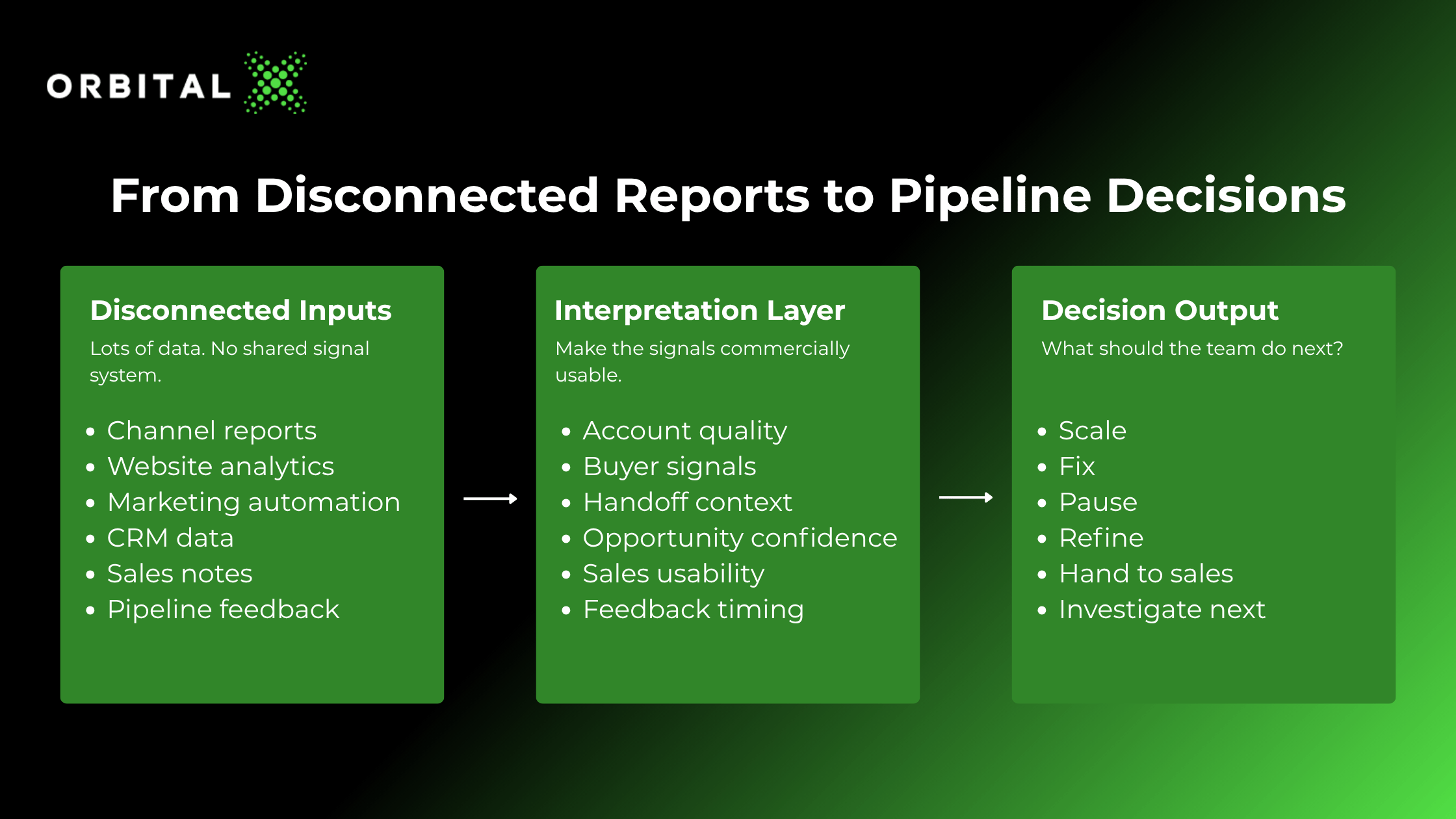
The team isn’t starving for data. It’s drowning in half-stories from systems that all swear they were helping:
Channel reports show clicks, impressions, costs, and conversions. Website analytics reveal sessions and page paths.
Marketing automation brings back form fills, scores, and nurture behavior.
CRM displays stage movement, tasks, meetings, opportunity value, and closed-lost reasons.
Sales has the live context, often trapped in notes, calls, Slack messages, or someone’s memory.
When those views never meet, the funnel turns into a pile of reports that are individually defensible but collectively useless. Every system brings its own little square of truth, and somehow, the final picture still looks like it lost a fight with a spreadsheet.
Activity-centric metrics miss the account and opportunity context that makes the numbers useful. A team can report high engagement without knowing whether the right accounts are engaging. They might claim MQL volume without knowing if sales has a reason to act. They may even say pipeline was created without knowing whether it’s progressing for the right reasons.
The team already has plenty of metrics. Some of them probably have their own dashboards, meetings, and emotional support spreadsheets. The real gap is that data, buyer signals, sales context, and pipeline feedback aren’t turning into decisions reliably enough.
That gets expensive fast for lean teams. They don’t have a spare department sitting around with magnifying glasses for every lead. They can’t rebuild every report, rewrite every nurture path, and run every channel experiment at the same time. They need the funnel to show where the next hour, dollar, and sales conversation should go.
Where DemandWEBS™ Fits
Adding another dashboard on top of the already teetering pile won’t fix things. You need a solution that will connect data, audience intelligence, content, channel execution, sales context, and feedback into one operating loop. That’s what lets the team make better pipeline decisions instead of admiring better-organized reports.
DemandWEBS™ is OrbitalX’s AI-supported marketing operating system backed by expert operators. For a demand gen funnel, it helps lean B2B teams move beyond disconnected reporting and read funnel signals with more commercial precision. It connects all critical elements so activity can be interpreted through audience quality, sales usefulness, handoff context, and pipeline movement.
You have plenty of leads, as your bursting CRM can attest. The real struggle is knowing which activity should get more investment, which signals deserve sales attention, which handoffs lack context, and which pipeline movement is actually credible.
A funnel gives the structure. DemandWEBS™ helps operate the signal system behind it.
How to Start Improving Your Demand Gen Funnel
Don’t jump right into rebuilding the entire funnel. That’s a one-way ticket for a useful diagnosis to get dragged into a six-week reporting renovation nobody asked for.
Start with the first stage where sales usefulness breaks instead. Is reach broad while account fit is weak? Does engagement look strong, but intent never sharpens? Are conversions healthy and yet sales acceptance stays low? Are opportunities created only to end up quietly sitting and waiting for real buying commitment to arrive?
Then, replace one vanity metric with one signal-quality metric. Instead of only reporting traffic, report target-account engagement. Rather than sticking with solely MQL volume, focus on sales acceptance and disqualification reasons. Turn attention away from pipeline created and toward opportunity quality and stage progression.
Finally, make the next funnel review end with a decision, such as:
Narrow down an audience.
Change a content path.
Pause a weak-fit channel.
Escalate a handoff issue.
Test a stronger capture offer.
Give sales a clearer reason to act.
A funnel that only reports what happened is a dashboard with delusions of strategy. A funnel that changes what the team does next is a genuine demand generation measurement system.
DemandWEBS™ helps connect the pieces so your funnel stops reporting movement and starts improving pipeline decisions. Talk to OrbitalX about where your demand gen funnel is losing signal quality, sales context, or pipeline confidence and how to plug the leaks.
FAQs
What is a demand generation funnel?
A demand generation funnel is a B2B framework for organizing how demand becomes pipeline. It covers how a company creates awareness, educates buyers, captures intent, qualifies demand, hands context to sales, tracks opportunity movement, and learns from feedback. Its real job is to show whether demand activity is turning into sales-usable pipeline.
What are the main stages of a demand generation funnel?
Most demand generation funnels follow the same broad path. They begin with awareness or demand creation, then move through engagement, demand capture, conversion or qualification, sales handoff, opportunity quality or pipeline movement, and feedback. Each stage should define what evidence became stronger and what decision should follow.
Is demand generation only top of funnel?
No. Demand generation includes top-of-funnel awareness, but a useful demand gen funnel keeps measuring after visibility is created. It should also track engagement quality, demand capture, qualification, sales acceptance, opportunity creation, pipeline movement, and feedback. Otherwise, a team may capture attention without knowing whether it became useful demand.
What is the difference between a demand gen funnel and a lead gen funnel?
A lead gen funnel usually focuses on capturing contacts or creating leads. A demand gen funnel is broader. It should evaluate demand quality, fit, readiness, context, sales usability, and pipeline movement. Lead generation can be part of demand generation, but it shouldn’t become the whole system.
What is a good demand generation funnel conversion rate?
There’s no universal “good” conversion rate. The right benchmark depends on industry, channel, offer, ACV, sales cycle, buying committee, conversion definition, ICP fit, and opportunity quality. Research and use external benchmarks for starting context, then compare against your internal baselines and downstream sales outcomes.
More Resources

B2B Content Marketing Funnel: Stages, Strategies, and How to Build One That Converts
Build a B2B content marketing funnel that aligns content with buyer needs, connects the journey, and turns content engagement into pipeline and revenue.

B2B Referral Marketing: How to Build a Program That Drives Qualified Growth
Learn how to build a B2B referral marketing program that turns trusted relationships into qualified introductions, pipeline, and measurable revenue.

A PE-Backed Company Cut Marketing From 12 People to 3. Then Had Its Best Six Months Ever.
A marketing team cut from 12 to 3, then the best six months in the company's history. Here's the growth system behind it, and what it means for PE portfolios.