B2B Video Marketing: How to Build a Strategy That Drives Results
Learn how to build a B2B video marketing strategy, choose the right video types, distribute content, measure results, and drive pipeline.
Key Takeaways
B2B video marketing helps businesses explain complex ideas, demonstrate solutions, build trust, and support sales conversations across the buyer journey.
Don’t just produce more content. An effective video strategy starts with a buyer need or business objective.
Video can extend beyond its original channel when marketers build a system for distributing, embedding, transcribing, clipping, and repurposing it.
In 2026, video creates opportunities for visibility in AI-powered discovery and search when supported by clear transcripts, metadata, captions, and relevant surrounding context.
Video performance should be measured against its intended business outcome, not view count alone.
B2B video marketing has moved well past the era of standard corporate headshots and polished promotional clips. If your LinkedIn feed feels like a low-budget episode of “The Office” where everyone is suddenly a video producer, you aren't imagining things. Everyone and their corporate dog is pressing the record button.
Modern video sits directly at the center of how businesses explain complex ideas, demonstrate products, build buyer trust, and drive measurable revenue. Across the board, 91% of businesses are using video marketing in 2026, up from 89% in 2025, according to Wyzowl data.
That high level of adoption proves that video is no longer an experimental format or merely a vanity exercise. But high usage also brings a cold splash of reality, since most B2B video teams produce noise instead of pipeline.
The difference between video that creates demand and video that burns budget comes down to structure. Effective B2B video starts with a buyer need and a business objective, matching the format to a specific job across the buying journey.
See More:
What is B2B Video Marketing?
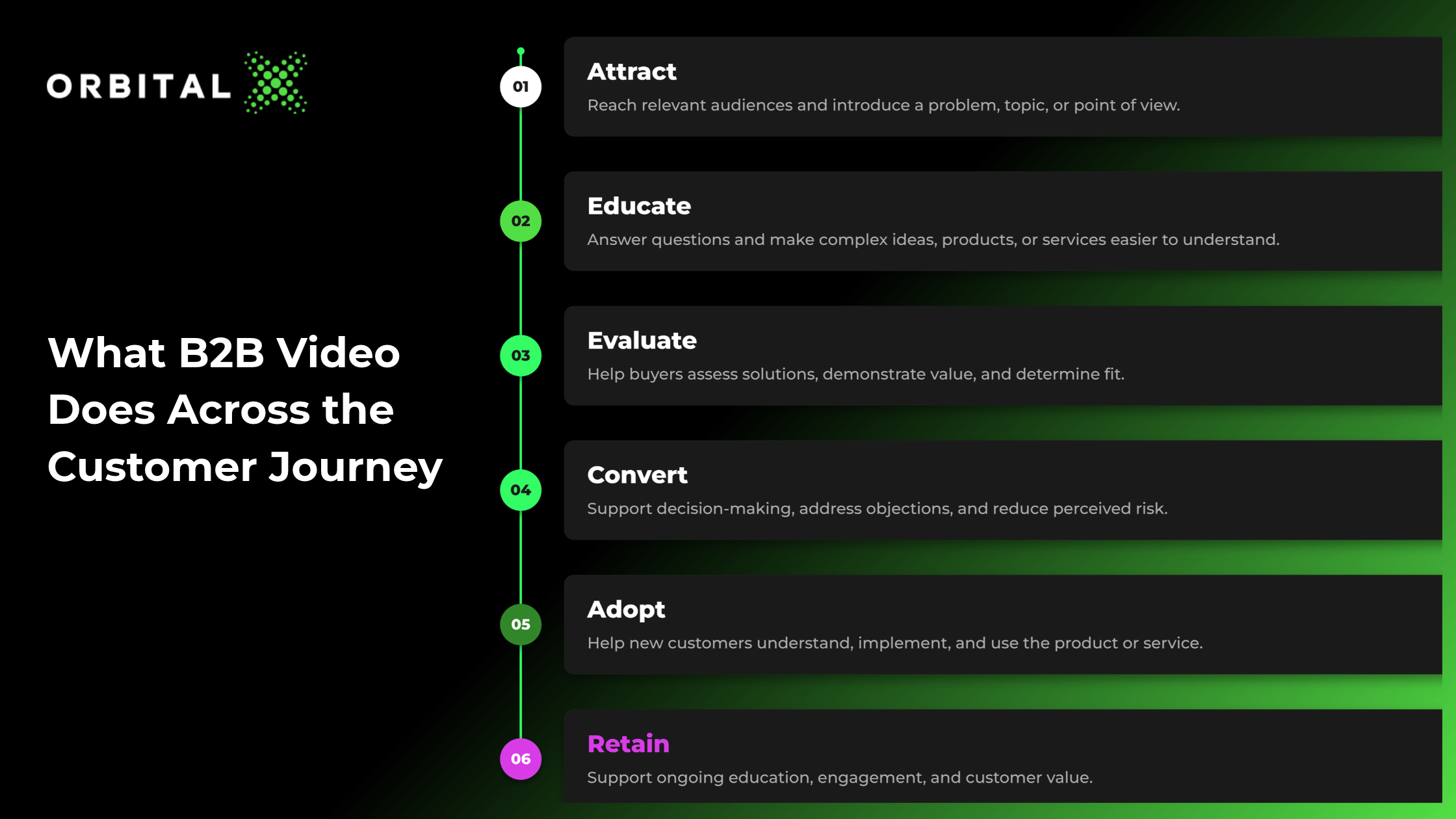
B2B video marketing uses video content to attract, educate, engage, convert, and retain business audiences. It can support different stages of the buyer journey, from introducing a problem or building awareness to explaining a solution, demonstrating a product, addressing objections, and helping customers get the most out of what they've purchased.
Unlike video created primarily to capture attention, B2B video often needs to communicate complex products, services, processes, or ideas clearly enough for business buyers to evaluate them. It can also help marketing teams communicate expertise, give sales teams useful assets for active opportunities, and provide customers with guidance after purchase.
Think about a good restaurant. The kitchen doesn't decide, “Tonight, we're making soup,” and then figure out what customers might want from there. It starts with the diner, the occasion, and what the meal needs to accomplish. B2B video works much the same way. A slick product demo, a thoughtful customer story, and a 30-second LinkedIn clip can all be useful, but only when they're doing a specific job.
A B2B video marketing strategy connects each video to a specific audience need or business objective, with the format, distribution, and measurement shaped by that purpose. That way, you avoid the awkwardness of your founder dropping £15k on a slick cinematic teaser featuring dramatic slow-motion shots of someone in a glass office … only for it to earn three likes from internal employees and zero sales conversations. Without a strategic foundation, video becomes an expensive production trap.
B2B Video Marketing vs. Traditional Video Marketing
B2B video operates in a completely different world than standard consumer video. Business purchases involve multiple stakeholders, longer buying cycles, higher price points, and substantial risk for the buyer.
While B2C video can win someone over in 30 seconds, B2B video has to survive a panel of skeptical stakeholders, a risk-averse procurement lead, and a CFO who looks at every invoice like it's a personal insult.
A traditional B2C clip may rely on impulse or visual entertainment, but B2B video has to do some serious heavy lifting. You can’t close a six-figure enterprise deal using a trending TikTok dance. It needs to educate skeptical committees, demonstrate tangible value, prove domain expertise, and give sales reps the exact assets they need to handle tough objections.
 Why B2B Video Marketing Matters in 2026
Your buyer is probably watching a video before they ever talk to your sales team. Maybe they’re scrolling LinkedIn between meetings, watching a product demo at 11 p.m., or asking an AI search tool to explain a problem your company happens to solve. If your expertise only exists in a 40-page PDF or a sales deck gathering dust in someone’s inbox, you’re making buyers work way too hard to find it.
That’s why B2B video marketing matters in 2026. Prospects can encounter video across more stages of the research and buying process, from social platforms and search to company websites, email, sales outreach, and AI-powered discovery experiences. Video gives B2B brands another way to explain complex topics, demonstrate products or services, communicate expertise, and highlight customer experiences.
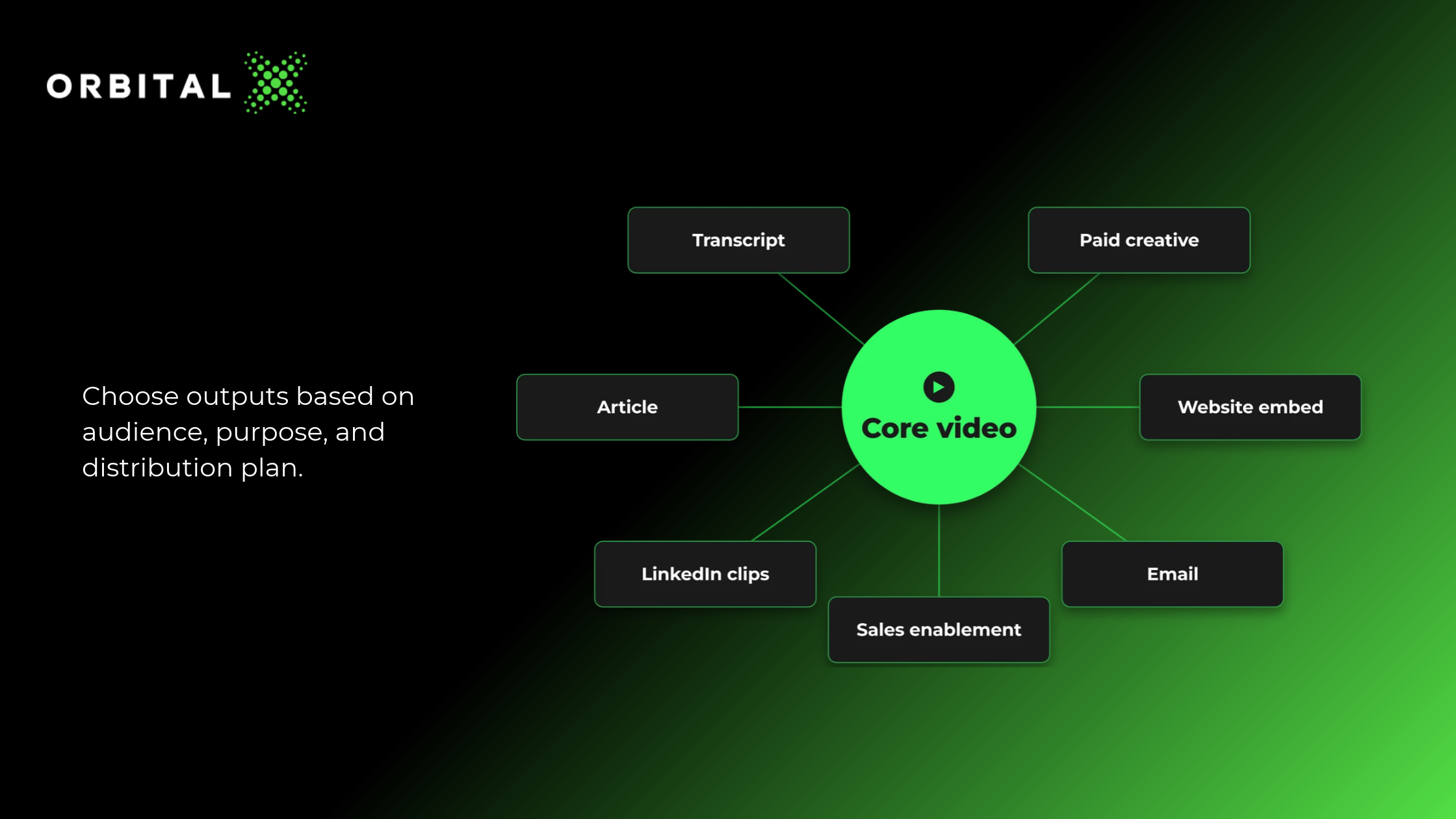
The value extends beyond the original recording too. A useful video can become a transcript, article, short-form clips, email content, sales enablement, and other supporting assets. It can also open opportunities for AI-powered discovery when it provides useful information for buyers and is supported by enough context and surrounding content. When video connects to the broader content strategy, the ideas and expertise inside one asset have more opportunities to be discovered, understood, and put to work.
According to LinkedIn research, 78% of B2B marketers now use video in their marketing programs, and more than half plan to increase their investment. B2B buyers no longer wait to read a 30-page white paper when evaluating a platform. They consume video across social feeds, YouTube, emails, and direct sales messages throughout their entire research phase.
Types of B2B Video Marketing
B2B video marketing includes several types, each suited to different audience needs and stages of the buying journey. The mix can range from educational content and product-focused videos to customer stories, live or long-form content, sales enablement, brand storytelling, and short-form social assets.
These categories aren't mutually exclusive. A single recording can produce several useful assets or serve different strategic purposes depending on how it’s developed and distributed. First, you need to choose the type of video and its strategic job. The right format depends on the audience, buyer stage, and business objective.
Considering that 63% of buyers said video directly helps drive their purchasing decisions, according to LinkedIn, you shouldn’t take this early stage lightly. Matching the right video format to the buyer's immediate need keeps prospects moving through your pipeline.
Educational and Thought Leadership Videos
Educational video breaks down industry concepts, tackles buyer challenges, and establishes clear domain expertise long before a prospect enters an active buying cycle. This format focuses entirely on solving problems rather than pitching product features.
It takes real discipline to sit in front of a camera and help your buyer without immediately launching into a frantic 40-slide feature pitch. Suppress your inner infomercial host. Showing up as a helpful peer is what earns trust.
Product Demo Videos
Product demos give buyers a clear walkthrough of how a platform or service actually operates. They remove friction from the evaluation stage by showing concrete functionality, user experience, and practical workflows.
Explainer Videos
Explainers take complex technical architecture, abstract methodologies, or dense processes and turn them into simple visuals. They help buying committees quickly grasp what a company does and why it matters.
Customer Testimonial and Case Study Videos
Customer success stories supply essential social proof by letting real clients share their challenges, implementation experiences, and tangible outcomes. They directly reduce perceived risk for late-stage decision-makers.
Webinar and Event Videos
Long-form recordings from live sessions or virtual panels provide deep educational value on core industry topics. They serve as anchor assets that can be sliced into dozens of shorter, focused pieces.
Personalized Sales Videos
Personalized videos are short, direct recordings created by sales reps or founders for individual prospects or target accounts. They help humanize outreach, explain custom proposals, and address specific deal objections.
Brand and Culture Videos
Brand videos communicate company positioning, team expertise, core values, and vision. They build long-term affinity and trust, helping differentiate a business in crowded categories.
Short-Form Social Videos
Short clips extracted from long-form recordings bring core takeaways directly to social feeds like LinkedIn. They spark curiosity and drive qualified traffic back to full assets.
B2B Video Types by Buyer Need
Buyer need | Video types |
Learn | Educational, thought leadership content |
Understand | Explainer, product demo |
Reduce risk | Customer story, testimonial |
Go deeper | Webinar, event |
Take action | Personalized sales |
Build connection | Brand and culture |
Discover | Short-form social |
How to Build a B2B Video Marketing Strategy
A B2B video marketing strategy starts with the buyer and the business objective, then builds a clear path from those decisions to the content, channels, and workflow that support them.
So, before anyone orders another camera, books a studio, or spends three weeks arguing over which shade of blue belongs in the intro animation, decide what the video is supposed to do.
A strong strategy also considers how video fits into the broader marketing system. From there, teams can build a repeatable approach that makes video easier to produce, distribute, and improve over time.
1. Start With the Buyer
Every successful asset starts with a specific buyer persona, their daily friction, and the questions keeping them up at night. Video plans built around internal product announcements instead of buyer needs end up ignored.
That’s because, news flash, nobody outside your product team cares that you updated the interface from light gray to slate gray. If the video isn't answering a question your buyer actually cares about, you're broadcasting into the void.
2. Define the Business Objective
Outline the precise commercial goal for each production before hitting record. Whether the target is top-of-funnel account awareness, accelerated deal velocity, or higher expansion revenue, every asset needs a distinct job.
3. Match the Video to the Buyer Journey
Map video formats directly to buyer stages. A prospect who barely understands their problem needs a light educational breakdown, whereas a late-stage buyer needs a targeted customer case study or technical demo.
4. Build Video Into the Wider Content Strategy
Video shouldn't run as an isolated experiment. Integrate video assets directly into existing website topic clusters, key landing pages, email nurture streams, and account-based plays to strengthen your broader B2B content strategy.
5. Plan for Distribution and Repurposing
Determine distribution formats and channel outputs before production starts. Plan how one core recording will generate snippets for LinkedIn, audio clips for podcasts, and written context for web pages.
 6. Make Video Discoverable
Equip every video with accurate transcriptions, contextual titles, detailed descriptions, closed captions, and schema markup. Search engines and AI discovery tools rely on these text signals to index and summarize your expertise.
7. Establish a Repeatable Production Workflow
Build a consistent operating rhythm that moves projects smoothly from briefing and recording to editing, formatting, publishing, and performance review.
Where to Distribute B2B Video
The right distribution channel depends on what the video is supposed to do, who needs to see it, and where they are in the buying journey. B2B video can be posted across social platforms, search, websites, email, sales outreach, and paid media.
Dropping the same raw video link onto every platform without channel-specific formatting wastes both budget and creative effort. It’s a tragedy when you upload a high-budget, 16:9 landscape video natively onto vertical mobile feeds, where it gets cropped into a tiny, unreadable box.
Distribution requires clear intention. So, plan your distribution around the video's intended job. A focused broadcasting plan puts each video where its audience is most likely to discover, consume, and act on it:
LinkedIn: Ideal for executive thought leadership, subject matter expert interviews, and bite-sized educational clips that drive native engagement in professional feeds. LinkedIn isn't just for “agree?” text posts and humblebrags anymore. It's where prospective buyers go to see whether your team actually knows its stuff or is just regurgitating generic AI copy.
YouTube: The go-to home for evergreen, searchable educational assets, product tutorials, detailed webinars, and platform explainers.
Your Website: Critical for embedding high-intent video on product pages, solution hubs, customer case studies, and landing pages to increase dwell time and conversion rates.
Email: Perfect for animating nurture sequences, introducing webinars, sharing product updates, and maintaining engagement with existing accounts.
Sales Outreach: Essential for personalized video messages, custom walkthroughs, and targeted objection-handling clips sent directly to target buyers.
Paid Media: Extends the reach of top-performing video assets through targeted account-based marketing (ABM) campaigns, retargeting sequences, and demand capture ads on platforms like LinkedIn video marketing.
How to Measure B2B Video Marketing
B2B video marketing should be measured based on what each video is meant to accomplish. Specifically, the appropriate KPIs depend on the video's role, audience, distribution channel, and place in the buyer journey. A thought leadership video intended to introduce a company to a new audience shouldn't be judged using the same criteria as a product demo embedded on a conversion page. Segment by stage to narrow your monitoring:
Awareness Metrics: Track reach, impressions, total view count, and view-through rates to evaluate initial distribution scale.
Engagement Metrics: Review average watch time, video completion rate, social shares, and click-through rates to verify if content holds buyer interest.
Conversion Metrics: Measure form fills, demo requests, resource downloads, and meeting bookings on pages hosting video assets.
Pipeline and Revenue Metrics: Track target account engagement, sales-accepted opportunity rates, deal velocity changes, and marketing-influenced revenue.
Views and engagement metrics can provide useful context, but they don't necessarily demonstrate business impact on their own. The key question is whether the video attracted the right audience and contributed to the outcome it was created to support, with views and engagement providing supporting context.
Connecting video metrics to pipeline progression provides clear proof of commercial value. In fact, Wyzowl learned that in 2026, video marketing delivered a strong, positive ROI for 82% of video marketers.
B2B Video Marketing on a Limited Budget
B2B video marketing doesn't require a large budget to be effective. Teams can prioritize useful content, clear communication, and consistent distribution over expensive equipment, elaborate sets, or highly produced creative. For many B2B use cases, a simple recording can be more useful than a polished product if it answers the audience's question or demonstrates the product clearly.
Production investment should reflect the video's purpose and audience, with resources focused on the elements that improve clarity, credibility, and usefulness:
Screen Recordings and Walkthroughs: Simple tool capture works brilliantly for software demos, feature highlights, and technical tutorials.
Employee and Executive-Led Content: Put internal subject matter experts and leadership in front of a camera to answer real buyer questions authentically. (You might need to break out the good biscuits to bribe your introverted lead software engineer to get on camera for two minutes and explain database architecture.)
Batch Recording Sessions: Record four to six short Q&A segments or topic breakdowns in a single sitting to keep production efficient.
Focus on Audio and Lighting: Crisp audio and clear lighting matter far more to viewers than 4K camera gear or expensive studio sets.
Leverage AI Tools: Use smart editing software for automated transcription, caption creation, short-form clipping, and script polishing.
A LinkedIn analysis of over 13,000 B2B video ads revealed that 73% of video completions and roughly half of total engagements were driven by story structure and narrative clarity rather than high-end production budget.
In other words, high production value won’t save a boring script or a generic pitch. The story is the multiplier. A passionate internal engineer talking into an iPhone with a £20 lapel mic can be far more effective than a million-pound glossy ad if they have something worth saying.
B2B Video Marketing Examples Worth Studying
Real-world B2B video marketing shows how different brands use the format to solve specific communication and marketing challenges. Some make complex products easier to understand, while others use customer stories, humor, or simple demonstrations to build interest and communicate value.
The most effective examples prove you don’t need an expensive or elaborate production. They work because the creative approach fits the audience, message, and intended outcome.
Identify useful principles without simply copying another company's execution. The goal is to understand why a video works, then apply the underlying idea to your own audience and offer.
Slack: “So Yeah, We Tried Slack”
What they did:
Slack created a mockumentary-style customer story featuring the production team at Sandwich Video as they adopted the platform. The popular app skipped the usual corporate case-study stiffness and leaned into pure “Parks and Recreation” energy. By poking fun at the chaos of adopting new software, the video made the product feel human, funny, and instantly relatable.
Why it worked:
Instead of listing collaboration features, the video captured authentic team reactions, daily friction, and real adoption hurdles.
What B2B marketers can learn:
Show product value directly through the user experience rather than running through static feature checklists.
HubSpot: “What is HubSpot?”
What they did:
HubSpot produced a concise explainer video introducing its broad CRM and marketing platform.
Why it worked:
It established a clear mental model of the overall business problem before diving into specific product suites.
What B2B marketers can learn:
Use structured visual storytelling to make wide, multi-faceted product ecosystems easy to digest.
Zendesk: “I Like It When He Gives Me the Business”
What they did:
Zendesk turned customer service dynamics into an amusing, relatable story about business relationships.
Why it worked:
Humor made a traditional software category memorable while keeping the central operational issue recognizable.
What B2B marketers can learn:
Creative humor can make a commodity category stand out when it reinforces the underlying message.
Dropbox: “My Shot + Your Illustration”
What they did:
Dropbox Paper combined live action with simple animation to show two creatives collaborating in real time.
Why it worked:
The visual concept instantly demonstrated seamless creative teamwork without relying on heavy narrative explanation.
What B2B marketers can learn:
Demonstrate core product value through a quick, relatable visual use case.
Asana: “What is Asana?”
What they did:
Asana delivered a focused product explainer highlighting how teams organize tasks, workflows, and projects in one hub.
Why it worked:
The script remained strictly focused on solving day-to-day work clutter rather than detailing every technical setting.
What B2B marketers can learn:
Keep product explainers tightly aligned with primary user workflows.
Get in Front of the Right People With B2B Video
High-performing B2B video marketing extends well beyond production exercises. It functions as an engine within a wider content and demand-generation system.
Building an effective video program means starting with clear buyer problems, assigning every asset a primary job, matching formats to buyer stages, and planning distribution before filming begins. It requires equipping video with rich text context for AI discovery, connecting clips to website conversion paths, and measuring impact against closed-won revenue.
If you’re a B2B marketing leader ready to stop making ad-hoc videos and turn your content into a predictable pipeline system, book a call with the OrbitalX team today.
FAQs
What makes B2B video marketing different from B2C video marketing?
B2B video marketing is designed for complex business buying decisions involving multiple stakeholders, longer evaluation periods, and higher perceived risk. Instead of relying on impulse buys or broad consumer entertainment, B2B video focuses on explaining complex products, demonstrating ROI, proving domain expertise, addressing deal objections, and supporting direct sales outreach.
What is the best type of video for B2B marketing?
There is no single "best" video type because format selection depends on buyer stage and objective. Educational assets build top-of-funnel problem awareness, product demos assist technical evaluations, customer case studies reduce late-stage purchase risk, and personalized sales videos help convert active pipeline opportunities.
How can B2B companies use video without a large production budget?
Focus on narrative clarity, domain expertise, and message utility over expensive equipment. Lean teams can record screen walkthroughs for software demos, run employee-led Q&A sessions, batch-record multiple clips in one sitting, and repurpose webinar assets. Clear audio and proper lighting matter far more than studio-grade cameras.
How should B2B video performance be measured?
Measure performance against the video's underlying business objective. Track reach and view-through rates for awareness assets, watch time and completion rates for engagement content, form fills and demo requests for conversion videos, and pipeline creation, deal velocity, and revenue impact for sales enablement video.
How does video support B2B content marketing?
Video acts as an anchor source asset for your entire content program. A single video session can be transcribed into written articles, sliced into social media snippets, embedded on high-intent website pages, and reformatted for email nurture sequences, extending the life cycle and discovery reach of your expert knowledge.
More Resources

B2B Product Marketing: Strategy and Execution
Learn how B2B product marketing connects positioning, GTM, sales enablement, and customer outcomes to drive commercial growth.

Risk Tiers and Bureaucracy? The B2B Guide to Earning Market Trust via the EU AI Act
The EU AI Act explained for business leaders: risk-based AI rules, global scope, and how governance maturity enables compliant, scalable AI adoption.

ICP Scoring Rubric: How to Score, Rank, and Prioritize Your Best Customers
Learn how to build an ICP scoring rubric, weight criteria, rank accounts, set tiers, and prioritize sales and marketing attention.