The Best B2B Marketing Ideas for Generating High Quality Pipeline
Discover B2B marketing ideas that generate qualified pipeline through SEO, ABM, LinkedIn, content marketing, and proven demand generation strategies.
Key Takeaways
The best B2B marketing ideas solve real buyer problems and support every stage of the buying journey.
Effective B2B marketing combines SEO, content, LinkedIn, ABM, and events into one connected demand generation strategy.
Creative campaigns stand out by delivering unique value, whether through original research, thought leadership, interactive tools, or customer communities.
Marketing performance should be measured by qualified pipeline and revenue, rather than vanity metrics like traffic or page views.
Long-term growth comes from aligning sales and marketing, consistently executing proven strategies, and balancing organic demand generation with paid acquisition.
It’s a familiar scene: Monday morning, time for a pipeline review meeting. Your marketing dashboard is practically glowing. Web traffic is up, email opens are looking healthier than the salad section at a farmers' market, and last week's webinar pulled in more registrations than the free bar at a company Christmas party.
Then the CFO asks, “Why hasn't the revenue forecast moved?” and you feel your stomach drop.
Lean B2B marketing functions don't need another random campaign idea or a shiny new tool to manage. What you need are strategies that reach real decision-makers, build credibility before they enter a buying cycle, and convert attention into qualified opportunities. You know, tactics that actually move the needle. Powerful, revenue-generating B2B marketing ideas bring together creative positioning, demand generation, sales alignment, and revenue measurement into a single engine.
How to Choose the Right B2B Marketing Ideas
Selecting the right B2B marketing ideas requires a deep understanding of your audience, goals, and buying process. Effective strategies don’t rely on copying competitors or chasing every new trend. Instead, they focus on reaching the right buyers using relevant messaging at the correct stage of their decision-making journey.
Before investing in a marketing tactic, consider who you’re trying to reach, what challenges your buyers face, and what outcome you want to achieve. A strategy that works for one company may not work for another since the audience, sales cycle, or purchasing process often have unique parameters.
Marketing ideas also perform differently depending on where buyers are at in their journey. Some activities help create awareness and build trust before prospects are actively evaluating solutions, while others capture demand from buyers already researching their options. To see the best results from your B2B marketing ideas, combine both approaches and create a steady flow of opportunities.
B2B buying has become a maze of stakeholders, opinions, approvals, and competing priorities, making it harder than ever to convert marketing activity into actual revenue. Buying committees now average 13 distinct stakeholders across multiple departments, and you have to appeal to all of them. Worse, research from Forrester shows that 81% of buyers were dissatisfied with their recent B2B purchases.
When over a dozen people with different demands need to agree on a purchase, generic campaigns typically fail. That’s why you need a targeted strategy tailored to your market’s specific parameters.
Start With Your ICP
Don't build campaigns for "enterprise companies." That’s too broad. Instead, let your ICP guide your marketing ideas.
Your choice of tactics depends heavily on industry nuances, target company size, specific buyer pain points, and sales cycle length. A strategy designed for mid-market SaaS will crash and burn in professional services. Understand who holds the budget and what keeps them awake at 2:00 AM before picking a single execution channel.
Match Ideas to the Buyer’s Journey
Every buyer moves through distinct phases before signing a contract, so your marketing efforts need to match them:
Awareness-stage tactics build trust and ignite demand among buyers who don't even know they have a problem.
Decision-stage tactics capture active intent from prospects currently comparing vendors.
High-yield strategies combine demand creation with demand capture to keep your pipeline full.
Once you know who you’re targeting and where they sit in their decision process, you can pick the specific marketing ideas that deliver commercial results.
See:
Creative B2B Marketing Ideas to Help You Stand Out
Creative B2B marketing finds innovative ways to earn attention, build trust, and craft memorable experiences for potential buyers. While proven channels like SEO, email, and paid advertising are still important, thinking outside the box helps companies differentiate themselves in competitive markets where products and services often appear similar.
The goal is to provide genuine value before asking for a contract. Creative tactics educate buyers, solve business problems, encourage meaningful conversations, or give prospects useful resources they can apply immediately. This builds credibility while fostering stronger relationships throughout the buying journey.
Successful campaigns still have to align with business goals, address buyer needs, and contribute to measurable outcomes such as qualified pipeline, customer engagement, and brand authority. Whether through original research, interactive resources, founder-led content, customer communities, or strategic partnerships, creative marketing works best when it complements a broader demand generation strategy.
“B2B” doesn't have to mean “boring.” Creative marketing goes further than being sanitized-but-smart for the sake of it. It’s about finding a memorable way to communicate something valuable, rather than wrapping the same old webinar, white paper, and product pitch in a new color.
The following ideas offer clever ways to build long-term competitive advantages.
Publish Original Industry Research
Proprietary data is a magnet for authority. When you publish original research, you become the primary source of truth in your niche.
Run annual benchmark surveys, salary reports, or market trend analyses across your target sector. Then use that data set to fuel blogs, social posts, PR pitches, and sales enablement assets for months. Competitors can copy your commentary but not your original data.
Build Free Tools and Resources
Give your prospects immediate, practical utility. Calculators, interactive assessments, policy templates, and diagnostic tools deliver value up front while earning qualified leads naturally.
Useful tools pull in repeat website visitors and earn high-quality organic backlinks. They solve an immediate problem for your buyer while positioning your offering as the logical next step.
Launch Founder-Led Content
People buy from people, not anonymous corporations. Nobody wakes up excited to read a press release from a logo. People want real human takes from founders who’ve been in the trenches and survived the chaos. Founder-led, executive-driven content humanizes your brand and builds trust faster than any corporate newsletter could.
Encourage founders and internal experts to share their unfiltered perspectives, hard lessons, and industry commentary. As The Drum points out, the flood of generic AI crap makes authentic human expertise and credible employee storytelling essential differentiators. Real human experience cuts through the digital slop.
Create Customer-Led Communities and Peer Events
B2B buyers want to talk to peers who share their struggles. Facilitating those conversations puts your brand at the center of your industry's network.
Host invite-only roundtables, executive customer councils, or private online groups. Don't turn them into sales pitches though. Position your brand as an industry connector, and the long-term advocacy, referrals, and pipeline will follow naturally.
Partner With Complementary Brands
Partner with businesses that serve your target ICP but don’t directly compete with your offering. This lets you expand your audience without doubling your customer acquisition costs.
Co-host webinars, publish joint research reports, or record collaborative podcast episodes. Combining expertise gives both audiences double the value while expanding your market reach efficiently.
Collaborate With Industry Creators
No, we aren’t talking about sending unboxing gifts to lifestyle influencers in Ibiza. In B2B, a creator is that niche analyst whose weekly newsletter gets quietly passed around executive Slack channels. They also include respected consultants, niche podcasters, LinkedIn practitioners, and newsletter writers who hold deep trust with your buyers.
B2B creator partnerships are rapidly replacing corporate-only messaging, and rightfully so. LinkedIn research discovered that 82% of B2B purchases were influenced by creator content. Additionally, 87% of industry buyers would rather have content from trusted experts than brand-only messaging.
The Salesforce and MrBeast Superbowl collaboration highlighted the power of using social media creators in large-scale B2B marketing campaigns while allowing them creative freedom to do what they do best. So, prioritize subject-matter depth and audience trust over raw follower numbers. In the B2B world where marketing is traditionally highly scripted, controlled, and risk-averse, creative freedom can steal the spotlight.
Proven B2B Marketing Ideas That Drive Pipeline
While creative marketing ideas help businesses stand out, long-term pipeline growth is built on a consistent set of proven strategies. High-performing B2B organizations invest in marketing activities that attract qualified buyers, educate decision-makers throughout the purchasing journey, and create multiple opportunities for engagement before a sales conversation begins.
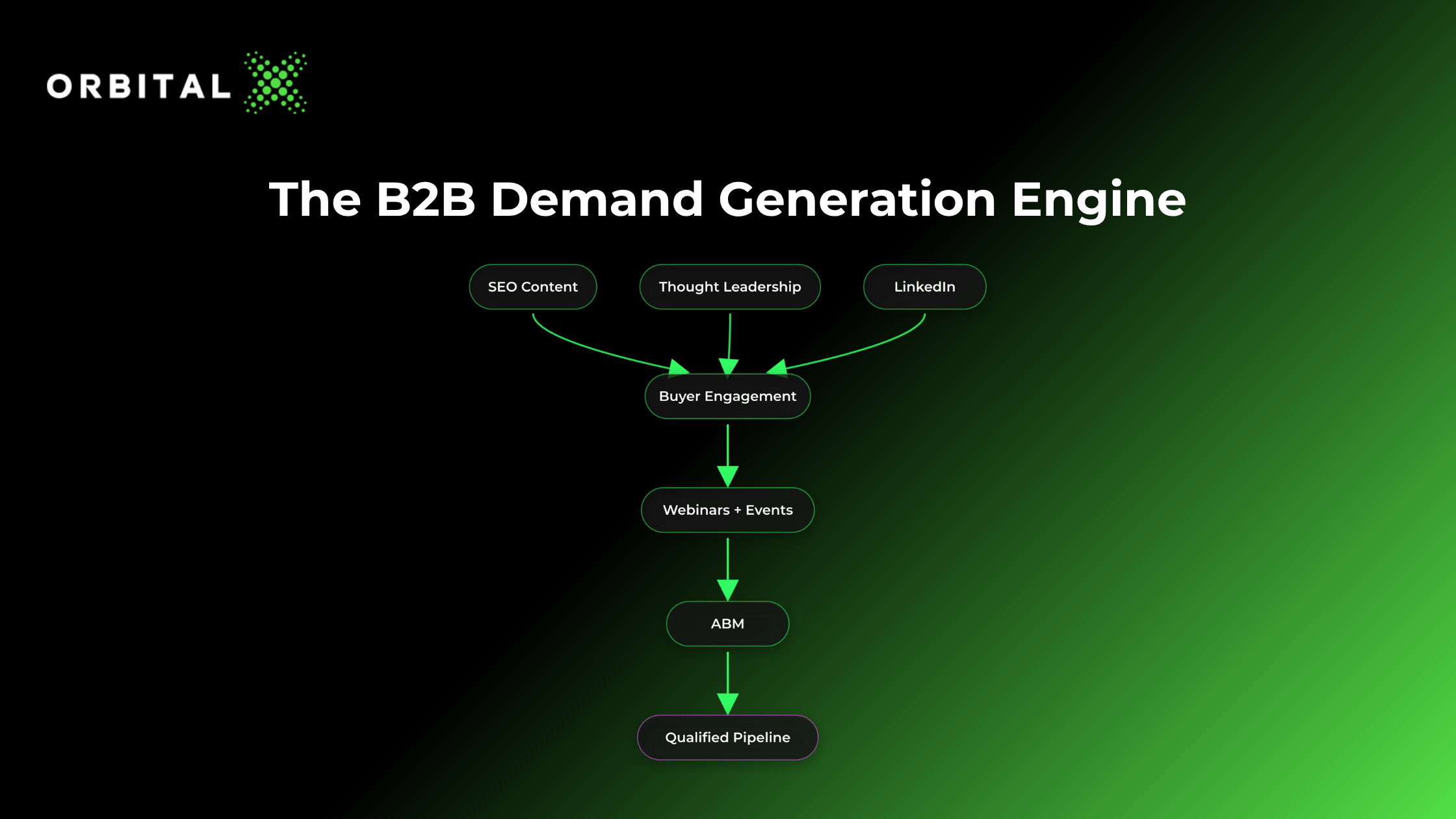
Rather than relying on a single channel, combine complementary tactics that work together to generate demand and capture existing buying intent:
Search marketing helps buyers discover solutions when they’re actively researching.
Educational content builds trust and answers key questions throughout the buying process.
Thought leadership strengthens credibility, while LinkedIn, webinars, and events create opportunities to engage directly with decision-makers.
For organizations targeting high-value accounts, ABM provides a more focused approach that aligns marketing and sales around shared revenue goals.
Isolated campaigns will only move the needle a bit for a short period of time. You’re better off investing in a set of tactics that operate as part of a connected demand generation system where each activity supports the next. Simply put, creativity gets you invited to the pub, but proven systems ensure you actually have the money to pay for the round. This unified approach lays a solid foundation for attracting qualified prospects, nurturing buying committees, and generating sustainable pipeline growth.
Capture Buyers With Commercial Search Content
When prospects are ready to buy, they turn to search engines. Content designed for commercial intent ensures you show up at that exact moment.
Publish high-value comparison pages, pricing guides, implementation breakdowns, and software alternative articles. Focus on answering real buyer questions rather than chasing random keyword volume. This captures existing demand from prospects who are actively evaluating options.
Turn Thought Leadership Into Demand
Most B2B buyers do extensive research before ever contacting sales. In fact, B2B buyers spend over a quarter of their time doing independent research online before reaching out to vendors, according to Gartner.
Strong thought leadership feeds that independent research phase. Share distinct market opinions, podcasts, and executive analyses that educate prospects on their challenges. When buyers are ready to talk, you’ll be the first brand they call.
Build Topic Clusters Based on What Buyers Search for
Stop writing random, disconnected blog posts. Organize your content into comprehensive topic clusters built around core buyer problems.
Craft a high-level pillar asset and link it to supporting articles covering specific subtopics. This umbrella structure fosters strong search engine authority while making it simple for prospects to navigate complex buying decisions.
Use LinkedIn to Build Buyer Trust
If you think LinkedIn is just a virtual bulletin board for corporate press releases, you’re missing a major opportunity. Use it as an educational distribution network to share real insights, carousels, video breakdowns, and founder commentary.
Data from LinkedIn demonstrates that creative, emotionally engaging ads generate far higher brand consideration and engagement than boring product feature posts. Focus on storytelling and helpful advice that fosters trust across long buying cycles.
Run Webinars, Events, and Educational Campaigns
Live events let you demonstrate domain expertise and interact with prospects directly. Host focused roundtables, workshops, or webinars that solve specific operational challenges.
Never make live events a product pitch. Instead, focus entirely on practical value. Afterward, slice the recording into video snippets, social posts, email newsletters, and sales enablement assets to post online and maximize your output.
Invest in Account-Based Marketing for High-Value Accounts
If your deal sizes are large and your target market is specific, broad lead generation just wastes budget. Account-based marketing (ABM) coordinates sales and marketing around a specific list of high-value prospects.
Select accounts based on clear intent and fit, then run personalized campaigns for each key decision-maker. Concentrating your resources on these targets yields higher win rates and larger deal sizes.
Strategy | Primary Objective | Key Deliverables |
Commercial Search | Capture active intent | Comparison pages, pricing guides, alternative pages |
Thought Leadership | Create future demand | Executive essays, market analyses, podcasts |
LinkedIn Marketing | Build buyer trust | Founder posts, educational carousels, video snippets |
Account-Based Marketing | Win enterprise accounts | Tailored landing pages, direct mail, personalized ads |
Make Every Marketing Idea Count
B2B marketing performance depends on how effectively your chosen activities contribute to qualified pipeline and revenue. Thriving marketing teams treat individual tactics as connected parts of a larger demand generation system, ensuring every initiative supports common business objectives.
This requires close alignment between sales and marketing, shared performance metrics, and a consistent process for measuring results. Rather than optimizing for isolated metrics like website traffic, impressions, or social engagement, evaluate marketing based on its influence on pipeline, opportunities, and revenue outcomes. Efforts should also balance immediate demand capture with long-term demand creation to support both short-term accomplishments and sustainable growth.
Continuous improvement is crucial as well. High-performing organizations regularly test new ideas, measure their impact, refine successful approaches, and discontinue activities that fail to deliver meaningful business value. Over time, this disciplined process transforms individual marketing ideas into a repeatable system that consistently generates stronger results and supports long-term business growth.
Align Sales and Marketing on Revenue
The classic marketing-sales relationship resembles a bad sitcom marriage. Marketing claims they delivered 1,000 leads, while sales claims 999 of them were university students looking for free white papers. These two departments need to operate as one commercial team with shared revenue metrics. Otherwise, misalignment wastes time, money, and high-intent leads.
It’s a major issue, with research from the LinkedIn B2B Institute revealing that sales and marketing target audiences overlap only 16% on average. Fix this problem by agreeing on precise ICP definitions, lead qualification rules, and sales feedback loops. When both teams aim at the exact same bull’s-eye, pipeline velocity accelerates.
Optimize for Pipeline
Vanity metrics look great in slide decks, but clicks, page views, and raw download counts mean nothing if they don't produce qualified opportunities. As Forbes highlights, top B2B SaaS marketing strategies optimize for pipeline contribution and sales-accepted revenue rather than raw lead volume. Measure qualified pipeline, deal velocity, and customer acquisition efficiency to paint the clearest picture of success.
Combine Organic and Paid for Sustainable Growth
Paid advertising captures demand that exists today, whereas organic marketing creates the demand that’ll fuel your business tomorrow. Balancing both channels produces a resilient growth engine. Use paid campaigns for immediate targeting and intent capture while leveraging organic to build long-term search authority, founder presence, and brand trust.
Try New Ideas and Double Down on Your Successes
High-performing growth operations run structured experiments. Test new marketing initiatives through small pilots, measure their impact on qualified pipeline, and scale what works. Document successful workflows as well so your team can execute them reliably.
Kill underperforming tactics quickly and reallocate budget toward proven channels. Systematic refinement transforms good ideas into a compounding pipeline.
Start Building a Compounding B2B Marketing Engine
No single marketing idea will transform your business overnight. Sustainable growth comes from unifying creative positioning, proven demand generation tactics, and tight revenue alignment in one connected system.
When your ICP is crystal clear, messaging is undeniably human, and channels work together, marketing becomes a predictable engine that consistently builds qualified pipeline and drives growth.
At OrbitalX, we help lean B2B teams construct performance marketing engines that deliver measurable outcomes without adding headcount or expensive software layers. Through our proprietary DemandWEBS™ platform, we unify owned, paid, and earned channels to turn buyer attention into closed revenue.
Ready for a demand generation system that compounds over time? Book a call with the OrbitalX team today to get started.
FAQs
What are the most effective B2B marketing ideas?
The most effective B2B marketing ideas help prospects solve real problems while supporting different stages of the buying journey. High-yield strategies include SEO, thought leadership, LinkedIn marketing, webinars, account-based marketing, educational content, and email nurturing. Rather than relying on a single tactic, successful organizations combine complementary channels into a connected demand generation strategy that consistently attracts qualified prospects and converts them into pipeline.
What is the difference between B2B marketing and B2C marketing?
B2B marketing targets businesses and focuses on educating buyers, building trust, and supporting complex decision-making through valuable content, thought leadership, and personalized engagement. B2C marketing focuses on reaching individual prospects making personal purchases. While B2C marketing leans more on emotional messaging and immediate purchases, B2B marketing requires a stronger focus on demonstrating value and building confidence throughout the buying process.
How can small B2B companies market themselves effectively?
Small B2B companies can compete by focusing on expertise. Publishing educational content, optimizing for commercial search intent, building a strong LinkedIn presence, creating thought leadership, hosting webinars, and partnering with complementary brands can all generate qualified demand. Consistent execution and a clear understanding of the ICP often produce better results than trying to compete across every marketing channel.
How do you measure B2B marketing success?
Measure B2B marketing success by evaluating its contribution to qualified pipeline and revenue. While metrics like website traffic and engagement provide useful context, organizations should prioritize conversion rates, sales-qualified leads, pipeline influenced, customer acquisition cost, and revenue generated. Tracking business outcomes helps marketers understand which activities drive sustainable growth and where future investment should be focused.
Should B2B companies focus on organic or paid marketing?
High-yield B2B marketing strategies combine both. Paid marketing helps capture existing demand by reaching buyers who are actively searching for solutions, while organic marketing builds long-term authority, trust, and visibility before buyers enter the market. Together, these approaches create a balanced demand generation strategy that supports immediate lead generation while building a sustainable pipeline for future growth.
More Resources

B2B Content Marketing Funnel: Stages, Strategies, and How to Build One That Converts
Build a B2B content marketing funnel that aligns content with buyer needs, connects the journey, and turns content engagement into pipeline and revenue.

B2B Referral Marketing: How to Build a Program That Drives Qualified Growth
Learn how to build a B2B referral marketing program that turns trusted relationships into qualified introductions, pipeline, and measurable revenue.

A PE-Backed Company Cut Marketing From 12 People to 3. Then Had Its Best Six Months Ever.
A marketing team cut from 12 to 3, then the best six months in the company's history. Here's the growth system behind it, and what it means for PE portfolios.