How to Choose a B2B Performance Marketing Agency That Drives Real Revenue
Learn how to choose a B2B performance marketing agency based on capabilities, measurement, pricing, fit, and its ability to drive pipeline and revenue.
Key Takeaways
“Performance” needs a commercial definition, as it can refer to clicks, leads, MQLs, pipeline, or revenue. Understand what an agency is measuring and why.
Measurement should follow the buying journey. B2B performance needs to account for what happens between the first interaction and a meaningful commercial outcome.
Skip the promises and look for hard evidence. Relevant case studies, clear measurement methods, strategic reasoning, and a credible delivery team provide more useful evidence than broad performance claims.
The right capabilities depend on the problem. Paid media, SEO and AI search, CRO, RevOps, measurement, and ABM can play different roles depending on the business and its growth challenge.
Agency fit extends beyond marketing services. Costs, internal capacity, business model, sales cycle, and the agency’s approach to managing performance all affect whether an engagement makes sense.
See More:
You’ve seen the pitch. An agency promises “performance,” unveils some attractive-looking charts, and forecasts a flood of leads. Three months later, your CRM is hosting a networking event for interns, competitors, and someone called “Test Testington.” Sales has nothing to follow up on, and the CFO has a few questions.
The trouble is agencies can measure performance very differently. Clicks, impressions, and form fills all tell you something, but if you don’t know whether any of those people might actually buy from you, that’s a red flag. Your reporting should connect campaign activity to qualified opportunities, pipeline, and revenue wherever the data supports it.
Choosing the right B2B performance marketing agency means finding a team that understands your buyers, works with your sales cycle, and can explain what your budget is achieving without requiring a guided meditation first. This guide covers agency capabilities, pricing, in-house trade-offs, and eight agencies to consider in 2027.
What is a B2B Performance Marketing Agency?
B2B performance marketing agencies help businesses plan, execute, measure, and improve marketing around defined commercial outcomes. Those can be qualified demand, opportunities, pipeline, customer acquisition efficiency, or revenue, depending on the business model, measurement infrastructure, and scope of the engagement.
This specific type applies a measurement and optimization approach to marketing activity, which can include paid media, SEO, content, conversion optimization, analytics, and other capabilities. The focus is on understanding how that activity contributes to business outcomes rather than evaluating channels in isolation.
Picture walking into a London pub with your CFO, ordering a pint, and suddenly being drilled by your boss on why you spent £50k on clicks that generated zero pipeline. That’s the exact nightmare a B2B performance agency prevents.
If you aim purely for cheap early leads, you’ll end up flooding sales with contacts who never had any intention of buying. Performance marketing requires evaluating channels based on how they move target accounts through the entire buying journey.
How B2B Performance Marketing Differs From General Digital Marketing
A thousand eBook downloads can look lovely in the monthly report. But if most of those came from university students researching an assignment, your sales team has nothing to work with.
Lead quality should inform what happens next. An agency can use sales qualification feedback to adjust targeting, messaging, or form fields. Those changes may increase cost per lead while improving the proportion that become qualified opportunities. The aim is to make customer acquisition more efficient, with results checked against what actually progresses through sales.
The B2B buying process adds further complexity. According to Forrester data, 73% of B2B purchases include three or more departments. Campaigns need to account for stakeholders with different priorities, budget constraints, and approval requirements. An individual form fill is one signal within that wider purchasing decision.
Long sales cycles and relatively few conversions also affect measurement. Clicks and downloads provide early feedback, while qualified opportunities and pipeline progression help show whether that interest is developing into potential business.
Data gaps and inconsistent CRM records can make revenue attribution difficult. A performance-focused approach can still work with imperfect attribution, provided the agency measures the furthest reliable commercial outcomes and makes the limits of its reporting clear.
What Does a B2B Performance Marketing Agency Do?
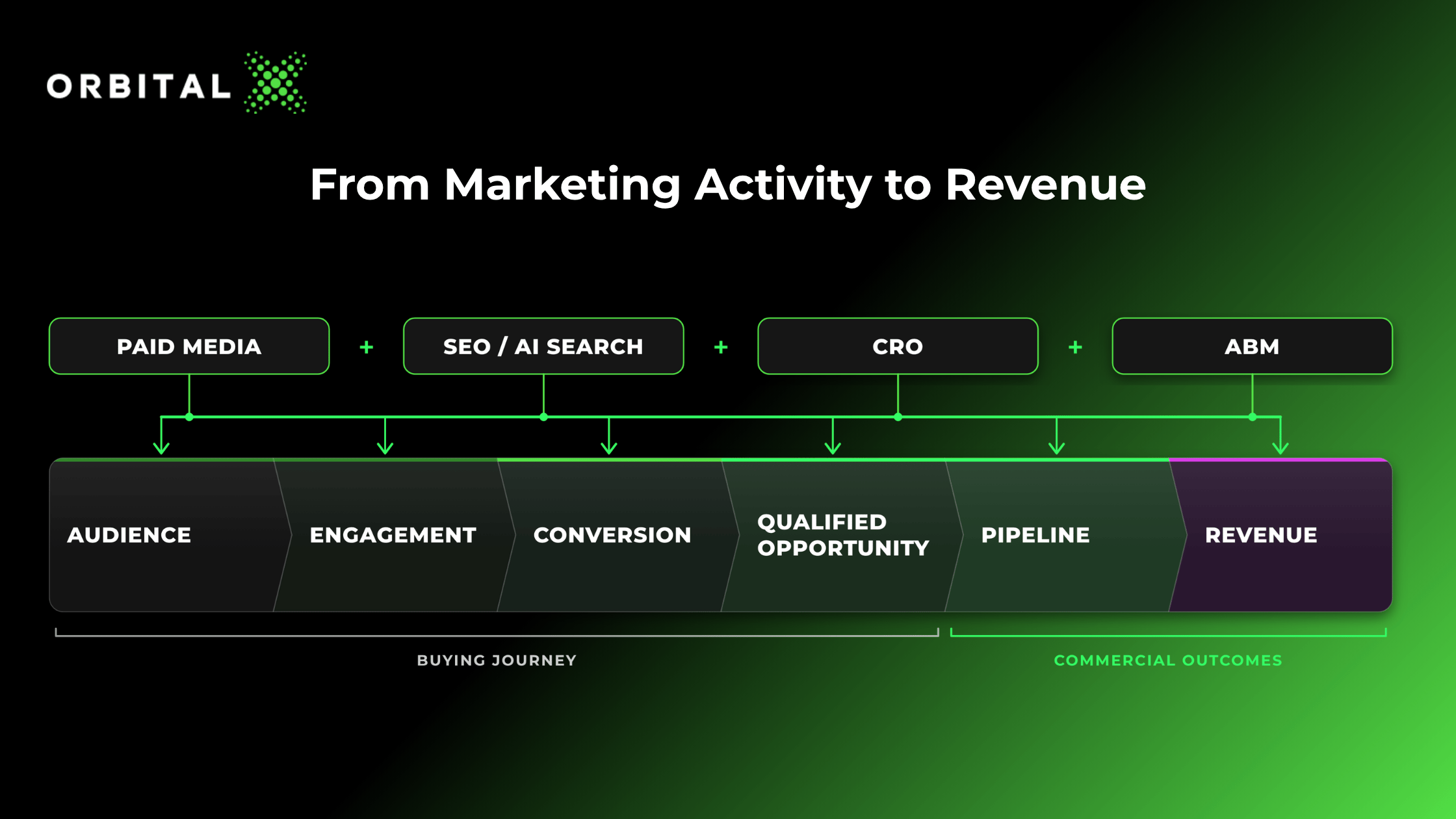
Think of a B2B performance agency as an operating system rather than a channel supplier. Strategy, execution, conversion, and measurement feed into one continuous feedback loop.
It starts with strategy and audience definition. The agency helps refine your ICP, map out buying groups, and clarify the specific commercial problem marketing must solve. Channel selection only happens after this foundation is solid.
Next comes the execution and conversion layer. Marketing campaigns reach target buyers across paid, search, and owned media. Website journeys, landing pages, and offers are optimized so traffic turns into real sales conversations rather than bounce rates.
Finally, the measurement layer connects front-end metrics to CRM data. Tracking and feedback loops between marketing and sales reveal what happens after the initial form submission. Optimization isn't about tweaking ad copy in a vacuum. It's about interpreting behavioral signals, identifying where pipeline drops off, and testing fixes based on real commercial evidence.
 What Should a B2B Performance Marketing Agency Offer?
A B2B performance marketing agency might offer paid media, SEO and AI search, conversion rate optimization (CRO), revenue operations (RevOps), measurement, and account-based marketing (ABM). The right mix depends on your audience, sales process, growth priorities, and existing resources.
Buying every service on an agency’s menu is like ordering every dish at an airport buffet. You’ll end up bloated, broke, and questioning whether the sushi needed to meet the lasagna. Start with the growth problem you need to solve, then choose the capabilities that address it:
Paid media can reach relevant buyers and capture existing demand.
SEO and AI search support visibility during buyer research.
CRO helps visitors take the next step.
RevOps connects campaign and sales data.
ABM coordinates engagement across priority accounts and buying groups.
Ask how the agency will connect those capabilities in practice. Its team should be able to explain who it’s targeting, how each activity supports the buying journey, and which results will guide its next decision.
Paid Media
Your LinkedIn campaign collected plenty of likes from people who’ll never buy. That’s lovely for morale. Awkward to explain to finance.
Paid media helps you reach relevant audiences across platforms such as LinkedIn, Google, and Meta. An agency should explain who it’s targeting, why each platform suits those buyers, and how the budget supports your commercial goals.
Campaigns need relevant offers, clear messaging, and landing pages that make the next step worthwhile. Adding another channel to a weak campaign just gives the problem a larger advertising budget.
Optimization should consider targeting, creative, conversion rates, and lead quality together. Platform-reported conversions provide useful feedback, while CRM data helps show whether those responses become qualified opportunities. Use that evidence to guide spending as enough data accumulates to support a decision.
SEO and AI Search
Ranking first for a keyword nobody in your target market searches for is like running the most popular pub in a ghost town. It makes for terrible takings.
A useful search strategy follows how your buyers research problems, compare vendors, and evaluate solutions. Informational content’s role here is to guide buyers even before they know what they need. The question is whether it attracts a relevant audience and helps them move toward a decision.
That research can span Google and AI tools like ChatGPT and Perplexity. An agency should explain how it makes your expertise accessible through clear, well-supported content and a technically sound website. Treat anyone promising a guaranteed formula for AI citations with the same enthusiasm you’d reserve for a “sure win” through the lottery.
Rankings, impressions, and AI mentions can help diagnose visibility. Evaluate them alongside relevant visits, conversions, and qualified opportunities where tracking allows. Being discoverable matters. So does giving the right buyer a reason to stay.
Conversion Rate Optimization
CRO is the bridge between landing traffic and generating commercial action. It focuses on your landing pages, website messaging, forms, and user journeys.
Real CRO isn't about changing button colors to get a tiny conversion bump. It involves testing core hypotheses around value propositions, offer structure, and friction points. Optimizing a page to get maximum form fills is useless if those submissions turn out to be non-ICP contacts. CRO must optimize for conversion quality, ensuring your site drives relevant demand into the pipeline.
Revenue Operations and Measurement
If your CRM looks like a crime scene where MQLs go to die, increasing ad spend just gives the detective more paperwork. RevOps connects your marketing and sales systems so you can see what happens after someone fills out a form.
That connection needs to serve your business goals. Forrester found that 61% of B2B marketing leaders say their measurement and analytics aren’t well aligned with company objectives and/or growth strategy. A dashboard can be technically impressive and still leave everyone wondering whether marketing is helping.
Attribution also has limits. Multi-touch models help interpret buyer interactions, but long sales cycles, missing data, and conversations outside tracked channels complicate the picture. Giving every touchpoint a percentage doesn’t make the accounting gospel.
A capable agency works with your CRM, agrees on qualification and pipeline definitions with sales, and uses reliable downstream data to guide campaign decisions. Reporting should show where prospects progress, where they stall, and what the team will investigate next.
Account-Based Marketing
Account-based marketing (ABM) makes sense when you have defined priority accounts, identifiable buying groups, and enough potential deal value to justify a targeted approach. For businesses selling complex software or enterprise services, it can help concentrate resources on accounts with strong commercial potential.
ABM coordinates paid media, tailored content, website experiences, and sales outreach around those accounts. According to Gartner, buyers who receive messaging relevant to their buying group are three times more likely to view a deal as high quality.
An agency should understand who influences the purchase, what each stakeholder needs, and where their priorities overlap. The work should help the buying group assess the shared business value and reach agreement. One enthusiastic contact is promising, but they may still need finance, IT, and procurement to join the party.
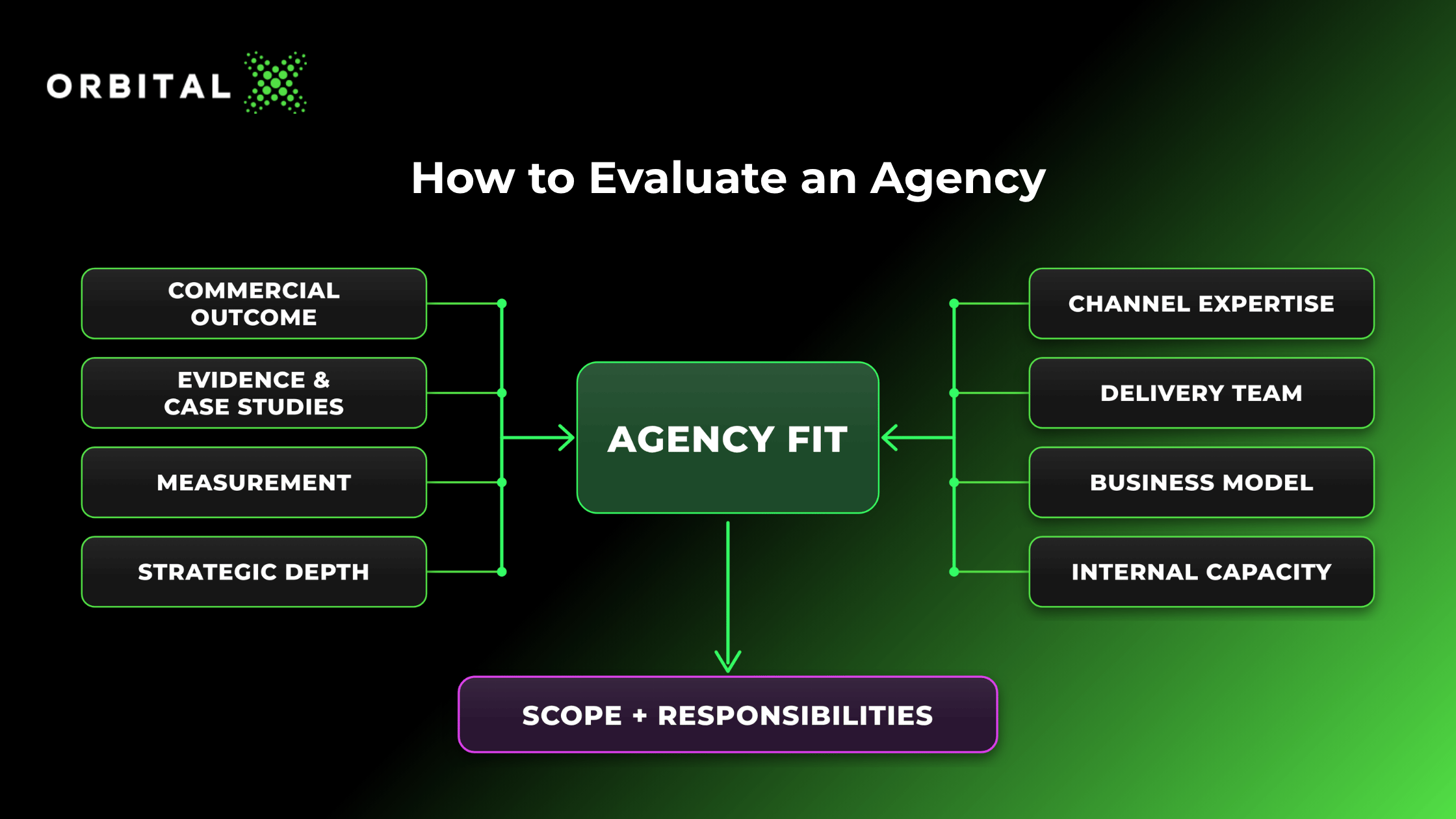
How to Evaluate a B2B Performance Marketing Agency
Before you sign with an agency, find out who’ll actually run your account. Getting catfished is irritating enough without a six-month retainer.
Ask who’ll do the work, how decisions will be made, and what happens when results fall short. Evaluate the agency’s relevant experience, measurement approach, and delivery capacity against your goals and internal resources. Request examples of reporting and campaign decisions so you can see how its promises translate into everyday work.
 Start With the Business Outcome
Before you hire an agency, get specific about what needs to improve. “More leads” is a vague wish. “More qualified opportunities in our target market,” gives everyone something useful to work toward.
Define the commercial challenge before shopping for channels. You might need to enter a new market, lower customer acquisition costs, move opportunities through sales faster, or attract buyers who actually fit your offer.
Each problem calls for a different approach. Give prospective agencies a clear goal, your starting numbers, and the constraints they’ll need to work within. Then ask them to explain how their proposed work will help. If the answer is the same package they sell everyone, keep searching.
Look for Evidence, Not Agency Claims
Take case studies with a grain of salt. Interrogate their degree of truth during pitches by asking agencies four simple questions:
What exact problem were you hired to solve?
What specific interventions did you implement?
How was the commercial outcome measured?
What was the sales cycle length and time frame for results?
Prioritize relevant experience over case study volume. Two case studies in your exact vertical with similar deal sizes are far more valuable than 20 unrelated examples.
Examine How the Agency Measures Performance
Turn measurement into an interview topic. Ask what metrics appear on weekly dashboards, how opportunities are defined, and what raw campaign data you can access.
Align on basic definitions up front too. "Lead," "qualified lead," and "pipeline" must mean the same thing to both your internal team and the agency. Ensure the agency can connect campaign performance to your CRM data without relying entirely on summarized, self-reported reports.
Assess Strategic Depth
Test whether the agency understands your market beyond basic ad execution. Ask them detailed questions about your ICP, buyer pain points, competitive positioning, and buying committee dynamics.
A strong strategic partner explains why a specific channel or campaign fits a buyer behavior. If their answers focus entirely on platform mechanics without touching buyer strategy, keep looking.
Check Channel Expertise and Integration
Hiring five single-channel agencies to fix your GTM strategy is about as effective as asking five chefs who refuse to speak to each other to cook Sunday dinner.
Specialists need to collaborate. If an agency manages paid media, search, and content, ask how those teams share insights and coordinate decisions.
Search query data can inform content topics, paid social can extend the reach of effective assets, and CRM feedback can help refine targeting. Ask for an example of how a finding in one channel changed activity in another. Every additional channel should have a clear role and someone responsible for connecting the work.
Understand Who Will Run the Account
Pitch meetings usually feature senior agency leaders who disappear the moment the contract is signed. Don’t get left in the dark. Ask:
Who will handle our account day-to-day?
What’s their level of seniority and experience in our sector?
How often will senior strategists review campaign performance?
What work is delegated to junior staff or external contractors?
Clear account structures and regular access to senior talent prevent execution drop-offs.
Match the Agency to Your Business Model
B2B sales models vary dramatically. Selling enterprise software with an 18-month sales cycle requires a completely different approach than selling self-serve SaaS or professional services.
Choose an agency that understands your price points, sales dynamics, and buyer committee friction. Sector familiarity means less time spent educating the agency on your basic go-to-market model.
Match the Agency to Your Growth Problem
Start with the constraint holding your business back. If your bottleneck is demand capture, you might need search and CRO. If you're launching a new category, you need demand creation and positioning support. Match the agency's primary strengths directly to your growth constraint.
Match the Agency to Your Internal Capacity
Map out clear responsibilities between your internal team and the agency:
Functional Area | Internal Team Ownership | Agency Ownership |
Strategy and Vision | Commercial priorities and ICP boundaries | Campaign strategy and channel execution |
Subject Matter Insight | Customer knowledge and product expertise | Content translation and creative assets |
Sales Alignment | Sales feedback and deal updates | CRM signal tracking and SLA reporting |
A lean internal team needs an agency that provides execution bandwidth alongside strategy. A larger marketing department may only need specialist execution in one specific channel.
Ask What Happens When Performance Changes
Ask the agency what it would do if, for instance, cost per lead jumped 40% in week three. “We’d try a new headline,” is just a suggestion. You’re paying for a diagnosis.
A useful answer starts with checking tracking accuracy and whether there’s enough data to establish a trend. The team should then investigate what changed across auction costs, targeting, creative, and landing-page conversion rates, alongside any shift in lead quality.
If leads are arriving but opportunities have stalled, the investigation should extend to qualification, CRM routing, and sales follow-up. Ask how the agency would prioritize fixes, test its explanation, and report back. You should leave knowing who’ll investigate, what they’ll check, and when you’ll hear from them.
Confirm Scope and Responsibilities Before Signing
Before signing a contract, run through a clear operational checklist like:
[ ] Which specific channels, tasks, and deliverables are included in the scope?
[ ] How are pipeline success metrics defined and reported?
[ ] What underlying CRM and campaign data will your team own and access?
[ ] Who runs the account day-to-day, and who owns major strategic decisions?
[ ] What client inputs, assets, and turnarounds are required?
[ ] What’s the review cadence and escalation path if targets are missed?
B2B Performance Marketing Agency Pricing and Costs
The cost of a B2B performance marketing agency depends on the scope and complexity of the engagement. Influential factors include the channel mix, level of strategic support, and content and data requirements.
To assess value, consider what’s included in the fee, which business outcomes the agency will work toward, and how progress will be measured. Factor in the time and resources your own team will need to contribute.
What Determines Agency Cost?
Agency fees depend on team seniority, service scope, strategic involvement, content production needs, and data complexity. A narrow paid search management contract costs significantly less than a full demand generation partnership spanning strategy, creative, RevOps, and multi-channel execution.
Agency Fees vs. Ad Spend
Always separate agency management fees from your ad spend paid to platforms like LinkedIn or Google. Agency pricing structures generally fall into one of four models:
Monthly Retainer: A fixed recurring fee covering a set scope of strategy, execution, and management.
Project-Based: Fixed fees for defined deliverables with clear timelines and acceptance criteria.
Percentage of Ad Spend: Agency fees scale alongside your media spend (though this can create conflicting incentives to increase ad budgets).
Hybrid Model: A base retainer paired with performance incentives tied to qualified pipeline benchmarks.
How to Judge Cost Against Commercial Value
Don't evaluate agency cost in a vacuum. Compare fees directly against your customer acquisition economics.
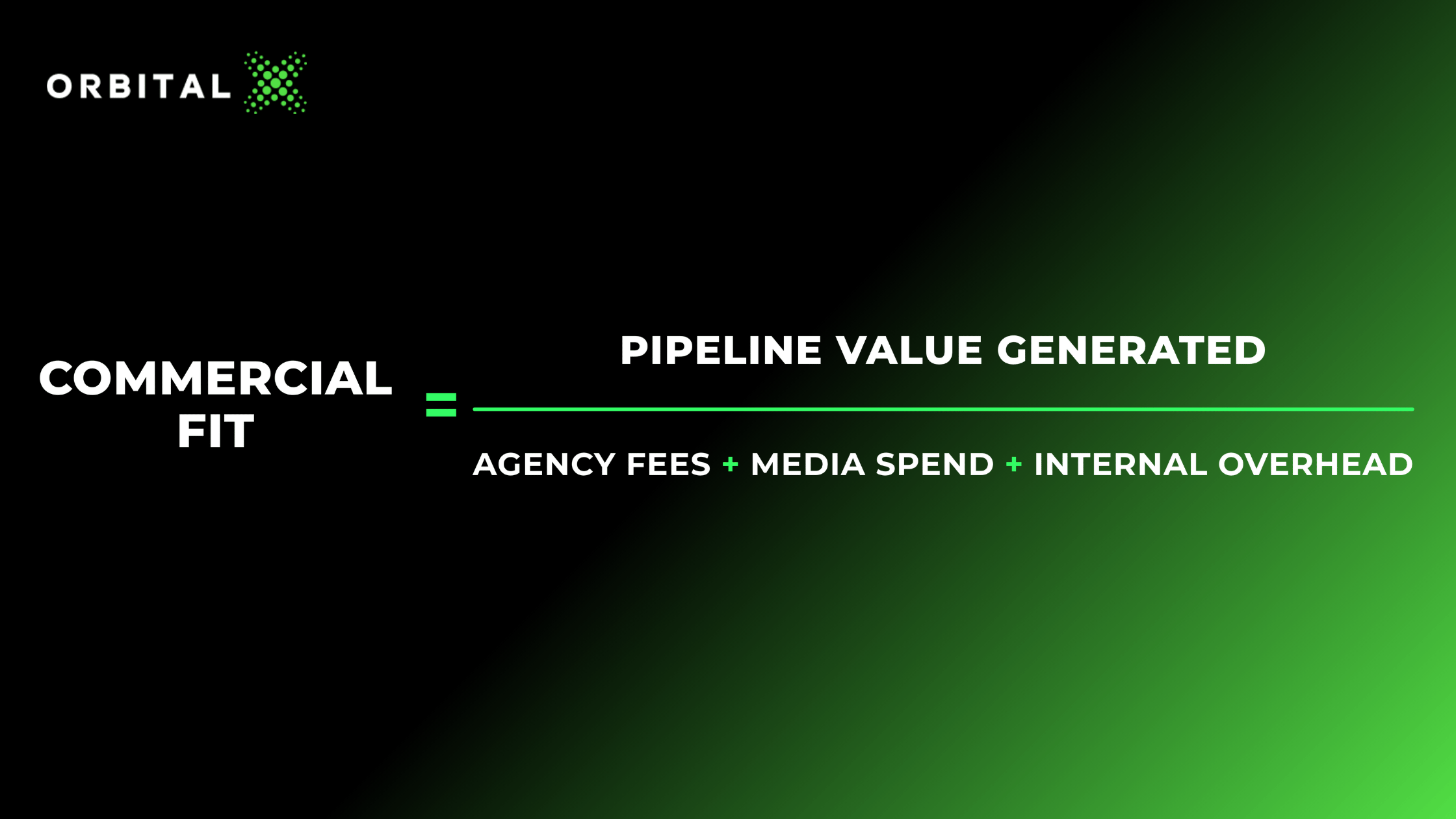 Factor in your average contract value (ACV), customer lifetime value (LTV), and target CAC paybacks. Hiring an agency that costs £10k per month to generate £200k in qualified pipeline makes complete commercial sense. Building that same capability internally often requires hiring multiple full-time roles, incurring significantly higher overhead.
B2B Performance Marketing Agency vs. In-House Team
Choosing between a B2B performance marketing agency and an in-house team depends on the capabilities, resources, and level of integration the business needs. The decision should be based on factors like the capabilities already available, the complexity and consistency of the workload, the level of specialized expertise required, the importance of internal collaboration, and who needs to own strategic decisions.
When an Agency Makes Sense
An agency is ideal when you need broad specialist expertise without scaling head count. Hiring internal specialists across paid media, SEO, CRO, copywriting, design, and analytics is expensive and slow. An embedded agency partner provides immediate access to an entire team and execution infrastructure, allowing lean marketing departments to move fast and stay agile.
When In-House Makes More Sense
Building in-house makes sense when you’ve established your core growth playbook, workload is steady, and deep daily integration with product and sales is essential. If your business requires constant, immediate access to internal subject-matter experts, dedicated in-house hires can be worth the recruitment and management overhead.
When a Hybrid Model Works
Many high-growth B2B companies adopt a hybrid approach. Internal marketers retain ownership of core messaging, positioning, and overall GTM strategy, while an external agency manages specialized channels, technical RevOps, ad execution, and creative scaling. This gives you internal strategic control paired with external execution firepower.
B2B Performance Marketing Agencies to Consider in 2027
B2B performance marketing agencies differ in terms of specialization, service mix, client profile, scale, and approach to measurement. Some focus on specific capabilities like paid acquisition, SEO, content, demand generation, or account-based marketing, while others provide broader full-funnel services.
When comparing agencies, consider the capabilities they provide, the types of businesses they work with, the problems they’re equipped to solve, and how they measure performance. Look for evidence that their experience is relevant to your business model, sales cycle, audience, and commercial priorities.
1) OrbitalX
Specialization: B2B demand generation, ABM, and connected pipeline execution for lean marketing teams.
Primary Capabilities: Account research, content strategy, paid media, earned media, RevOps, and sales enablement.
Typical Client Profile: PE-backed and bootstrapped mid-market SaaS, fintech, and professional services businesses look for predictable pipeline without scaling internal headcount.
Current Positioning: OrbitalX operates as an embedded growth partner, combining an expert team with AI-driven execution systems to deliver full marketing output for the cost of a single hire.
Public Evidence: Driven by our proprietary DemandWEBS™ platform, OrbitalX integrates owned, paid, and earned channels into a compounding pipeline engine. In a recent case study, EngageTech partnered with OrbitalX to function as their complete marketing engine, driving consistent net-new pipeline and closed-won deals.
Buyer Context: Ideal for lean B2B teams requiring specialized execution, clear pipeline tracking, and multi-channel orchestration without adding internal headcount.
2) Directive
Specialization: Customer generation and revenue-focused performance marketing for B2B tech brands.
Primary Capabilities: Paid media, SEO, content creation, CRO, and RevOps analytics.
Typical Client Profile: High-growth B2B SaaS and enterprise technology companies with complex sales cycles.
Current Positioning: Positions around pipeline generation and measurable revenue outcomes rather than vanity digital metrics.
Public Evidence: Directive's B2B demand generation offering emphasizes tight CRM integration and buyer-committee targeting, supported by commercial results across their case study library.
Buyer Context: A fit for enterprise technology brands looking for connected paid and organic demand generation tied directly to CRM pipeline.
3) NoGood
Specialization: Full-funnel growth marketing spanning B2B and SaaS verticals.
Primary Capabilities: Paid acquisition, organic search, CRO, content, and growth analytics.
Typical Client Profile: Venture-backed startups, scale-ups, and mid-market B2B brands looking for agile growth experimentation.
Current Positioning: Positions as an agile growth studio focused on rapid testing and performance optimization.
Public Evidence: Features diverse growth campaigns across their B2B case studies and broader results gallery, demonstrating rapid acquisition testing.
Buyer Context: Best suited for fast-moving businesses seeking a modern growth marketing methodology that combines paid acquisition, organic experiments, and rapid CRO.
4) Jordan Digital Marketing
Specialization: Paid acquisition, SEO, conversion strategy, and AI search optimization.
Primary Capabilities: Paid search, paid social, technical SEO, CRO, and LLM/AI search optimization.
Typical Client Profile: B2B tech and SaaS brands seeking efficient, transparent digital performance management.
Current Positioning: Focuses on transparent data management, channel performance, and emerging AI search visibility.
Public Evidence: Highlights client outcomes in their case study portfolio and outlines specialized methodology for generative discovery on their AI & LLM search page.
Buyer Context: Relevant for B2B brands needing strong paid media execution paired with forward-looking AI search optimization.
5) Refine Labs
Specialization: Demand generation and revenue engine architecture for B2B SaaS companies.
Primary Capabilities: Buyer research, demand creation, paid media, creative strategy, and revenue attribution.
Typical Client Profile: Mid-market to enterprise B2B software companies transitioning from legacy lead-gen to demand creation.
Current Positioning: Promotes their "Brand, Demand, Expand" operating model to build pipeline by capturing in-market buyer intent.
Public Evidence: Outlines client transformations on their customer stories hub, emphasizing demand creation principles for long sales cycles.
Buyer Context: Well suited for B2B software companies looking to modernize their GTM strategy around demand creation rather than gated lead acquisition.
6) Omniscient Digital
Specialization: Organic growth, SEO, content strategy, and AI search visibility for B2B software brands.
Primary Capabilities: Product-led SEO, content production, AI search/GEO optimization, and content analytics.
Typical Client Profile: B2B SaaS companies seeking organic pipeline engines.
Current Positioning: Positions as an organic growth agency that turns content and SEO into predictable revenue assets.
Public Evidence: Details technical strategy on their case studies page, demonstrating how content strategy drives qualified pipeline.
Buyer Context: Ideal for businesses seeking a specialized organic search and content strategy without paid media management.
7) Ironpaper
Specialization: B2B growth marketing, demand generation, and sales-marketing alignment.
Primary Capabilities: ABM, demand generation, inbound content, website development, and marketing automation.
Typical Client Profile: B2B mid-market companies facing complex sales cycles and alignment gaps.
Current Positioning: Focuses on driving revenue growth by closing execution gaps between sales and marketing.
Public Evidence: Highlights multi-channel execution across their portfolio page, illustrating long-term client pipeline impacts.
Buyer Context: A strong match for mid-market B2B companies requiring end-to-end support across messaging, marketing automation, and sales enablement.
8) Wpromote
Specialization: Integrated performance marketing for enterprise B2B and B2C brands.
Primary Capabilities: Multi-channel paid media, SEO, data analytics, creative strategy, and ABM.
Typical Client Profile: Large mid-market and enterprise organizations requiring cross-channel execution at scale.
Current Positioning: Operates as a major independent performance agency connecting brand visibility to measurable sales revenue.
Public Evidence: Outlines enterprise strategic frameworks on their B2B marketing services page and shares detailed client wins in their case study library.
Buyer Context: Relevant for larger organizations seeking a full-service agency with broad media buying power and cross-channel scale.
How Long Does B2B Performance Marketing Take to Work?
The time needed to produce meaningful results depends on your starting position, sales cycle, and the work involved. Capturing existing demand may generate signals sooner than building organic visibility or creating demand among buyers who aren’t actively looking. Tracking quality, messaging, and the website’s conversion experience also affect progress.
Early indicators such as engagement, conversion rates, and lead quality help guide campaign adjustments. Qualified opportunities, pipeline, and revenue generally need longer evaluation windows, particularly in complex sales cycles. Agree on those windows with your agency based on how your customers buy and what you can reliably measure.
Turn Performance Into Pipeline
A dashboard full of green arrows is lovely. So is a sales team with someone relevant to call. B2B performance marketing earns its budget when targeting, content, conversion, and measurement work together to create qualified opportunities and help turn them into customers.
At OrbitalX, we help lean B2B marketing teams connect that work through our proprietary DemandWEBS™ platform. It unifies audience intelligence, content, and coordinated execution across channels with specialist support so your team can spend more time building pipeline and less time refereeing disconnected campaigns.
Ready to give your next board update a stronger plot? Book a call with our team today.
FAQs
What is a B2B performance marketing agency?
A B2B performance marketing agency manages campaigns tied to defined business outcomes. It tracks whether marketing attracts ideal buyers, generates qualified sales opportunities, and supports efficient revenue growth. The agency connects multi-channel marketing activity directly to buyer progress through the sales cycle.
What services does a B2B performance marketing agency provide?
Services vary by agency but generally include paid media, SEO, AI search optimization, content strategy, conversion rate optimization, account-based marketing, analytics, and revenue operations. The best agencies integrate these capabilities into a single connected system rather than managing them in isolated silos.
How much does a B2B performance marketing agency cost?
Agency costs depend on scope, sales complexity, team seniority, and execution requirements. Engagements are typically structured as monthly retainers, project fees, or hybrid performance models. Ad spend is billed separately from agency management fees. Evaluate cost against expected pipeline contribution and internal headcount savings.
How do B2B performance agencies measure ROI?
Performance agencies assess ROI by tracking qualified opportunities, pipeline value, customer acquisition cost (CAC), deal velocity, and closed-won revenue. Calculating true ROI requires connecting front-end marketing touch points to CRM deal stages and revenue data.
How long does it take for a B2B performance marketing agency to generate results?
The timeline depends on your sales cycle length, existing demand, and channel maturity. Initial diagnostic signals like engagement and conversion rates appear within four to six weeks. Meanwhile, commercial outcomes like qualified pipeline and closed revenue build over three to nine months as target accounts progress through your buying process.
More Resources

Organic vs. Paid Marketing and How to Give Every Marketing Dollar a Job
Organic vs. paid marketing? Cut through the noise, compare the tradeoffs, and learn where to invest for stronger B2B pipeline and smarter marketing growth.

Lead Generation Companies: How to Choose the Right Partner and What to Expect
Compare lead generation companies, spot weak promises, and choose a partner that delivers qualified opportunities. Know what to buy and how to judge results.

B2B Marketing Strategy Framework: Stop Chasing Tactics, Start Building Strategy
Build a B2B marketing strategy framework that connects audience, positioning, demand generation, sales alignment, and measurement to revenue.