Lead Generation Strategies Ranked by Pipeline Usefulness
Rank B2B lead generation strategies by pipeline usefulness, from ABM and SEO to AI, outbound, webinars, and tactics to use carefully.
Key Takeaways
Fruitful lead generation strategies clarify which accounts to prioritize, which signals deserve action, and where sales should follow up.
They establish account fit, buying-group relevance, seller context, and usable feedback when they're built around pipeline decisions.
Medium-rated or conditional strategies can produce useful pipeline when targeting, message, routing, and follow-up are strong.
Use volume-led tactics carefully. Cold outbound, outsourcing, generic gated assets, popups, and low-context list-building can drive activity without improving pipeline quality if they lack fit, intent, or sales usability.
The strongest strategy mix connects data, audience intelligence, content, execution, sales action, and feedback so each signal leads to a clearer next step.
B2B marketing teams have no shortage of lead generation options, from webinars and ABM to podcasts and referrals. What’s tough is deciding which tactics deserve resources, time, and sales attention when the team is already under pressure to create more pipeline without adding headcount.
That pressure rears its head during budget planning, where teams face tight purse strings, insufficient resources, and a gap between AI investment and organizational readiness, according to Gartner. For lean B2B teams, strategy choice is a resource-allocation decision. Treating every tactic as equally valuable just leads to more activity rather than clarity.
More tactics isn’t always the answer either, as they can still produce poor-fit leads, messy CRM data, weak sales handoff, missed follow-up, and reporting that only looks active.
The following ranking judges each lead generation strategy by the decision it helps teams make next. Whether it’s which accounts matter, which signals deserve action, what sales should say, what should enter nurture, or what the next campaign should change, there’s more than one strategy to help you reach your goals.
How We Ranked Lead Generation Strategies
Lead volume matters because names allow for reach, although volume alone doesn't make a tactic useful. Capturing a bunch of names is less valuable than honing in on fewer signals that are a better fit, better routed, and have more sales potential.
B2B buying no longer moves through one visible contact. Gartner found that buyers use digital and AI-assisted sources but still turn to sellers to validate information at key moments. Research from Forrester, too, revealed that buying decisions now involve larger internal and external networks, with procurement and other specialists helping evaluate risk, validate solutions, and justify spend.
A strong lead generation strategy should help marketing and sales make a clearer next decision. That’s why we ranked each tactic by the account fit, signal quality, buying group context, sales usability, routing value, resource demand, and feedback it creates.
Lead generation strategy ranking summary
Use the table below as a quick map. The entries explain each strategy’s strongest use case and limits, as well as the pipeline decision it should improve.
Tier | Strategy | Pipeline decision it drives |
Strong | Account-based demand generation/ABM | Accounts that deserve coordinated effort |
Strong | SEO and high-intent content | Problems and searches that reveal demand |
Strong | Webinars and virtual events | Attendees or accounts that deserve action |
Strong | Thought leadership and customer proof | Concerns that need content or proof support |
Strong/Medium | Diagnostics, assessments, calculators, useful lead magnets | Leads to route, nurture, or escalate |
Medium/Conditional | Paid search and paid social | Paid audiences and offers that deserve more budget |
Medium/Conditional | Retargeting and behavior-based nurture | Signals that deserve another touch |
Medium/Conditional | AI-assisted lead generation and personalization | Signals that can be interpreted faster |
Medium/Conditional | Chatbots and conversational qualification | Visitors ready for sales or nurture |
Medium/Conditional | Social selling and LinkedIn activity | Buyers showing familiarity or interest |
Medium/Conditional | Podcasting and partner content | Audience relationships worth building |
Medium/Conditional | Landing pages, forms, and CRO | Conversion paths that need less friction |
Medium/Conditional | Demos, trials, and product-led paths | Prospects ready for evaluation |
Use carefully | Cold outbound and volume SDR prospecting | Accounts that should receive human outreach |
Use carefully | Lead generation outsourcing | Whether external execution can extend the system |
Use carefully | Generic, gated ebooks and content syndication | Contacts worth nurturing or filtering out |
Weak as primary | Pop-ups, sticky bars, and generic capture mechanics | Whether or not a visitor should be captured at all |
Weak/Avoid as primary | Low-context list-building | If the CRM should trust the record |
Pipeline usefulness scorecard
Ranking criterion | What to ask | Why it matters |
ICP precision | Is this strategy attracting or revealing the right accounts? | Prevents broad lead volume from crowding out fit |
Signal strength | What meaningful buyer or account behavior does it show? | Separates activity from actionable intent |
Buying-group usefulness | Does it help more than one visible contact? | Supports complex B2B decisions and internal consensus |
Sales context | Does sales get a better reason to follow up? | Improves timing and message relevance |
Routing/Nurture value | What next step does the strategy make clearer? | Prevents good signals from dying in CRM or spreadsheets |
Resource efficiency | Can a lean team execute it without creating uncontrolled work? | Keeps effort aligned with capacity |
Feedback-loop value | Does it improve the next audience, offer, campaign, or workflow? | Turns execution into learning |
Strong Lead Generation Strategies for B2B Pipeline
These strategies rank highest because they improve several pipeline decisions at once. They help teams identify better-fit accounts, educate buyers, capture richer signals, establish sales context, and learn what should change next. Instead of sweating bullets during a board meeting as you awkwardly point to an increased clicks metric, you’ll be able to prove actual revenue.
Account-based demand generation/ABM
Rating: Strong
Account-based demand generation ranks high because it starts with fit. Capturing as many contacts as possible is the wrong entry point. The motion instead starts by asking which accounts deserve coordinated attention and which buying groups need a more focused motion.
Demand Gen Report shows ABM is a good fit for revenue growth, new account acquisition, expansion, and demand generation integration. Strong lead generation in B2B depends on choosing the right accounts, mapping relevant buying-group needs, and coordinating content, channels, sales engagement, and follow-up around those accounts.
ABM fails when it turns into account-list spraying. A list of named accounts plus lightly personalized emails doesn't give sales enough context. Use account tiers, buying-group relevance, intent signals, and sales feedback to decide where scarce time should go.
Recommended watch:
In OrbitalX’s Do More With Less episode with Robert Norum of Propolis, the conversation explains why ABM belongs in the Strong tier only when it sharpens account focus.
Norum and host Mark Choueke push past the common mistake of treating ABM as a large target-account list with light personalization and return to the operating questions that matter. Their discussion explores where ABM adds value, how to balance one-to-one and one-to-many motions, and how to engage the right accounts with enough focus to create meaningful sales action.
SEO and high-intent content
Rating: Strong
Nobody wants to rank number one for a high-volume search term that brings in tons of student traffic but zero people with buying authority or actual budget. SEO and high-intent content deserve consideration because they help buyers research the problem before sales engagement. They excel when they use traffic to capture demand and support buyer education, with search volume judged by commercial usefulness.
B2B buyers increasingly self-educate, compare options, and validate risk before speaking to sales, according to Gartner’s buyer research. Leads want digital paths but still need seller validation at the right moment. High-intent content supports the buyer while they’re researching, then gives sales cleaner context when the account shows activity.
The question then turns to which problems, categories, and search behaviors reveal meaningful demand. A good SEO program chooses keywords based on whether they bring ICP-fit accounts into a better buying conversation.
SEO weakens when the team celebrates traffic from audiences that will never buy. It stays strong when it clearly connects search demand, account fit, content depth, and conversion path.
Webinars and virtual events
Rating: Strong/Strong-conditional
Webinars foster engagement signals and follow-up context. Measuring their success by registrations alone weakens their value. One unengaged registrant who leaves the stream running silently in the background while making a cup of PG Tips is vastly different from an attendee who stays for the full 45 minutes and drops a question about implementation in the chat.
A webinar captures much more, from watch time, questions, and poll answers to CTA clicks, replay views, and same-account participation. These, in turn, reveal interest, urgency, and fit. After all, a registrant who never attends is different from someone who stays for the full session, asks an implementation question, and returns to the replay.
Those signals make webinars useful for deciding which attendees deserve sales follow-up, which accounts need nurturing, and which topics should shape the next campaign. When audience fit, engagement capture, CRM routing, replay reuse, and sales feedback are connected, webinar lead generation transforms event behavior into usable follow-up context instead of treating registrations as the outcome.
Thought leadership, original POV content, and customer proof
Rating: Strong/Strong-conditional
Thought leadership and customer proof help buyers understand risk, align internally, and trust the seller before a direct conversation.
That requires more than just pumping out a higher volume of blogs though. Strong thought leadership gives buying groups a clear way to define the problem internally, a point of view to test, and evidence that the company understands the commercial pressure behind it. Authoritative ideas influence trust and buying group alignment, especially when hidden stakeholders are involved, according to Edelman and LinkedIn.
Customer proof shows buyers why their problem warrants action and why the proposed approach is credible. For lead generation, the decision is which concern, objection, or internal argument needs proof before sales can move the conversation forward.
Thought leadership weakens when it drifts into generic visibility content. It works as a strong lead generation strategy when it creates sharper buyer understanding and better sales conversations.
Interactive diagnostics, assessments, calculators, and useful lead magnets
Rating: Strong when qualified; Medium if generic
Interactive diagnostics, assessments, calculators, and useful lead magnets can rank strongly when they reveal problem fit. Their value decreases if they only gate contact data though.
A generic ebook just captures a name, while a diagnostic can show what the buyer is trying to solve, how mature the problem is, and whether the next step should be a sales task, an account review, nurturing, or suppression. That turns the asset from a contact-capture scheme into a qualification layer and gives the team context for routing the response.
Medium Or Conditional Strategies That Need The Right System Around Them
These strategies can still generate useful pipeline, but they depend more heavily on targeting, offer quality, data, routing, sales follow-up, and feedback.
Paid search and paid social
Rating: Medium/Conditional
Paid search and paid social can accelerate reach, test offers, and capture demand. They can also scale waste if used incorrectly. That’s how you end up burning through a five-figure monthly LinkedIn budget on broad targeting, only to hand sales a list of $400 leads that get thrown straight in the bin. Paid is strongest when the audience, offer, landing path, and follow-up motion are clear.
Paid channels mainly come down to budget allocation. Which audience or offer deserves more spend because it produces fit, signal, and sales-accepted opportunities? A high CPL is acceptable when it creates qualified pipeline, and a low CPL can be a waste when it fills the CRM with weak-fit names.
Paid needs a clear job. It’s a force multiplier, so the strategy must define whether it’s multiplying useful signals or expensive noise.
Retargeting and behavior-based nurture
Rating: Medium/Conditional
Retargeting and nurture are valuable support layers because they respond to behavior over time. However, they rarely carry the strategy on their own.
A retargeted audience, nurture stream, or behavior-based email path can keep a buyer close to the problem after an initial signal. Someone who reads multiple related pages, returns to a webinar replay, or clicks a comparison asset shouldn't receive the same treatment as a cold contact.
The choice here is what continuing interest should trigger. Does the behavior deserve education, proof, a sales alert, suppression, or another offer? Retargeting and nurturing yield results when they answer that question. If the audience is broad, the message is generic, or every lead receives the same sequence regardless of fit, they just dry up your pipeline.
AI-assisted lead generation and personalization
Rating: Medium/Conditional
Be careful with AI-assisted lead generation. AI can either improve judgment or amplify drivel, and the difference depends on the use criteria underneath it. Unguided AI tools are no better than an eager intern running on five shots of espresso and churning out hundreds of generic, "I hope this email finds you well," messages. That’s a sure-fire way to make buyers instantly hit “Unsubscribe.”
AI can help teams identify patterns, summarize account research, personalize outreach, enrich records, analyze intent, and route signals faster, but human judgment still matters. Although buyers may use AI and digital channels early on in their journeys, validation, trust, and context remain central.
Signal interpretation is critical for AI to be successful. So, you need to determine which accounts or contacts deserve faster action because AI surfaced a meaningful pattern. If the system has clear criteria, AI can reduce manual drag and improve timing. If the criteria are weak, it simply spits out more messages, lists, and activity that sales will end up questioning.
Chatbots and conversational qualification
Rating: Medium/Conditional
Chatbots can improve website lead capture and qualification by providing value, capturing intent, routing high-fit visitors, and establishing clear handoff context.
A form with a friendly interface is still a form unless the chatbot helps the visitor answer a question, find the right resource, qualify their need, or move toward a useful next step. That requires determining if the person should book time, enter a nurturing phase, receive content, or be set aside until they show more buying potential.
Asking for contact details too early or sending everyone into the same workflow kills the strategy. Effective chatbots read behavior, ask progressive questions, connect to your CRM, and know when a human should take over. They should use the conversation to determine fit and route the visitor to the right next step.
Social selling and LinkedIn activity
Rating: Medium/Conditional
Social selling and LinkedIn activity build familiarity, trust, and exposure. Social sees the best results when the audience is precise and the content points toward a real buying problem. Preachy posts and humble-brags might get polite claps from colleagues, but you’ll see zero attention from actual target buyers.
A founder, CMO, sales leader, or subject-matter expert can make the company more visible to the right people before those buyers are ready to convert. Social can also distribute customer proof, POV content, webinars, and diagnostic assets. These channels clarify audience attention by revealing which buyers show familiarity with the problem, and which topics are creating useful engagement.
Avoid drifting into general visibility posting or disconnected personal branding with no follow-up path.
Podcasting and partner content
Rating: Medium/Conditional
Podcasting and partner content are better treated as authority, trust, and demand creation than direct lead capture.
Podcasting builds executive credibility, enables partner reach, and generates reusable content. It also helps buyers understand the company’s perspective before they enter an active buying process. Distribution, repurposing, and a clear path to content, nurture, or sales context keep it close to pipeline.
Treat this as a relationship and audience-building decision. Which audiences, partners, and themes are worth investing in because they help the market understand the problem? Podcasting shouldn't be over-ranked as a direct lead generation channel unless the team has evidence that it drives qualified conversions.
Landing pages, forms, and CRO
Rating: Medium/Conditional
Landing pages, forms, and CRO are important conversion layers, but they don't function as complete strategies by themselves. These shouldn’t replace upstream demand creation or block usage data from reaching the follow-up process.
A landing page doesn't decide who to target, what signal matters, or which account deserves follow-up. A shorter form may increase submissions without automatically improving fit or sales usefulness. For its part, CRO is less successful when it optimizes for form fills without preserving qualification or routing value.
Both the page and the form move prospects down the path only after the strategy has brought the right visitor and offer together. Review which offer path needs less friction so the right visitor can take the right next step.
Demos, trials, and product-led conversion paths
Rating: Medium/Conditional
Demos, trials, and product-led paths are useful when buyer readiness is high and follow-up is structured.
Forrester showed that trials are an excellent way to reduce evaluation risk by letting buyers test a solution and gather proof before a larger commitment. The resulting behavior can reveal active evaluation, but only when usage context reaches sales and the team separates serious evaluation from casual exploration.
The practical decision is readiness. Which prospects are actively evaluating, and what context does sales need to respond well? This strategy weakens when product usage remains isolated from CRM, qualification, and follow-up.
Lead Generation Strategies to Use With Caution
These tactics can have a role in your pipeline creation. Just be careful not to treat them as primary growth engines because they could end up producing activity without proper fit, signal, or sales usability.
Cold outbound and volume SDR prospecting
Rating: Use carefully/Conditional
Don’t let volume lead the motion. An SDR sending 5,000 spray-and-pray emails will only be met with cold silence. A seller reaching out right as a target account announces a major restructuring is a warm outbound move. Outbound works best when ICP, message relevance, qualification, and feedback loops are strong.
Cold outbound can open doors, especially when the team knows exactly which accounts matter and why now is the right time. Blunt volume prospecting often pushes qualification downstream to sales. The dashboard shows activity, but sellers have to spend time reworking weak-fit meetings.
Focus on account priority, starting with which accounts deserve human outreach now. If outbound can't answer that, it loses strategic value. Keep outbound in its proper role as a useful motion when fit and feedback are present.
Lead generation outsourcing
Rating: Use carefully/Conditional
If you’ve outgrown your execution capacity, consider lead generation outsourcing. Be aware, though, that it won’t fix weak targeting, qualification, or conversion.
External support helps when the bottleneck is bandwidth. If the team knows its ICP, has clear qualification standards, and can follow up well, outsourcing can expand execution. If the system is unclear, outsourcing will only amplify the problem by creating more activity for sales to sort through.
Treat outsourcing as a capacity diagnosis. Is the team short on execution, or is the real bottleneck fit, signal, handoff, or conversion? Lead generation outsourcing can extend a working system, but it can’t supply the commercial judgment the system lacks.
Generic gated ebooks and content syndication
Rating: Use carefully/Weak as primary
Generic, gated assets and content syndication excel at capturing names. Using them to optimize contact capture without fit, intent, or sales usability is a recipe for disaster.
Poor lead data disrupts handoffs and sales productivity, as Demand Metric and Integrate reported. That makes these strategies risky. A download doesn't equal readiness. It may just show interest, curiosity, or a content exchange with little buying relevance.
If you decide to employ this tactic, the next decision should be whether to nurture or filter. Ask if a contact belongs in a useful path or if it should be deprioritized. If the asset can't help answer that, it’s mostly a list-building tactic.
Pop-ups, sticky bars, and generic capture mechanics
Rating: Weak as primary
Pop-ups, sticky bars, and generic capture mechanics are excellent supports for conversion.
They can help a visitor notice a relevant offer, register for a webinar, or request a useful asset. They don't decide who the buyer is, if the account fits, what the signal means, or how sales should respond.
Their decision value is narrow. Should this visitor be invited into a conversion path? Treat capture mechanics as supportive. If the offer and audience are weak, a better pop-up only captures weak demand faster.
Low-context list-building
Rating: Weak/Avoid as primary
Low-context list-building can create contacts quickly, but it often lacks signal, fit, and permission quality.
Response rate is only part of the problem. The larger issue is trust in the record. If sales doesn't know why a contact exists, what problem they have, whether the account fits, or what signal triggered outreach, the CRM gets noisier and follow-up declines.
A record without context rarely tells the team what to do next. Broad list-building may support a tightly controlled research or enrichment motion in limited cases, but as a primary B2B lead generation strategy, keep it low on your list.
How to Choose The Right Mix of Lead Generation Strategies
Avoid a stack of disconnected tactics. A strategy mix that bears fruit includes a primary demand or account focus, a capture path, a signal and routing layer, acceleration support, and a feedback loop.
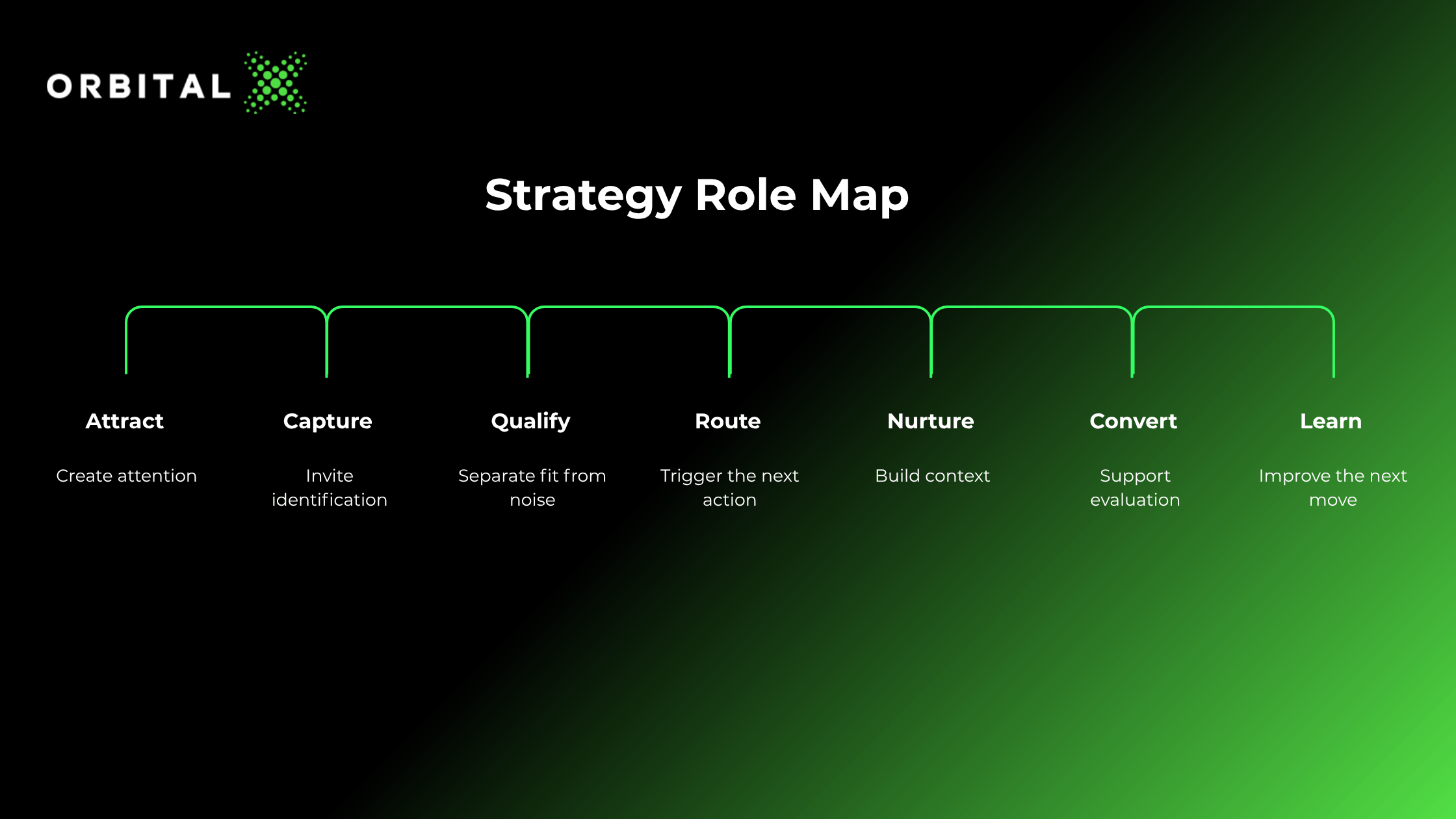 A lean team should build a strategy mix based on what’s currently holding pipeline back rather than spreading attention across every tactic at once:
If account focus is the issue, ABM and high-intent content may matter most.
When buyers need education, SEO, thought leadership, webinars, and proof assets can carry more of the work.
Capture and qualification problems point toward diagnostics, chatbots, landing pages, demos, and trials.
Timing problems usually need retargeting, nurture, and sales alerts to create the missing response layer.
Hyperpersonalization, scaled AI, and clear sales-led account-based governance are reinforcing components of one commercial operating system, McKinsey asserts. For a lean team, that means individual tactics create more value when data, execution, and accountability work together.
The team needs to move past asking, “Which channel should we run?” and switch to, “Which pipeline decision are we trying to improve first?” That’ll empower you to explain to a skeptical CFO how spreading budget across four different social channels actually helps close deals faster.
The table below translates that system into the roles and decisions a lean team needs to coordinate.
Role | Strategies that often support it | Decision improved |
Attract | SEO, thought leadership, social, partner content, webinars | Active audience or account problem |
Capture | Landing pages, diagnostics, demos, trials, forms, chatbots | Visitors who should identify themselves |
Qualify | ABM, diagnostics, chatbots, lead scoring, sales feedback | Leads or accounts that fit the business |
Route | CRM workflows, nurture, enrichment, sales tasks | The next action to take |
Nurture | Email, retargeting, proof content, webinars, social | Buyers who need more context |
Convert | Demos, trials, sales conversations, customer proof | Prospects ready for evaluation |
Learn | Reporting, sales acceptance, opportunity quality, feedback | What the next campaign should change |
Hone in one what’s limiting progress, then choose the smallest set of strategies that can improve it.
How Lean B2B Teams Unify Lead Generation Strategies in One System
A ranked list helps teams decide where to focus. The next job to tackle is connecting each strategy to a decision, signal, owner, and feedback loop. Break through this wall by following these steps:
Define the decision before launching the tactic. State whether the strategy should improve account selection, buyer education, qualification, routing, follow-up, or learning. Without a defined job, activity is useless.
Preserve context with every signal. Store account fit, source, content or event behavior, buying group role, and timing in the CRM. Sales should see why the signal matters, not just that a form was submitted.
Route the signal to an explicit next action. Decide what should create a sales task, account review, nurture path, content response, or suppression. ABM, SEO, webinars, paid, chatbots, and AI all depend on this handoff.
Feed outcomes into the next decision. Use sales acceptance, opportunity quality, conversion, and lost-deal reasons to change and improve the next audience, offer, channel, and workflow.
Audience choices, channel execution, CRM context, follow-up, and feedback must be connected. Trying to manually link five disconnected marketing tools is like herding cats across Piccadilly Circus at 5 PM while holding a tray of hot scones. That’s the operating gap a lean team has to solve after it chooses tactics.
How DemandWEBS™ Connects Strategy, Signal, And Execution
Even if channels are active and signals flow, a lean B2B team can still struggle to decide what deserves attention, coordinate the response, and carry the outcome into the next campaign.
OrbitalX’s DemandWEBS™ combines an AI marketing operating system with expert operators to unite your metrics and processes. Its data-to-demand strategy connects information and account intelligence with audience selection, content, channel execution, CRM routing, sales follow-up, and performance feedback.
That gives the team a clearer basis for three decisions:
Which accounts deserve attention?
Which signals should change sales follow-up?
What should the next campaign change?
No more drowning in 14 open browser tabs, unread Slack alerts, and messy spreadsheets. For lean teams, that coordination closes the gap between running individual tactics and operating them as one pipeline system. DemandWEBS™ morphs marketing noise into clear sales tasks.
More Isn’t Always Better in Lead Generation
Whatever lead generation strategies you choose, they should improve the next pipeline decision before increasing activity.
For some teams, that means stronger account-based demand generation. For others, it’s better high-intent content, richer webinar signals, sharper diagnostic assets, or cleaner routing.
Resources are limited, so you have to choose your tactics wisely. Some marketers think spreading a tight budget across 10 different tactics is hedging their bets. But honestly? It’s a fast track to burning out growth marketers while getting mediocre results. Lean B2B teams need to know which strategies will generate sales-usable signals, which require specific systems to be successful, and which just create noise when treated as primary growth engines.
If your team has plenty of lead generation tactics and still can't tell which accounts deserve attention, which signals should change follow-up, or where handoff is breaking down, book a call with OrbitalX. You’ll see firsthand how DemandWEBS™ can turn disconnected lead-generation activity into better pipeline decisions.
FAQ
What is a lead generation strategy?
A lead generation strategy is a structured way to attract, identify, qualify, and route potential buyers into a revenue motion. In B2B, it shapes lead quality, sales context, and follow-up timing. A strong strategy creates contacts and helps the team decide which accounts matter, which signals deserve action, and what should happen next.
What is the best lead generation strategy for B2B?
There’s no single best B2B lead generation strategy for every company. The strongest choice depends on which pipeline decision needs improvement. ABM, high-intent content, webinars, thought leadership, and diagnostic assets often rank highly because they can improve account fit, buyer education, signal quality, and sales context. The “best” strategy is the one that removes the bottleneck restricting pipeline.
Are outbound strategies still effective?
Outbound can still work when it starts with a clear ICP, relevant message, strong qualification criteria, and a feedback loop from sales. It loses force when volume is the main operating principle. The better test is whether outbound helps the team reach the right accounts at the right time with enough context to be useful.
Is SEO a lead generation strategy?
Yes, SEO is a lead generation strategy when it captures high-intent demand and helps buyers self-educate before sales engagement. It weakens when measured only by traffic. Strong B2B SEO connects topics to buyer problems, account fit, conversion paths, and follow-up context. The goal is more useful demand from the right audience.
How should B2B teams choose between inbound, outbound, ABM, paid, and content?
Choose based on the pipeline decision the team needs to improve first. If account focus is poor, ABM is a good option. If buyers need education, content and SEO should lead. If reach is the issue, paid or outbound can support the motion. If follow-up is weak, nurture, routing, and CRM workflows need attention before any channel receives more spend.
What lead generation strategies should lean teams avoid?
Lean teams should avoid treating contact capture as pipeline creation. Generic, gated assets, broad content syndication, pop-ups, low-context list-building, and volume-first outreach drive activity without improving sales usability. Instead, give these tactics support roles, especially when ICP fit, intent, qualification, routing, and feedback are clear.
More Resources

B2B Content Marketing Funnel: Stages, Strategies, and How to Build One That Converts
Build a B2B content marketing funnel that aligns content with buyer needs, connects the journey, and turns content engagement into pipeline and revenue.

B2B Referral Marketing: How to Build a Program That Drives Qualified Growth
Learn how to build a B2B referral marketing program that turns trusted relationships into qualified introductions, pipeline, and measurable revenue.

A PE-Backed Company Cut Marketing From 12 People to 3. Then Had Its Best Six Months Ever.
A marketing team cut from 12 to 3, then the best six months in the company's history. Here's the growth system behind it, and what it means for PE portfolios.