B2B Market Research: Methods, Process, and How to Use It
Learn what B2B market research is, explore key methods and types, and discover how to turn research findings into better business decisions.
Key Takeaways
B2B market research gives teams the evidence they need to make better decisions about buyers, markets, competitors, and growth.
B2B buying decisions involve multiple stakeholders, specialized audiences, and longer sales cycles, so market research needs to take a different approach than B2C.
The right research method depends on what you need to understand, from buyer motivations and journeys to market opportunities and competitive positioning.
Effective B2B market research starts with a clear business question and follows a structured process from data collection through analysis and validation.
Research drives commercial value by influencing decisions across product, positioning, GTM, content, sales, and competitive strategy.
B2B teams make big commercial bets on what they believe buyers want. Which markets to enter, how to position an offer, where to spend the budget…. But buyer priorities shift, and the assumptions behind those decisions can quickly fall behind.
Last year’s customer feedback, a handful of sales anecdotes, and a broad industry report may offer clues. But how well do they explain what your buyers care about today?
Forrester found that 81% of B2B buyers were dissatisfied with their chosen provider, with concerns including pricing, expertise, and flexibility. Winning the deal clearly leaves plenty of room to miss expectations.
B2B market research gives teams reliable evidence to answer the important questions. Which segment deserves your attention? Why are qualified prospects choosing competitors? Does your messaging reflect what buyers value? Is that new market worth entering? Well-thought-out research has you covered.
What is B2B Market Research?
B2B market research gathers and analyzes information about business buyers, markets, competitors, and buying behavior to direct company efforts where they’ll have the greatest impact. It gives marketing, sales, product, and leadership teams evidence they can use to understand the market they’re operating in and where opportunities or risks may exist.
This type of research specifically helps a company understand its target buyers, the problems and priorities shaping their decisions, how purchasing decisions are made, how its brand or offering is perceived, what competitors are doing, and how market conditions are changing.
Research can draw on both primary and secondary sources:
Primary research involves gathering new information directly from relevant buyers, customers, prospects, or other stakeholders.
Secondary research uses information that already exists, such as industry reports, public data, company filings, or published research.
The research question determines what evidence the business needs, which people or sources can provide it, and how to gather it. That can include interviews and surveys, competitive analysis, industry data, or behavioral evidence. Good research translates evidence about potential buyers and their environment into clearer, more confident business decisions.
Once you identify target markets and buyer nuances through research, moving into formal B2B market segmentation becomes the natural next step. Because B2B purchases rarely involve a single buyer, research needs to account for organizational complexity across entire buying committees.
How B2B Market Research Differs From B2C Research
Buying trainers is a Sunday-night impulse purchase. Buying enterprise software can mean six months of demos, a security review, and finance asking whether you really need it. B2B market research has to account for all those people, priorities, and potential roadblocks.
B2B buying groups can include executives, end users, procurement, finance, and technical teams, each with different priorities and levels of influence. To further complicate things, Gartner reports that 68% of buying teams experience unhealthy conflict, including competing objectives, frequent disagreements, and overruled recommendations. Research needs to capture those different perspectives, rather than assuming one person speaks for the entire committee.
Those higher-level audiences can also be smaller but harder to win over, making careful screening important. Potential parties need relevant purchasing experience, and a senior title alone isn’t enough here. Someone with an impressive title might have no involvement in the decision, while a less senior colleague may strongly influence it.
Longer buying cycles add another layer of complexity. Interviews help explain the motivations, objections, language, and internal dynamics behind purchasing decisions. Even a single conversation still captures a particular moment, so researchers should consider whether priorities may change as the target account progresses.
Types of B2B Market Research
B2B market research delves into different questions about buyers, markets, competitors, opportunities, and brand perception. The information a company needs to learn or decide should determine the type to conduct.
Research objectives aren’t the same as research methods, though. The former define what you need to understand, while the latter determine how you collect the evidence. For example, a company researching its buyer’s journey might use interviews, surveys, behavioral data, or a combination of approaches.
Businesses can also combine research types when a single decision requires several perspectives. A company considering expansion into a new market, for instance, would need to understand potential buyers, competitors, market conditions, and its own positioning before deciding how to proceed.
Business Question | Example Research Type | Collection Methods |
Who are our buyers? | Buyer research | Interviews, surveys |
What do their buyer’s journeys look like? | Buyer journey research | Interviews, behavioral data |
Who are we competing with? | Competitive research | Secondary research, interviews |
Where should we grow? | Market opportunity research | Secondary research, surveys |
How are we perceived? | Brand perception research | Surveys, interviews |
Buyer Research
Your buyer persona might say “VP of IT,” while the operations manager who’s fed up with the current software is building the shortlist and pushing for a switch. The organization chart only tells you so much.
Buyer research uncovers who influences a purchase and what drives their decisions. It examines priorities, operational constraints, evaluation criteria, purchase triggers, and the language buyers use to describe their problems. These insights help refine ideal customer profiles (ICPs), personas, messaging, and product direction.
Buyer Journey Research
Buyer journey research tracks how a purchasing decision unfolds, from initial problem recognition through vendor selection. It examines triggers, information channels, stakeholder friction, and objection points. B2B journeys are non-linear, and buyers frequently establish preferences before ever contacting a vendor. In fact, 68% of B2B buyers already have a preferred candidate in mind by the time they start the purchase process, and that candidate closes the deal 55% of the time, according to Forrester. Understanding what shapes those early preferences allows teams to fix gaps in messaging, content distribution, and sales engagement.
Competitive Landscape Analysis
A competitor’s website might call its product “the #1 AI-powered, friction-free platform.” Buyers know it as “that expensive tool that crashes on Tuesdays.” It pays to hear both sides.
Competitive research examines how alternative solutions are positioned, what they offer, and how buyers assess their strengths and weaknesses. Combining public information with buyer interviews helps distinguish competitor claims from customer experience and identify gaps your business could address.
Market Opportunity Research
Market opportunity research evaluates whether entering a new segment, geographic region, or category is commercially viable. It assesses market size, demand drivers, growth trajectories, barriers to entry, and potential risks. Market size alone doesn't guarantee success. This research is what determines if your business has a clear, defensible path to capture value.
Because if your offer lands in a new market with a dull thud, having a multi-billion-pound market size just means you failed in an expensive room.
Brand Perception Research
Brand perception research uncovers how the market actually remembers and understands your business. This method will tear through your internal expectations to get to the buyer’s reality. It evaluates awareness, brand associations, and differentiation relative to competitors. Gathering evidence from buyer interviews, review sites like G2 or Trustpilot, and industry forums helps close the gap between how you want to be known and how buyers actually describe you.
Once you know what information you need, the next step is selecting how to gather it.
B2B Market Research Methods
B2B market research methods are how businesses gather evidence about buyers, markets, competitors, and buyer behavior. Your research question, audience, evidence needed, timeline, and available resources dictate the best approach to use.
Common methods include in-depth interviews, surveys, focus groups, and secondary research. Like we said earlier, businesses can also combine methods to investigate the same question. Method selection should always follow the business question rather than personal tool preferences.
In-Depth Interviews
Interviews are one-on-one conversations with buyers, prospects, customers, or industry experts. They help uncover motivations, objections, internal buying dynamics, and the reasoning behind decisions. Getting useful evidence requires relevant participants, non-leading questions, and a willingness to hear answers you weren’t hoping for.
Ask a prospect why they passed on your flagship offer, and you might spend the next 30 minutes resisting the urge to defend it. Don’t. Let them finish. Maybe the pricing confused them, the demo skipped their biggest concern, or your headline benefit solved a problem they didn’t have. That’s useful information, even if it bruises a few egos.
Surveys
Surveys gather structured quantitative data across a target sample. They’re ideal for measuring the prevalence of specific problems, ranking buyer preferences, evaluating perception across segments, and validating hypotheses. Clear question design and strict sample screening matter far more here than acquiring raw response volume. What’s the point of celebrating 150 survey responses if they only answered a three-question satisfaction check with all neutral responses?
Focus Groups
Focus groups use moderated group discussions to gauge reactions to new messaging, product concepts, or brand positioning. While group dynamics can spur spontaneous insights, they can also introduce peer bias. These are therefore less suited to exploring sensitive financial details or individual buying journeys.
Secondary Research
Secondary research analyzes existing data from sources like industry analyst reports, public filings, trade publications, and governmental datasets. It offers a fast, cost-effective way to evaluate market size, track macro trends, and build initial hypotheses. Always evaluate secondary sources for recency, methodology, and potential publisher bias.
Mixed-Method Research and Triangulation
Mixed-method research combines multiple approaches to validate findings. For instance, secondary research might highlight an emerging market trend, while qualitative interviews explore why buyers care about it. A quantitative survey can then test how widespread the issue is across your total addressable market. Triangulating evidence across sources builds higher confidence when making critical commercial bets.
How to Conduct B2B Market Research
B2B market research should start with the business decision you need. The goal is to gather reliable evidence that helps you answer a specific question, reduce uncertainty, and decide what to do next.
Research should make clear why the findings matter and which decisions they inform. For example, whether to prioritize a different buyer segment, revise product messaging, or adjust an offer. It should also direct who will act on the findings and how your business will evaluate the results.
The process doesn't need to be complicated. A lean B2B team can conduct useful research by keeping the decision clear, using appropriate evidence, and maintaining a direct connection between what it learns and what it does.
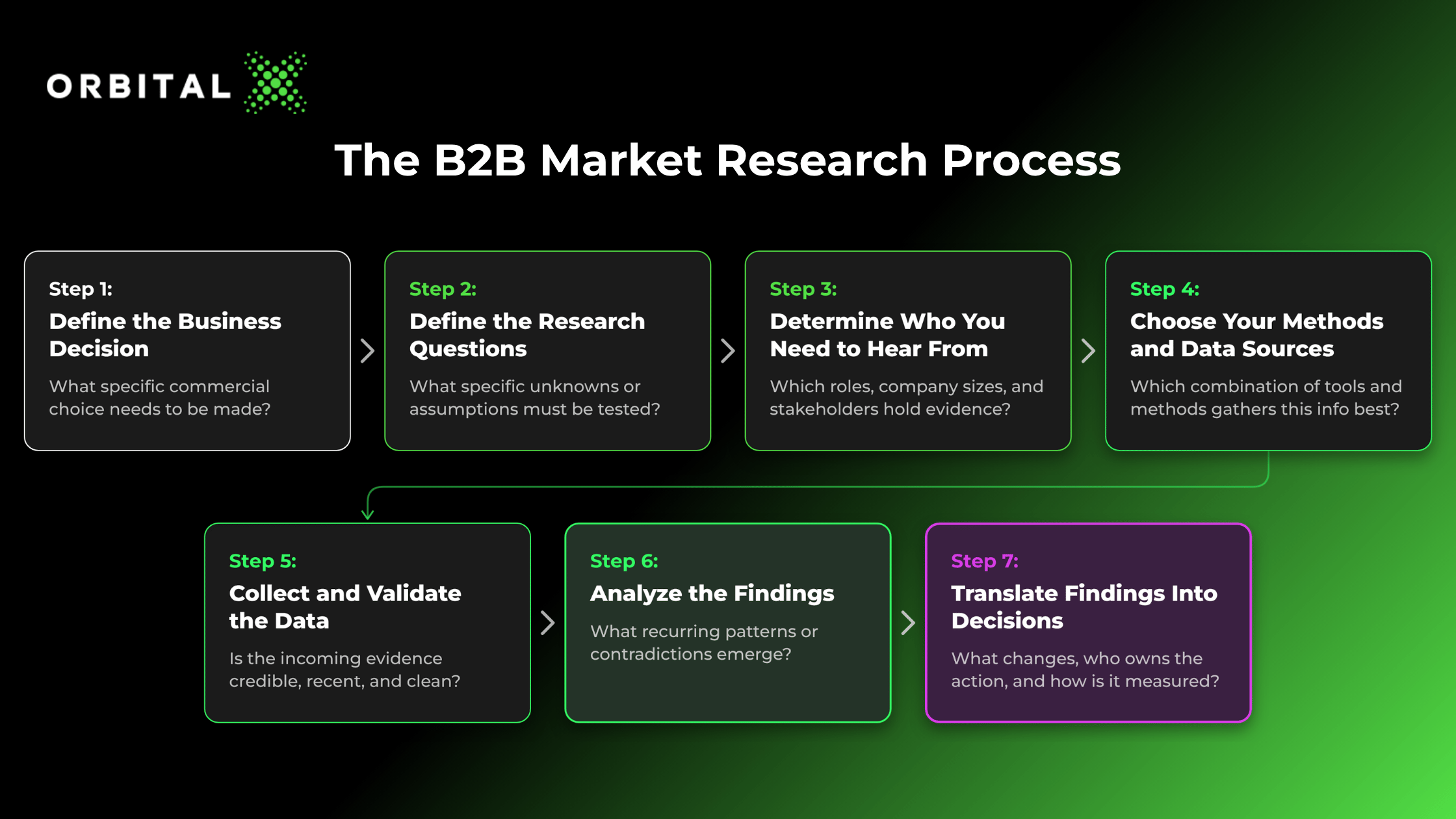 1. Define the Business Decision
A £50,000 research project can still end with a 90-page deck gathering digital dust in Google Drive if nobody asks, “What are we going to do with this?”
Start with the commercial decision the research needs to inform. “Understand the market better” is too vague and needs a sharper brief like:
Should we enter the enterprise healthcare segment?
What should we change to help stalled deals progress?
Should we adjust our core pricing tier?
A clear decision gives the research focus and the findings a practical use.
2. Define the Research Questions
Break down the business decision into specific questions. Identify what you already know, what remains uncertain, and which assumptions require testing. Instead of asking, "What do buyers want?" ask, “What specific problems are buyers prioritizing this quarter? What criteria do they use to evaluate alternatives? What security or procurement blockers halt deals late in the cycle
3. Determine Who You Need to Hear From
Define your target audience based on company size, industry, role, seniority, and direct involvement in the purchase process. Look beyond job titles to ensure participants have recent, hands-on experience with the aspect you're researching. Include multiple buyer committee perspectives, such as technical leads, end users, and financial sign-offs, to get a complete view of the transaction.
4. Choose Your Methods and Data Sources
Let your questions determine how you research them. If you need to understand why qualified buyers drop out during sales conversations, conduct one-on-one interviews with recent lost prospects, then use a targeted survey to check if those reasons apply across your wider target list. Support the work using lightweight internal infrastructure like survey platforms, interview recording tools, CRM records, and competitive intelligence databases.
5. Collect and Validate the Data
Collecting responses is only the start. You then have to check for duplicates, suspiciously fast completions, and low-quality answers. Assess source credibility, publication dates, and whether respondents have relevant experience. Data and analytics leaders estimate that 26% of their organizations’ data is untrustworthy, according to Salesforce, so you need to be extra confident about what you’re working with.
Apply the same standards to findings you’d rather not hear. Research suggesting that customers see little value in the CEO’s favorite feature might earn you an awkward boardroom silence. That’s a reason to examine the evidence carefully, instead of quietly removing the slide.
6. Analyze the Findings
Organize collected evidence into patterns that answer your original research questions. Look for recurring themes in qualitative interviews and test them against survey trends. For instance, if quantitative data shows prospects frequently cite price as an objection, use qualitative interview context to determine if the issue is actual budgetary limits or confusion around expected ROI.
7. Translate Findings Into Decisions
Connect every key finding directly to a commercial action. Name the finding, the required change, the owner, and how you’ll evaluate the result.
If research shows buyers regularly misunderstand your core differentiator, revise your primary website messaging and test message comprehension among target accounts. If procurement requirements consistently stall deals, create targeted compliance documentation for sales reps to share early in the discovery stage. Documenting these decisions ensures research work turns directly into execution.
How to Apply B2B Market Research Findings
B2B market research can shape product development, positioning, go-to-market strategy, content, demand generation, sales, and competitive strategy, depending on what it reveals. The same research may lead different teams to different actions. A finding about a recurring buyer concern could change product priorities, reshape messaging, give sales a new objection-handling approach, and influence the topics marketing develops.
Connect findings to decisions and document what changed as a result. Research leads to tangible value when insights guide the people making daily commercial decisions. A single key finding can spark synchronized actions across several departments.
Product and Offer Development
Research pinpoints which buyer problems are urgent so product teams can prioritize features that solve high-value friction points. It guides packaging options, onboarding refinements, and offer structures based on buyer feedback rather than internal guesswork.
Positioning and Messaging
Research exposes the gap between how you want to be perceived and how buyers actually describe your category. Uncovering exact buyer terminology allows marketing teams to rewrite landing pages, ad copy, and pitch decks using phrases that instantly resonate with target decision-makers.
If your homepage describes your platform as an "omnichannel orchestration ecosystem for agile acceleration," please stop. Nobody talks like that in the real world. Buyers use simple words to describe their problems, so your messaging needs to sound like someone they would trust for honest advice.
Go-to-Market Strategy
GTM decisions have to align with shifting buyer habits. For example, digital and omnichannel capabilities have moved from being competitive differentiators to baseline expectations in modern B2B purchases. Research informs segment prioritization, account selection, and channel investments, ensuring your B2B go-to-market strategy reflects how prospects evaluate vendors today.
Content and Demand Generation
Instead of guessing what topics might work, buyer research reveals the exact questions, risks, and challenges prospects evaluate during their purchasing process. Building demand programs around verified buyer struggles creates high-converting content assets that fosters trust early.
Sales Strategy
Nobody on your team is flipping through a 40-page battlecard while a prospect waits for an answer. Research needs to give reps insights they can use during a conversation, including what buyers care about, which objections keep surfacing, and how they compare alternatives. Translate those findings into focused questions, relevant proof points, and clear responses that help buyers evaluate the offer.
Competitive Strategy
Market research reveals how buyers evaluate alternative options when you aren't in the room. Identifying competitor perception gaps equips teams to adjust differentiation strategies, address market vulnerabilities, and capture market share effectively.
How One Research Finding Can Inform Different Teams
Imagine you conduct market research and discover that buyers struggle to estimate ROI and are uncertain about implementation timelines. You’d several options to choose from for your next step, depending on the area you focus on:
Product and offer development: Investigate implementation concerns and assess whether onboarding or support needs improvement.
Positioning and messaging: Explain expected time-to-value using verified customer examples.
GTM strategy: Test whether these concerns differ by segment before adjusting targeting or campaigns.
Content and demand generation: Create an ROI calculator with transparent assumptions and an implementation guide.
Sales strategy: Give reps questions for assessing implementation needs and evidence for discussing likely returns.
Competitive strategy: Compare implementation requirements and substantiate any claims about faster setup.
Spin Those Golden Revenue Threads From Research Straw
B2B market research should improve business decisions. Start by identifying what you need to learn, gather reliable evidence from the right sources, and analyze what it tells you. Then put those insights to work through clear commercial actions.
Even with solid buyer intelligence, execution can feel like a full-time job before any marketing gets done. You’re juggling tools that don’t talk to each other, briefing agencies working from different plans, and leaving another strategy meeting with more actions than anyone has time to deliver. The research is ready, but turning it into coordinated campaigns is where the team gets stretched.
This is where DemandWEBS™ helps. OrbitalX acts as an embedded demand generation partner, providing an AI marketing operating system alongside expert operators to help lean B2B software companies turn market intelligence into multi-channel strategy. By weaving owned, paid, and earned media into a single compounding system, the DemandWEBS™ platform transforms buyer signals into coordinated messaging and measurable pipeline. That gives you an entire growth engine for the cost of a single hire.
Ready to secure predictable pipeline from your market insights? Book a call with the OrbitalX team today to get started.
FAQs
What is B2B market research?
B2B market research gathers and analyzes information about business buyers, markets, competitors, and buying behavior. It helps companies make better decisions using credible evidence. Research can look at buyer priorities, purchasing criteria, market opportunities, competitor positioning, brand perception, or changing industry conditions. It draws on primary research, such as interviews and surveys, as well as secondary sources like industry reports, public data, and company filings.
What are the main B2B market research methods?
The main B2B market research methods include in-depth interviews, surveys, focus groups, secondary research, and mixed-method approaches. Interviews provide detailed insight into buyer motivations, priorities, and objections. Surveys help identify patterns across a larger group. Focus groups explore reactions and discussion between participants. Secondary research uses existing reports, public data, filings, and other published sources. Mixed-method research combines approaches when a decision requires different types of evidence, such as qualitative context alongside quantitative data.
How do you conduct B2B market research?
Start by defining the business decision the research needs to clarify. Then identify the questions to answer and determine who or what can provide reliable evidence. Choose research methods and data sources based on those questions. Collect and validate the evidence, then analyze patterns, differences, contradictions, and unexpected findings. Finally, translate the findings into decisions and actions.
Why is B2B market research important?
B2B market research helps companies make decisions based on current evidence about their buyers and markets. Research can inform targeting and ICP development, positioning and messaging, go-to-market strategy, product and offer decisions, content and demand generation, sales strategy, and competitive planning. It can also expose gaps between what a company assumes buyers want and what buyers value.
More Resources

How to Choose A B2B Marketing Agency That Drives Pipeline
Learn what a B2B marketing agency does, when to hire one, what services it provides, what it costs, and how to choose the right agency for your business.

B2B Product Marketing: Strategy and Execution
Learn how B2B product marketing connects positioning, GTM, sales enablement, and customer outcomes to drive commercial growth.

Risk Tiers and Bureaucracy? The B2B Guide to Earning Market Trust via the EU AI Act
The EU AI Act explained for business leaders: risk-based AI rules, global scope, and how governance maturity enables compliant, scalable AI adoption.