Demand Gen Software: How to Choose the Right Stack for Better Pipeline Generation
Learn what demand gen software includes, which B2B software categories matter, how to evaluate platforms, and why software alone does not create better pipeline decisions.
Key Takeaways
Demand gen software is how B2B teams create and capture demand signals. The same stack can nurture interest, route follow-up, measure activity, and support pipeline decisions.
The right tech stack starts with the job each layer performs. A familiar logo means nothing when the software leaves data quality, timing, handoff, and sales action untouched.
Demand gen software and lead gen tools overlap, but they serve different operating jobs. Lead generation usually captures or routes interest. Demand generation has to support awareness, engagement, and prioritization, then help sales act and feed learning back into the system.
There’s no universal “best” demand generation platform. Free or freemium tools, starter platforms, mid-market execution layers, and enterprise ABM or account-intelligence systems all create different costs, limits, and operating demands. The real test is whether the software fits the company’s data quality, workflow maturity, sales handoff, reporting needs, and team capacity.
Any B2B team can look impressive with a nice suite of software. They show off their CRM, marketing automation platform, landing page builder, and attribution dashboard. Intent data, routing, ads, and reporting are the shiny accessories.
Then Monday arrives, and the spreadsheet everyone still calls temporary is apparently mission-critical. Turns out that Armani was actually from Wish.
Demand gen software is supposed to help the team reach the market, capture interest, nurture buyers, and route demand. The same tech stack has to measure what happened and give sales something useful to work with.
Logo shopping is where the trouble starts. The stack produces dashboards, scores, alerts, and workflows. Forms are captured, reports are generated, and meetings are routed.
But by the next pipeline meeting, the awkward questions are still sitting there: Which accounts should we care about? And what should happen next?
This guide maps demand gen software by the job each layer performs to show what your tech stack should look like. You’ll learn what each layer does, where it falls short, and how to evaluate platforms before the stack turns into fragmented software that produces more noise than pipeline intelligence anyone can use.
What Is Demand Gen Software?
Demand gen software helps B2B teams create, capture, nurture, prioritize, route, measure, and act on demand signals across the buyer journey. (Hopefully, it has enough closet space to hold all those hats!)
The category gets messy because demand generation intersects with so many jobs. CRM and revenue data systems sit beside marketing automation, landing pages, forms, and lead routing. Account intelligence and intent data enter the same conversation. So do ABM orchestration, analytics, attribution, workflow automation, and distribution tools.
That breadth shows up in market categories from TrustRadius and G2 demand generation software. A large category doesn’t mean every platform does the same job though.
Demand Gen Software vs. Lead Generation Tools vs. Demand Generation Platforms
You say, “po-tay-toh,” I say, “po-tah-toh.” In B2B circles though it’s a major difference. Vendors blur these terms because they sell more comfortably. But buyers have to live with the difference after the purchase:
Demand gen software is the umbrella term. It covers the technology used across the demand system, from audience building and campaign execution to engagement and capture. Scoring, routing, measurement, reporting, and feedback sit under the same roof. That range is useful … and also why the category quickly becomes a slippery slope.
Lead generation tools are narrower in focus. They help teams source contacts, capture interest, enrich records, and book meetings. Some route inbound demand to the right owner. Sales gets speed and context.
The trap is treating lead capture as the whole demand generation job. A form fill, contact record, or booked meeting is an input. Someone still has to judge fit, timing, and useful action.
Demand generation platforms are broader systems or suites. They bring CRM-connected workflows, life cycle automation, account intelligence, and orchestration into one larger operating layer. Reporting and integrations usually come along for the ride.
A platform can reduce fragmentation when it fits the operating model. Put it on top of the wrong model, and you’ve basically bought a more expensive version of the same confusion.
Why Demand Gen Software Works Better When Job Comes Before Logo
Every layer of a demand generation stack needs a job. Otherwise, it’s just a licensed pile of potential that isn’t worth the pinch to your wallet.
Category labels help buyers navigate the market, but on their own, they’re weak selection logic. “Marketing automation” puts a tool in roughly the right aisle. The harder question is whether its workflows match how buyers actually move. “Intent data” sounds more precise. The label alone still won’t show whether sales gets the right context while the account is still warm though.
The better map is operational. Start with the decision the software should improve. Does it clean up the data foundation, reach the right audience, capture declared interest, or interpret account signals? Does it automate a workflow, route demand, support sales action, or measure activity? Does it feed learning back into the next campaign?
That framing protects teams from the familiar trap of recognizable logos, a clean vendor deck, and yet Monday’s pipeline priorities barely move.
Core Demand Gen Software Categories for B2B Teams
Imagine building a robot to clean your house, but you forget to program the instructions. You’d end up with a pretty expensive coat rack. A good category map gives every software layer purpose. The moment that stops, the stack falls back into tidy labels and the same old operating problem.
Use the categories below as an operating map. Each row gives you the software layer, the job it should organize, and the failure point to watch.
Software Layer | Job It Should Organize | Failure Point to Watch |
CRM and revenue data foundation | Account, contact, opportunity, life cycle, and sales-activity context | Bad data spreads into scoring, routing, reporting, and follow-up |
Marketing automation, landing pages, and conversion paths | Nurture, segmentation, scoring, forms, offers, and campaign response | Activity looks healthy while buyer fit and sales readiness stay unclear |
Lead routing and meeting scheduling | Owner assignment, booked meetings, and time-to-response signals | Speed helps little when fit, qualification, or context is weak |
Intent data, account intelligence, and enrichment | Firmographic, technographic, behavioral, and intent context | Signal volume gets mistaken for purchase certainty |
ABM and account orchestration | Account engagement, buying-group signals, sales alerts, and account-level reporting | Weak account lists and messaging still produce poor outcomes |
Attribution, analytics, tracking, and reporting | Dashboards, attribution models, UTM/source data, and journey analytics | Modeled credit gets treated like clean causality |
Integration and workflow automation | Synced fields, triggered workflows, notifications, and cross-platform context | Signals die when process design and governance are weak |
All-in-one platforms and suite consolidation | Shared data models, broader visibility, fewer handoffs, and central reporting | A bigger suite still needs adoption, expertise, and operating fit |
CRM and Revenue Data Software
CRM and revenue data software sit at the bottom of the stack for an uncomfortable reason. Many demand problems are already baked in before the campaign ever launches. This layer gives teams the account history, contact records, life cycle stages, opportunity context, owner activity, and sales notes needed to understand what has actually happened with a prospect or account.
That context helps marketing and sales decide whether a signal deserves nurture, qualification, routing, suppression, or immediate follow-up. Incomplete account records and unreliable life cycle stages make every downstream signal harder to trust. The CRM stores the signal, but clear operating rules are what decide whether anyone acts on it in time.
Marketing Automation and Scheduling
Marketing automation, landing pages, forms, routing, and scheduling are where demand activity becomes visible. Workflows fire. Scores change. Contacts move. Meetings get booked. This layer helps teams see which offers create response, which segments engage, where nurture movement happens, and when captured interest should become a sales-owned conversation.
It also organizes the mechanics of follow-up. Form capture, scoring changes, routing rules, meeting paths, and life cycle movement all become part of the same operating path. The machinery looks alive, but its value depends on segmentation, messaging, qualification, and handoff logic strong enough to carry the buyer forward. A form fill is a hand raise. Calling it revenue is how teams end up congratulating the dashboard.
Intent Data, Enrichment, and Account Intelligence
Intent data, enrichment, and account intelligence help teams decide where to look. These tools surface account behavior, firmographic fit, technographic context, first- or third-party signals, and research patterns that may not appear in a form fill. When used appropriately, they help the team compare account priority, sharpen segmentation, adjust messaging, and decide whether sales needs context now or whether marketing should keep warming the account.
Beware of treating signal volume as judgment though. Intent points the team toward a priority. The buying decision still has to be earned.
ABM and Account Orchestration
ABM and account orchestration platforms coordinate account-level engagement, prioritization, sales alerts, and reporting. These are crucial in a demand gen stack because B2B demand rarely moves through one isolated lead. The useful signal is often account-level movement. That might mean several people from the same company engaging, target accounts responding to specific campaigns, or buying-group roles appearing across channels. When those patterns become visible, sales has a clearer reason to act.
These platforms give marketing and sales a shared account view so they can decide which accounts deserve attention, what message should move next, and where follow-up needs to be coordinated. A weak account list still stays weak. A message nobody cares about still lands like a politely formatted shrug.
Analytics and Attribution
Analytics and attribution software help teams review what happened and decide where to adjust. This layer can show campaign sources, conversion paths, offer response, page engagement, channel contribution, drop-off points, and the modeled role different touch points played before a conversion or opportunity-stage movement.
Those signals show teams where to shift budget, which content deserves more support, which channels are creating useful movement, and where follow-up or qualification is breaking down. However, Google Analytics reminds us that attribution depends on models and available touch points. A full dashboard can still leave the next sales decision untouched when modeled credit is treated as causality instead of decision support.
Integration and Workflow Automation
Integration and workflow automation decide whether the stack works as a system or a museum of disconnected signals. This layer moves context from the place where a signal appears to the place where someone can act on it. That movement can show up in CRM field updates, routing triggers, life cycle changes, sales notifications, nurture rules, suppression logic, and reporting workflows.
A signal trapped in a dashboard doesn’t help sales. A field that syncs incorrectly can poison scoring, routing, and reporting. Smart integration turns a form fill, account signal, score change, or campaign response into the next operational step. Done badly, it buries the signal in the plumbing.
All-in-One Platforms and Suite Consolidation
All-in-one platforms and suite consolidation can reduce handoffs with the right operating model underneath. Their value is strongest when a shared data model, centralized reporting, fewer disconnected workflows, and clearer ownership make it easier for teams to compare signals and coordinate action. That can matter for larger teams dealing with multiple stakeholders, regions, business units, or campaign motions.
The wrong model just gives the team a bigger command center for the same confusion. The largest suite has to answer, “What should we do next? For which account? Why?”
How to Evaluate Demand Gen Software for B2B and Enterprise Teams
Break out the scorecards and put on your judge’s hat. This is where you get to be picky and no one will call you out for it. Thorough software evaluation starts with the job the system must perform. Enterprise buying adds stakeholders, data dependencies, governance pressure, and integration risk.
How demand gen software pricing usually breaks down
Pricing is one of the fastest ways to see how wide the demand gen software category really is. Some products just help small teams capture contacts, send emails, or test basic prospecting. Others are built for account intelligence, ABM orchestration, enterprise reporting, or sales and marketing governance. Use the table below as a buyer-facing shortlist before jumping into the deep end of vendor evaluation.
Buying Tier | Examples Buyers May Compare | Typical Pricing Posture | Best Fit |
Free or freemium starting point | Free access with limits around users, contacts, credits, sends, features, or support | Founders and lean teams testing CRM, capture, prospecting, email, enrichment, or account research | |
Starter/Self-serve execution tools | Published monthly pricing, often shaped by seats, contacts, sends, credits, or feature access | Small teams that need basic campaigns, forms, email, nurture, prospecting, or simple automation | |
Mid-market demand execution layer | HubSpot Professional, ActiveCampaign Pro, AdRoll ABM-style paid media layers where relevant | Subscription plus usage, seats, contact tiers, integrations, reporting, and sometimes media spend | Teams with repeatable campaigns and growing needs around routing, reporting, and sales context |
Enterprise ABM/account-intelligence layer | Custom or enterprise pricing, often shaped by platform access, users, credits, data, onboarding, support, and integration needs | Larger B2B teams that need account prioritization, buying-group context, intent, enrichment, orchestration, and shared reporting | |
Adjacent demand support tools | and other brand advocacy, social distribution, review/reputation, partner, or loyalty tools surfaced in broader demand generation categories | Ranges from self-serve plans to enterprise contracts | Teams trying to extend reach, advocacy, social proof, or distribution around campaigns |
A free or starter tool can be enough when the bottleneck is basic capture, email, or prospecting. That changes once the team needs cleaner data, stronger routing, better reporting, or more reliable sales context.
Mid-market platforms make more sense when campaigns and handoff rules are already repeatable. They give the team more workflow depth, but they also expose weak segmentation and messy CRM logic faster. Enterprise software raises the stakes again. It only pays off when account signals, workflows, and reporting can become decisions that sales and marketing will actually use.
Once the buying tier is clear, return to the operating question. Which decision, workflow, or handoff should the software improve? If the answer is vague, evaluation drifts toward feature breadth and brand comfort. Once the job is clear, inspect the data foundation. Record hygiene, field consistency, CRM sync, life cycle logic, and ownership decide whether the rest of the stack has anything trustworthy to work with.
Signal interpretation comes next. The software should help the team separate useful timing from noise instead of just creating a louder alert system. Routing deserves the same pressure test. Who owns the lead or account? What context do they receive? How fast can they respond? Speed only helps when fit and qualification logic are sound.
Measurement needs the same restraint. Attribution models and dashboards help teams review activity. They don’t hand over clean causality. Their job is to guide decisions about budget, audience, content, channel mix, and follow-up. A cleaner report that changes nothing is just pipeline pantomime with better lighting.
Integration deserves special attention because enterprise stacks often break between systems. MuleSoft frames system connectivity as a live enterprise challenge. The stack gets larger while shared context struggles to keep up. For AI features, the NIST AI Risk Management Framework gives teams a sharper lens for governance, evaluation, oversight, and trustworthiness.
Five Platform Roles Enterprise Teams Should Evaluate
Don’t expect a “Top Five Demand Generation Platforms for Every Enterprise Team” list. If it was that easy, you wouldn’t be here. A better use of your time is to pinpoint the jobs you need the platform to carry out.
But first, look for these five characteristics in candidates:
A reliable CRM and revenue data foundation
Marketing automation and life cycle engagement
Account intelligence or ABM orchestration
Attribution, analytics, and reporting
Integration, workflow automation, and governance
Vendor evaluation gets sharper once the buyer has named the operating problem. Otherwise, the “top platform” question is mostly a polite way to ask procurement to solve a pipeline problem.
Assess AI Features Without Buying Hype
Treat AI features as capability layers. The shortcut pitch is usually a red flag.
Ask what data the model uses, what output it creates, and where human oversight sits. Then follow the recommendation into the workflow. Can the team audit it, challenge it, or explain why it deserves action?
AI scoring layered over messy CRM data just sticks on a shinier badge.
That doesn’t make AI useless though. The operational test is whether the output helps marketing or sales make a better decision, move faster, or work with clearer context.
Where Demand Generation Software Breaks Down
You have a shiny, new gadget. Great…. How do you use it? If you can’t translate theory into action, you’re stuck with a glorified paperweight, and software is the same.
Demand gen software breaks at the handoff between output and action. The failure points are usually pretty obvious:
CRM data is incomplete.
Life cycle stages mean different things to different teams.
Intent signals create alerts without context.
Attribution dashboards imply more certainty than the model can support.
Routing rules move leads quickly and miss fit.
UTM discipline exists, then the signal dies in a report nobody uses.
B2B buying makes the gap harder to ignore. Data from Gartner emphasizes that buyers move through complex, non-linear buying journeys that span digital and human interactions. A dashboard with a neat funnel view doesn’t make that path any less rocky.
Software output should support pipeline decisions. Scores need to reorder priorities, form fills need the right qualification path, and account signals have to change timing or message. Dashboards earn their place by moving budget, content, audience, or follow-up.
When there’s no movement, decision, or learning, it perpetuates the same pipeline confusion, just with a cleaner dashboard wrapped around it.
Lean teams feel that gap fast. They may have enough tools but still miss the operating layer that turns records, signals, workflows, reports, and sales conversations into learning. A signal is worthless until it changes the conversation.
Where DemandWEBS™ Fits in a Fragmented Stack
By the time the software problem is visible, the missing piece is rarely another login. That’s like using a cup to scoop water out of a leaking ship. The question that bares its teeth is what operating layer can turn the stack the team already owns into clearer pipeline decisions.
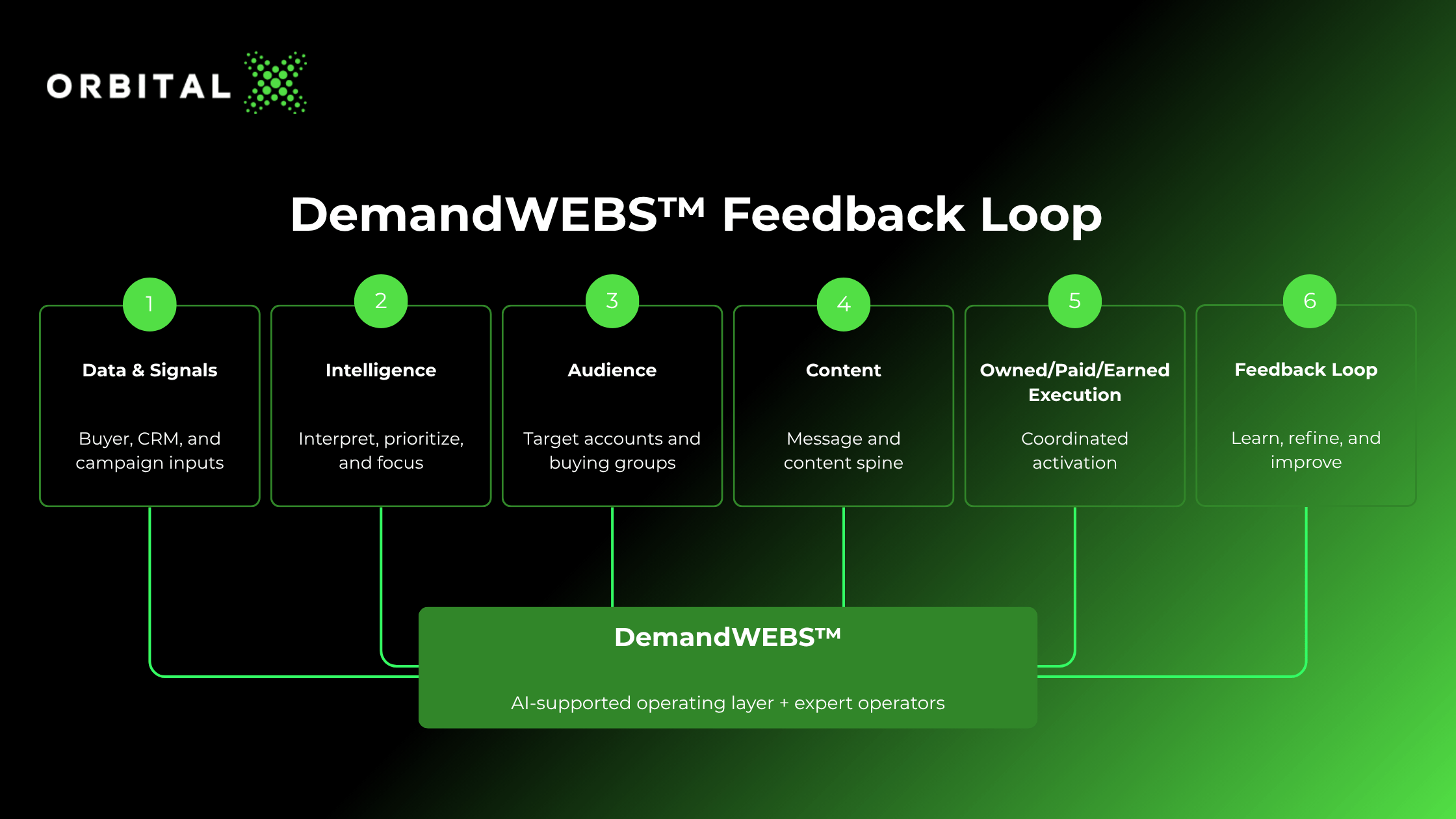
DemandWEBS™ sits on the operating-system side of that problem. It combines OrbitalX’s AI marketing system with expert operators.
That combination is where the software story can get uncomfortable. The usual workstreams love to drift apart. Data sits in one spot. Audience intelligence, content, channel execution, and feedback are stored somewhere else. DemandWEBS™ is built to make those pieces inform the next pipeline decision. No more ignoring each other in different tabs.
 Most software categories create partial outputs. One layer stores the record. Another captures the form fill. A third surfaces the account signal. Reporting assigns modeled credit while routing moves the meeting.
Each output has value on paper. Real lift starts after those outputs clarify decisions. Which accounts deserve attention? What message should change? Which channel needs the next move? How soon should sales act? What should the next cycle learn?
Ripping out the stack entirely won’t solve the operating problem. The smarter move is connective intelligence around the tools the team already uses. That’s the logic behind OrbitalX’s DemandWEBS™. It brings data, audience intelligence, content, channel execution, and feedback into one operating rhythm.
The need shows up fastest in lean B2B teams dealing with tool sprawl, weak data, thin bandwidth, and unclear handoffs. That’s how software output gets trapped below pipeline judgment.
Prop up Your Demand Generation With the Right Technological Supports
Demand gen software should make the demand system easier to operate. That means the stack has to do more than collect logos, capture forms, automate emails, route leads, and produce dashboards.
The right software layer improves a specific operating job, whether it’s data quality, engagement, conversion, prioritization, routing, measurement, integration, or feedback. The right stack helps the team decide what to do next, for which account, and with what context.
If software doesn’t change decisions, it’s mostly documenting the same confusion in a cleaner interface.
If your demand gen stack is producing signals, dashboards, workflows, and routed activity but still not improving pipeline decisions, OrbitalX can help connect the pieces. Our DemandWEBS™ combines an AI marketing operating system with expert operators to turn data, audience intelligence, content, execution, and feedback into clearer account priorities, better timing, and smarter sales conversations.
Book a call to see how we can help your team turn demand gen software into a working demand system.
FAQ
What is demand gen software?
Demand gen software is technology that helps B2B teams create and capture demand signals, then nurture, route, measure, and act on them. Common categories include CRM and marketing automation, landing pages and routing, intent data and ABM orchestration, analytics and integration tools. The software supports strategy and execution discipline.
What is the difference between demand gen software and lead gen tools?
Lead gen tools usually source contacts, capture interest, enrich records, book meetings, or route leads. Demand gen software covers a wider operating system. It supports awareness, engagement, prioritization, capture, routing, measurement, and pipeline learning. The two overlap, but the buying job is ultimately different.
What types of software are used for demand generation?
Common demand generation software categories include CRM and revenue data systems, marketing automation, landing pages and forms, and lead routing. Teams also use intent and account intelligence, ABM orchestration, attribution and analytics, integration and workflow automation, and distribution tools. Most teams get more value from adopting specific layers that solve their actual operating bottleneck rather than collecting the whole category map.
What is the best demand generation software for B2B teams?
There’s no universal “best” demand generation software for every B2B team. The right choice depends on ICP, CRM architecture, data quality, sales handoff, reporting needs, integration complexity, governance, team bandwidth, execution support, and budget tier.
A free or starter tool may be enough when the bottleneck is basic capture or outreach. A mid-market or enterprise platform only makes sense when the team can use the added data, workflows, and reporting to change pipeline decisions. A team with bad routing has a different software problem from a team with fragmented account data.
What should enterprise teams look for in a demand generation platform?
Enterprise teams should evaluate five platform jobs first: revenue data foundation, life cycle automation, account intelligence or ABM orchestration, attribution and reporting, and integration or workflow governance. The platform also needs to fit CRM architecture, data quality, AI oversight, sales handoff, and team capacity. Feature breadth alone doesn’t prove operational fit.
More Resources

Your Team Is Producing More Content Than Ever. Is Any of It Working?
AI is producing more B2B marketing content than humans now, but volume without engagement is just cost with extra steps. OrbitalX's new metric, Marketing Per Marketer (MPM), plots output against real audience engagement to show which teams are actually breaking through versus which are just running on the content treadmill.

Unlock enterprise value with AI and ABM in PE value creation
A practical guide for PE value creation teams on how AI SDR, AI-powered ABM, and AI content workflows can increase commercial capacity without scaling headcount at the same rate.

How to Evaluate Lead Generation Outsourcing Based on Pipeline Impact
Looking into lead generation outsourcing? Learn how to evaluate providers based on pipeline performance and revenue impact to improve sales outcomes.